Using an Explicit Rule for Linear Growth or Decay (VCE SSCE General Mathematics): Revision Notes
📚Revision Notes
Using an Explicit Rule for Linear Growth or Decay
Introduction
When working with sequences that grow or decay at a constant rate, repeatedly adding or subtracting to find each term can be time-consuming. An explicit rule allows you to calculate any term in the sequence directly, without needing to work through all the previous terms first. This makes calculations much faster and more efficient.
Note
The power of explicit rules lies in their ability to skip straight to any term in a sequence. Instead of calculating terms 1 through 99 to find the 100th term, you can calculate it directly!
Understanding the pattern
Let's explore how an explicit rule develops by looking at a simple interest investment example.
Suppose you invest $2000 at 5% simple interest per annum. Each year, you earn $100 in interest. Using a recurrence relation, this is modelled as:
If we write out the first few terms, a pattern emerges:
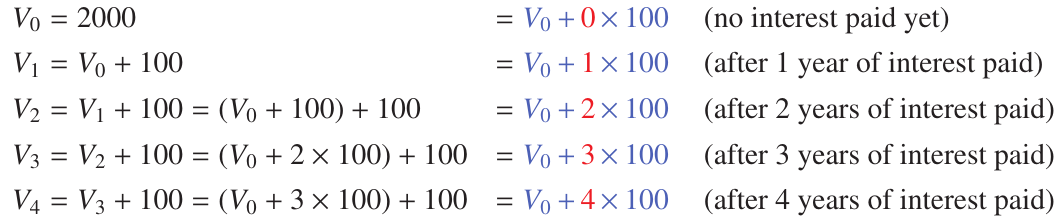
Notice how each term can be expressed as the initial value plus a multiple of 100:
- After 0 years:
- After 1 year:
- After 2 years:
- After 3 years:
- After 4 years:
Following this pattern, after years:
This explicit rule allows us to find the value after any number of years directly. For instance, after 15 years:
Note
The coefficient of in the explicit rule (100 in this example) always matches the common difference from the recurrence relation!
Explicit rule for linear growth
When a sequence increases by the same amount each time (linear growth), we can use an explicit rule to find any term.
Important
For a recurrence relation of the form:
The explicit rule is:
where:
- is the starting value
- is the common difference (the amount added each time)
- is the number of iterations
Explicit rule for linear decay
When a sequence decreases by the same amount each time (linear decay), the explicit rule uses subtraction instead.
Important
For a recurrence relation of the form:
The explicit rule is:
where:
- is the starting value
- is the common difference (the amount subtracted each time)
- is the number of iterations
Converting recurrence relations to explicit rules
To convert a recurrence relation to an explicit rule, follow these steps to identify whether you're dealing with growth or decay, then apply the appropriate formula.
Example
Worked Example: Converting Recurrence Relations
Convert these recurrence relations to explicit rules and calculate for each:
a)
b)
c)
Solution:
Part a:
- Starting value:
- Common difference:
- This is linear growth (adding each time)
- Explicit rule:
- Calculate :
Part b:
- Starting value:
- Common difference:
- This is linear decay (subtracting each time)
- Explicit rule:
- Calculate :
Part c:
- Starting value:
- Common difference:
- This is linear decay (subtracting each time)
- Explicit rule:
- Calculate :
Note
In part c, the value becomes negative, which may not be meaningful in some real-world contexts. Always consider whether your mathematical answer makes sense in the practical situation!
Applications of explicit rules
Simple interest investments and loans
Simple interest involves adding the same amount of interest each period, making it an example of linear growth. The explicit rule is particularly useful for these calculations.
Formula:
For simple interest:
where
Here, is the interest rate as a percentage, and is the principal (initial investment or loan amount).
Example
Worked Example: Modelling Simple Interest Investments
Amie invests $3000 in a simple interest investment with interest paid at 6.5% per year. Find the value of the investment after 10 years.
Solution:
-
Starting value:
-
Calculate the common difference:
- Write the explicit rule (this is linear growth):
- Calculate :
The investment will be worth $4950 after 10 years.
Example
Worked Example: Using a Rule to Determine Investment Value
The following recurrence relation models a simple interest investment:
where is the value of the investment after years.
a) What is the principal of the investment? How much interest is added each year?
b) Write the explicit rule for the value after years.
c) Find the value after 15 years.
d) When does the value first exceed $10,000?
Solution:
Part a:
- Principal: $3000 (this is )
- Interest added each year: $260
Part b:
- Use the general rule
- Substitute and :
Part c:
- Substitute :
The investment is worth $6900 after 15 years.
Part d:
- Set and solve for :
Since interest is only added after whole years, we round up to the next whole number.
The investment first exceeds $10,000 after 27 years.
Important
When solving for time in investment problems, if you get a decimal answer, you must round up to the next whole year because interest is typically only added after complete years.
Flat rate depreciation
Flat rate depreciation involves reducing an asset's value by the same amount each period, making it an example of linear decay.
Formula:
For flat rate depreciation:
where
Here, is the depreciation rate as a percentage, and is the initial value of the asset.
Example
Worked Example: Modelling Flat Rate Depreciation
A photocopier costs $6000 when new. Its value depreciates at a flat rate of 17.5% per year. Write an explicit rule and use it to find the value after 4 years.
Solution:
-
Starting value:
-
Calculate the common difference:
- Write the explicit rule (this is linear decay):
- Calculate :
The photocopier is worth $1800 after 4 years.
Example
Worked Example: Using a Rule for Flat Rate Depreciation
The following recurrence relation models the flat rate depreciation of office furniture:
where is the value of the furniture after years.
a) What is the initial value? How much does the value decrease each year?
b) Write the explicit rule for the value after years.
c) Find the value after 6 years.
d) How long does it take for the furniture's value to reach zero?
Solution:
Part a:
- Initial value: $12,000
- Depreciation each year: $1200
Part b:
- Use the general rule
- Substitute and :
Part c:
- Substitute :
The furniture is worth $4800 after 6 years.
Part d:
- Set and solve for :
The furniture's value reaches zero after 10 years.
Unit cost depreciation
Unit cost depreciation reduces an asset's value based on usage rather than time. The value decreases by a fixed amount for each unit of use (e.g., per hour, per kilometre, per item produced).
Example
Worked Example: Unit Cost Depreciation
A hairdryer in a salon was purchased for $850. The value depreciates by 25 cents for every hour it is used. Let be the value after hours of use.
a) Write an explicit rule for the value after hours.
b) What is the value after 50 hours of use?
c) The salon uses the hairdryer for 17 hours each week on average. How many weeks will it take for the value to halve?
d) The hairdryer has a scrap value of $100. After how many hours of use does it reach this value?
Solution:
Part a:
- Starting value:
- Common difference: (25 cents = $0.25)
- This is linear decay:
Part b:
- Substitute :
After 50 hours of use, the hairdryer has a value of $837.50.
Part c:
-
Half the original value is:
-
Set and solve for :
- Convert to weeks (at 17 hours per week):
After 100 weeks, the hairdryer's value will have halved.
Part d:
- Set and solve for :
The hairdryer can be used for 3000 hours before it reaches its scrap value.
Note
Key Differences in Depreciation Types:
In unit cost depreciation, the variable represents units of use (hours, kilometres, etc.) rather than time periods. This makes it useful for assets whose value depends more on usage than age.
Exam tips
Important
Essential Tips for Success:
- Always identify whether you're dealing with linear growth (adding) or linear decay (subtracting) before writing your rule.
- When solving for time and you get a decimal answer, consider the context: for investments that pay interest annually, round up to the next whole year.
- Check your formula makes sense: for growth, the value should increase; for decay, it should decrease.
- Remember to convert percentages to decimals when calculating (divide by 100).
- Keep units consistent: if depreciation is given in cents, convert to dollars or vice versa.
Remember!
Summary
Key Points to Remember:
- Explicit rules allow you to find any term in a sequence directly without calculating all previous terms.
- For linear growth: (adding the same amount each time).
- For linear decay: (subtracting the same amount each time).
- Simple interest and flat rate depreciation both use explicit rules, with where is the percentage rate.
- Unit cost depreciation is also linear decay, but represents the depreciation per unit of use rather than per time period.