Equations of Straight Lines (VCE SSCE General Mathematics): Revision Notes
📚Revision Notes
Equations of Straight Lines
Finding the slope using a formula
While the rise/run method always works for calculating slope, there is also a useful algebraic formula. This formula is particularly helpful when working with coordinate points.
The slope formula is derived by considering two points on a line. If we label the first point as and the second point as , we can express the slope algebraically.
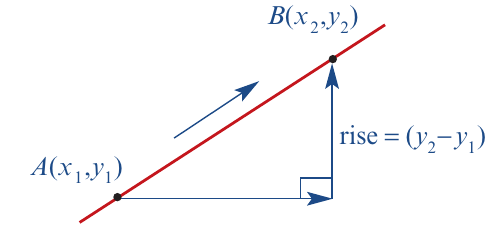
By definition, slope equals rise divided by run. From the diagram:
- Rise = (the vertical change)
- Run = (the horizontal change)
Therefore:
This formula allows you to calculate the slope by substituting the coordinates of any two points on the line.
Important
It doesn't matter which point you designate as and which as . The formula will give you the same result either way.
Example
Worked Example: Finding Slope Using the Formula
Question: Find the slope of the line passing through and using the slope formula. Give your answer to two decimal places.
Solution:
Using the formula:
Let and
Substituting these values:
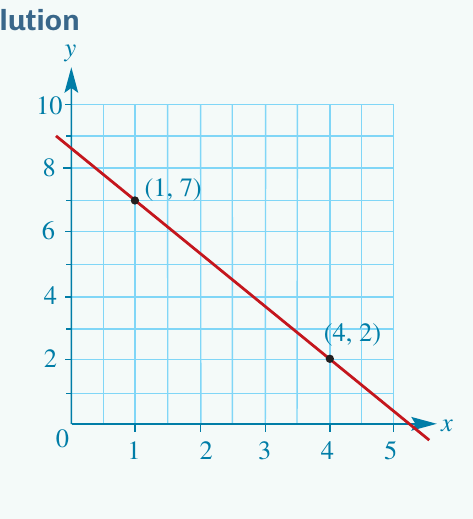
The negative slope indicates that the line is decreasing (going downward from left to right).
The intercept-slope form of the equation of a straight line
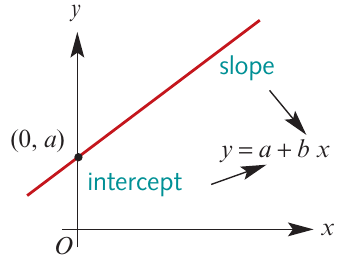
We can express the equation of a straight line in a standard form called intercept-slope form:
This form is particularly useful because it immediately reveals two important characteristics of the line:
- represents the y-intercept (where the line crosses the y-axis, when )
- represents the slope (the steepness of the line)
Note
The intercept-slope form is valuable when modelling real-world situations and is the standard form used in statistical analysis.
Understanding the components
Let's examine the equation as an example.
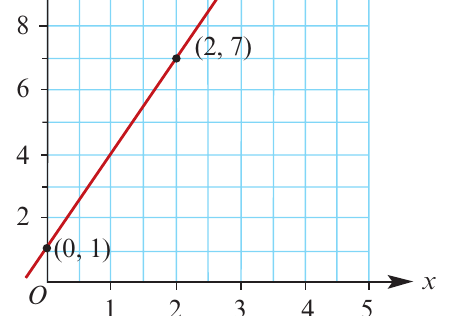
From this graph, we can verify:
- The y-intercept = (the line crosses the y-axis at the point )
- The slope =
Notice that:
- The y-intercept corresponds to the constant term in the equation (intercept = )
- The slope is given by the coefficient of in the equation (slope = )
Important
Exam Tip: You may have previously learned to write straight-line equations as . In VCE General Mathematics, we use instead. This is the standard form used in examinations and on calculators for statistical work. The terms are simply written in reverse order, with different letters: for the intercept (instead of ) and for the slope (instead of ).
Finding the y-intercept and slope from an equation
When an equation is written in intercept-slope form , you can immediately identify:
- The y-intercept = (the constant term)
- The slope = (the coefficient of )
Note
If an equation is not in intercept-slope form, you will need to rearrange it by making the subject before you can identify the intercept and slope.
Example
Worked Example: Identifying Intercept and Slope
Question: Write down the y-intercept and slope of each straight line:
- a)
- b)
- c)
- d)
Solution:
For each equation, we need to ensure it's in intercept-slope form , then identify the values.
a)
This is already in intercept-slope form.
- y-intercept =
- slope =
b)
This can be written as
- y-intercept =
- slope =
c)
This can be written as or
When there is no constant term, the y-intercept is zero.
- y-intercept =
- slope =
d)
First, rearrange into intercept-slope form by making the subject:
Now we can identify:
- y-intercept =
- slope =
Writing equations given intercept and slope
To construct the equation of a straight line when you know the y-intercept and slope, simply substitute these values into the standard form .
Example
Worked Example: Constructing Equations
Question: Write down the equations of straight lines with the following y-intercepts and slopes:
- a) y-intercept = , slope =
- b) y-intercept = , slope =
- c) y-intercept = , slope =
Solution:
Using the form , substitute the given values for (y-intercept) and (slope).
a) y-intercept = , slope =
Substituting and :
b) y-intercept = , slope =
Substituting and :
This can also be written as:
c) y-intercept = , slope =
Substituting and :
This can also be written as:
Sketching straight-line graphs
Since a straight line is completely determined by just two points, we only need to find two points to sketch the graph. When the equation is in intercept-slope form, one point is immediately available: the y-intercept at . We can then find a second point by choosing a convenient value for and calculating the corresponding -value.
This approach to drawing a graph is called creating a sketch graph.
Note
Choosing Convenient Values: When selecting an -value for your second point, choose a number that makes the calculation easy. Values like , , or often work well, depending on the equation.
Example
Worked Example: Sketching a Graph from its Equation
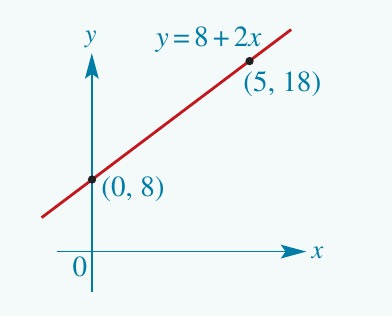
Question: Sketch the graph of
Solution:
Step 1: Identify the equation
Step 2: Find the y-intercept
The equation is in intercept-slope form, so the y-intercept is the constant term:
This gives us the point
Step 3: Find a second point
Choose a convenient value for . Let's use :
When :
So is a point on the line.
Step 4: Draw the graph
- Draw and label the axes
- Mark the two points: and
- Draw a straight line through these points
- Label the line with its equation
Summary
Key Points to Remember:
-
The slope formula allows you to calculate the gradient of a line using any two coordinate points.
-
The intercept-slope form of a straight-line equation is , where is the y-intercept and is the slope.
-
To identify the y-intercept and slope from an equation, rearrange it into the form if necessary. The constant term is the y-intercept, and the coefficient of is the slope.
-
To write an equation given the intercept and slope, substitute the values into .
-
To sketch a straight-line graph, use the y-intercept as one point, calculate a second point by choosing a convenient -value, then draw a line through both points.