Practical Applications of Simultaneous Equations (VCE SSCE General Mathematics): Revision Notes
📚Revision Notes
Practical Applications of Simultaneous Equations
Introduction
Simultaneous equations are powerful tools for solving real-world problems. When a situation involves two unknown quantities that are related in two different ways, we can set up a system of two equations to find both values. This approach is used across many practical contexts, from shopping and pricing to geometry and ticket sales.
Important
The key to success is defining your unknown quantities with appropriate variables before attempting to write any equations. This clear definition helps you translate word problems into mathematical statements that can be solved systematically.
General method for solving practical problems
When tackling a practical problem using simultaneous equations, follow this structured approach:
Step 1: Define your variables
Select appropriate letters to represent the unknown quantities. Choose letters that make sense for the context (e.g., for roses, for width). Clearly state what each variable represents, including units where relevant.
Step 2: Set up your equations
Read the problem carefully and identify two separate pieces of information that relate your variables. Translate each piece of information into a mathematical equation. Label these as equation (1) and equation (2).
Step 3: Solve the system
Use your CAS calculator to solve the simultaneous equations. Input both equations correctly and find the values of your variables.
Step 4: Check your solution
Substitute your solutions back into one of the original equations to verify correctness. Check that the left hand side (LHS) equals the right hand side (RHS).
Step 5: State your answer
Write your final answer in words, including the correct units and context from the original problem.
Note
Following all five steps systematically ensures you don't miss important details and helps you present your working clearly in exams. Many students lose marks by skipping the checking step or forgetting to include units in their final answer.
Worked example 1: Shopping problems
Shopping and pricing problems are common applications of simultaneous equations. These problems typically give you total costs for different combinations of items, and you need to find the individual prices.
Example
Worked Example: Finding Individual Flower Prices
Problem: Mark purchases 3 roses and 2 gardenias for $15.50. Peter purchases 5 roses and 3 gardenias for $24.50. What is the cost of each type of flower?
Solution:
Defining variables:
Let represent the cost of one rose (in dollars)
Let represent the cost of one gardenia (in dollars)
Setting up equations:
From Mark's purchase:
From Peter's purchase:
Using a CAS calculator:
To solve these equations using a CAS calculator, you'll need to enter both equations into the system. The calculator interface will look similar to this:
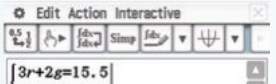
After entering the equations, access the solve function (often found in the Variables menu) to find the solution:
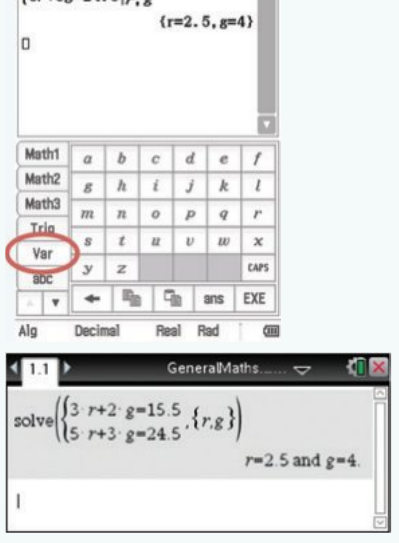
The calculator gives us:
Checking the solution:
Substitute and into equation (2):
The solution checks out correctly.
Final answer:
Roses cost $2.50 each and gardenias cost $4.00 each.
Worked example 2: Geometry problems
Geometry problems involving simultaneous equations often use perimeter formulas or other geometric relationships. The key is recognizing how different dimensions relate to each other.
Example
Worked Example: Finding Rectangle Dimensions
Problem: A rectangle has a perimeter of 48 cm. The length of the rectangle is three times the width. Find the dimensions of the rectangle.
Solution:
Defining variables:
Let represent the width of the rectangle (in cm)
Let represent the length of the rectangle (in cm)
Setting up equations:
The perimeter of a rectangle is the total distance around its edges. This can be calculated by adding together two widths and two lengths:
We're told the length is three times the width:
Solving the system:
Use your CAS calculator to solve these simultaneous equations. Enter both equations into the solver function as demonstrated in Worked Example 1.
The solution is:
Final answer:
The rectangle has a width of 6 cm and a length of 18 cm.
Note
Key Point for Geometry Problems:
In geometry problems, remember standard formulas like the perimeter formula for rectangles. Also look for relationships between dimensions (such as "length is three times width") that give you a second equation. These relationship statements are crucial for setting up your system of equations.
Worked example 3: Ticket sales problems
Ticket sales and revenue problems combine quantity information (total number sold) with financial information (total revenue). This creates a natural pair of equations.
Example
Worked Example: Calculating Ticket Sales
Problem: Cinema tickets cost $19.50 for adults and $14.50 for children. A total of 200 tickets were sold, generating $3265 in revenue. How many children's tickets were sold?
Solution:
Defining variables:
Let represent the number of adult tickets sold
Let represent the number of children's tickets sold
Setting up equations:
The total revenue from ticket sales is:
The total number of tickets sold is:
Note: When you know a total quantity (like total tickets), this often provides your second equation.
Solving the system:
Use your CAS calculator to solve these simultaneous equations following the method shown in the previous examples.
The solution is:
Final answer:
127 children's tickets were sold.
Verification: You should also be able to work out that 73 adult tickets were sold (since ). You can verify by calculating: ✓
Tips for exam success
Here are essential strategies to maximize your performance when solving simultaneous equations in practical contexts:
Note
Critical Exam Strategies:
-
Always define your variables clearly at the start. Write down what each letter represents, including units. This helps you avoid confusion and makes your working easier to follow.
-
Read the problem twice. The first time, get the general idea. The second time, identify the specific numerical information you'll use in your equations.
-
Label your equations as (1) and (2). This makes it clear you're working with a system of simultaneous equations.
-
Check your solution makes sense. If you're solving for a number of tickets and get a negative answer, something has gone wrong!
-
Include units in your final answer. Don't just write ; write "Roses cost $2.50 each."
-
Show your substitution check in exam questions, as this demonstrates your understanding and may earn method marks even if you made an earlier error.
Important
Common Mistakes to Avoid:
- Forgetting to define variables before writing equations
- Mixing up which equation represents which piece of information
- Not checking whether your answer is reasonable in the context
- Leaving out units in the final answer
- Skipping the verification step entirely
Remember!
Summary
Key Points to Remember:
- Simultaneous equations help solve practical problems where two unknown quantities are related in two different ways
- Always begin by clearly defining your variables with appropriate letters and units
- The general process is: define variables → set up two equations → solve with CAS → check by substitution → state your answer with units
- Common problem types include:
- Shopping/pricing problems (multiple items with total costs)
- Geometry problems (especially perimeter and dimension relationships)
- Ticket sales problems (combining quantity and revenue)
- Always verify your solution by substituting values back into one of the original equations to ensure LHS = RHS