Perpetuities (VCE SSCE General Mathematics): Revision Notes
📚Revision Notes
Perpetuities
What is a perpetuity?
A perpetuity is a special type of investment that provides regular payments indefinitely. Unlike a standard annuity that eventually runs out, a perpetuity maintains its value forever by ensuring that the payments you receive exactly match the interest earned during each compounding period.
To understand perpetuities, recall that an annuity involves depositing money into an investment and then making regular withdrawals over time. In most cases, these withdrawals are designed to exhaust the investment over a specific timeframe, meaning the account eventually reaches zero.
Note
However, if the regular payments are smaller than the interest earned, the investment will continue to grow. When the payments are exactly equal to the interest earned in each period, the investment maintains its original value whilst still providing income. This creates a perpetuity - an investment that can theoretically provide payments forever.
Perpetuities have the same relationship to annuities as interest-only loans have to reducing balance loans. In an interest-only loan, you only pay the interest each period, so the principal never decreases. Similarly, in a perpetuity, you only withdraw the interest each period, so the principal never decreases.
Modelling perpetuities
We can model perpetuities using a recurrence relation. Let represent the value of the perpetuity after payments have been made.
The recurrence relation is:
where:
- is the growth multiplier
- is the regular payment per compounding period
The growth multiplier is calculated as:
where:
- is the annual interest rate (as a percentage)
- is the number of compounding periods per year
Important
The Key Perpetuity Formula
For a perpetuity, the regular payment equals the interest earned, which is given by:
This formula is the key to solving perpetuity problems. It tells us that the payment depends on three factors: the interest rate, how often interest is compounded, and the initial investment.
Calculating the payment from a perpetuity
When you know the initial investment and the interest rate, you can calculate what regular payment the perpetuity will provide.
Example
Worked Example: Finding Monthly Payment from a Perpetuity
Elizabeth invests her superannuation payout of $500,000 into a perpetuity that will provide a monthly income. If the interest rate for the perpetuity is 6% per annum, what monthly payment will Elizabeth receive?
Solution:
We need to find the monthly interest earned using the formula:
Substituting the values:
- (annual interest rate)
- (monthly compounding means 12 periods per year)
- (initial investment)
Answer: Elizabeth will receive $2500 every month from her investment.
Calculating the investment required to establish a perpetuity
If you know what regular payment you need and the available interest rate, you can work backwards to find how much you need to invest initially.
Example
Worked Example: Finding Required Investment Amount
Calculate how much money will need to be invested in a perpetuity account, earning interest of 4.8% per annum compounding monthly, if $300 will be withdrawn every month.
Solution:
We use the same formula, but this time we solve for :
Substituting the known values:
Solving for :
Answer: $75,000 will need to be invested to establish the perpetuity investment.
Calculating the interest rate of a perpetuity
Sometimes you need to determine what interest rate is required to achieve a specific payment from a given investment. This can be solved using either algebraic calculation or a financial calculator.
Example
Worked Example: Finding Minimum Interest Rate
A university mathematics faculty has $30,000 to invest. It intends to award an annual mathematics prize of $1500 with the interest earned from investing this money in a perpetuity. What is the minimum interest rate that will allow this prize to be awarded indefinitely?
Solution method 1: Calculation
Since we only need to consider one compounding period (as all periods are identical), we can use the formula:
Substituting the values:
- (annual prize)
- (annual compounding)
- (investment)
Solving for :
Answer: The minimum annual interest rate to award this prize indefinitely is 5%.
Solution method 2: Using a financial calculator
Open the Finance Solver and enter the following values:
- N: 1 (one payment period)
- I%: (leave blank - this is what we're solving for)
- PV: -30000 (negative because it's money going out)
- Pmt or PMT: 1500 (the prize amount)
- FV: 30000 (the balance remains the same after each payment)
- Pp/Y: 1 (yearly payment)
- Cp/Y: 1 (interest compounds yearly)
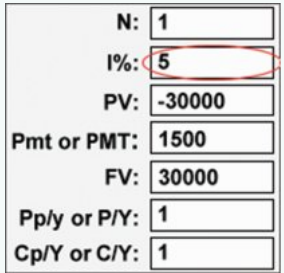
Solve for the unknown interest rate (I%):
- On TI-Nspire: Move the cursor to the I% entry box and press enter to solve
- On ClassPad: Tap on the I% entry box and tap Solve
The calculator shows that I% = 5.
Answer: The minimum annual interest rate to award this prize indefinitely is 5%.
Remember!
Summary
Key Points to Remember:
- A perpetuity is an investment that provides regular payments indefinitely by ensuring payments equal the interest earned.
- The key formula is , where is the payment, is the annual interest rate, is the number of compounding periods per year, and is the initial investment.
- The value of a perpetuity remains constant over time because withdrawals exactly match the interest earned each period.
- Perpetuities can be modelled using the recurrence relation , where the balance never changes.
- Problems can be solved using either algebraic methods or financial calculators, depending on which value you need to find.