Data Transformations (VCE SSCE General Mathematics): Revision Notes
📚Revision Notes
Data Transformations
Introduction to data transformations
When we plot data from two variables on a graph, we might notice a clear relationship between them that is not linear (not a straight line). To make these relationships easier to analyse, we can transform the data by changing the scale of one variable using a mathematical function.
Note
Transforming the data means changing the scale of a variable by applying a mathematical function to its values.
Linearisation is the process of transforming data so that a non-linear relationship becomes linear (a straight line). This makes the relationship much easier to analyse using methods we already know.
In this section, we focus on two important transformations:
- The squared transformation ()
- The reciprocal transformation ()
The squared transformation:
What is the squared transformation?
In the squared transformation, we change the scale on the horizontal axis from to . This means instead of plotting our data points using the original values, we square each value first and then plot against .
When do we use it?
Note
The squared transformation is useful when we have a parabolic (curved) relationship between variables. This type of relationship often appears in situations involving direct variation with a power, such as .
Example from physics
Example
Worked Example: Distance and Time for a Falling Object
Consider a metal ball dropped from a tall building. The distance fallen () and time () have a relationship where .
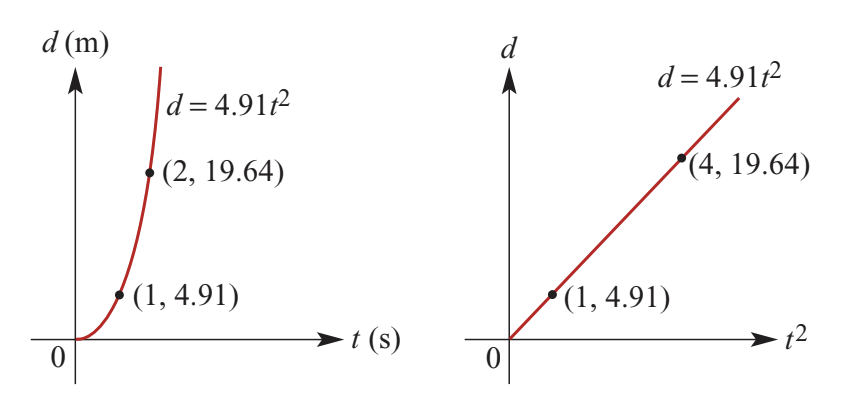
On the left, the graph of against is curved (a parabola). However, when we plot against (on the right), we get a straight line through the origin. The slope of this line equals the constant of variation (4.91 in this case).
How to perform the squared transformation
Step 1: Start with your table of and values
| 0 | 1 | 2 | 3 | 4 | |
|---|---|---|---|---|---|
| 1 | 2 | 5 | 10 | 17 |
Step 2: Plot the original data ( against )
This will typically show a curved relationship.
Step 3: Create a new row by squaring all values
| 0 | 1 | 2 | 3 | 4 | |
|---|---|---|---|---|---|
| 0 | 1 | 4 | 9 | 16 | |
| 1 | 2 | 5 | 10 | 17 |
Step 4: Plot the transformed data ( against )
Important
Make sure to label the horizontal axis as , not .
Step 5: Check if the graph is linear
If the points form a straight line, the transformation has successfully linearised the data. The slope of this line is the constant of variation.
Summary
Key Points About the Squared Transformation:
- If , then plotting against produces a straight line through the origin
- The slope of the resulting line equals the constant of variation ()
- This transformation is particularly useful for quadratic relationships
The reciprocal transformation:
What is the reciprocal transformation?
In the reciprocal transformation, we change the scale on the horizontal axis from to . This means we calculate the reciprocal (one divided by each value) of each value and plot against .
When do we use it?
Note
The reciprocal transformation is useful when we have a hyperbolic relationship between variables. This type of relationship appears in situations involving inverse variation, such as .
Example of inverse variation
Consider the relationship , where the constant of variation is 6.
The table shows both values and their reciprocals :
| 1 | 2 | |||
|---|---|---|---|---|
| 3 | 2 | 1 | ||
| 18 | 12 | 6 | 3 |
When we plot against , we get a curved line (hyperbola). However, when we plot against , we get a straight line with slope 6.
Important
The graph will not have a point at the origin because is undefined.
How to perform the reciprocal transformation
Step 1: Start with your table of and values
| 1 | 2 | 4 | 5 | |
|---|---|---|---|---|
| 10 | 5 | 2.5 | 2 |
Step 2: Plot the original data ( against )
This will typically show a hyperbolic (curved) relationship.
Step 3: Calculate the reciprocal of each value
Example
Worked Example: Calculating Reciprocals
To find , divide 1 by each value:
| 1 | 2 | 4 | 5 | |
|---|---|---|---|---|
| 1 | 0.5 | 0.25 | 0.2 | |
| 10 | 5 | 2.5 | 2 |
Step 4: Plot the transformed data ( against )
Important
Remember to label the horizontal axis as , not .
Step 5: Check if the graph is linear
If the points form a straight line, the transformation has successfully linearised the data. The slope of this line is the constant of variation.
Summary
Key Points About the Reciprocal Transformation:
- If , then plotting against produces a straight line
- The line will not pass through the origin because is undefined
- The slope of the resulting line equals the constant of variation ()
- This transformation is particularly useful for inverse relationships
Using technology for transformations
Both the squared and reciprocal transformations can be performed using a CAS (Computer Algebra System) calculator. The general process involves:
- Entering your data into lists named and
- Creating a new column for the transformed variable (either or )
- Plotting the original data to see the non-linear relationship
- Plotting the transformed data to verify linearisation
Note
For the squared transformation:
- Create a column calculating (or ^2 on the calculator)
- Plot against
For the reciprocal transformation:
- Create a column calculating (or 1/x on the calculator)
- Plot against
Direct variation vs inverse variation
Understanding which type of variation you have helps you choose the correct transformation:
Direct variation:
- As increases, increases
- If , use the squared transformation
- The graph of against will be a straight line through the origin
Inverse variation:
- As increases, decreases
- If , use the reciprocal transformation
- The graph of against will be a straight line, not defined at the origin
Summary
Key Points to Remember:
- Data transformation changes the scale of a variable by applying a mathematical function
- Linearisation converts non-linear relationships into linear ones for easier analysis
- Squared transformation (): Use when you have a parabolic relationship; change the horizontal axis from to
- Reciprocal transformation (): Use when you have a hyperbolic relationship; change the horizontal axis from to
- The slope of the linearised graph equals the constant of variation ()