Further Modelling of Non-Linear Data (VCE SSCE General Mathematics): Revision Notes
📚Revision Notes
Further Modelling of Non-Linear Data
Introduction to modelling non-linear data
When we collect data that doesn't form a straight line when plotted, we call it non-linear data. However, we can often transform this data to reveal linear (straight-line) relationships. Once we create a straight line, we can use our knowledge of linear equations to model the relationship.
In this topic, we'll explore three different ways to model non-linear data using transformations. Each method transforms the -values in a specific way:
- Square transformation:
- Reciprocal transformation: where
- Logarithmic transformation: where
Note
For each of these models, k represents the slope of the transformed line, and c represents the y-intercept.
Key idea: Instead of plotting against directly, we plot against , , or . This transformation converts curved relationships into straight lines.
Using the model
Understanding the x² transformation
When data follows a quadratic pattern, squaring the -values before plotting can reveal a linear relationship. This means we transform our original -values into values and then plot against these new values.
What to do:
- Calculate for each -value
- Plot against (not against )
- If the points form a straight line, the relationship follows the model
Finding the equation
Once we've confirmed the transformed data is linear, we need to find two values:
- k (the slope): Calculate using
- c (the y-intercept): Either read directly from the graph where , or substitute known values into the equation and solve
Example
Worked Example: Modelling with
Here's a dataset that has undergone an transformation:
| 0 | 1 | 2 | 3 | 4 | |
|---|---|---|---|---|---|
| 0 | 1 | 4 | 9 | 16 | |
| 2 | 4 | 10 | 20 | 34 |
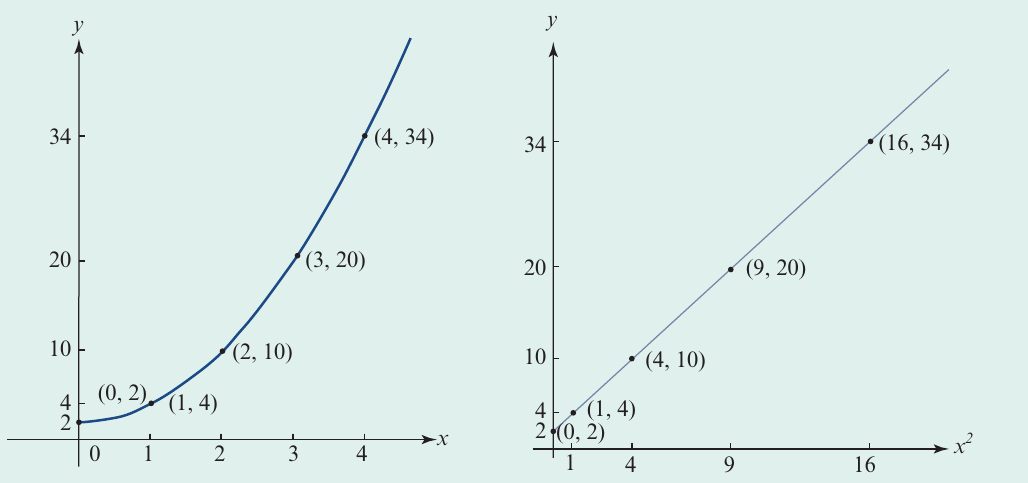
Step 1: Find k by calculating the slope
Select any two points from the linearised graph (the right-hand graph where is plotted against ).
Let's use the points and :
Step 2: Find c (the y-intercept)
Looking at the linearised graph, the line crosses the y-axis at , so c = 2.
Alternatively, we can substitute our known values into the equation:
Using the point where and :
Step 3: Write the final equation
Substituting and :
Using the model
Understanding the reciprocal transformation
Some relationships show an inverse pattern where decreases as increases. For these, transforming -values to their reciprocals () can reveal a linear relationship.
Note
What to do:
- Calculate for each -value
- Plot against (not against )
- If the points form a straight line, the relationship follows the model
Finding the equation
The process is similar to the previous model:
- k (the slope): Calculate using
- c (the y-intercept): Substitute known values into and solve
Example
Worked Example: Modelling with
Here's a dataset that has undergone a transformation:
| 1 | 2 | 4 | 8 | |
|---|---|---|---|---|
| 1 | 0.5 | 0.25 | 0.125 | |
| 5 | 3 | 2 | 1.5 |
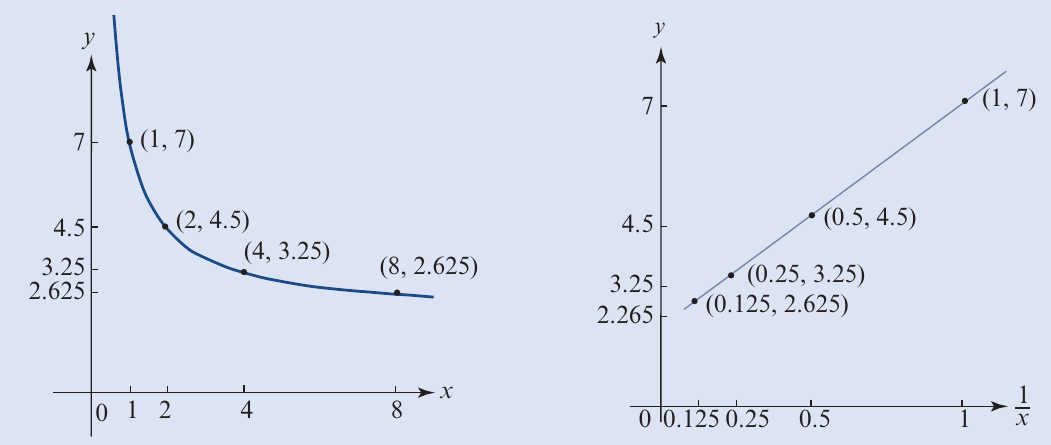
Step 1: Find k by calculating the slope
Select two points from the linearised graph. Let's use and :
Step 2: Find c by substitution
Using the equation and the point where and :
Step 3: Write the final equation
Substituting and :
Using the model
Understanding the logarithmic transformation
When data shows logarithmic growth (rapid increase initially, then slowing down), transforming -values using logarithms can reveal a linear relationship.
Note
What to do:
- Calculate for each -value
- Plot against (not against )
- If the points form a straight line, the relationship follows the model
Finding the equation
Same approach as before:
- k (the slope): Calculate using
- c (the y-intercept): Substitute known values into and solve
Example
Worked Example: Modelling with
Here's a dataset that has undergone a transformation:
| 10 | 50 | 100 | 150 | 500 | |
|---|---|---|---|---|---|
| 1 | 1.7 | 2 | 2.2 | 2.7 | |
| 1 | 2.4 | 3 | 3.4 | 4.4 |
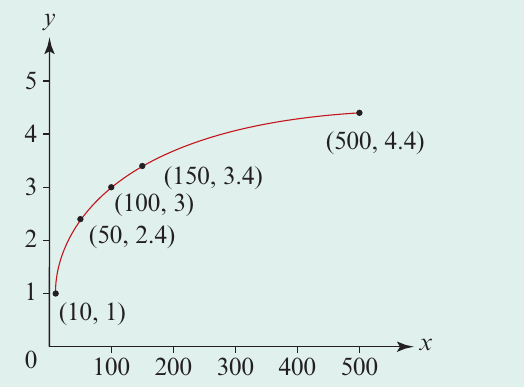
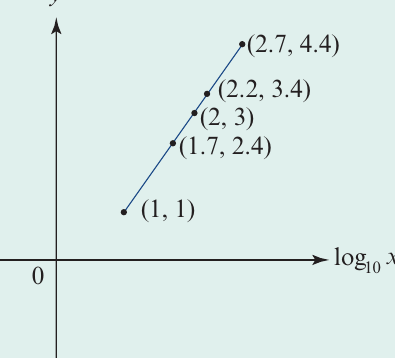
Step 1: Find k by calculating the slope
Select two points from the linearised graph. Let's use and :
Step 2: Find c by substitution
Using the equation and the point where and :
Remember that :
Step 3: Write the final equation
Substituting and :
Exam tips
Important
Critical Exam Strategies
-
Always transform first: Don't try to find the equation using the original -values. Always work with the transformed values (, , or ).
-
Choose clear points: When calculating slope, select points with coordinates that are easy to read and calculate with.
-
Check your y-intercept: The y-intercept occurs where the horizontal axis equals zero. For transformations, this is straightforward. For and transformations, you may need to use substitution.
-
Use your calculator wisely: For logarithmic transformations, use your calculator's log function. Make sure you're using (common logarithm), not natural logarithm.
-
Verify your answer: Substitute one of the original data points into your final equation to check it works.
Remember!
Summary
Key Points to Remember:
-
Non-linear data can be modelled using three main transformations: , , and
-
The transformation determines what you plot on the horizontal axis: Plot against , , or respectively
-
In all three models, k is the slope and c is the y-intercept of the transformed (linear) graph
-
To find k: Calculate the slope of the straight-line graph using with any two points on the line
-
To find c: Either read the y-intercept from the graph (where the transformed x-value equals zero) or substitute known values into the equation and solve