The Features of Australia’s Aid Program (VCE SSCE Health and Human Development): Revision Notes
📚Revision Notes
The Features of Australia’s Aid Program
Introduction to Australia's aid program
Australia's aid program is managed by the Department of Foreign Affairs and Trade (DFAT). The program works to promote human development by reducing poverty in low- and middle-income countries around the world. Through this work, Australia also promotes its own national interests by contributing to sustainable economic growth and poverty reduction in neighbouring regions.
Note
Australia's aid program serves a dual purpose: it helps reduce poverty and promote development in partner countries while also advancing Australia's national interests through regional stability and security.
Key features of Australia's aid program
Purpose and goals
The main purpose of Australia's aid program is to promote national interests by contributing to sustainable economic growth and poverty reduction. This approach recognises that helping neighbouring countries develop stronger economies and healthier populations benefits Australia as well, particularly in terms of security and stability in our region.
Two development outcomes
DFAT focuses on achieving two main development outcomes:
Strengthening private sector development
The private sector refers to the part of a country's economic system that is run by individuals and companies, rather than the government. Strengthening the private sector is crucial because:
- It provides most employment opportunities (around 90 per cent of all jobs are in the private sector)
- People need opportunities to develop and use their skills productively through self-employment or wage-earning jobs
- A thriving private sector creates more jobs, helping people escape poverty
- Economic growth depends on a strong private sector
Enabling human development
Promoting economic growth and reducing poverty also depends on achieving human development. This means:
- Improving education and health services
- Achieving gender equality
- Developing a skilled workforce
- Improving living standards
Note
These improvements are necessary to create the conditions for sustainable development. Australia's aid program directly assists in achieving the Sustainable Development Goals through these efforts.
Provision of Official Development Assistance
Official Development Assistance (ODA) is the formal aid that Australia provides to other countries. In 2020-21, the Australian government allocated $4 billion for overseas aid, which equals 0.22 per cent of Australia's Gross National Income (GNI). This means all Australian taxpayers contributed approximately 22 cents for every $100 they earned.
Important
Australia's contribution of 0.22% of GNI represents a reduction in foreign aid investment from previous years. The United Nations recommends that countries invest 0.7 per cent of their GNI in overseas aid, so Australia's contribution is below this international target.
Geographic focus: Indo-Pacific region
Given its proximity to Australia, the Indo-Pacific region is the primary focus of Australia's aid program. This geographic focus makes sense for several reasons:
- Many people in the region live in poverty and struggle to meet their basic needs
- These countries are our nearest neighbours
- Many countries in the region are affected by conflict, which could directly affect Australia's national and security interests
- Stronger growth, prosperity and stability in our region benefits Australia
- Australia's aid can make the greatest difference in this region
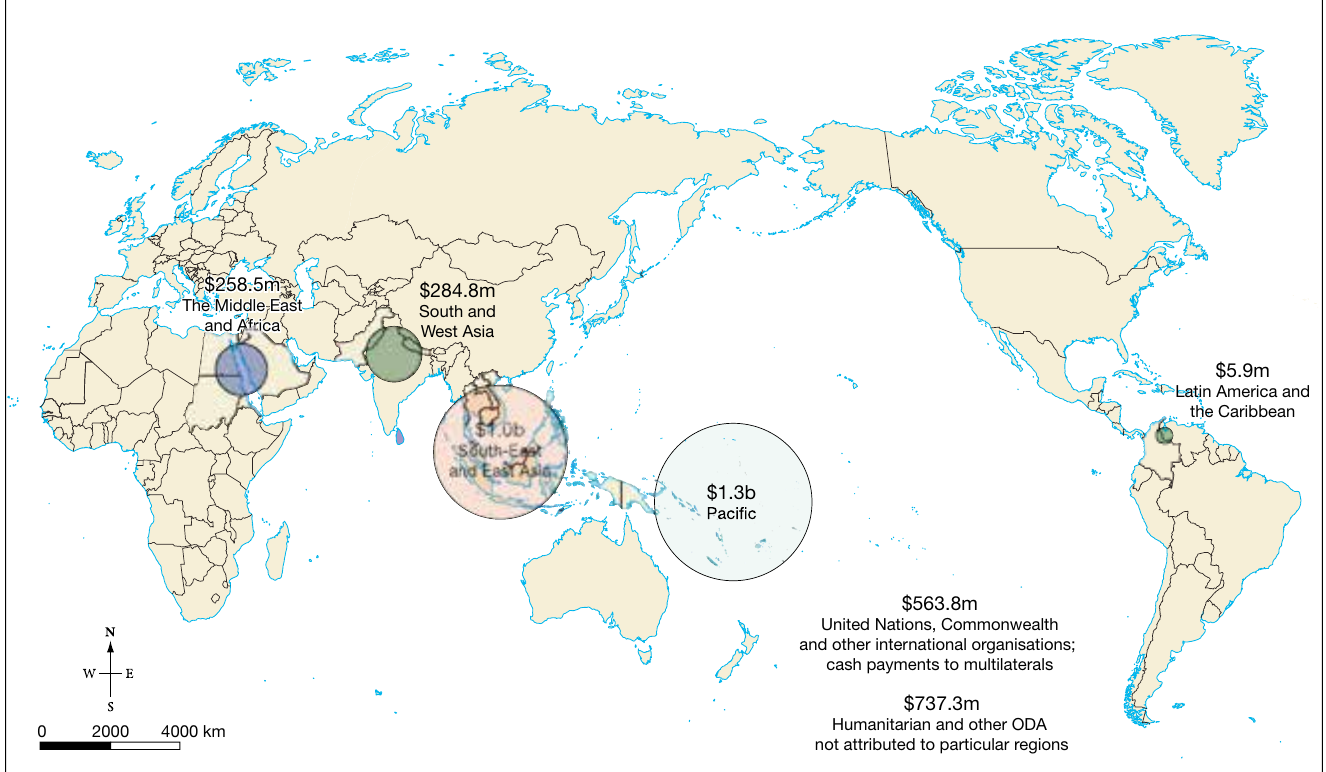
The map above shows the distribution of Australia's aid across different regions. The largest portions go to:
- Pacific region: $1.3 billion
- South-East and East Asia: $1.0 billion
- Humanitarian and other ODA: $737.3 million
- United Nations and other international organisations: $563.8 million
- South and West Asia: $284.8 million
- The Middle East and Africa: $258.5 million
- Latin America and the Caribbean: $5.9 million
Aid partnerships
The Australian government works in partnership with various organisations and agencies to deliver its aid program effectively. These partnerships strengthen the reach and impact of Australia's aid efforts.
Note
Partnership Model
Australia uses five distinct types of partnerships to maximize the effectiveness and reach of its aid program. Each partnership type brings unique strengths and capabilities to development work.
Other government departments
While DFAT is responsible for administering Australia's international aid program, it works with many other government departments and agencies that provide assistance to other countries. Examples include:
- Australian Centre for International Agricultural Research: Works to improve the agricultural sector in countries in the Indo-Pacific region
- Australian Federal Police: Works to develop and monitor peace, stability and security in a range of countries in the region
Private sector partnerships
DFAT partners with companies within the private sector to achieve its aid and development objectives. These partnerships recognise that businesses can contribute valuable expertise and resources to development work.
Example
Partnership Example: Westpac Corporate Partnership
This partnership aims to increase economic activity by:
- Providing access to finance, particularly for women
- Improving access to financial services through mobile phones
- Improving access to loans for small and medium enterprises owned by women in low- and middle-income countries
Bilateral partnerships
Bilateral partnerships involve direct cooperation between Australia and another country. The effectiveness of Australian aid is increased through these partnerships where experience and resources can be combined. This allows countries to work together on shared development goals.
Multilateral organisations
Australia provides funding to large international organisations including:
- World Bank
- United Nations and its many agencies (such as World Food Programme and World Health Organization)
- Asian Development Bank
Note
These multilateral organisations extend the reach of Australia's aid program. Their large size enables them to undertake projects on a scale that would not be possible for individual donor countries like Australia working alone.
Non-government organisations
DFAT partners with many non-government organisations (NGOs) to complement its aid program. NGOs bring valuable expertise in community-based development work and can often access areas that are difficult for governments to reach, such as conflict-affected regions.
Types of aid provided by the Australian government
Australia provides several different types of aid to support development in low- and middle-income countries.
Bilateral aid
Through DFAT, the government provides bilateral aid directly to 75 countries, including Australia's nearest neighbours: Indonesia, Papua New Guinea, East Timor and the nations of the South Pacific region.
This aid comes in various forms:
- Funding
- Donations of material resources
- Training
- Advice
Purpose of bilateral aid
This assistance helps partner governments to strengthen their economic, political, health and education systems. The ultimate aim is for these countries to eventually become self-sufficient and no longer need Australia's support.
Example
Programs in Papua New Guinea
Programs in Papua New Guinea focus on improving the lives of women and girls across all areas through investments that:
- Enhance women's voice in decision-making, leadership and peace-building
- Promote economic empowerment
- End violence against women and girls
- Increase access to support services
Australia also works in Papua New Guinea to enhance health by:
- Targeting maternal and child health
- Addressing communicable diseases
- Strengthening health security
- Building a more effective health system
Example
Pacific Island COVID-19 Response
Australia supported Pacific Island countries to more effectively detect and prevent the spread of COVID-19 by:
- Providing rapid diagnostic tests
- Working with local organisations to raise awareness of hygiene and prevention measures
Economic development focus
Australia seeks to partner with the private sector to create opportunities that:
- Promote economic growth in the region
- Reduce poverty
- Return commercial profits
Multilateral aid
Approximately one-third of Australia's aid budget is dedicated to multilateral aid. The Australian government provides multilateral funds to international aid organisations to run programs in low- and middle-income countries.
Multilateral organisations supported by Australia include:
- World Bank: Provides financial and technical assistance to developing countries
- Asian Development Bank: Focuses on economic development in Asia and the Pacific
- United Nations Development Programme: Coordinates UN development activities
- UNICEF: Focuses on children's rights and wellbeing
- World Health Organization: Leads global health initiatives
- The Global Fund to Fight AIDS, Tuberculosis and Malaria: Combats these three diseases
- Gavi, the Global Vaccine Alliance: Helps reduce childhood deaths by ensuring low-income countries can access vaccines at affordable costs and assists in development and distribution of vaccines including COVID-19
- The Global Partnership for Education: Supports children to achieve primary and lower secondary school education
- The Green Climate Fund: A global platform to respond to climate change by investing in low-emission and climate-resilient development
Benefits of multilateral aid
Multilateral organisations extend the reach of Australia's aid program because:
- Their large size enables them to undertake projects on a scale that would not be possible for individual countries
- They have global expertise and networks
- They can coordinate responses across multiple countries
Note
Working with the United Nations and its humanitarian agencies, Australia ensures that carefully targeted programs are put in place to promote health and wellbeing and human development globally.
Focus areas
By funding multilateral organisations, Australia hopes to accelerate achievement of the Sustainable Development Goals by improving:
- Access to health services, particularly maternal and child health
- Prevention and treatment of COVID-19
- HIV/AIDS treatment and prevention
- Gender equality
- Education
- Health
- Reduction of poverty
All of these improvements help to enhance health and wellbeing and promote human development at a global level.
Humanitarian assistance or emergency aid
In times of crisis, such as natural disasters and conflict, populations often rely on emergency supplies of resources to survive. These resources include:
- Food
- Water
- Shelter
- Healthcare
The Australian government responds quickly in these situations, providing personnel and material resources to assist in saving lives.
Working with partners
Australia usually works with multilateral and NGO partners to ensure emergency aid reaches those who need it. For example, during the COVID-19 pandemic, the Department of Foreign Affairs and Trade provided ongoing humanitarian assistance through:
- World Health Organization
- World Food Programme
- United Nations Children's Fund
- UN Women
- United Nations Population Fund
This assistance aimed to save lives, address human suffering and protect the most vulnerable.
Example
Emergency Response: Cyclone Gita in Tonga (2018)
Following Cyclone Gita in Tonga in 2018, Australia provided:
- $350,000 in life-saving equipment including emergency shelter, kitchen and hygiene kits to assist more than 2000 people
- Released humanitarian supplies including tarpaulins and water purification tablets through the Tongan Red Cross
- The Australian Defence Force assisted with debris removal, water, sanitation and distribution of emergency supplies at the request of the Government of Tonga
Emergency response capacity
Australia maintains stockpiles of relief items both in Australia and overseas. These stockpiles include essential life-saving items such as:
- Water purification tablets
- Shelter supplies
- Hygiene kits
- Mosquito nets
- Blankets
Important
This preparation means Australia has the capacity to provide supplies within 48 hours of a request for assistance by a partner government.
Aid provided to NGOs and volunteers
In 2020-21, around $175.1 million of Australia's aid funding went to NGOs to deliver aid programs directly to people in need, as well as volunteer programs such as the Australian Volunteers for International Development program. This program supports skilled Australians to undertake volunteer work in low- and middle-income countries.
Australian NGO Cooperation Program
The Australian government funds Australian NGOs through the Australian NGO Cooperation Program, which:
- Provides grants supporting more than 57 Australian-registered NGOs
- Delivers over 450 projects in 57 countries
Major NGO partners
Under this program, DFAT has a close partnership with ten of Australia's largest NGOs:
- World Vision Australia
- Oxfam Australia
- Caritas Australia
- PLAN International Australia
- Child Fund Australia
- CBM Australia
- CARE Australia
- TEAR Australia
- The Fred Hollows Foundation
- Save the Children Australia
Other NGOs that have been accredited by DFAT also receive funds to assist them in carrying out their work.
Why NGOs strengthen the aid program
NGOs strengthen Australia's aid program because they:
- Work in areas that are difficult to access, such as conflict-affected regions
- Often focus their efforts on small, community-based development work
- Have expertise in working in emergency situations where fast and flexible responses are needed
- Can build strong relationships with local communities
- Bring specialized knowledge and experience
Case study: Tropical Cyclone Harold
Example
Case Study: Tropical Cyclone Harold Response
In early April, Tropical Cyclone Harold swept through Solomon Islands, Vanuatu, Fiji and Tonga, leaving a trail of destruction and claiming 31 lives.
Immediate response
Australia took swift action by:
- Releasing humanitarian relief supplies that had been pre-positioned with local partners
- Assisting governments to conduct damage assessments
- Following formal requests for assistance, deploying eight Australian Defence Force flights to Fiji and Vanuatu
- Delivering 224 tonnes of blankets, lanterns, shelters, hygiene kits and other essential items
Funding and partnerships
Australia provided over $17 million in funding, which enabled:
- The Red Cross to provide immediate assistance to affected communities
- NGOs to support affected populations
- Governments to deliver support services
- Early recovery activities, including restoring education and health services
COVID-19 complications
The risk of COVID-19 transmission complicated relief work. Australia developed strict protocols on handling, packing and storing relief supplies to ensure the safety of both aid workers and recipients.
Recovery support
Australia continued to support long-term recovery by:
- Supporting repairs to schools and health facilities
- Distributing food crop seedlings and cuttings to help communities rebuild their food security
This case study demonstrates how Australia's aid program combines different types of aid (bilateral, multilateral, emergency and NGO partnerships) to respond effectively to crises and support both immediate relief and long-term recovery.
Remember!
Summary
Key Points to Remember:
-
Australia's aid program is administered by DFAT and aims to promote national interests through sustainable economic growth and poverty reduction in low- and middle-income countries
-
The program focuses on two key development outcomes: strengthening private sector development and enabling human development
-
Australia contributes 0.22% of GNI ($4 billion in 2020-21) as Official Development Assistance, which is below the UN recommendation of 0.7%
-
The Indo-Pacific region is the primary focus of Australia's aid due to proximity, poverty levels and national security interests
-
Australia works through five types of partnerships: other government departments, private sector, bilateral, multilateral organisations and NGOs
-
Four main types of aid are provided: bilateral aid (direct to 75 countries), multilateral aid (through international organisations), humanitarian/emergency aid (rapid response to crises) and support to NGOs and volunteers
-
The aid program directly supports achievement of the Sustainable Development Goals through improvements in health, education, gender equality and poverty reduction