Funding and Sustainability and the Role of Australia’s Health System (VCE SSCE Health and Human Development): Revision Notes
📚Revision Notes
Funding and Sustainability and the Role of Australia's Health System
Introduction
Australia's health system plays a vital role in promoting the health status of the population. The implementation and effectiveness of the health system can be explored through four interconnected areas:
- Funding - providing financial resources for healthcare services
- Sustainability - ensuring the system can continue operating effectively into the future
- Access - making healthcare available to those who need it
- Equity - ensuring fair distribution of health resources and outcomes
Note
These four areas are deeply interrelated and impact each other. For example, adequate funding improves access to healthcare, which in turn promotes equity by making services available to more people. Similarly, sustainability depends on efficient funding mechanisms and equitable distribution of resources.
This note focuses on funding and sustainability, which form the foundation for an effective healthcare system.
Funding
What is funding?
Funding involves providing the financial resources necessary to keep the health system adequately staffed and equipped, ensuring high-quality care is available for those who need it.
How funding promotes health outcomes
Health system funding enables more people to receive treatment by reducing individual costs. This increased accessibility means more people can obtain healthcare for various conditions, which helps reduce morbidity and mortality rates across the population.
The Australian health system receives funding from multiple sources:
- Federal and state/territory governments
- Private health insurance
- Other insurance schemes
- Individual contributions
Funding sources and their contributions
Four main funding mechanisms contribute to improved health outcomes in Australia:
Medicare provides subsidies or full coverage for:
- Doctor and specialist consultations
- Pathology tests
- Fee-free treatment in public hospitals
Pharmaceutical Benefits Scheme (PBS) subsidises essential medicines, making treatment more affordable for many conditions.
National Disability Insurance Scheme (NDIS) funds resources that promote health status, including:
- Carers who support daily living and social connection
- Assistive technology such as wheelchairs and bed rails
Note
Private health insurance funds approximately 40% of hospital treatments through private hospitals. The federal government provides a private health insurance rebate, making coverage more affordable for more Australians.
What does funding provide?
Healthcare funding supports six key areas that are essential for maintaining an effective health system:
Healthcare infrastructure includes hospitals, consulting rooms, and medical technology necessary for delivering care.
Highly trained health professionals benefit from adequate funding that maintains professional standards through ongoing training and education.

Personnel such as administrative and support staff in public hospitals are largely funded through Medicare and government grants.
Medical supplies encompass surgical tools, tapes, bandages, and other materials used to administer treatments.
Public health programmes work to promote health and prevent disease. Examples include Quit (smoking cessation) and LiveLighter (healthy eating and physical activity).
Research advances lead to developments in preventing, diagnosing, and treating common conditions, improving healthcare effectiveness.
Total health expenditure
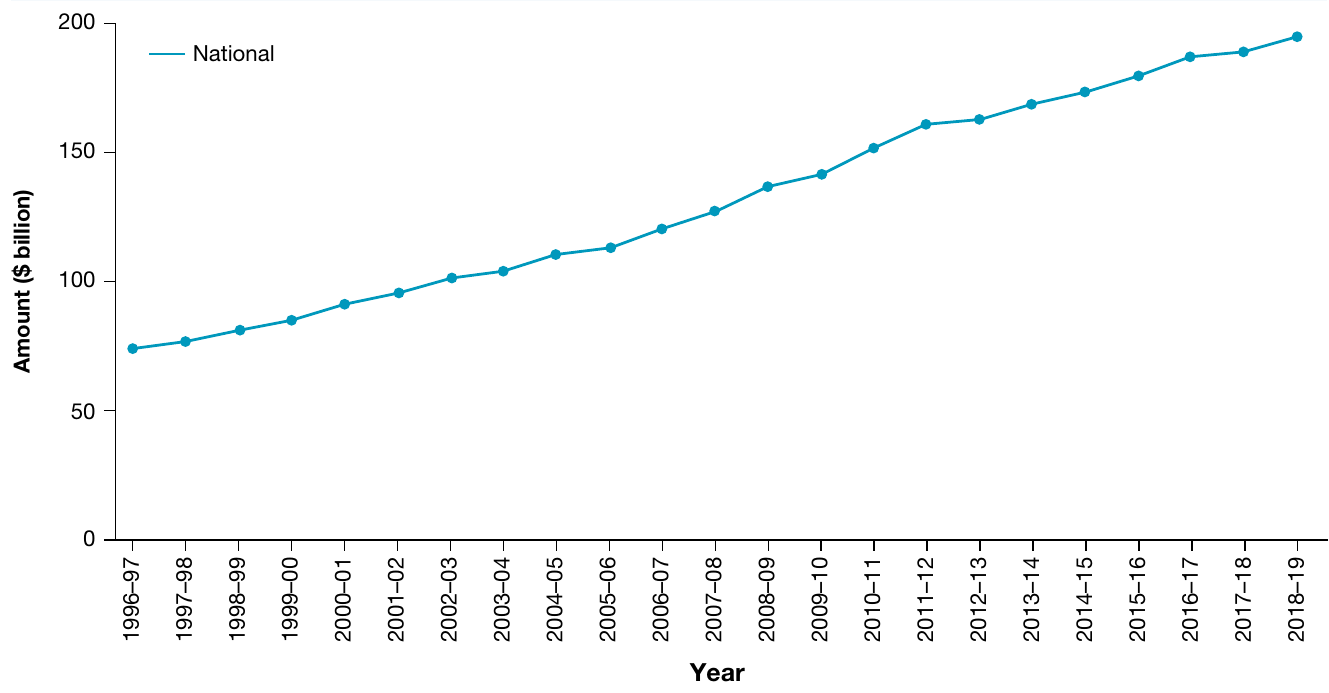
In 2018-19, Australia's total health expenditure reached $195.7 billion, compared to $189.7 billion the previous year - an increase of approximately 3%. This represented an average expenditure of $7772 per person.
Health expenditure as a proportion of gross domestic product (GDP) was around 10% in 2018-19, compared to 7.5% in 1995-96, demonstrating significant growth in health spending relative to the economy.
Note
The steady increase in health expenditure over time reflects Australia's growing population, ageing demographics, and expanding access to advanced medical technologies and treatments. This upward trend is expected to continue as healthcare needs evolve.
Reasons for increasing health costs
Several factors contribute to rising healthcare expenditure over time:
Ageing population - Australia's average age is increasing, resulting in a higher proportion of chronic conditions requiring ongoing care.
Rising incomes and expectations - A growing economy means more money is available for healthcare spending. As financial capacity increases, the population expects more comprehensive health services.
Advanced technologies and services - Research and development create new medical technologies and services, which contribute to increased expenditure.
Medicine costs - Many PBS-listed medicines have increased in price over time, contributing to higher health-related spending.
Important
The challenge for governments and non-government organisations is developing sustainable funding systems that maintain the quality of care people expect into the future. Without careful planning and innovation, rising costs could threaten the long-term viability of the health system.
Breakdown of funding sources
In 2018-19, approximately 68% of health system funding came from government sources:
- Almost two-thirds from the federal government
- One-third from state/territory and local governments
The federal government's main contributions are through Medicare, the PBS, and the NDIS. However, the Medicare levy and surcharge raised only $16.05 billion in 2017-18, while Medicare paid out $23.2 billion. This shortfall is covered by general taxation revenue. The PBS contributed almost $12.6 billion in 2019-20, funded through general taxation. In 2014, the Medicare levy increased from 1.5% to 2% to help fund the NDIS, with the remainder funded by federal and state/territory taxation revenue.
The private (non-government) sector contributed around $62 billion or 32% of total health system funding in 2018-19.
Note
The division between government and private funding reflects Australia's mixed healthcare model, where public and private systems work together to provide comprehensive coverage. This approach helps distribute the financial burden while maintaining universal access to essential healthcare services.
Main categories of health expenditure
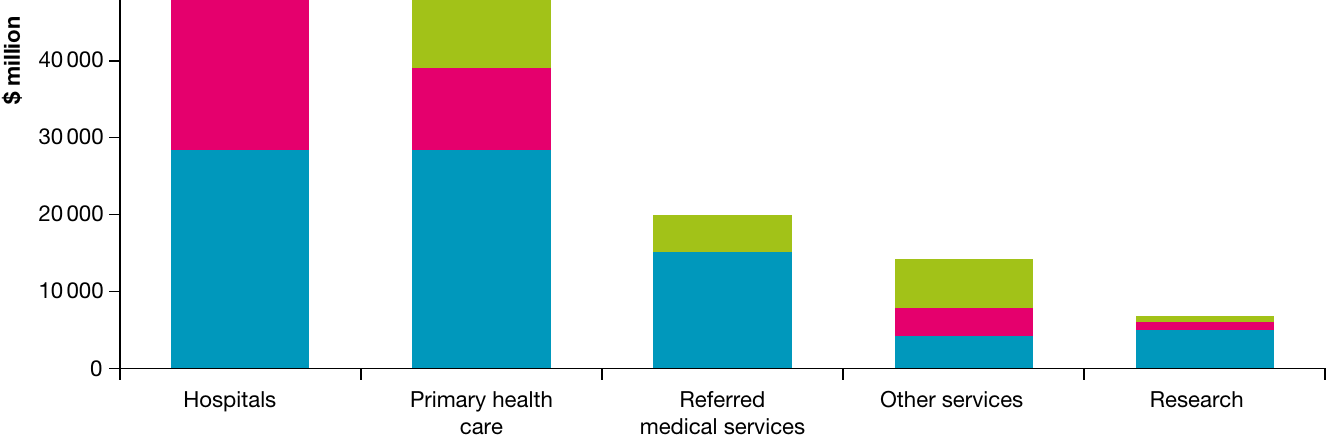
Hospitals receive the greatest funding and include both private and public hospitals.
Primary healthcare encompasses general health services delivered outside hospitals, including:
- General practitioner consultations
- Dental services
- Medications
- Public health initiatives
Referred medical services are specialist consultations referred by a general practitioner.
Other services include:
- Patient transport
- Aids and appliances (hearing aids, glasses, wheelchairs)
- Administration of healthcare facilities
Research aims to discover new methods of preventing, diagnosing, and treating illness.
Sustainability
What is sustainability?
Sustainability refers to the health system's capacity to provide workforce and infrastructure (facilities and equipment) into the future, while being innovative and responsive to emerging needs through interventions such as research and monitoring.
As the population grows and ages, the health system experiences increasing pressure. The system must evolve to ensure high-quality care remains available for everyone who needs it.
Key considerations for sustainability
Four interconnected pillars support a sustainable health system:
- Ensuring adequate funding and regulation
- Maintaining an efficient health workforce and system
- Promoting disease prevention and early intervention
- Supporting research and monitoring
Note
These four pillars work together synergistically. For example, disease prevention reduces the burden on the healthcare workforce, while research and monitoring inform more efficient funding allocation. Understanding how these elements interconnect is crucial for maintaining long-term sustainability.
Funding and regulation
Adequate funding is crucial for sustainability. The health system must have sufficient financial resources to meet population needs into the future. Healthcare funding in Australia has increased over time and currently sustains the system's operations.
Regulation helps the health system remain sustainable by promoting efficient use of funds and resources. The federal and state/territory governments are responsible for most health system regulations.
Medicare sustainability measures include:
- Determining which services receive subsidies, preserving funds for essential services that yield the greatest health gains
- Increasing the Medicare levy from 1.5% to 2% in July 2014 to maintain the health system and fund the NDIS
PBS sustainability measures include:
- Continually reviewing available medicines to prioritise those with greatest benefits
- Using the Therapeutic Goods Administration (a federal government body) to verify PBS medicine effectiveness, contributing to improved treatment and reduced health system reliance
Note
NDIS sustainability is promoted through individualised participant plans, ensuring only necessary funds are spent on each person, allowing more people to access the scheme and experience improved health outcomes.
Private health insurance sustainability is supported by:
- The private health insurance rebate
- Lifetime Health Cover
- Age-based discounts
These incentives maximise private system funding, meaning more people receive treatment privately, reducing strain on the public system and improving health outcomes for more people.
State and territory governments manage public hospitals and ensure funds are used sustainably.
An efficient health system and workforce
The healthcare workforce consists of healthcare practitioners, administrative staff, and support personnel. Ensuring adequate staffing with highly trained professionals is essential for sustainability - a responsibility resting with state and territory governments. The workforce must continue developing in size and skill to achieve improved health and wellbeing for all Australians. Delivering health services efficiently helps reduce healthcare costs.
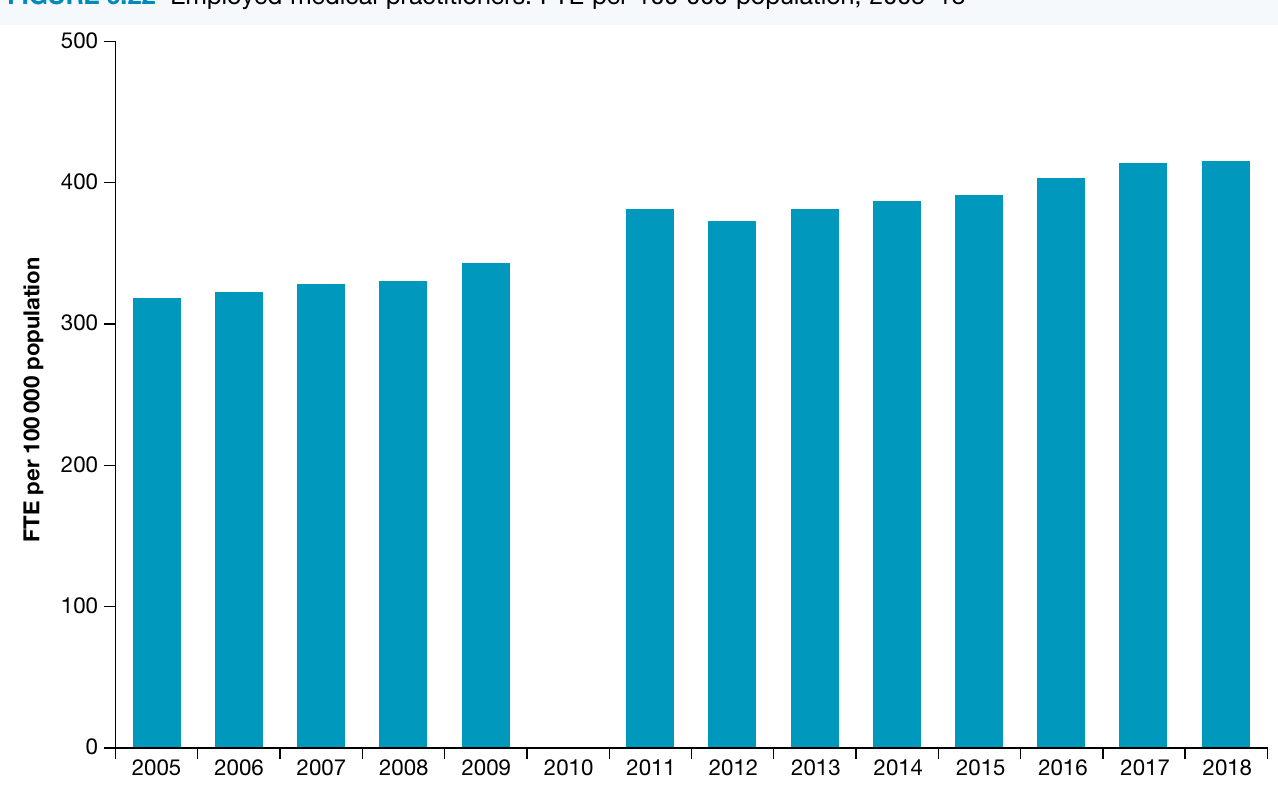
The rate of medical practitioners has increased over time in Australia. FTE (full-time equivalent) is a measurement where one FTE equals one person working full-time (40 hours per week). If two people each work 20 hours weekly, they contribute one FTE. This measurement is useful because many healthcare workers are employed part-time.
Federal and state/territory governments are also improving health system efficiency. A key development is My Health Record, Australia's electronic health record (eHealth) system. My Health Record promotes sustainability by:
- Streamlining the recordkeeping system
- Allowing healthcare providers anywhere in Australia to access an individual's healthcare information electronically
- Promoting health literacy by giving individuals greater access to and control over their healthcare information
- Improving health status through better-informed healthcare decisions
Important
An efficient workforce and system are critical for sustainability. As demand for healthcare services grows with an ageing population, the system must deliver care more efficiently to avoid overwhelming available resources and maintain quality standards.
Disease prevention and early intervention
A crucial strategy for reducing health system strain is decreasing the number of people who need to use it through disease prevention, early detection, and health promotion. The health system plays a key role by providing:
Free testing for infectious diseases such as COVID-19 reduces strain on the health system, allowing resources to be allocated to other conditions.
Public cancer screening programmes include BreastScreen and BowelScreen. Early detection reduces treatment costs and improves health status.

Immunise Australia Programme provides free vaccines for 16 diseases to people at specific ages. Vaccination reduces disease incidence through a cost-effective intervention, saving the health system millions in treatment costs.
Health promotion programmes implemented by government and non-government organisations work to decrease disease risk or impact, reducing health system strain as fewer people require healthcare. Examples include Quit, LiveLighter, and SunSmart.
Note
Prevention is more cost-effective than treatment. By investing in disease prevention and early intervention, the health system can reduce long-term costs while improving population health outcomes. This approach is fundamental to maintaining sustainability as the population ages and chronic disease rates increase.
Research and monitoring

Through the National Health and Medical Research Council (NHMRC), the government funds research into various health and medical areas. The NHMRC supports research to find new ways to cure, treat, and prevent illness and disease, and to improve health service effectiveness in Australia.
Example
Examples of NHMRC-funded Research:
The NHMRC funds a wide range of research projects that contribute to health system sustainability:
- Reducing the spread and impact of sexually transmissible infections, especially among high-risk groups (young people, Aboriginal and Torres Strait Islander peoples, homosexual men)
- Developing new cancer therapies
- Creating new and more effective vaccines for infectious diseases
- Developing new influenza prevention and treatment methods
- Suicide prevention among Aboriginal and Torres Strait Islander youth
- Preventing chronic disease through health promotion, including in Aboriginal and Torres Strait Islander communities
- Providing rapid, evidence-based advice to the Chief Medical Officer during the COVID-19 pandemic
- Conducting studies to improve public health and medical responses to the COVID-19 outbreak
Through research projects like these, the NHMRC helps prevent disease and treat illness more effectively and efficiently, saving valuable health system funding and promoting sustainability.
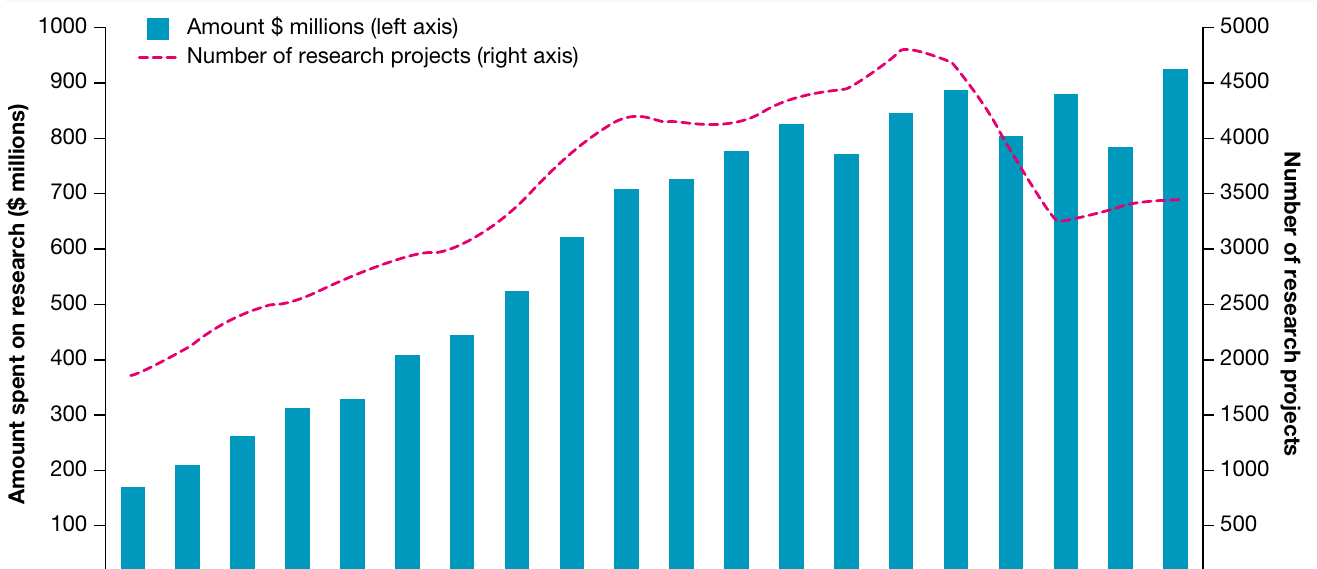
NHMRC research funding has increased substantially from 2000 to 2019, though the number of research projects fluctuated. Research spending grew from approximately $170 million to over $920 million, while project numbers peaked at nearly 4800 before declining to around 3400, suggesting a shift toward fewer but better-funded research initiatives.
Note
The increase in funding per research project reflects a strategic focus on supporting high-quality, impactful research that can deliver significant improvements in healthcare outcomes and system efficiency. This approach maximises the return on investment in medical research.
Summary
Key Points to Remember:
-
Funding provides the financial foundation for Australia's health system, enabling adequate staffing, equipment, and services that reduce individual costs and improve health outcomes.
-
Total health expenditure reached $195.7 billion in 2018-19 (about $7772 per person), with government sources providing 68% and the private sector contributing 32% of funding.
-
Sustainability ensures the health system can continue operating effectively into the future through four key pillars: adequate funding and regulation, efficient workforce and systems, disease prevention and early intervention, and research and monitoring.
-
The Medicare levy increased from 1.5% to 2% in 2014 to help fund the NDIS and maintain Australia's health system sustainability.
-
Research through the NHMRC plays a vital role in sustainability by developing more effective and efficient ways to prevent, diagnose, and treat illness, saving valuable health system resources while improving health outcomes.