Key Skills (Unit 2) (VCE SSCE Health and Human Development): Revision Notes
📚Revision Notes
Key Skills (Unit 2)
Understanding the analysis skill
In your VCE Health and Human Development studies, you'll need to analyse how different parts of Australia's health system work to promote better health outcomes. This means going beyond simply describing what these components do – you need to examine and explain their specific roles in improving health and wellbeing across the Australian population.
The four key components you must be able to analyse are:
- Medicare
- The Pharmaceutical Benefits Scheme (PBS)
- The National Disability Insurance Scheme (NDIS)
- Private health insurance
What you need to know
To effectively analyse these health system components, you need comprehensive knowledge of how each one operates and contributes to health outcomes. Your understanding should extend across several dimensions for each component.
Essential knowledge areas
For Medicare, you should understand what services are included in its coverage, such as doctor consultations and public hospital treatment, as well as what services fall outside Medicare's scope. You also need to know how Medicare receives its funding through taxation and the Medicare levy.
Note
When studying private health insurance, focus on how it complements the public system by reducing pressure on Medicare services. Examine the different coverage options available to individuals, including hospital cover and extras cover. You should also understand the government incentives designed to encourage uptake, such as the private health insurance rebate and the Medicare levy surcharge.
For the Pharmaceutical Benefits Scheme, concentrate on its function in making prescription medications affordable and accessible to Australians. Understand how it subsidises medication costs and the co-payment system that operates.
Regarding the National Disability Insurance Scheme, know what support it provides to Australians living with disability, including funding for equipment, therapies, and support services that enable greater independence and participation in daily life.
Evaluation framework
Important
A crucial part of your analysis involves evaluating each component against four specific criteria:
Funding refers to how each component contributes financial resources to support healthcare services and how this funding enables health promotion.
Sustainability considers whether the component can continue to operate effectively into the future without exhausting resources or creating unsustainable financial burdens.
Access examines how each component enables Australians to obtain the healthcare services they need, including considerations of geographical location, waiting times, and availability.
Equity looks at whether the component promotes fairness in health outcomes, ensuring all Australians can achieve good health regardless of their socioeconomic status, location, or other circumstances.
How to structure your analysis
When analysing a health system component, you need to make clear connections between its features and improved health outcomes. A strong analysis identifies specific aspects of the component, explains how these promote health, and links them to measurable improvements in health status or wellbeing.
Example
Worked Example: Medicare and health promotion
Let's examine how you might analyse Medicare's role in improving health outcomes, specifically in relation to funding and equity.
Medicare operates as Australia's universal health insurance scheme, providing substantial funding for doctor consultations and treatment in public hospitals. This funding arrangement means that when Australians experience medical problems, they can access medical assessment and necessary treatment without facing prohibitive costs. By enabling early detection and treatment of disease symptoms, Medicare substantially reduces the risk of premature death, thereby improving mortality rates across the population.
The Medicare Safety Net further enhances equity within the system. This mechanism provides additional subsidies for services like specialist consultations once an individual or family has paid a threshold amount for Medicare-funded services within a calendar year. This feature particularly promotes equity for people living with chronic or ongoing medical conditions who require frequent treatment. By reducing the financial burden of healthcare for these individuals, the Safety Net promotes mental health and wellbeing by alleviating the stress and anxiety associated with paying for necessary medical care.
Breaking down the example
Note
Notice how this analysis includes four key elements:
-
Specification of funding contribution: The example clearly identifies how Medicare contributes to health system funding through coverage of consultations and hospital treatment.
-
Link to health status: The explanation connects Medicare's funding to improved health outcomes, specifically mentioning reduced premature death and improved mortality rates.
-
Identification of equity feature: The analysis names a specific Medicare feature (the Safety Net) that promotes equity.
-
Connection to wellbeing: The explanation shows how equity in the system promotes mental health and wellbeing by reducing financial stress.
Practising your analysis skills
To develop your ability to analyse health system components effectively, work through various practice scenarios. Consider questions that require you to examine single components in depth, compare multiple components, or explain how components work together to support health outcomes.
Note
Try explaining how different components might support the same individual. For example, someone diagnosed with cancer might benefit from:
- Medicare-funded doctor visits and hospital treatment
- PBS-subsidised cancer medications
- Potentially NDIS support if the cancer results in disability
- Private health insurance might provide faster access to specialist consultations or choice of doctor for surgical procedures
Evaluation framework table
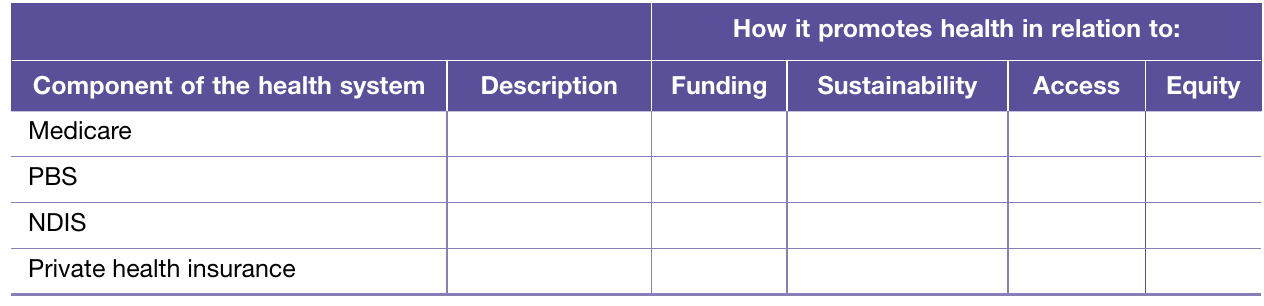
Use this framework to organise your analysis of each health system component:
Important
When completing this table, ensure each cell contains specific, detailed information rather than vague generalisations. For example, under "Funding" for Medicare, don't just write "provides funding" – explain what is funded, how much, and the resulting health impact.
Remember!
Summary
Key Points to Remember:
-
Analysis requires depth: Go beyond describing what components do – explain how they promote health and make clear links to health outcomes and wellbeing.
-
Know your evaluation criteria: Always consider funding, sustainability, access, and equity when analysing any health system component. These four criteria provide a comprehensive framework for evaluation.
-
Use specific examples: Strong analysis includes specific features like the Medicare Safety Net, PBS co-payments, NDIS individualised plans, or private health insurance incentives, explaining how each promotes health.
-
Make explicit connections: Clearly link health system features to health outcomes. Explain the chain of cause and effect – how does funding lead to improved mortality? How does equity reduce stress and improve mental wellbeing?
-
Understand how components work together: Recognise that individuals often benefit from multiple health system components simultaneously, and be prepared to explain these interactions in your analysis.