Improving Health Status Using the Social and Biomedical Approaches to Health (VCE SSCE Health and Human Development): Revision Notes
📚Revision Notes
Improving Health Status Using the Social and Biomedical Approaches to Health
Introduction
Over the past century, Australia has experienced remarkable improvements in health status, with significant changes in patterns of death and disease. As these disease patterns evolve, the strategies needed to address them must also adapt. Understanding how disease and illness have changed over time, and examining the interventions that have been implemented, helps us tackle contemporary health challenges more effectively.
Both the biomedical and social models of health offer different perspectives on health, wellbeing and illness. Whilst each approach has its own strengths and limitations, there is now clear recognition that both are essential for bringing about meaningful improvements in health status and overall wellbeing.
Note
Rather than viewing these approaches as competing alternatives, they should be seen as complementary strategies that work together to enhance population health. This integrated perspective recognizes that preventing disease through social interventions and treating illness through medical care are both necessary for optimal health outcomes.
We can see the value of combining these two approaches by examining how lung cancer mortality has changed over time, and identifying which interventions have proven most effective.
Lung cancer case study
Historical context and trends
During the early twentieth century, lung cancer was considered uncommon, and specific mortality data for lung cancer was not collected until 1945. The graph below shows how death rates from lung cancer have changed since recording began.
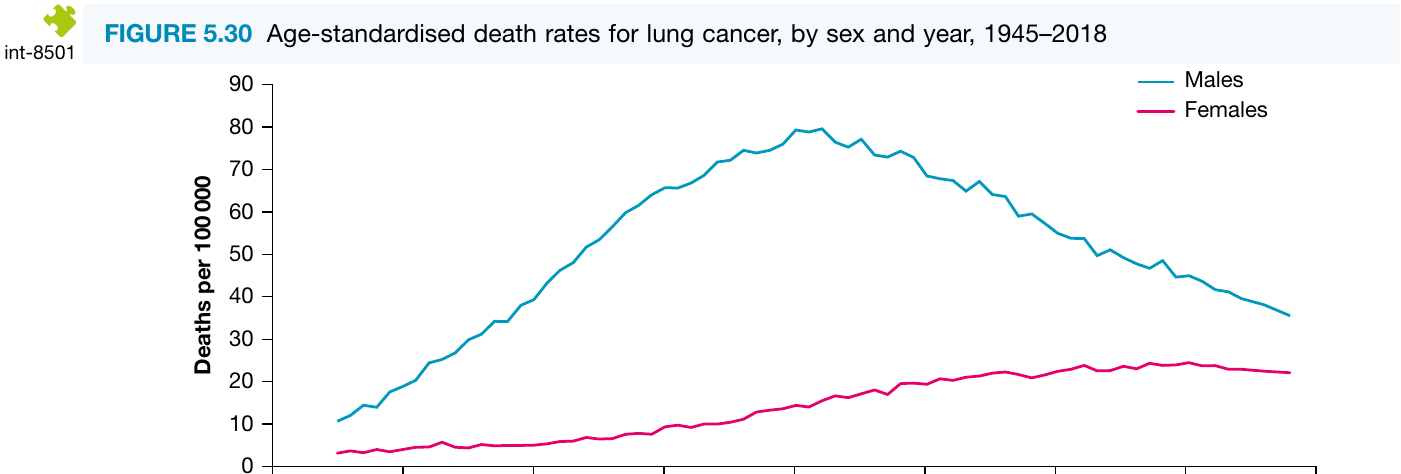
For males, there was a sharp rise in lung cancer deaths that reached its highest point around 1980. Tobacco smoking was responsible for the vast majority of these lung cancer deaths in both males and females.
Important
The subsequent decline in death rates reflects the combined impact of comprehensive health promotion strategies and public health policies (representing the social model of health), alongside improved diagnostic technology and more effective treatments (representing the biomedical approach to health). This demonstrates why both approaches are essential.
Health promotion and the social model of health
Early anti-smoking campaigns
Anti-smoking health promotion campaigns first appeared in Australia during the early 1970s. This timing coincided with growing scientific understanding about the connection between smoking and various forms of cancer, particularly lung cancer. The catalyst for government action was the 1964 United States Surgeon General's report on smoking, which definitively linked smoking to disease and death, and called for urgent government intervention.
Population-based approaches
Recognising that sociocultural and environmental factors significantly influence health and wellbeing, both state and Commonwealth governments implemented a wide range of population-based approaches. These initiatives were designed to promote health and wellbeing, minimise the harmful effects of passive smoking on non-smokers, and encourage people to either quit smoking or avoid taking it up altogether.
These approaches clearly reflect the social model of health principles and included:
- Comprehensive anti-smoking media campaigns that educated the public about smoking dangers
- Policies that made tobacco products significantly more expensive through taxation
- Strict regulations on tobacco products, including advertising bans
- Requirements for plain packaging on all tobacco products
- Mandating that tobacco products be kept out of sight in retail outlets
Note
The introduction of health warnings on cigarette packets demonstrates the social model principle of empowerment, as it provides individuals and communities with knowledge about smoking dangers, enabling them to make informed choices. Similarly, banning smoking in pubs and clubs exemplifies intersectoral collaboration, as it required cooperation between health authorities, hospitality industry and government regulators.
These population-wide strategies have been instrumental in reducing smoking uptake rates and encouraging existing smokers to quit.
Timeline of key anti-smoking interventions
The following timeline shows major milestones in Australia's comprehensive anti-smoking efforts over nearly five decades:
1973 — Health warnings first appeared on cigarette packets in Australia
1976 — Tobacco advertising banned on radio and television
1985 — Quit organisation established; anti-smoking television commercials launched
1987 — Commonwealth Government banned smoking on domestic flights
1990 — Commonwealth Government banned tobacco advertising in newspapers and magazines
1995 — Most tobacco sponsorship phased out
1996 — Billboards, outdoor and illuminated cigarette advertising signs banned
2006 — Graphic anti-smoking advertisements broadcast
2010 — Multiple significant changes implemented:
- Smoking banned in pubs and clubs
- Tobacco taxes increased by 25 per cent
- All states and territories (except Northern Territory) banned smoking in cars carrying children
- Point-of-sale displays in retail outlets selling tobacco prohibited
- Plain packaging became mandatory for all tobacco products
- Publishing tobacco advertising on internet or other electronic media became an offence
2013 — First 12.5 per cent tobacco excise increase on 1 December
2017 — Four additional annual 12.5 per cent tobacco excise (tax) increases implemented each 1 September from 2017 to 2020
Note
This progressive timeline demonstrates the multi-faceted approach of the social model of health, incorporating education, policy, environmental changes, and economic measures to address the complex social factors influencing smoking behavior.
Decline in smoking rates
The social model of health has proven highly effective in reducing smoking prevalence and minimising harm from passive smoking. According to the National Drug Strategy Household Survey, only 11.6 per cent of Australian adults smoked daily in 2019. This represents a significant decline from 12.8 per cent in 2016, and the rate has fallen by half since 1991, when it stood at 25 per cent.
Important
Whilst smoking prevalence is predicted to continue declining, many Australians still smoke, putting themselves at risk of lung cancer and other smoking-related diseases. This ongoing risk highlights why the biomedical approach remains important alongside prevention efforts — we must continue to provide medical care and treatment for those who develop smoking-related illnesses.
Biomedical approach to lung cancer
Importance of medical intervention
Despite declining death rates from lung cancer, cancer remains a major cause of both death and disability in Australia, even after decades of health promotion initiatives. Therefore, it is crucial that people who develop lung cancer can access medical care for early diagnosis and receive appropriate treatment when needed. The biomedical approach to health is essential for improving both individual health and wellbeing outcomes and overall population health status.
Improvements in survival rates
Advances in our understanding of lung cancer and developments in medical technology have significantly improved survival chances. The five-year survival rate was only 8 per cent during 1983–87. By 2018, this rate had more than doubled to 18 per cent.
Note
These improvements are largely attributable to developments in medical technology and the biomedical approach to health, which have enabled earlier and more accurate diagnosis of lung cancer, along with a broader range of treatments that increase an individual's likelihood of surviving the disease.
Diagnosis methods
Early and accurate diagnosis is crucial for effective treatment. Lung cancer is diagnosed using various tests and procedures, including:
- Chest X-rays — create images of the lungs to identify abnormalities
- Sputum cytology — involves examining phlegm samples under a microscope
- Bronchoscopy — insertion of a flexible tube through the mouth or nose into the lungs to examine airways
- Fine needle aspiration — removes a small tissue sample from the lungs through the chest wall for analysis
- CT scans — computed tomography scans use specialised x-rays taken from multiple angles to build a three-dimensional picture of the body
- PET scans — involve injecting a small amount of radioactive material, enabling a scanner to build up a detailed picture of the body
- Bone scans — detect whether cancer has spread to the bones
Treatment options
Once diagnosed, various treatments may be implemented, including:
- Surgery — to remove affected parts of the lung
- Radiotherapy — uses high-energy radiation to destroy cancer cells
- Chemotherapy — uses drugs to kill cancer cells or stop them from growing
Until recently, there was limited evidence suggesting that people with terminal lung cancer could be cured. However, new technologies are currently being trialled that may offer those with advanced cancer a genuine chance of cure. Furthermore, improvements in technology have enabled people suffering from terminal lung cancer to receive more effective palliative care.
Note
Palliative care is an approach designed to improve quality of life for patients with life-threatening illness who have little or no prospect of cure. This is achieved through preventing and relieving suffering and treating pain effectively.
The value of combining both approaches
It is clear that both the biomedical and social models of health have made vital contributions to reducing lung cancer death rates and improving health status. The social model has focused on bringing about behaviour change through education, policy and environmental modifications, whilst the biomedical model has improved diagnosis and treatment services. Together, these complementary approaches have achieved far more than either could accomplish alone.
Example
Case Study: The Lung Cancer Success Story
The dramatic reduction in lung cancer mortality demonstrates the power of combining both approaches:
Social Model Contributions:
- Population-wide education campaigns about smoking dangers
- Policy interventions (advertising bans, plain packaging, taxation)
- Environmental changes (smoke-free public spaces)
- Result: Daily smoking rates reduced from 25% (1991) to 11.6% (2019)
Biomedical Model Contributions:
- Advanced diagnostic technologies (CT scans, PET scans, bronchoscopy)
- Improved treatment options (surgery, radiotherapy, chemotherapy)
- Better palliative care for terminal patients
- Result: Five-year survival rates more than doubled from 8% to 18%
Combined Impact: Significant reductions in lung cancer mortality and improvements in quality of life for those affected.
Summary
Key Points to Remember:
-
Both biomedical and social approaches to health are essential for improving health status — they work best when used together rather than in isolation.
-
Lung cancer deaths increased dramatically in males until 1980, then declined due to comprehensive anti-smoking campaigns and improved medical treatments.
-
The social model of health has successfully reduced daily smoking rates from 25 per cent in 1991 to 11.6 per cent in 2019 through education, policy changes and taxation.
-
Major anti-smoking interventions include health warnings on packets (1973), advertising bans (1976 onwards), plain packaging (2010), and substantial tobacco tax increases.
-
The biomedical approach has more than doubled five-year survival rates for lung cancer from 8 per cent (1983–87) to 18 per cent (2018) through better diagnosis and treatment.
-
Modern lung cancer diagnosis uses multiple technologies including CT scans, PET scans, bronchoscopy and various imaging techniques, whilst treatment includes surgery, radiotherapy and chemotherapy.