Key Skills (VCE SSCE Health and Human Development): Revision Notes
📚Revision Notes
Key Skills
Note
This section focuses on two essential analytical skills for understanding Australia's changing health status. You'll learn how to interpret health data over time and evaluate different approaches to improving health outcomes.
Analysing data showing health improvements over time
This skill involves carefully examining graphs and tables to identify patterns in health status changes and explaining what caused these improvements. When you analyse health data, you need to recognise trends and connect them to specific historical interventions and policy changes.
Understanding the reasons for health improvements
Throughout the 20th and early 21st centuries, several major factors have contributed to improvements in Australia's health status. You need to understand these reasons so you can link them to data trends:
Environmental improvements (old public health)
In the early 20th century, governments implemented policies focused on improving the physical environment. These included:
- Providing safe drinking water
- Installing sewage facilities and better sanitation systems
- Improving nutrition standards
- Creating better housing conditions
- Making workplaces safer
Vaccines and immunisation programs
After 1930, the discovery of vaccines revolutionised disease prevention. Mass immunisation programs were introduced to protect populations from infectious diseases like diphtheria, poliomyelitis, pertussis, tetanus, measles and tuberculosis.
Quarantine measures
Government quarantine policies helped protect Australia from disease outbreaks occurring in other countries, preventing the spread of infectious diseases across borders.
Medical technology advances
Improvements in medical technology led to better diagnosis, more effective treatment options, and higher cure rates for various diseases. This includes developments like X-rays, scans, antibiotics and surgical techniques.
Health promotion campaigns
Educational campaigns were introduced to raise awareness about health risks and encourage behaviour changes, particularly around issues like smoking, diet and physical activity.
The social model of health
The new public health approach, also called the social model of health, shifted focus from just treating disease to addressing the broader social, economic and environmental factors that influence health outcomes.
Important
Critical Skill: Linking Trends to Reasons
When analysing health data, you must do more than just describe what you see in graphs and tables. The key is to connect observable trends to specific historical interventions that explain why those changes occurred. Always support your analysis with concrete examples of how each factor contributed to the observed improvements.
How to analyse health data effectively
When you're given a graph or table showing health changes over time, follow these steps:
- Read the data carefully - Check what the axes show, what time periods are covered, and what health indicators are being measured
- Identify clear trends - Look for increases, decreases, or patterns in the data
- Select the most significant changes - Focus on the categories showing the greatest improvements or most notable patterns
- Link trends to reasons - Connect the changes you've identified to the specific historical factors that explain them
- Provide specific examples - Use concrete details about how each factor contributed to the observed changes
Example
Worked Example: Analysing Disease Patterns from 1907 to 2018
Let's look at how to apply this analytical skill using real data on disease patterns in Australia.
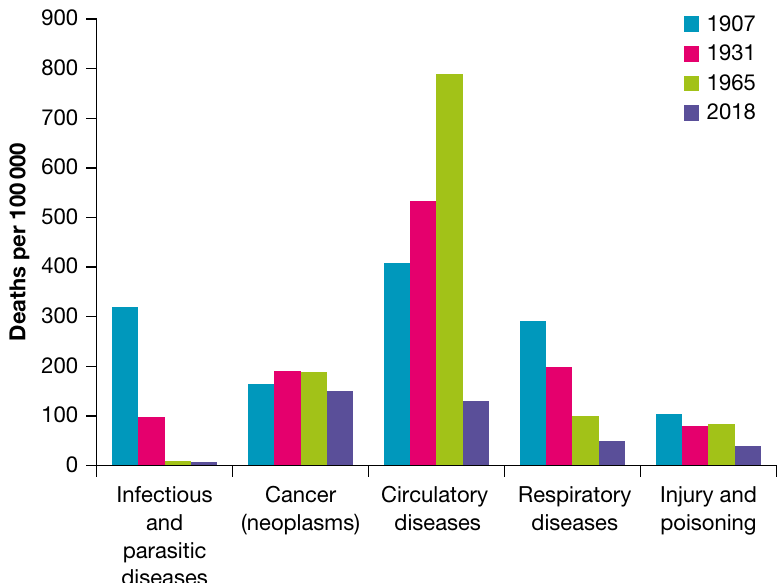
Step 1: Identifying the overall trend
The patterns of death and illness in Australia have changed significantly since 1900. Age-standardised death rates have decreased across all five broad disease categories between 1907 and 2018. The most dramatic improvements occurred in infectious and parasitic diseases, cardiovascular diseases, respiratory diseases, and injury and poisonings.
Step 2: Analysing infectious and parasitic diseases
Infectious and parasitic diseases showed the greatest reduction over this period. In 1907, these diseases caused approximately 310 deaths per 100,000 population, but by 2018, deaths had fallen to nearly zero.
This dramatic decline can be explained by several key interventions:
The old public health measures played a crucial role in the early 20th century. When scientists discovered the link between bacteria and disease, governments took action to improve living conditions. They ensured people had access to safe drinking water and implemented better sanitation and sewage systems. These environmental improvements brought about huge reductions in deaths from parasitic diseases like diarrhoea and cholera, particularly among children.
Step 3: Analysing respiratory diseases
Respiratory diseases also declined significantly during this period. Housing improvements contributed to this reduction by decreasing infectious diseases such as pneumonia and influenza. Better ventilation, less overcrowding and improved heating all helped reduce the spread of respiratory infections.
There was a notable spike in deaths around 1919 due to the Spanish influenza epidemic, but the overall trend continued downward afterwards.
Step 4: The role of vaccines and antibiotics
The introduction of vaccines in the early 1930s further reduced both infectious and respiratory diseases. Mass immunisation campaigns over the following 30 years dramatically decreased deaths from diseases like diphtheria, pertussis, poliomyelitis, tetanus, measles and tuberculosis.
After World War II, the discovery of antibiotics contributed even more to reducing deaths from diseases like pneumonia and complications from infections. These medications could cure bacterial infections that had previously been fatal.
Step 5: Analysing cardiovascular diseases
Cardiovascular diseases showed a different pattern. Deaths from these diseases steadily increased from 1907 to 1931 and reached their peak in 1965 at approximately 790 deaths per 100,000 population. Since then, they have declined substantially.
By 1965, researchers understood that most cardiovascular disease deaths were lifestyle-related. They believed that educating people about risk factors like cigarette smoking, physical inactivity and poor diet would motivate behaviour changes. This understanding led to the introduction of health promotion campaigns targeting individual behaviours.
Step 6: The role of medical technology
Improved medical technology also contributed to the decline in cardiovascular deaths. New diagnostic tools helped doctors identify heart disease earlier. Better medications helped manage these conditions, and advances in surgical techniques enabled more effective treatment and curative procedures. These medical advances increased survival rates and improved quality of life for people with cardiovascular disease.
Step 7: The social model of health and the Ottawa Charter
Despite health promotion efforts, changing behaviour proved difficult. People recognised that many factors influencing health lie outside individual control. This realisation led to the development of the new public health approach, also known as the social model of health.
Rather than focusing solely on individual behaviour change, this approach addressed the physical, sociocultural and political environments that influence health and wellbeing. The Ottawa Charter provided a framework for implementing the social model of health. Combined with continuing medical technology improvements, these approaches have resulted in continued reductions in cardiovascular disease deaths since 1965.
Practice opportunity: Diarrhoea deaths in children
Note
Practice Your Analytical Skills
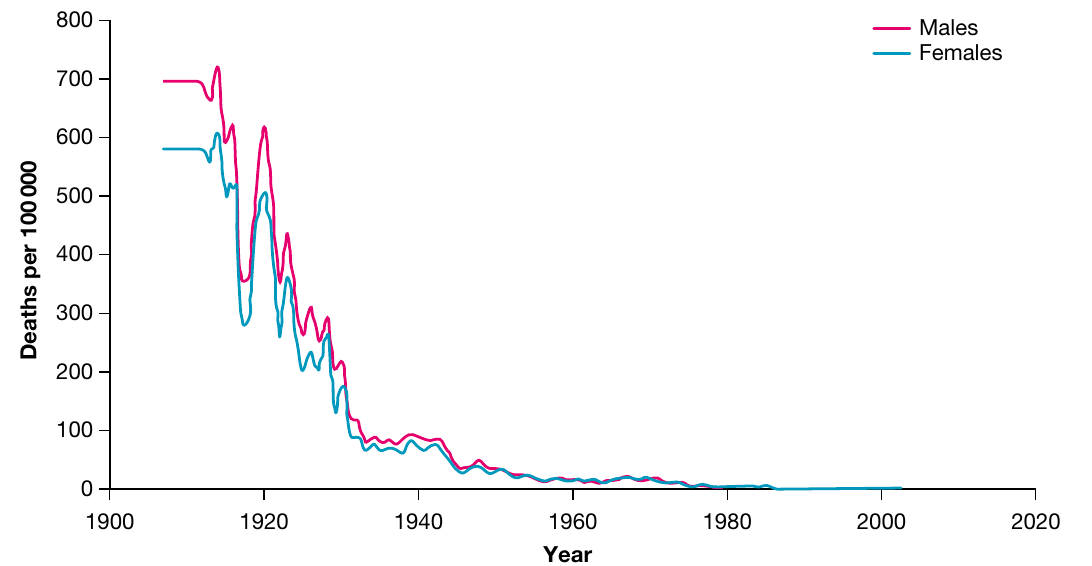
This graph shows death rates from diarrhoea in children aged 0-4 years from 1907 to 2003. Use this data to practise the analytical approach you've just learned:
- Describe the changes in deaths from diarrhoea shown in the graph from 1907 to 2003
- Explain how two specific old public health actions might have contributed to reducing diarrhoea deaths
- Consider what might explain the spike in deaths around 1919-1920
Analysing biomedical and social models of health
This skill requires you to evaluate how both the biomedical model and social model of health have contributed to health improvements. You need to understand what each model focuses on, their advantages and disadvantages, and provide specific examples of their contributions.
What you need to demonstrate
To analyse these models effectively, you should be able to:
- Describe each model - Explain what each model focuses on and its key features
- Identify advantages - Outline the benefits and strengths of each approach
- Identify disadvantages - Explain the limitations and weaknesses of each approach
- Provide specific examples - Show how each model has contributed to addressing particular health concerns over time
Note
Using the five broad disease categories is an effective way to structure your analysis and demonstrate how both models have contributed to health improvements.
Example
Worked Example: Injury and Poisoning Analysis
Let's examine how both models have contributed to reducing deaths from injury and poisoning.
Understanding the category
Deaths from injury and poisoning include fatalities from motor vehicle and other accidents, suicide, assault, poisoning, drowning, burns and falls, as well as complications from medical and surgical care.
Trends over time
Over the past 100 years, death rates from injury and poisoning have more than halved, with the most rapid decline occurring since the 1970s. Both the biomedical and social models of health have played important roles in achieving this reduction.
Advantages of the biomedical model for injury and poisoning
The biomedical model has contributed significantly to reducing deaths from injuries through several medical advances:
Treatment of infections
The discovery of antibiotics after World War II meant that infections frequently occurring after accidents or injuries could be cured, reducing deaths from accidents. Before antibiotics, many accident victims died from secondary infections rather than the initial injury.
Better diagnosis
The development of X-rays and scanning technology resulted in more accurate diagnosis of injuries, leading to more effective treatment. Doctors could identify internal injuries, broken bones and other damage that wasn't visible externally.
Improved surgical techniques
Better anaesthetics enabled more complex surgery to take place, increasing the likelihood of survival from serious accidents and injuries. Surgeons could perform longer, more intricate procedures to repair damaged organs and tissues.
Impact on health status
These biomedical advances have increased life expectancy and improved quality of life for accident survivors. People who previously would have died from injuries now survive and often make full recoveries.
Disadvantages of the biomedical model for injury and poisoning
Despite its benefits, the biomedical approach has several limitations:
High costs
Dependence on technology contributes to high healthcare system costs. Advanced medical equipment is expensive to purchase and maintain. Specialist medical personnel are required to treat patients with potentially life-threatening injuries, adding to costs.
Cannot cure all injuries
In some cases, the nature of injuries, especially spinal cord injuries, cannot be cured even with the best medical treatment. The biomedical model can only manage symptoms and prevent further complications.
Limited prevention
The biomedical approach has limited impact on preventing injuries in the first place. For example, in drowning cases, the biomedical approach can only help if resuscitation is possible. It cannot prevent the drowning from occurring.
Advantages of the social model for injury and poisoning
The social model of health has played a crucial role in reducing death rates from injury and poisoning over time through prevention strategies:
Road safety measures
Deaths from motor vehicle crashes peaked in 1970 and then declined steadily. This decline resulted from a range of public health actions introduced by government, including:
- Compulsory wearing of seatbelts (introduced in 1970)
- Drink-driving restrictions
- Lower speed limits
- Better road design and maintenance
- Improved car design and safety features
Mass media campaigns
A series of campaigns raised awareness about dangers associated with speeding, driving under the influence of drugs or alcohol, and the importance of being alert through adequate sleep and rest breaks. These campaigns changed social attitudes and behaviours around driving.
Workplace safety
The introduction of occupational health and safety laws improved workplace safety, contributing to fewer workplace accidents and deaths. Employers became legally required to provide safe working environments.
Poison prevention
Poisoning deaths declined due to better labelling of toxic substances, child-proof lids for medicines and household chemicals, and increased health awareness through education campaigns.
Drowning prevention
Deaths from drowning decreased through compulsory pool fencing regulations and health promotion campaigns about water safety.
Population-wide benefits
The social model targets the whole population rather than just treating injured individuals. It aims to create equity in health and wellbeing by changing the physical, sociocultural and political environments so that healthy choices become easy choices.
Cost-effectiveness
The social model of health tends to be comparatively less expensive than the biomedical approach because prevention is generally cheaper than treatment.
Disadvantages of the social model for injury and poisoning
The social model also has limitations:
Requires careful planning
Success depends on careful planning and research to ensure health promotion messages are effective and not ignored. Poorly designed campaigns waste resources and may not change behaviour.
Cannot prevent all injuries
Not all injuries and poisonings can be prevented, no matter how good the prevention strategies are. Accidents still happen despite safety measures.
Doesn't treat injuries
The needs of people who are injured are not addressed through the social model of health. Once an injury occurs, the biomedical model is needed to provide treatment and care.
The complementary relationship
This example shows how both models work together to improve health outcomes. The social model prevents many injuries from occurring in the first place, while the biomedical model treats those injuries that do occur. Both approaches are necessary for maximising health improvements.
Practice opportunity: Heart disease
Note
Understanding the Complementary Relationship
Consider this statement about heart disease treatment and prevention:
Medicine can only do so much. A heart is permanently damaged by heart disease — you can't take away the damage inflicted. Taking medication and receiving treatment can reduce the impact of heart disease on a woman's life, but they don't get rid of it. That is why it's important for women to be proactive. By taking steps to prevent heart disease you're not only improving your heart but you're also improving your general health.
Think about:
- How does this statement illustrate the relationship between biomedical and social models of health?
- What are two ways the biomedical approach can minimise the impact of heart disease?
- What are two ways heart disease can be prevented through the social model of health?
Summary
Key Points to Remember:
-
When analysing health data over time, always identify clear trends first, then link these trends to specific historical reasons for improvement
-
The six major reasons for health improvements are: old public health measures, vaccines and immunisation, quarantine, medical technology, health promotion campaigns, and the social model of health
-
Both the biomedical and social models of health have important but different roles in improving health status
-
The biomedical model focuses on treating disease and injury through medical intervention, while the social model focuses on preventing illness by addressing broader environmental and social factors
-
Use the five broad disease categories (infectious and parasitic diseases, cancer, cardiovascular diseases, respiratory diseases, and injury and poisoning) as a framework for analysing how different approaches have contributed to health improvements