The Ottawa Charter for Health Promotion (VCE SSCE Health and Human Development): Revision Notes
📚Revision Notes
The Ottawa Charter for Health Promotion
What is the Ottawa Charter?
The Ottawa Charter for Health Promotion is a framework created by the World Health Organization to guide organisations in developing health promotion strategies. It was developed at the First International Conference on Health Promotion held in Ottawa, Canada, in 1986. Before this conference, there were no clear guidelines for how to incorporate health promotion ideas into policies and campaigns.
Note
The Ottawa Charter was groundbreaking because it provided the first comprehensive framework for health promotion worldwide. It shifted the focus from simply treating illness to actively creating conditions that support good health across entire populations.
The Ottawa Charter aims to reduce inequalities in health and wellbeing. It reflects the social model of health, which recognises that health is influenced by many factors beyond just biology and healthcare. The framework consists of three core strategies and five action areas that work together to improve health status across populations.
According to the World Health Organization, health promotion is the process of enabling people to increase control over, and to improve, their health. This approach focuses on prevention rather than cure. Instead of simply treating diseases after they occur, health promotion addresses the underlying causes of disease and aims to stop health problems before they start.
Strategies for health promotion
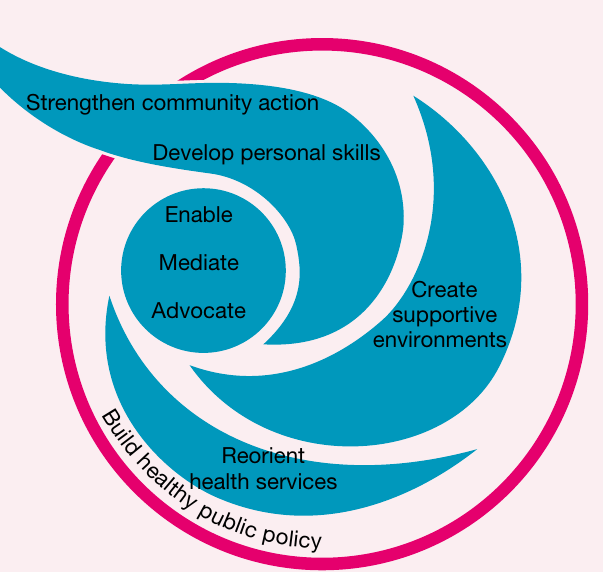
The Ottawa Charter identifies three fundamental strategies that underpin all successful health promotion work. These strategies provide the foundation for implementing the five action areas.
Important
The three core strategies - advocate, enable, and mediate - work together as the foundation for all health promotion activities. Every successful health promotion program incorporates elements of all three strategies to create lasting change.
Advocate
Good health and wellbeing represents a major resource for individuals, communities, nations and the world. Many different factors can either support or harm health and wellbeing. The advocacy strategy aims to make these factors more supportive through targeted action.
Advocacy for health involves taking action to gain support from governments and societies to improve health and wellbeing for everyone. This is crucial because many factors that affect health require policy changes or societal shifts that individuals cannot achieve alone.
Examples of advocacy actions include:
- Running media and social media campaigns to raise awareness
- Public speaking at community events or forums
- Conducting and publishing research to build evidence
- Gathering and sharing public opinion data
- Lobbying governments, where individuals or groups work to influence those who make policies and laws
Advocacy ensures that health promotion remains visible and prioritised in government decision-making and community planning.
Enable
Health promotion recognises that different population groups experience different levels of health and wellbeing. The enable strategy focuses on achieving equity by working with those who face poorer health status.
Enabling is about reducing differences in health outcomes between population groups. This involves ensuring equal opportunities and resources are available so all people can achieve optimal health and wellbeing. Importantly, enabling means empowering people to take control of factors affecting their health, not simply providing handouts or doing things for people.
Note
The key difference between enabling and simply providing services is empowerment. Enabling gives people the tools and resources they need to make their own healthy choices, rather than making choices for them. This creates sustainable, long-term health improvements.
To achieve optimal health and wellbeing, people need access to:
- Quality education
- Meaningful employment
- Adequate housing
- Nutritious food
- Healthcare services
This enabling approach applies equally across all population groups, including women and men, Indigenous and non-Indigenous Australians, people in different socioeconomic groups, and those living in cities versus regional and remote areas. The goal is to give people the tools and resources they need to make healthy choices, rather than making choices for them.
Mediate
Health promotion often requires changes to funding structures, legislation, policies, and physical and sociocultural environments. These types of changes inevitably create conflict between different stakeholders, including individuals, community groups, businesses and political parties.
Mediating involves helping these diverse groups resolve conflicts and reach outcomes that promote health and wellbeing. Health professionals and community organisations play an important role in bringing different perspectives together.
Example
Real-World Example: Speed Limit Mediation
Reducing speed limits is a policy change aimed at saving lives, but it may not be supported by all community members. Some people might see it as government overreach or an inconvenience.
Mediation involves working with groups who oppose such changes to help them understand the evidence and reach consensus that prioritises health and safety outcomes. This might include:
- Presenting data on crash reduction
- Addressing concerns about travel time
- Finding compromise solutions that balance safety with community needs
The mediation strategy recognises that health promotion requires negotiation and compromise. By facilitating dialogue between stakeholders with different interests, mediators can help create policies and programs that have broad support while still advancing health goals.
Action areas of the Ottawa Charter
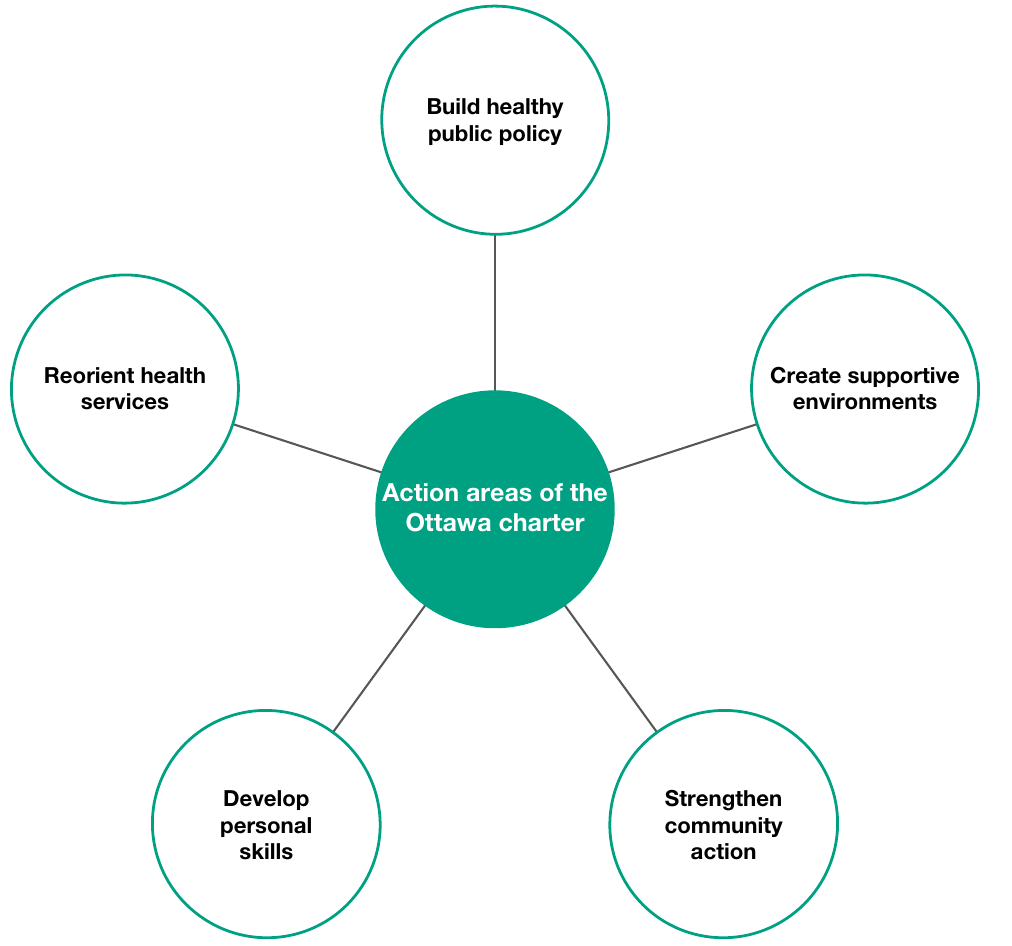
The Ottawa Charter outlines five specific action areas that provide a comprehensive framework for health promotion. These action areas work together and often overlap in practice. Understanding each area helps health professionals and policymakers design more effective programs.
Build healthy public policy
This action area focuses on government and organisational decisions about laws and policies. The goal is to create a policy environment that makes healthy choices the easier choices for people.
Healthy public policy can work in several ways. It can make unhealthy behaviours more difficult or less appealing, while simultaneously making healthier options more accessible and attractive. This shifts the environment in which people make decisions, rather than simply telling people what to do.
Australian examples of healthy public policy include:
| Policy approach | How it works | Health benefit |
|---|---|---|
| Removing GST from unprocessed foods | Makes healthier whole foods cheaper to purchase compared to processed alternatives | Encourages consumption of nutritious foods |
| Increasing taxes on tobacco and alcohol | Makes these products more expensive, which discourages purchase, particularly among young people | Reduces rates of smoking and harmful alcohol consumption |
| Banning smoking in public places | Creates smoke-free environments in restaurants, workplaces, and other public venues | Protects everyone from secondhand smoke exposure |
| Mandatory seatbelt laws | Requires all vehicle occupants to wear seatbelts | Dramatically reduces deaths and serious injuries from vehicle crashes |
Note
These policies work because they change the default environment. People don't have to make special efforts to avoid unhealthy situations - the policy has already created a healthier context. This is more effective than simply educating people and hoping they make healthy choices in unhealthy environments.
Create supportive environments
This action area recognises that broader determinants significantly impact health and wellbeing. The physical and sociocultural environments in which people live, work, learn and play greatly influence their health outcomes.
A supportive environment is one that actively promotes health and wellbeing by being safe, stimulating, satisfying and enjoyable. These environments make it easier for people to make healthy choices in their daily lives without requiring constant conscious effort.
Physical environment examples include:
- Providing safe, well-lit walking and cycling paths
- Creating shaded areas in school playgrounds and outdoor spaces to reduce UV exposure
- Ensuring smoke-free areas in public spaces
- Maintaining safe working conditions in employment settings
Sociocultural environment examples include:
- Having a supportive family where healthy behaviours are practiced and encouraged
- Creating inclusive communities where all members feel valued
- Establishing services like Quitline that provide support for people trying to quit smoking
- Investing in sustainable energy production to ensure future generations inherit a healthy environment
Supportive environments reduce barriers to healthy living. When the environment is designed with health in mind, healthy choices become the natural, convenient option.
Strengthen community action
This action area centres on building connections between individuals and their communities. It recognises that communities often know best what they need and can be powerful drivers of change.
Strengthening community action means communities working together toward common health goals. When people feel a sense of ownership over health strategies in their area, participation increases and programs become more effective. This bottom-up approach contrasts with top-down programs designed without community input.
Example
Case Study: Central Australian Aboriginal Congress (CAAC)
The Central Australian Aboriginal Congress in Alice Springs demonstrates this action area effectively. This health service is run by Aboriginal people for Aboriginal people.
Because community members feel connected to and represented by the service, participation rates are high. CAAC brings together Aboriginal people across central Australia to promote health and wellbeing through:
- Healthcare delivery
- Education programs
- Advocacy initiatives
The success comes from community ownership and cultural appropriateness.
Another example is immunisation strategies in Australia. These involve multiple groups - media organisations, medical professionals, schools and parents - working together to achieve higher immunisation rates for children. Each group brings different strengths and reaches different audiences, but all work toward the shared goal of protecting children from preventable diseases.
Community action is effective because it:
- Builds on existing community strengths and resources
- Respects local culture and knowledge
- Creates sustainable change led by community members themselves
- Increases trust in health programs
- Addresses issues most relevant to that specific community
Develop personal skills
Education forms the core of this action area. Developing personal skills means providing people with health-related knowledge and practical skills that allow them to make informed decisions affecting their health and wellbeing.
This education goes beyond simply providing information. It includes teaching practical skills and building confidence so people can apply their knowledge in real-life situations. Education might be directly about health topics, or it might address skills that indirectly support health, such as conflict resolution, cooking, budgeting or stress management.

Health education can occur in many settings:
- Schools teaching nutrition, physical activity, relationships and mental health
- Workplaces offering professional development and wellbeing programs
- Families passing on knowledge and modelling healthy behaviours
- Community health centres running classes and workshops
- Government and non-government organisations providing public health campaigns
Note
Why Personal Skills Matter
Developing personal skills empowers people to take control of their health. When people understand why certain behaviours affect health and have the skills to change those behaviours, they become active participants in improving their own wellbeing.
This is more sustainable than passive approaches where people simply follow instructions without understanding the reasoning behind them.
Australian examples include:
- Community health centres running cooking classes that teach people how to prepare nutritious, affordable meals
- Quit campaigns educating people about the harmful effects of smoking and providing strategies to quit
- Sun safety programs teaching parents and children about sunscreen application and UV protection
- Schools teaching students about healthy relationships and conflict resolution
- Workplace training on stress management and work-life balance
Reorient health services
This action area calls for a fundamental shift in how health systems operate. Instead of focusing primarily on diagnosing and treating illness (the biomedical approach), health services should prioritise promoting health and preventing disease.
Reorienting health services means addressing all factors that influence health and wellbeing, not just diseases and their treatments. This requires health professionals to expand their role beyond clinical care to include education, advocacy and health promotion.
Important
A Paradigm Shift in Healthcare
This action area represents a major change from the traditional biomedical model. Rather than waiting for people to become sick and then treating them, the health system should work to keep people healthy in the first place.
This shift requires significant changes to:
- How health services are funded
- What health professionals prioritise
- How success is measured in healthcare
In practice, this might look like:
- Doctors discussing healthy eating and exercise as the first approach to managing cardiovascular disease risk, rather than immediately prescribing medication
- Medical professionals recommending physical activity programs to prevent type 2 diabetes before it develops
- Health services providing funding for community walking groups or cooking classes
- Healthcare providers implementing health promotion campaigns in their communities
The My Health for Life program in Queensland exemplifies this action area. Rather than waiting for people to develop chronic conditions and then treating them, this government-funded initiative works to prevent conditions like type 2 diabetes, heart disease and stroke from occurring in the first place. By funding prevention programs, the health system demonstrates a commitment to keeping people healthy rather than just treating them when they become ill.
This reorientation also means recognising social determinants of health. Health services might advocate for affordable housing, support employment programs, or work to improve food security in their communities, understanding that these factors fundamentally affect health outcomes.
The Ottawa Charter in action - My Health for Life
The My Health for Life program demonstrates how the Ottawa Charter action areas work together in practice. This Queensland government initiative shows how a single program can address multiple action areas simultaneously.
Example
Case Study: My Health for Life Program
Program Overview
My Health for Life targets Queenslanders aged 18 and over who are either at high risk of developing chronic conditions (type 2 diabetes, heart disease, stroke) or who have pre-existing conditions like gestational diabetes, pre-diabetes, high blood pressure or high cholesterol.
The program provides free six-session support where participants work with a health coach to achieve personal health goals. Participants can choose between small group sessions or one-on-one phone coaching, making the program accessible to different preferences and circumstances.
How the Program Reflects Ottawa Charter Action Areas
Reorient health services: The program shifts focus from treating disease to preventing it. By funding a prevention program, Queensland's health system demonstrates commitment to keeping people healthy rather than waiting to treat them after conditions develop. The program addresses major burdens of disease in Australia proactively.
Create supportive environments: Participants work with health coaches who provide structured support and encouragement. They receive resources including manuals, workbooks, progress messages and reminders about at-home activities. An online maintenance program provides continued support for six months after completion. This creates an environment where healthy change is supported at every step.
Strengthen community action: The program is delivered by an alliance of health organisations across Queensland. The My Health for Life community includes local health professionals, various cultural groups, sporting groups, councils and workplaces. This collaborative approach brings together diverse stakeholders working toward shared health goals. Participants also connect with others facing similar health challenges, building peer support networks.
Develop personal skills: Participants learn practical skills including how to break large goals into achievable steps, incorporate healthier choices into everyday life, and overcome barriers when they arise. They develop understanding of their personal risk levels and learn evidence-based strategies for making sustainable healthy changes. The program doesn't just tell people what to do - it teaches them how to do it.
The My Health for Life program shows how effective health promotion addresses multiple action areas simultaneously. By combining education, support, community partnerships and a prevention focus, the program creates conditions where people can successfully improve their health.
Summary
Key Points to Remember
-
The Ottawa Charter for Health Promotion was developed by the World Health Organization in 1986 to provide a framework for health promotion strategies that reduce health inequalities.
-
The three core strategies are advocate (gaining support for health from governments and society), enable (ensuring equal opportunities and resources for all groups to achieve good health), and mediate (resolving conflicts between stakeholders to reach health-promoting outcomes).
-
The five action areas are: build healthy public policy (creating laws and policies that make healthy choices easier), create supportive environments (promoting safe, healthy physical and sociocultural settings), strengthen community action (building community connections and ownership of health strategies), develop personal skills (providing education and skills for informed health decisions), and reorient health services (shifting from treatment to prevention and health promotion).
-
Health promotion focuses on prevention rather than cure, addressing the causes of disease before health problems develop rather than simply treating diseases after they occur.
-
Successful health promotion programs typically address multiple action areas simultaneously and use all three strategies together, as demonstrated by programs like Queensland's My Health for Life initiative.