Optimal Health and Wellbeing as a Resource (VCE SSCE Health and Human Development): Revision Notes
📚Revision Notes
Optimal Health and Wellbeing as a Resource
Introduction: health and wellbeing as a resource
In 1986, the World Health Organization declared that for people to achieve optimal health and wellbeing, they must be able to identify and realise their aspirations, satisfy their needs, and adapt to or manage their environment. This means health and wellbeing functions as a resource for everyday life, rather than being the ultimate goal of living.
Note
The WHO's 1986 statement emphasises that health and wellbeing should be viewed as "a resource for everyday life, not the objective of living". This means optimal health enables us to achieve our goals and adapt to challenges, rather than being simply an end in itself.
Understanding health and wellbeing as a resource helps us see it has a dual nature - it is both something we use (a resource) and something we achieve (an outcome). When populations experience optimal health and wellbeing, this creates benefits for individuals, nations, and the global community.
Importance of health and wellbeing as a resource for individuals
Health and wellbeing as a personal characteristic
Health and wellbeing represents a fundamental human characteristic, similar to other traits like knowledge, social skills, and creativity. Like these attributes, health and wellbeing enhances human life but cannot be directly sold or traded for goods and services. Instead, it acts as a personal resource that enables us to engage more fully with life.
Reducing risks and improving daily life
At the most basic level, experiencing optimal health and wellbeing decreases the likelihood of disease, injury, and premature death. According to the Australian Institute of Health and Welfare (2019), approximately 4.8 million years of healthy life were lost in Australia during 2015 due to either premature death or time spent living with disease or injury.
By reducing these risks, optimal health and wellbeing allows people to live free from pain and concentrate on activities that genuinely improve their lives. This includes studying, working productively, and socialising with others. Good health also reduces stress and anxiety whilst promoting positive emotions like happiness.
The cycle of wellbeing
Good health improves quality of life and creates a self-reinforcing cycle of wellbeing. When individuals are healthy, they can work more effectively and enhance their lives, which in turn promotes further improvements in health and wellbeing.
People experiencing optimal health have an increased capacity to participate in health-promoting activities and behaviours, including:
- Sleeping well
- Living independently
- Working towards their purpose in life
- Maintaining a nutritious diet
- Exercising regularly
- Running a household effectively
- Taking time for social and leisure activities
This creates a positive outlook where individuals can live life to the highest level possible.
Comprehensive benefits for individuals
Optimal health and wellbeing provides numerous specific benefits for individuals:
The diagram shows twelve key ways health and wellbeing benefits individuals:
- Work productively - ability to engage effectively with employment
- Sleep well - achieve quality rest and recovery
- Live independently - maintain autonomy and self-determination
- Gain an education - access and benefit from learning opportunities
- Earn an income - participate in paid employment
- Exercise - engage in physical activity
- Effectively run a household - manage shopping, cleaning, and caring for children
- Spend time with friends - maintain social connections
- Increase leisure time - enjoy recreational activities
- Work towards their purpose in life - pursue meaningful goals
- Reduced healthcare costs - spend less on medical care
Financial benefits for individuals
Disease and injury generate significant health-related expenses, including doctor consultations and medications. Individuals often must contribute financially towards these costs. Optimal health and wellbeing therefore reduces these expenses, increasing the amount of money available for other priorities such as education, housing, food, leisure pursuits, and social activities.
Note
By reducing healthcare costs, optimal health and wellbeing frees up personal finances that can be redirected towards quality of life improvements such as education, better housing, nutritious food, leisure activities, and social engagement.
The positive feedback loop
Health and wellbeing creates a positive feedback mechanism that strengthens itself over time:
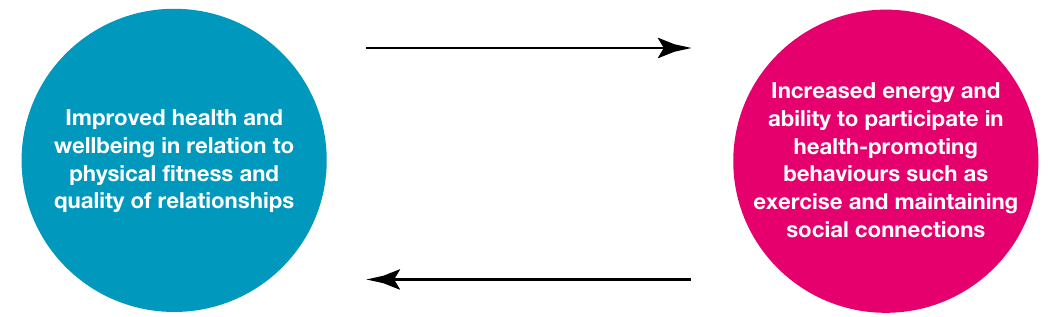
When people experience improved health and wellbeing, particularly in areas like physical fitness and quality relationships, they gain increased energy and ability to participate in health-promoting behaviours such as exercise and maintaining social connections. These activities then further improve health and wellbeing, creating an upward spiral of positive outcomes.
Example
Worked Example: The Positive Feedback Cycle
- Starting point: A person begins exercising regularly and eating nutritiously
- Immediate effect: They experience improved physical fitness and energy levels
- Enhanced capacity: With more energy, they can exercise more effectively and maintain social connections
- Reinforcement: These activities further improve their physical and mental health
- Cycle continuation: Better health enables even more participation in health-promoting activities
This demonstrates how good health doesn't just benefit us once - it creates a self-sustaining cycle where each improvement makes the next one easier to achieve.
Importance of health and wellbeing as a resource for nations
Beyond individual benefits, optimal health and wellbeing delivers substantial social and economic advantages for entire populations and countries.
Economic benefits at the national level
Countries whose populations experience optimal health and wellbeing gain significant economic advantages:
Reduced healthcare expenditure: The health system creates substantial costs for nations. In Australia, doctors' consultations, medications, and other health services cost over $195 billion during 2018-19. Many of these costs could be prevented if all people experienced optimal health and wellbeing.
Savings reinvestment: Money saved through improved population health can be redirected towards promoting quality of life through education, infrastructure improvements (including housing and transport systems), development of new industries by confident individuals pursuing innovation, and social security for those experiencing hardship.
Increased productivity: The Royal Australian and New Zealand College of Psychiatrists estimated the economic cost of mental illness alone approaches $100 billion annually. When populations experience optimal health and wellbeing, they are better equipped to work productively.
Note
Productivity relates to the efficiency of production of goods and services. Productivity is measured by the amount of output produced per unit of input. In simple terms, it's about how much work can be accomplished with the available resources.

Important
Research shows that the healthiest Australian employees are almost three times more productive than their colleagues. Furthermore, employees with poor overall health status are much more likely to be absent from work, with unhealthy employees being nine times more likely to take sick days compared to healthy employees.
These statistics demonstrate the massive economic impact of population health on national productivity.
Higher incomes and tax revenue: Optimal health and wellbeing increases people's ability to work and earn income. This strengthens the country's economy through higher taxation revenue.
Reduced welfare dependence: Fewer people rely on social security payments due to reduced unemployment, further enhancing the national economy.
Social benefits at the national level
The social importance of optimal health and wellbeing can be more difficult to measure than economic benefits, but it is equally significant.
Reduced premature death and illness: Optimal health and wellbeing decreases the risk of premature death and development of illness and disease. Beyond improving population health indicators and outcomes, this reduces stress and anxiety that communities experience when loved ones suffer premature death, disease, or injury.
Less strain on health systems: With optimal population health, the number of encounters with the health system (such as doctor consultations and hospital admissions) decreases, thereby shortening waiting times for people who do require healthcare.
Reduced workplace pressure: A healthy and productive workforce reduces pressure on the workforce as a whole. When fewer people take time off work, everyone can concentrate on their own jobs, further decreasing stress and other work-related pressures.
Increased social participation: Populations experiencing optimal health and wellbeing demonstrate higher levels of social participation. This promotes feelings of belonging and provides vital resources and services to society.
Note
Social participation includes:
Formal activities:
- Organised groups such as sport or physical recreation groups
- Arts or heritage groups
- Religious or spiritual groups or associations
Informal activities:
- Social gatherings with friends and families
- Providing support and care for those in need, such as the sick or immobile
Civic participation refers to involvement in a community group such as a union, professional association, political party, environmental or animal welfare group, human and civil rights group, or body corporate or tenants' association.
Intergenerational benefits: Optimal health and wellbeing creates a positive cycle through generations. Parents experiencing good health and wellbeing have increased capacity to adequately care for and raise their children. Consequently, their children are more likely to experience optimal health and wellbeing themselves, producing future generations who can provide for themselves and their families whilst contributing to society and their country.
Importance of health and wellbeing as a resource globally
Optimal health and wellbeing provides crucial benefits for the world's population, extending beyond national boundaries.
Reducing disease transmission between countries
Optimal health and wellbeing reduces the risk of infectious or communicable diseases spreading between countries.
Note
Communicable diseases are infectious diseases that are transmitted from the environment, including through air, water, food, and other infected organisms (including other humans).
These diseases spread through two main routes:
Direct contact transmission:
- Touch (e.g. chickenpox)
- Sexual intercourse (e.g. syphilis, HIV)
- Saliva and droplets from coughing (e.g. influenza, COVID-19)
- Human waste such as faecal or oral transmission (e.g. hepatitis A)
Indirect contact transmission:
- Water (e.g. cholera)
- Food (e.g. E. coli)
- Blood (e.g. hepatitis B and HIV)
- Vectors such as mosquitoes (e.g. malaria)
Note
A vector is a living thing that carries and transmits pathogens to other living things. The most common example is mosquitoes, which transmit diseases like malaria, dengue fever, and Zika virus.
Under favourable conditions, these diseases can spread rapidly from person to person, potentially resulting in a pandemic.
Important
A pandemic is the spread of infectious disease through human populations across a large region such as multiple continents or worldwide.
Pandemics create major health, social, and economic consequences for the global population, including:
- Significant rates of disease and premature death
- Reduced workforce participation and productivity
- Shutdown of non-essential services
- Disruptions to travel and transport of goods
- Food shortages
- School closures
- Breakdown of law and order
During crises such as pandemics, people often cannot conduct their daily activities and must instead focus on survival, impacting all aspects of life.
Economic impact of pandemics: Even conservative estimates suggest pandemics destroy up to 1% of global GDP, comparable to other major threats like climate change. The COVID-19 pandemic caused close to 2 million deaths and reduced global GDP by approximately 4.5% in 2020 alone.
Increasing disease outbreak frequency: With globalisation and increased affordable transportation of people, products, and food, the last 30 years have witnessed a steady increase in the frequency and diversity of disease outbreaks. Most originate from bacteria or microbes of animal origin transmitted to people, such as COVID-19, Ebola, and avian flu. No country is immune to the potential impacts of infectious disease, making the reduction of infections and maintenance of good health and wellbeing increasingly important.
Promoting peace and security
Populations experiencing good health and wellbeing contribute to world peace and security. When populations are healthy, they can work for the benefit of themselves, their country, and the planet. They can be productive and access the resources required for a decent standard of living, including employment, education, food, water, shelter, and healthcare.
Note
When populations lack positive health and wellbeing, they may resort to extreme measures to access essential resources for survival. This can contribute to conflict at both national and international levels, as groups compete for scarce resources like food, water, and healthcare.
Supporting sustainability
Optimal health and wellbeing on a global scale promotes sustainability. When people have their needs met and feel good about themselves, they are more likely to live sustainably. They can work productively and provide for their families. Governments generate greater taxation revenue, which can fund sustainable energy, water, and agricultural systems.
Important
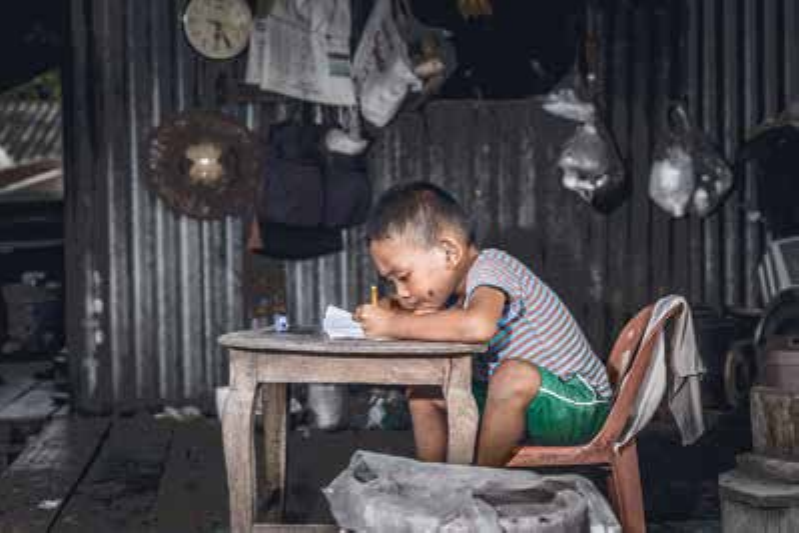
Children are often the most vulnerable to poor health and wellbeing. When health and wellbeing is poor, children cannot focus on education or thrive in ways that promote future social and economic development and sustainability.
Promoting economic and social development
Economic development through trade: Good health and wellbeing is essential for optimal trade between countries. Healthy populations are better equipped to produce goods and services for trading on the global market. Global trade is increasingly important for the economic development of many countries, generating revenue that helps governments provide essential resources and services such as education, public housing, healthcare, and infrastructure.
Poor health and wellbeing significantly impacts the social and economic development of countries, especially low-income countries that often lack the economic or social resources to manage the negative consequences of poor health and wellbeing.
Social development: When children experience good health and wellbeing, they can access education and develop in ways that promote future social and economic progress. This is particularly important in developing countries where health challenges can prevent children from reaching their potential.
Case study: COVID-19 impact on global health and wellbeing
The COVID-19 pandemic demonstrated the critical importance of health and wellbeing as a global resource. According to a joint statement by the International Labour Organization (ILO), Food and Agriculture Organization (FAO), International Fund for Agricultural Development (IFAD), and World Health Organization (WHO) in October 2020:
Important
Health and economic impacts:
- The pandemic led to dramatic loss of human life worldwide
- Presented an unprecedented challenge to public health, food systems, and employment
- Tens of millions of people faced risk of extreme poverty
- The number of undernourished people (estimated at 690 million) could increase by up to 132 million
- Nearly half of the world's 3.3 billion global workforce risked losing their livelihoods
Particularly vulnerable populations:
- Informal economy workers lacked social protection and quality healthcare access
- Agricultural workers faced high levels of working poverty, malnutrition, and poor health
- Migrant agricultural workers struggled to access government support
- Women, over-represented in low-paid jobs and care roles
- Youth and older workers
- Small-scale farmers and indigenous peoples
Food system disruption:
- Border closures and trade restrictions prevented farmers from accessing markets
- Agricultural workers could not harvest crops
- Domestic and international food supply chains were disrupted
- Access to healthy, safe, and diverse diets was reduced
- For many people, no income meant no food or less nutritious food
Note
Need for global solidarity: The joint statement emphasised that only through global solidarity and support, especially for the most vulnerable populations, can the world overcome the intertwined health, social, and economic impacts of the pandemic and prevent escalation into a protracted humanitarian and food security catastrophe.
Remember!
Summary
Key Points to Remember:
-
Health and wellbeing functions as a resource that enables people to pursue their aspirations, satisfy needs, and manage their environment, rather than being merely an end goal in itself.
-
For individuals, optimal health and wellbeing creates a positive cycle where good health enables participation in health-promoting activities (work, exercise, social connections), which further improves health. It also reduces personal healthcare costs, freeing resources for education, housing, and leisure.
-
For nations, optimal health provides economic benefits (3x greater productivity for healthy workers, 9x fewer sick days, savings from $195 billion annual healthcare costs) and social benefits (longer lives, reduced stress, increased community participation, intergenerational advantages).
-
For the global community, optimal health reduces pandemic risks that can cost up to 4.5% of global GDP (as COVID-19 demonstrated with 2 million deaths), promotes peace and security by ensuring populations can access necessary resources, supports environmental sustainability, and enables productive international trade that funds essential services in developing countries.
-
Communicable diseases spread through direct contact (touch, sexual intercourse, coughing, human waste) and indirect contact (water, food, blood, vectors like mosquitoes), making global health security increasingly important in our interconnected world where disease outbreaks have steadily increased over the past 30 years.