Youth Perspectives on the Meaning of Health and Wellbeing (VCE SSCE Health and Human Development): Revision Notes
📚Revision Notes
Youth Perspectives on the Meaning of Health and Wellbeing
How young people view health and wellbeing
Understanding of health and wellbeing varies according to age and life stage. Within any particular age group, there are often common patterns in how people view and prioritise different aspects of their health and wellbeing. However, significant variations also exist, even among young people of similar ages.
Note
The way young people understand and value health changes significantly as they progress through adolescence, shifting from a primarily physical focus to a more comprehensive view that includes social, mental, and emotional dimensions.
What young people value most
Research shows that young Australians place greatest importance on their social health and wellbeing. When asked to rate various aspects of their lives, young people identified family relationships and friendships as their two highest priorities. This demonstrates that social connections and relationships form the foundation of what young people consider important for their wellbeing.
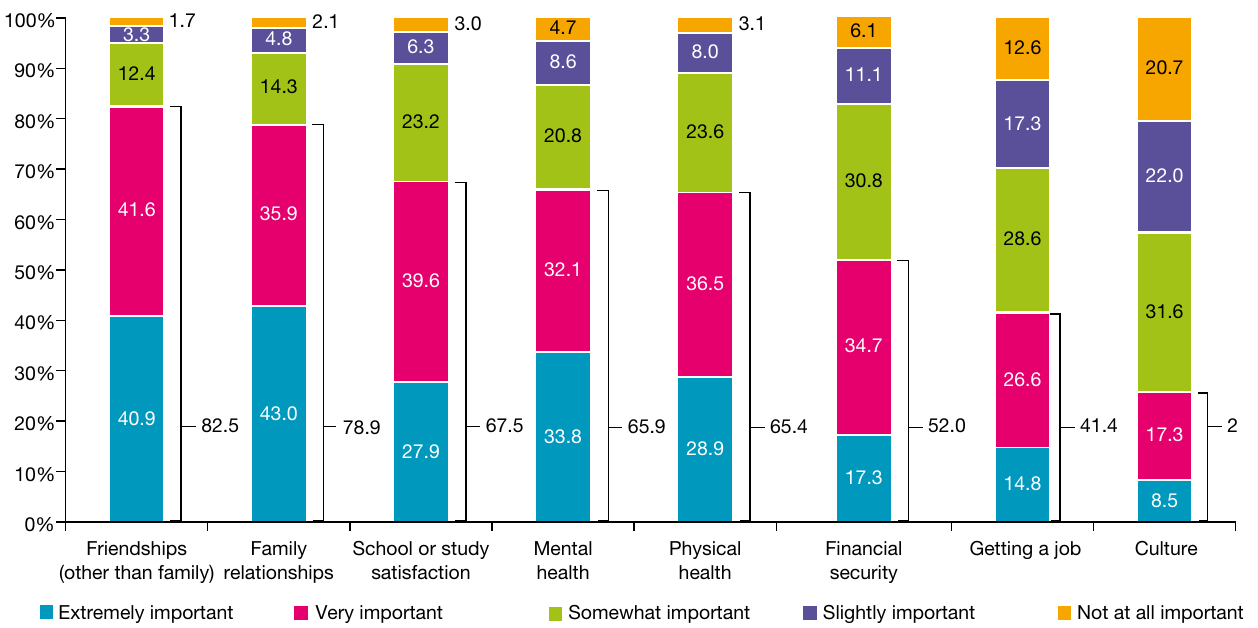
The data reveals that over 80% of young people rate friendships and family relationships as either extremely or very important. Mental health, physical health, and school or study satisfaction also feature prominently among youth priorities, whilst cultural aspects and employment concerns receive relatively less emphasis.
Note
Social connections dominate youth values
The emphasis on social relationships reflects a key insight: young people understand that their wellbeing is deeply connected to the quality of their relationships with family and friends, rather than individual achievements or material success alone.
Changing perspectives through adolescence
A large-scale 2020 study involving nearly 26,000 young Australians revealed how perspectives on health and wellbeing evolve during the teenage years. The research identified clear differences between younger and older adolescents:
Younger participants (under 16 years) tended to view health primarily through a physical lens. They emphasised that health was maintained by eating well, particularly through daily servings of fresh fruit and vegetables whilst limiting junk food consumption. This represents a somewhat one-dimensional understanding focused on the physical dimension of health.
Older participants (over 16 years) demonstrated a more holistic view of health and wellbeing. Whilst they recognised the importance of physical aspects like exercise and nutrition, they also highlighted the social dimension. These older youth specifically mentioned that social relationships with family and friends made them feel good and contributed to their sense of wellbeing. This broader perspective reflects growing life experience and maturity.
Important
The Evolution of Health Understanding
This progression from physical to holistic understanding is a crucial developmental pattern. Younger adolescents focus on concrete, tangible aspects of health (what they eat, how they exercise), while older teens develop the capacity to recognise that wellbeing encompasses emotional, social, and mental dimensions alongside physical health.
Body image and mental health concerns
Body image issues significantly impact youth health and wellbeing. During adolescence, when young people particularly need to feel accepted by their peers, body image becomes critically important. The pursuit of often unrealistic ideal body shapes frequently damages mental health and wellbeing.
Mental health concerns remain a significant challenge for young people, particularly in the context of recent events. The COVID-19 pandemic created multiple stressors for youth, including:
- Uncertainty about the future
- Unemployment and financial worries
- Social isolation from peers and extended family
- Disruption to education and normal routines
Important
The Social Media Effect
Beyond pandemic-related concerns, cyber bullying and body image anxieties continue to be major stressors for young people. Social media platforms such as Instagram and TikTok appear to amplify these anxieties, contributing to concerns about self-worth and appearance. The constant exposure to curated, often unrealistic images creates pressure to conform to impossible standards.
Issues of personal concern
When young people were asked about their concerns across various life issues, clear patterns emerged regarding what matters most to them.
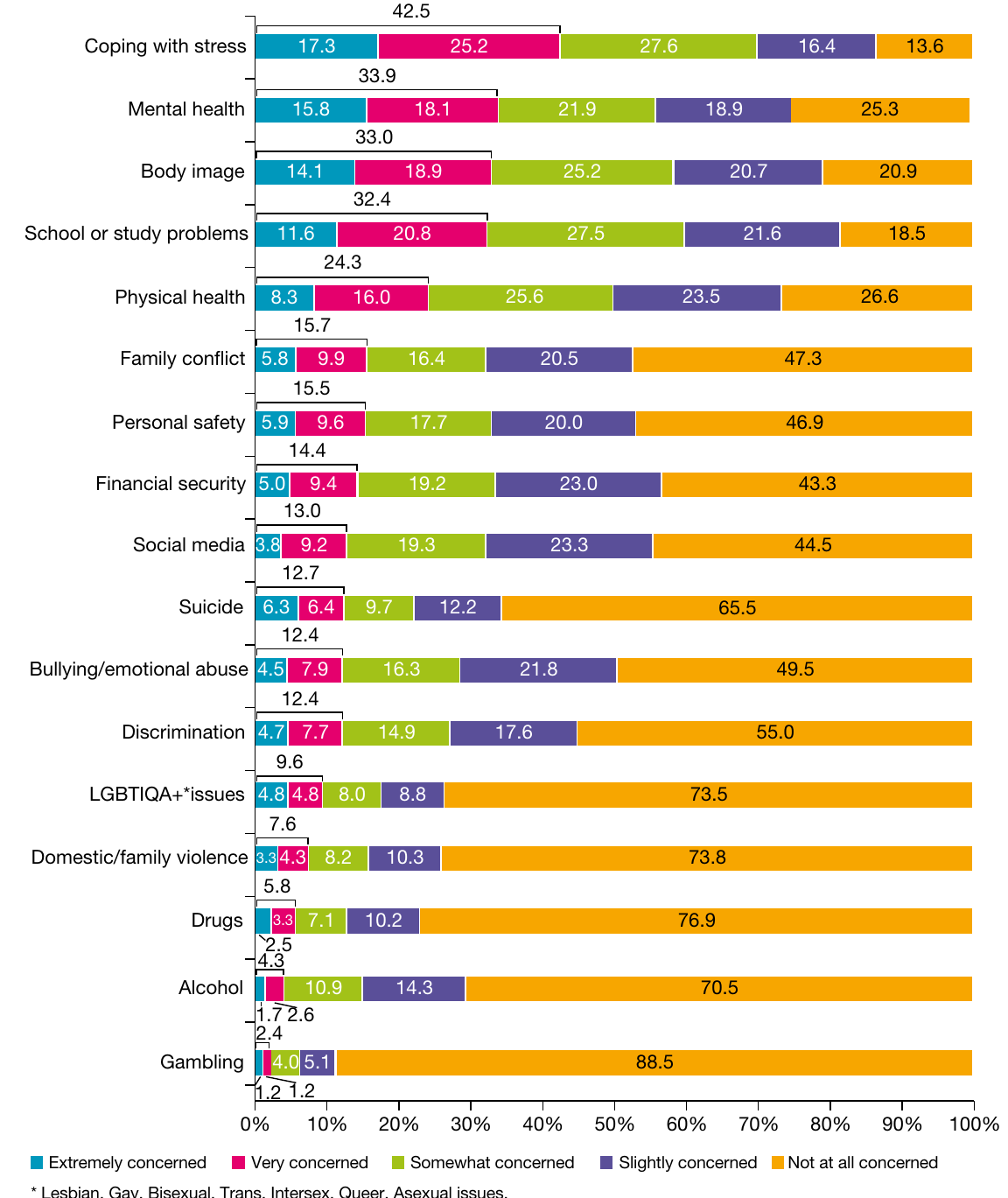
The issues generating greatest concern related predominantly to the mental dimension of health and wellbeing. The top concerns included:
- Coping with stress (42.5% extremely or very concerned)
- Mental health (33.9% extremely or very concerned)
- Body image (33.0% extremely or very concerned)
- School or study problems (32.4% extremely or very concerned)
In contrast, young people showed relatively little concern about substance-related issues. Gambling, alcohol, and drugs ranked among the lowest concerns, with the majority of respondents indicating they were not at all concerned about these issues.
Note
Mental vs. Substance Concerns
This pattern reveals an important insight: today's young people are far more concerned about mental and emotional wellbeing challenges than traditional risk behaviours involving substances. Their worries centre on managing stress, maintaining mental health, and navigating social pressures rather than avoiding drugs or alcohol.
Gender differences in concerns
Significant gender differences exist in how young people experience concerns about various issues. Females consistently report higher levels of concern across most issues compared to males.
Key gender differences
| Issue | Females (extremely/very concerned) | Males (extremely/very concerned) |
|---|---|---|
| Coping with stress | 55.5% | 24.8% |
| Mental health | 43.4% | 20.7% |
| Body image | 45.9% | 15.7% |
| School/study problems | 40.5% | 21.4% |
| Physical health | 27.6% | 19.6% |
| Family conflict | 19.7% | 9.9% |
The data reveals that over half of all females identify coping with stress as a major concern, compared to fewer than one quarter of males. Similarly, females express approximately double the level of concern about mental health and school problems compared to their male peers.
Important
Significant Gender Gap in Mental Health Concerns
The substantial differences between females and males across mental health, stress, and body image concerns highlight the need for gender-responsive approaches to youth wellbeing support. Females report concern levels that are often twice as high as males, indicating they may face particular pressures or be more willing to acknowledge mental health challenges.
For both genders, concerns about substances remain low. The majority of both males and females indicate little to no concern about gambling (over 86% for both groups), drugs (over 76%), or alcohol (over 68%).
Understanding physical versus mental wellbeing in youth
Overall physical health and wellbeing (including fitness, body weight, and absence of illness) tends to be good among young people compared to older age groups. However, mental and emotional health and wellbeing represent the leading causes of concern during youth.
Youth and early adulthood are complex life stages. Young people face numerous pressures relating to study, work, and relationships, which can culminate in high stress levels. Mental and emotional wellbeing during these years largely depends on the quality of social networks, including family, friends, school, work, and other relationships.
Note
The Youth Health Paradox
There's an interesting contrast here: while young people generally enjoy better physical health than older adults, they experience greater challenges with mental and emotional wellbeing. This highlights that health in youth is less about physical illness and more about managing emotional stress, social pressures, and psychological challenges.
Measuring youth wellbeing
What is subjective wellbeing?
Subjective wellbeing refers to how people experience the quality of their lives and includes both how they feel about their lives and what they think about their own personal circumstances. This concept recognises that wellbeing involves personal perceptions and feelings, not just objective measures.
The Personal Wellbeing Index
VicHealth, Victoria's leading health promotion agency, conducted research to measure wellbeing and resilience in young Victorians aged 16-25 years. One thousand young people participated in a telephone survey examining seven key areas:
- Standard of living
- Health
- Safety
- Future security
- Relationships
- Community connections
- Achievement in life
Results were calculated as a Personal Wellbeing Index (PWI) score, which categorises young people into three groups based on their overall wellbeing.
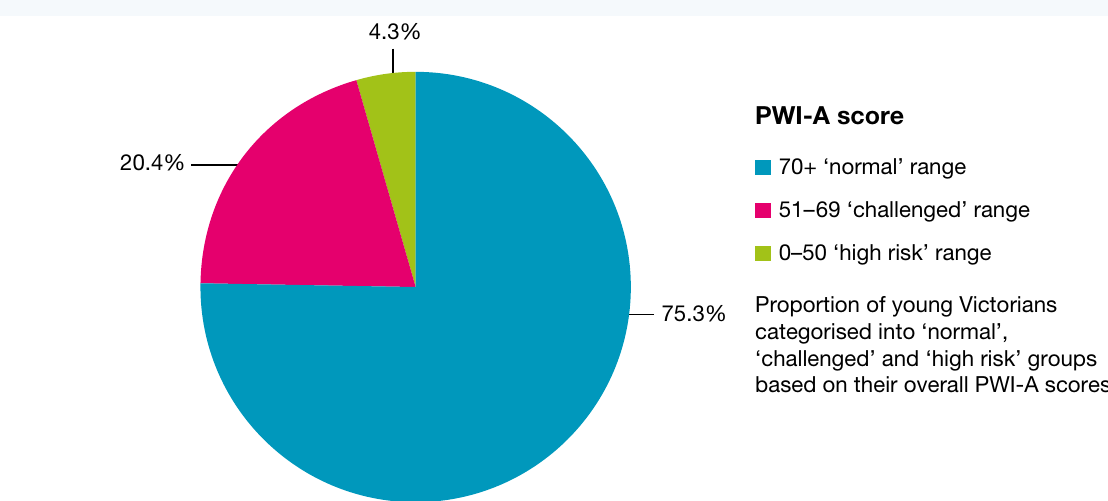
The research found that:
- 75.3% of young Victorians scored in the normal range (70+ score)
- 20.4% scored in the challenged range (51-69 score)
- 4.3% scored in the high risk range (0-50 score)
Note
Understanding PWI Categories
- Normal range (70+): Young people experiencing good overall wellbeing across most areas of life
- Challenged range (51-69): Those facing difficulties in some areas but maintaining basic wellbeing
- High risk range (0-50): Young people experiencing serious wellbeing challenges requiring intervention and support
These results indicate that whilst most young Victorians experience normal levels of wellbeing, approximately one quarter face wellbeing challenges that may require support.
Factors affecting youth wellbeing
Characteristics of above-average wellbeing
Young people with above-average wellbeing scores tend to share certain characteristics:
- Participation in sport and recreation - regular physical activity and recreational engagement
- Access to social support - strong networks of family, friends, and community
- Higher socioeconomic status background - greater financial security and resources
Characteristics of below-average wellbeing
Conversely, young people with below-average Personal Wellbeing Index scores are more likely to:
- Have limited access to social support - fewer strong relationships or community connections
- Be unemployed - lacking work opportunities or stable employment
- Come from lower-income households - experiencing financial stress or insecurity
- Live alone - without the support of family or housemates
Important
Gender Differences in Depression Risk
The research identified that females are 50% more likely than males to be at high risk for depression. This finding aligns with the higher levels of concern females express about mental health, stress, and body image issues. It underscores the need for targeted mental health support and intervention programs that address the specific challenges faced by young women.
Summary
Key Points to Remember:
- Young people prioritise social health and wellbeing, valuing family relationships and friendships above all else
- Perspectives on health evolve from a physical focus in early adolescence to a more holistic understanding in later teenage years
- Mental health concerns (stress, mental health, body image) represent the top issues of concern for young people
- Gender differences are significant, with females expressing much higher levels of concern about mental health, stress, and body image compared to males
- The majority (75.3%) of young Victorians experience normal levels of wellbeing, but nearly one quarter face challenges requiring attention and support
- Social support, sport participation, and socioeconomic factors play crucial roles in determining youth wellbeing outcomes