Key Skills (VCE SSCE Health and Human Development): Revision Notes
📚Revision Notes
Key Skills
Understanding the skill
To master this key skill, you need to be able to analyse how particular global trends affect health and wellbeing. This requires a solid understanding of all five dimensions of health and wellbeing (physical, social, emotional, mental and spiritual) as well as familiarity with the various global trends that impact populations worldwide.
Framework for analysing global trends
When examining how a global trend affects health and wellbeing, use this systematic approach by asking yourself these questions:
Important
Four-Question Framework for Analysis:
-
Which global trend are you examining? The trend could be climate-related (such as rising sea levels or extreme weather events), social (like conflict or mass migration), economic (such as world trade or tourism) or technological (like digital technologies). This information might be presented as a case study, graph, table or quotation.
-
What does this global trend mean or include? Make sure you understand the key features and characteristics of the trend you're analysing.
-
Does this trend have positive impacts on health and wellbeing? Consider how it might benefit each of the five dimensions: physical, social, emotional, mental and spiritual health and wellbeing.
-
Are there any negative influences on health and wellbeing? Think about potential harmful effects the trend might have on different dimensions of health and wellbeing.
Worked example: Digital technologies and mobile phones
Let's apply this framework to a real example using data about mobile phone subscriptions in developing countries.
Example
Worked Example: Analysing Digital Technology Trends
Identifying and understanding the trend
The global trend we're examining is the growth in digital technologies, specifically the increase in mobile phone subscriptions. The data shows how access to this form of digital technology has expanded between 2010 and 2019 in selected low- and middle-income countries.
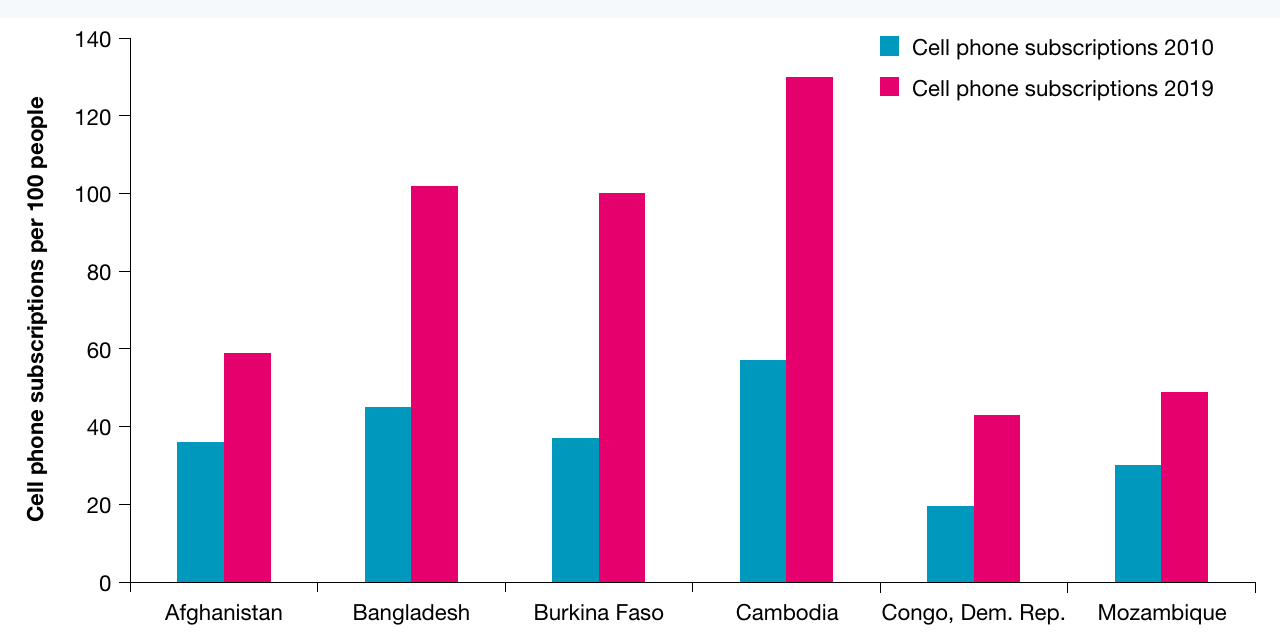
Each country depicted shows substantial growth in mobile phone access over this nine-year period. This expansion has contributed to a world that is becoming increasingly interconnected. People, businesses and governments can now deliver and access services, obtain and share knowledge, conduct transactions, shop, work and interact with each other in ways that weren't possible before.
Note
The development of mobile phone technology has been made possible through the expansion of affordable mobile phone networks. This has made them accessible to everyone, including those living in remote and economically disadvantaged areas of the world. Mobile phone technology has opened communication channels globally, enabling more sophisticated data collection and the sharing of health information.
Positive impacts on health and wellbeing
Mobile phones create numerous opportunities to enhance health and wellbeing across multiple dimensions:
Physical health and wellbeing
Mobile phone technologies enable individuals and families to be more directly involved in their healthcare. People can access self-care and diagnostic information to monitor and improve their health and wellbeing, helping them adopt healthier behaviours. This allows people to take preventative action before health problems develop.
Additionally, mobile phones can be used for disaster preparedness. Countries can transmit SMS messages to issue emergency warnings and provide instructions to help people minimize injuries and deaths during natural disasters or other emergencies.
Social, emotional and mental health and wellbeing
Digital technologies allow births, deaths and marriages to be registered, which is crucial for health and wellbeing. Civil registration contributes to people having access to legal protection, education and basic human rights. When people can exercise their human rights, they experience better social, emotional and mental health and wellbeing.
Mobile phones also help with emergency preparedness, which reduces anxiety and fear during disasters, promoting mental and emotional health and wellbeing.
Spiritual health and wellbeing
When people's human rights are fulfilled through access to civil registration and legal protection, they feel more connected to their communities. This sense of belonging and connection promotes spiritual health and wellbeing.
Supporting healthcare systems
Healthcare workers can use mobile phones to gather population data quickly and efficiently. They can collect information about:
- The number and ages of people in an area
- How many women are accessing healthcare during and after pregnancy
- The number of people suffering from various diseases and their locations
This data promotes good health and wellbeing by providing valuable information that allows governments to implement appropriate programs in the right areas to help people stay healthy.
Negative impacts on health and wellbeing
While digital technologies offer many benefits, they also have potential negative effects that must be considered:
Online safety and privacy concerns
The privacy and safety of children and young people online is a significant concern in most countries, particularly in low- and middle-income countries where children are less protected. Many young people share personal information online with strangers and are exposed to inappropriate content. Others experience cyberbullying, threats or online embarrassment. These experiences can have serious negative impacts on children's emotional and mental health and wellbeing.
Applying the skill: Practice exercise
Let's practice applying this analytical framework to a different global trend:
Example
Practice Exercise: The Syrian Refugee Crisis
Since the Syrian war began in 2011, more than 5.6 million Syrians have fled the country as refugees, and another 6.2 million people are displaced within their own country. Half of the people affected are children.
Consider these questions:
- What is the global trend represented in this information?
- What are the differences between refugees and those who are displaced?
- What are two implications of the Syrian war for health and wellbeing?
When answering, remember to:
- Clearly identify the global trend (conflict and mass migration)
- Explain what refugees and displaced persons are
- Link your implications to specific dimensions of health and wellbeing
- Consider both immediate and long-term effects
Exam tips
Note
Key Strategies for Success:
- Always start by clearly identifying which global trend you're analysing
- Be specific about which dimensions of health and wellbeing are affected
- Support your analysis with evidence from the data or case study provided
- Consider both positive and negative implications
- Use proper terminology related to the five dimensions of health and wellbeing
- Link your points back to real-world impacts on people's lives
Summary
Key Points to Remember:
- To analyse global trends effectively, you must understand all five dimensions of health and wellbeing: physical, social, emotional, mental and spiritual
- Use the four-question framework: identify the trend, explain what it means, explore positive impacts, and consider negative implications
- Global trends can have both beneficial and harmful effects on health and wellbeing, sometimes affecting multiple dimensions simultaneously
- Always link your analysis to specific dimensions of health and wellbeing with clear explanations
- Real-world examples, like mobile phone technology or refugee crises, help demonstrate how global trends create tangible impacts on people's lives