Hospitalisation, Core Activity Limitation, and Psychological Distress (VCE SSCE Health and Human Development): Revision Notes
📚Revision Notes
Hospitalisation, Core Activity Limitation, and Psychological Distress
Introduction
These three health status indicators provide important insights into the health and wellbeing of Australian youth. By examining hospitalisation rates, core activity limitations, and psychological distress levels, we can identify areas where young people may need additional support and understand the health challenges they face.
Note
These indicators are essential for understanding the overall health status of young Australians and help inform healthcare policies and support services targeted at youth populations.
Rate of hospitalisation
Hospitalisation rates give us valuable information about levels of illness requiring medical treatment among young people. Understanding these patterns helps identify the main health concerns affecting youth in Australia.

What is hospitalisation?
Note
Hospital separations are episodes of hospital care that begin with admission and conclude with transfer to another facility, discharge home, or death. These separations provide a standardized way to measure and track healthcare utilization among different population groups.
Hospital separations can occur for two main reasons:
- Chronic conditions: These are diseases or conditions lasting a long time (usually more than six months) that cannot be cured and require ongoing treatment and management. Examples include arthritis and asthma.
- Emergency care: This involves unexpected events requiring urgent medical attention, such as car accidents or sporting injuries.
Overall trends in hospitalisation
Compared to other life stages, youth experience relatively low levels of hospitalisation. The graph below shows how hospitalisation rates vary across different age groups.
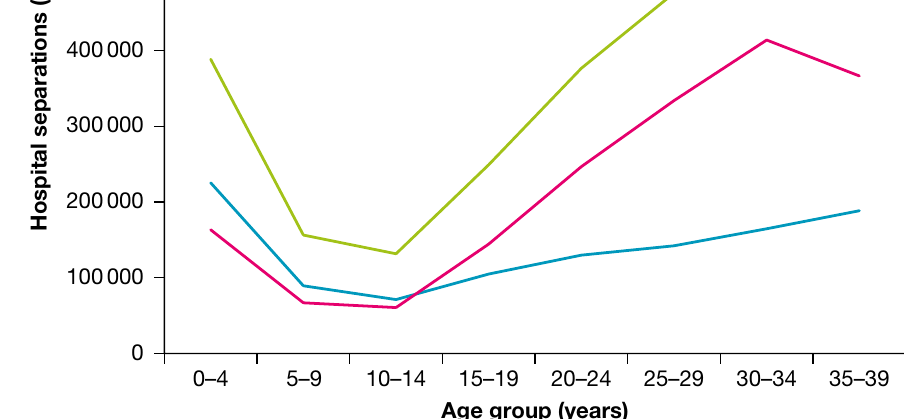
In 2018-19, there were 381,526 hospital separations for young people aged 10-19 years. The majority of these occurred in the older youth age group, with 249,705 separations for those aged 15-19 compared to 131,821 for those aged 10-14.
Gender differences in hospitalisation
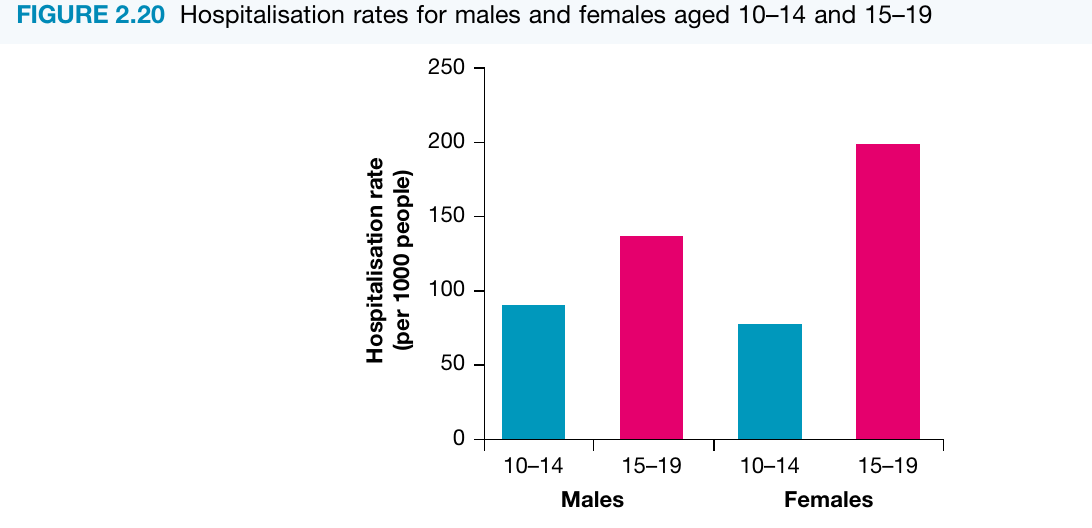
Hospitalisation patterns differ between males and females, and these differences change with age:
Aged 10-14 years:
- Males experience higher hospitalisation rates than females in this age group
Aged 15-19 years:
- Females experience significantly higher hospitalisation rates than males
Important
The higher hospitalisation rate among females aged 15-19 is largely due to:
- Pregnancy and childbirth (over 20,000 hospitalisations each year in this age group)
- Higher rates of mental and behavioural disorders, including eating disorders
Overall, females aged 10-19 were more likely to be hospitalised than males (205,273 and 176,161 separations respectively).
Leading causes of hospitalisation
The five main causes of hospitalisation for young people aged 10-19 are shown below:
1. Injury and poisoning
This is the leading cause of hospitalisation during youth. Several factors contribute to this pattern:
- Increasing independence: Young people have greater access to unsupervised settings such as schools, sporting grounds, streets, and neighbourhoods
- Risk-taking behaviours: These increase during youth, particularly among boys
- Peer influence: The peer group becomes more important, and risk-taking may be motivated by wanting to fit in with friends
- Brain development: The part of the brain controlling decision-making is still developing, leading to a tendency to value short-term gains over long-term consequences
- Greater exposure: Older youth have more access to motorised transport, employment, alcohol, and drugs
Note
The most common forms of injury requiring hospitalisation are fractures and superficial wounds such as cuts and lacerations. These injuries reflect the active lifestyles and increased independence that characterize the youth life stage.
2. Diseases of the digestive system
These were the second most common cause of hospitalisation for 10-19 year-olds. Common examples include:
- Appendicitis: Requires surgical removal of the appendix
- Dental surgery: Including extraction of wisdom teeth, which are more likely to erupt during the later youth stage
3. Diseases of the respiratory system
These were the third most common reason for hospitalisation and include conditions such as:
- Asthma
- Bronchitis
4. Mental and behavioural disorders
These were the fourth most common cause and include:
- Depression
- Anxiety
- Eating disorders
- Drug-induced mental disorders
Important
Mental and behavioural disorders represent a significant health concern for young people, particularly females aged 15-19. These conditions often require ongoing treatment and support beyond initial hospitalisation.
5. Diseases of the musculoskeletal system and connective tissues
These were the fifth most common cause and include:
- Back and disc conditions
- Joint reconstruction surgery
- Treatment for arthritis
- Other muscle, joint, and bone problems
Core activity limitation
Core activity limitation is an important indicator of disability and health challenges that affect daily functioning. Understanding these limitations helps identify young people who may need additional support.
What are core activities?
Core activities relate to three main areas of life that are essential for independent functioning:
| Core activity | Examples relating to the core activity |
|---|---|
| Self-care | - Bathing/showering - Dressing/undressing - Eating/feeding - Going to the toilet - Bladder/bowel control |
| Mobility | - Moving around away from home - Moving around at home - Getting in or out of bed or chair |
| Communication in own language | - Understanding/being understood by strangers, friends or family - Including use of sign language/lip reading |
What is core activity limitation?
Note
Core activity limitation occurs when an individual has difficulty with, or requires assistance to perform, any of the three core activities. This assistance might come from:
- Another person
- Special equipment or aids (such as a wheelchair)
Core activity limitations can result from:
- Injury
- Developmental problems
- Chronic illness

Levels of core activity limitation
People's core activity limitations are classified into four levels based on how much help they need:
- Profound: Always needs help with core activities
- Severe: Doesn't always need help, but requires help at times
- Moderate: Has difficulty with core activities but can manage without constant help
- Mild: Simply requires aids or equipment to undertake the tasks
Important
A person's overall level of core activity limitation is determined by their highest level of limitation across any of the three core activities. This means that if someone has profound limitation in one area but mild in others, they are classified as having profound limitation overall.
Statistics on core activity limitation
The graph below shows the proportion and severity of core activity limitations among young people. Note that the available data covers ages 5-24, which includes some children and young adults, but provides a useful reflection of youth experiences.
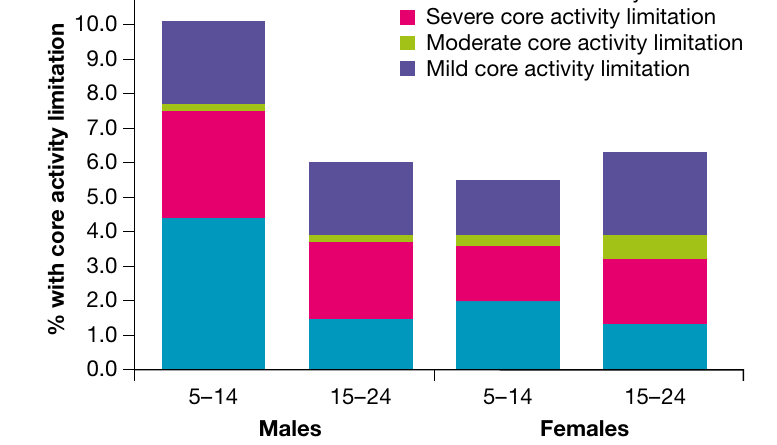
Key findings:
- Males aged 5-14 experience significantly higher rates of core activity limitation than females in the same age group
- Males in this age group also have the highest level of profound limitation
- For those aged 15-24, rates are similar between males and females, with females experiencing slightly higher rates than males
- Males aged 5-14 experience the overall highest rate of core activity limitations
Psychological distress
Psychological distress is an important indicator of mental and emotional health among young people. Measuring distress levels helps identify those who may need mental health support.
What is psychological distress?
Psychological distress refers to unpleasant feelings and emotions that impact an individual's ability to function in daily life. Measuring psychological distress provides important information about the mental and emotional wellbeing experienced by young people.
The Kessler Psychological Distress Scale (K10)
The K10 is a scale used to measure psychological distress based on responses to ten questions about negative emotional and mental states experienced in the four weeks prior to assessment. It classifies psychological distress as low, moderate, high, or very high.
The 10 K10 questions
The scale asks: "During the last 30 days, about how often did you feel..."
- Tired out for no good reason?
- Nervous?
- So nervous that nothing could calm you down?
- Hopeless?
- Restless or fidgety?
- So restless you could not sit still?
- Depressed?
- That everything was an effort?
- So sad that nothing could cheer you up?
- Worthless?
Scoring system
For each question, respondents choose from:
- None of the time (0 points)
- A little of the time (1 point)
- Some of the time (2 points)
- Most of the time (3 points)
- All of the time (4 points)
The overall score ranges from 0 (lowest) to 40 (highest) and is calculated by adding up all question scores.
Example
Worked Example: Calculating a K10 Score
Imagine a young person responds to the 10 questions with the following answers:
- Questions 1-3: "A little of the time" (1 point each) = 3 points
- Questions 4-6: "Some of the time" (2 points each) = 6 points
- Questions 7-8: "None of the time" (0 points each) = 0 points
- Questions 9-10: "A little of the time" (1 point each) = 2 points
Total K10 score: 3 + 6 + 0 + 2 = 11 points
According to the classification table, a score of 11 falls into the moderate distress category (6-11 range).
K10 classifications
| K10 total score | Level of distress |
|---|---|
| 0-5 | Low |
| 6-11 | Moderate |
| 12-19 | High |
| 20-40 | Very high |
Important
Important note: The K10 is not a diagnosis of mental illness, but an indication of distress levels. While high distress is often associated with mental disorders, some people experience psychological distress without meeting criteria for a mental disorder. Only a medical doctor can diagnose a mental disorder.
Psychological distress statistics for youth
According to Australian Bureau of Statistics data, one in five (19.9%) young people aged 11-17 experience very high or high levels of psychological distress.
The distribution is:
- Low distress: 50.9%
- Moderate distress: 29.1%
- High distress: 13.3%
- Very high distress: 6.6%
Gender and age differences
Psychological distress levels vary by gender and age:
| Sex | Age group | Low (%) | Moderate (%) | High (%) | Very high (%) |
|---|---|---|---|---|---|
| Males | 11-15 years | 57.6 | 29.2 | 9.9 | 3.3 |
| 16-17 years | 53.0 | 29.4 | 11.8 | 5.8 | |
| 11-17 years | 56.3 | 29.3 | 10.4 | 4.0 | |
| Females | 11-15 years | 49.8 | 28.9 | 14.7 | 6.6 |
| 16-17 years | 34.8 | 29.0 | 20.3 | 15.9 | |
| 11-17 years | 45.1 | 29.0 | 16.4 | 9.5 | |
| All persons | 11-15 years | 53.9 | 29.1 | 12.2 | 4.8 |
| 16-17 years | 43.6 | 29.2 | 16.2 | 11.0 | |
| 11-17 years | 50.9 | 29.1 | 13.3 | 6.6 |
Key patterns:
- Females experience higher rates of very high and high psychological distress than males in both age groups
- Among females aged 11-15, 9.5% experience very high distress and 16.4% experience high distress
- Among males aged 11-15, 4.0% experience very high distress and 10.4% experience high distress
- Distress levels increase with age for both genders
- Among 16-17 year-olds, 11.0% experience very high distress and 16.2% experience high distress
- Among 11-15 year-olds, 4.8% experience very high distress and 12.2% experience high distress
Note
The data reveals a particularly concerning trend for females aged 16-17, with over one-third (36.2%) experiencing high or very high levels of psychological distress. This represents a significant increase from the 11-15 age group and highlights the need for targeted mental health support during this developmental period.
Remember!
Summary
Key Points to Remember:
-
Hospitalisation rates provide important data about youth health status. Youth generally experience lower hospitalisation rates compared to other life stages, with injury and poisoning being the leading cause.
-
Gender differences in hospitalisation emerge during youth, with females aged 15-19 experiencing higher rates than males due to pregnancy/childbirth and mental health issues.
-
Core activity limitation measures difficulty with three essential activities: self-care, mobility, and communication. These limitations are classified as profound, severe, moderate, or mild based on the level of assistance required.
-
Psychological distress is measured using the K10 scale, which asks 10 questions about emotional and mental states. Nearly one in five youth (19.9%) experience high or very high levels of distress.
-
Age and gender patterns show that psychological distress increases with age during youth, and females consistently experience higher rates of distress than males, particularly in the 16-17 age group.