Self-Assessed Health Status and Life Expectancy (VCE SSCE Health and Human Development): Revision Notes
📚Revision Notes
Self-Assessed Health Status and Life Expectancy
Understanding health status
Health status refers to the overall level of health and wellbeing experienced by an individual or population. It takes into account various aspects including life expectancy, levels of disability, and disease risk factors.
When we talk about health and wellbeing, it's not enough to simply understand the five dimensions (physical, social, emotional, mental, and spiritual). We also need to be able to measure how healthy people actually are. This is where health status comes in - it provides measurable aspects that allow us to make informed judgements about the health of individuals, groups, or entire populations.
Note
The ability to measure health status is crucial because it transforms abstract concepts of health and wellbeing into concrete, comparable data. Without these measurements, it would be impossible to track progress or identify areas needing improvement.
Why do we measure health status?
Measuring health status serves several important purposes:
- It allows governments and organisations to identify areas where health improvements are needed (for example, addressing obesity-related conditions)
- It helps track trends in health over time, showing whether things are getting better or worse
- It provides feedback on health interventions that have already been put in place
- It guides future actions aimed at improving health and wellbeing
Health status indicators
Health indicators are standard statistics used to measure and compare health status. Think of them as different tools in a toolkit - each one tells us something specific about health.
The diagram above shows the main health status indicators. For this topic, we'll focus on two of them: self-assessed health status and life expectancy.
Important
Exam tip: Remember that each health indicator provides specific information. To get a complete picture of health status, we need to examine multiple indicators together.
Self-assessed health status
What is self-assessed health status?
Self-assessed health status is based on how individuals perceive their own health and wellbeing. This makes it a subjective measure - different people might assess the same health situation differently based on their personal views and priorities.
How is it measured?
When measuring self-assessed health status, people are asked to rate their level of health and wellbeing by choosing from five options:
- Excellent
- Very good
- Good
- Fair
- Poor
Note
The subjective nature of this indicator means it can vary significantly between individuals. For example, one person might rate their health as 'excellent' if they are physically fit, even if their mental and emotional wellbeing is poor. Another person might consider all five dimensions of health when making their assessment.
Self-assessed health status of Australian youth

Australian young people generally rate their health status very positively. The data shows some interesting patterns:
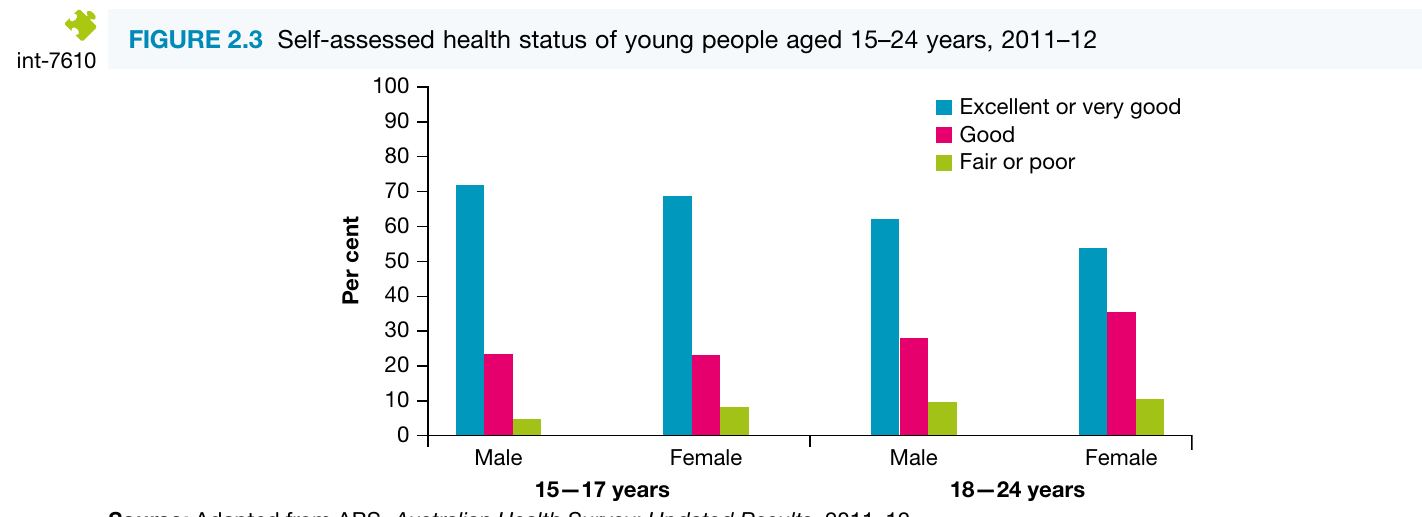
Key findings from the data include:
- The majority of young people in both age groups (15-17 years and 18-24 years) rate their health as 'excellent' or 'very good'
- Youth aged 15-17 years rate their health slightly more positively than those aged 18-24 years
- Both males and females show similar patterns
- Only a small percentage rate their health as 'fair' or 'poor'
Important
Exam tip: When interpreting self-assessed health status data, remember that this is a subjective measure. What one person considers 'good' health might be different from another person's definition.
Life expectancy
What is life expectancy?
Life expectancy is one of the most commonly used methods to measure health status. It indicates how long a person can expect to live if current death rates remain the same. Unless stated otherwise, life expectancy data relates to a person born in the years provided.
Important
Life Expectancy Definition:
Life expectancy is the number of years of life, on average, remaining to an individual at a particular age if death rates do not change. The most commonly used measure is life expectancy at birth.
Historical improvements in life expectancy
Australia has experienced remarkable improvements in life expectancy over the past century. The table below shows how dramatically life expectancy has increased:
| Age | Males 1901-1910 | Males 2017-2019 | Females 1901-1910 | Females 2017-2019 |
|---|---|---|---|---|
| Birth | 55.2 | 80.9 | 58.8 | 85.0 |
| 30 | 66.5 | 81.8 | 69.3 | 85.6 |
| 65 | 76.3 | 85.0 | 77.9 | 87.7 |
| 85 | 87.7 | 91.4 | 89.2 | 92.6 |
Key observations:
- Life expectancy at birth has increased by more than 25 years over the past century
- A child born in 2019 can expect to live to 80.9 years (males) or 85.0 years (females)
- Females consistently have higher life expectancy than males
- Life expectancy continues to improve, while death rates decrease
Life expectancy for Australian youth
The life expectancy for Australian youth reflects the high figures experienced by all age groups in this country:
| Age | Males | Females |
|---|---|---|
| 12 | 81.2 | 85.4 |
| 15 | 81.3 | 85.4 |
| 18 | 81.3 | 85.4 |
| 21 | 81.4 | 85.5 |
| 25 | 81.6 | 85.5 |
Why does life expectancy increase with age?
You might notice that life expectancy increases slightly as people get older. For example, a 12-year-old male has a life expectancy of 81.2 years, while a 25-year-old male has a life expectancy of 81.6 years.
Note
This happens because life expectancy is based on averages. Some individuals sadly do not survive infancy or childhood, which brings down the average for life expectancy at birth. Once a person survives these early stages, the likelihood that they will live longer than the life expectancy at birth increases.
Limitations of life expectancy
While life expectancy is a valuable indicator that reflects overall health status, it has limitations:
- It doesn't provide information about how sick the population is
- It doesn't tell us what the leading causes of death are
- It doesn't reveal what health conditions people are experiencing
For these reasons, other health indicators are needed to make fully informed judgements about health status.
Important
Exam tip: Be prepared to discuss both the strengths and limitations of life expectancy as a health indicator. It's excellent for showing overall health trends but doesn't give the complete picture on its own.
Summary
Key Points to Remember:
- Health status refers to the overall level of health and wellbeing of individuals or populations, measured using various health indicators
- Self-assessed health status is a subjective measure based on how people rate their own health (excellent, very good, good, fair, or poor). Most Australian youth rate their health positively
- Life expectancy is an objective measure showing how long people can expect to live if current death rates stay the same
- Life expectancy in Australia has increased by over 25 years in the past century, demonstrating significant health improvements
- Each health indicator provides specific information - using multiple indicators together gives a more complete picture of health status