Key Skills (VCE SSCE Health and Human Development): Revision Notes
📚Revision Notes
Key Skills
This section covers essential skills you need to master for analyzing youth health and wellbeing. These skills focus on interpreting data, understanding health inequalities, and examining how community values shape health programs for young Australians.
Using research and data to identify social inequality and priority areas
To demonstrate this skill, you need to understand two important concepts and how they relate to young people:
Health inequalities are differences in health status or how health risk and protective factors are distributed among young people. For example, some groups of youth may experience higher rates of mental health conditions or injury than others.
Social inequalities are differences that arise from factors such as access to resources or opportunities, ethnicity, or geographic location. These social factors often create or worsen health inequalities.
Understanding the skill
This skill requires you to identify and discuss differences in health outcomes for young people that stem from social factors. You also need to recognize areas of concern that arise from risk-taking or unhealthy behaviours that are common during youth.
Additionally, you must be able to use information presented in various formats (tables, graphs, or case studies) and combine it with your existing knowledge to draw conclusions about health issues facing Australian youth.
Important
Exam tip: When working with data, take time to understand what the information is telling you. For graphical data, examine the axes, labels, and trends carefully. For written information, always read it twice - it's easy to miss important details on the first reading.
Analyzing body weight as a priority area
Example
Case Study: Body Weight and Obesity in Australian Youth
According to Australia's Health 2020, the following statistics reveal important patterns:
- More than one in four children and young people (26%) aged 5-17 were overweight or obese. Of these, 17% were overweight but not obese, and 8.5% were obese.
- Rates of overweight and obesity are significantly higher in low socioeconomic status (SES) areas.
- Nearly all students (92%) spent two hours or more using electronic media on a school day.
- Most students (89%) spent two hours or more using electronic media on weekends.
- Only 8% of students aged 13-17 years achieved 60 minutes of physical activity per day.
- Almost all students (99%) did not meet the daily recommended intake of four vegetable servings.
- More than half of students (54%) did not meet the daily recommended intake of three fruit servings.
- Fourteen percent of students aged 12-17 drink at least a liter of soft drink weekly.
Note
Drawing conclusions from the data
This data reveals that body weight is a health issue affecting 26% of young Australians - this is a health inequality. The higher rates of overweight and obesity in low SES areas demonstrate a social inequality, as access to resources and opportunities influences health outcomes.
Overweight or obesity occurs when someone consumes more kilojoules (energy) than they need for growth and activity. The excess energy is stored as body fat, leading to weight gain. Over time, this can result in overweight and obesity.
Young people are exposed to several risk factors:
- Low physical activity levels: Only 8% achieve the recommended 60 minutes of daily physical activity
- High screen time: 92% spend more than two hours daily on electronic devices during school days
- High energy intake: 14% consume at least a liter of soft drink weekly, which adds significant kilojoules
- Poor nutrition: Low intake of fruits (54% not meeting recommendations) and vegetables (99% not meeting recommendations) may lead to consuming more energy-dense foods instead
Why this is a priority area
Body weight is a priority area for health action because:
Short-term impacts on youth:
- Psychological distress
- Sleep problems
- Low energy levels
- Impact on self-assessed health status
- Bullying and discrimination affecting mental and social wellbeing
- Reduced self-esteem and confidence
- Limited social contact
Long-term impacts:
- Increased risk of cardiovascular disease in adulthood
- Higher likelihood of developing type 2 diabetes
- Continued social and mental health challenges
Issues of importance to young Australians
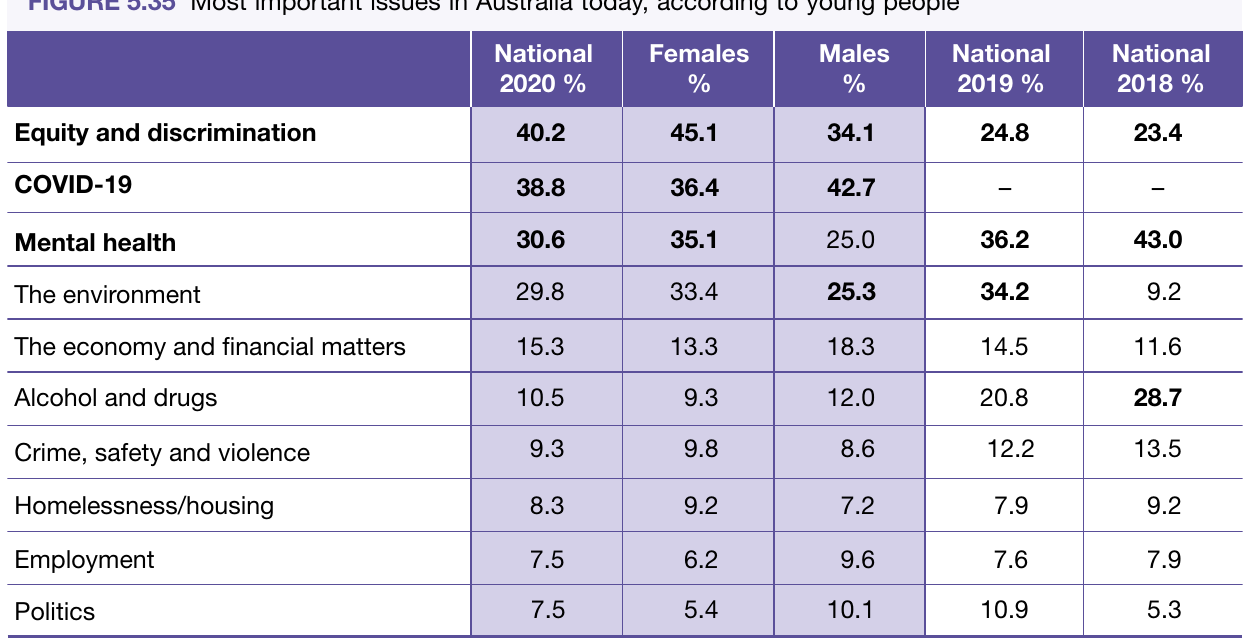
This table shows what young Australians identified as the most important issues in 2020. Notice that equity and discrimination (40.2%) and COVID-19 (38.8%) were the top concerns, followed by mental health (30.6%) and the environment (29.8%).
Note
The data reveals gender differences - females rated equity and discrimination much higher (45.1%) than males (34.1%), while males were more concerned about COVID-19 (42.7%) than females (36.4%).
When comparing trends over time, concerns about equity and discrimination increased significantly from 23.4% in 2018 to 40.2% in 2020, while concerns about mental health decreased from 43% in 2018 to 30.6% in 2020. This information helps identify priority areas that reflect young people's own perspectives on health and wellbeing issues.
Describing and analyzing factors that contribute to health inequalities
This skill requires you to explain why some groups of young people experience different health outcomes compared to others. You need to identify the factors causing these differences and discuss the likely consequences for youth health status.
Important
Remember that your focus must be on youth specifically. When describing a contributing factor, always provide examples relevant to young people's lives and experiences.
Important
Exam tip: When discussing contributing factors to injuries in youth, mention youth-specific factors such as lack of driving experience and the ongoing development of decision-making areas in the brain. These factors make young people more vulnerable on roads than older adults.
Understanding contributing factors
To demonstrate this skill effectively, you need to:
- Explain why young people's health and wellbeing may differ from other age groups
- Explain why different groups of young people within Australia have varying health status
- Identify factors that create these differences
- Predict the likely consequences for youth health status using specific indicators
Example
Worked Example: Factors Contributing to Overweight and Obesity
Weight gain results when kilojoule intake exceeds energy expenditure. When this imbalance continues over time, obesity can develop, increasing associated impacts on illness and death rates.
Contributing factor: Increased screen time and reduced physical activity
Research by the Cancer Council and the National Heart Foundation shows Australian teenagers spend increasing amounts of time using electronic devices including computers, laptops, tablets, video games and television. According to the Australian Institute of Health and Welfare, 92% of Australian youth spent more than two hours using electronic devices for entertainment on school days. Weekend screen time has also increased, with the proportion of teenagers exceeding two hours per day rising from 83% to 89%.
Physical activity is essential for maintaining healthy weight balance. While there has been a small improvement in exercise levels since 2010, over 90% of young Australians still don't achieve the recommended minimum of one hour's physical activity daily.
Environmental factors in the home
Research indicates that over 50% of students have at least three televisions at home, and approximately 40% have one in their bedroom. Many also have video games in their bedrooms. This combination of easy access to sedentary entertainment is one factor contributing to 17% of young people being classified as overweight and 8.5% as obese.
Health status consequences
Short-term consequences for Australian youth include:
- Psychological distress
- Sleep problems
- Low energy levels
- Self-assessed health status rated as only fair or poor
Impact on social and mental wellbeing:
Early obesity influences social and mental health because young people may experience bullying about their weight or face negative stereotypes and discrimination. This can result in higher levels of psychological distress (measurable using the Kessler Psychological Distress Scale).
Long-term consequences include:
- Greater likelihood of developing type 2 diabetes in adulthood
- Increased risk of cardiovascular disease
Important
Exam tip: When predicting consequences of a factor on youth health status, use specific indicators from your studies. For example, injury from road accidents may increase years of life lost to injury or disability, or increase core activity limitation due to reduced mobility from spinal injury.
Health behaviors affecting youth health status
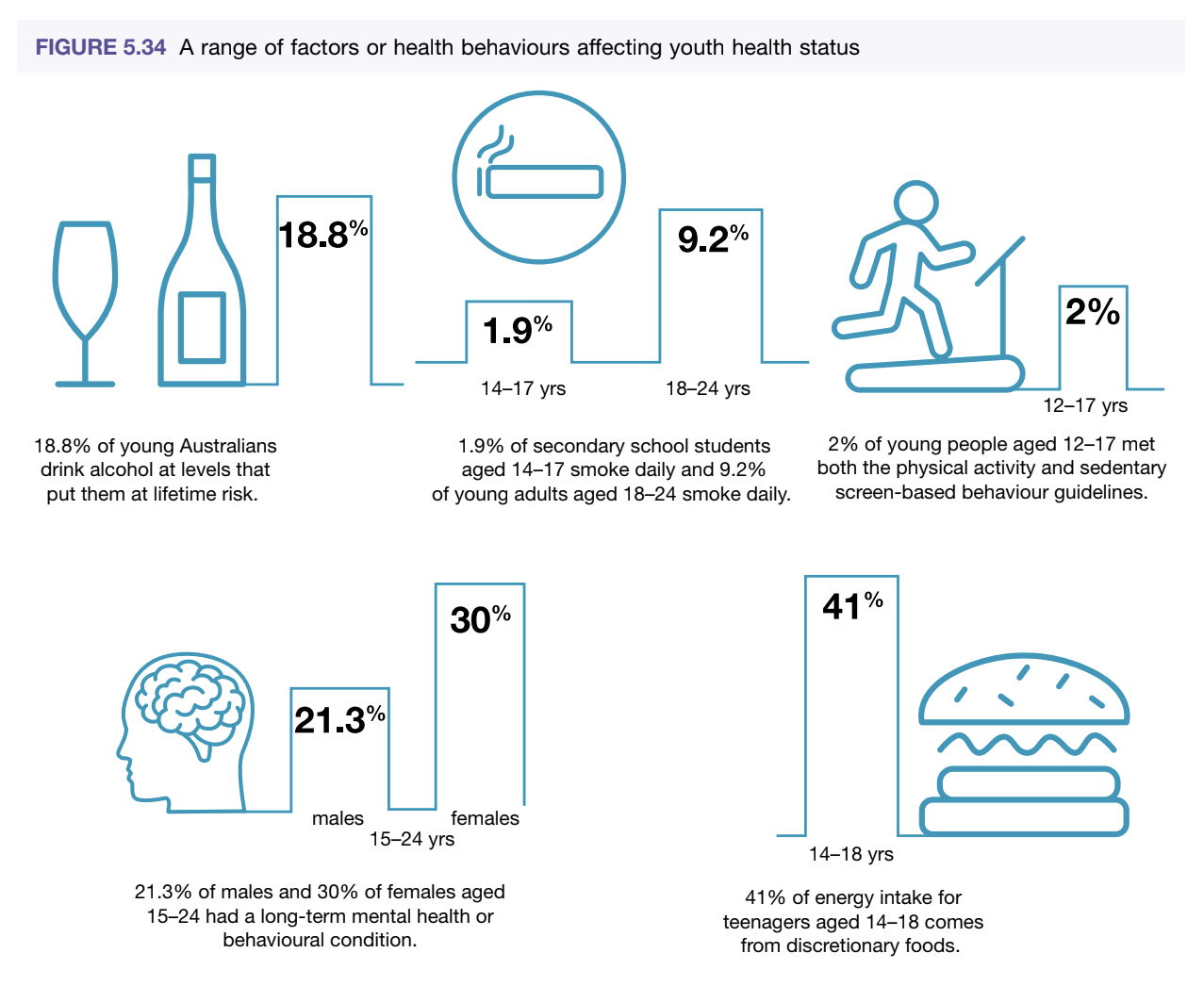
These statistics illustrate various health behaviors that contribute to inequalities in youth health status:
Substance use patterns:
- Smoking rates differ by age: only 1.9% of secondary students aged 14-17 smoke daily, while 9.2% of young adults aged 18-24 smoke daily
- Nearly one in five young Australians (18.8%) drink alcohol at levels that put them at lifetime risk
Physical activity concerns:
- Only 2% of young people aged 12-17 meet both the physical activity guidelines and sedentary screen-based behavior guidelines, highlighting a significant gap in achieving healthy lifestyle recommendations
Mental health disparities:
- Gender differences exist in mental health conditions: 21.3% of males and 30% of females aged 15-24 had a long-term mental health or behavioral condition
- This nearly 9 percentage point difference shows females experience higher rates of mental health concerns during youth
Nutritional concerns:
- Forty-one percent of energy intake for teenagers aged 14-18 comes from discretionary foods (foods high in saturated fat, sugar, salt, or alcohol that are not necessary for health)
- This high proportion of unhealthy food intake contributes to poor nutrition and potential weight issues
Analyzing community values and expectations in health programs
This skill requires you to examine how community beliefs, values, and expectations influence the development and implementation of health promotion programs for young people.
Note
The analysis process
To conduct this analysis effectively, follow these three steps:
- Recognize a youth health and wellbeing concern
- Select a program designed to address this concern
- Describe how the program links to community expectations and values
Understanding community expectations
Communities expect that health programs will:
- Be accessible to young people
- Be appropriate for youth needs and preferences
- Address concerns effectively
- Be delivered in formats young people understand
- Be responsive to changing youth needs
- Take a strength-based approach
- Put young people at the center of health action
- Enhance youth capability to take control of their lives
- Improve health and wellbeing outcomes
Example
Case Study: The Check in App for Mental Health
Identifying the concern:
Mental health is the second highest personal concern for Australian youth. According to the 2020 Mission Australia Youth Survey Report, 15.8% of youth were extremely concerned and 18.1% were very concerned about mental health. This demonstrates a significant area of need in youth wellbeing.
The program:
The Check in app was created to help anyone who wants to check in with a friend but feels concerned about saying the wrong thing or making the situation worse. The app provides practical support through four quick and easy steps:
- Think about where you might check in with your friend
- Consider what you might say
- Plan how you might support them
- Access guidance on things to consider (such as what to do if a friend denies there's a problem)
After having a conversation with a friend, users can return to the app and rate how the interaction went. The app then provides advice on next steps for helping a friend while maintaining your own mental health.
Program aims:
The Check in app aims to reduce worries, anxiety, and distress through social connection. Expected health and wellbeing outcomes include:
- A sense of calm
- Greater capacity to relax and regulate emotions
- A sense of empathy and connectedness
- Improved sleep quality
How the program meets community expectations
The Check in app aligns with community expectations in several important ways:
Accessibility: The app is free and readily available to all young people, removing financial and practical barriers to accessing mental health support.
Appropriateness: The program uses a peer-to-peer approach, recognizing that young people often turn to friends first when experiencing difficulties. This approach respects how youth naturally seek support.
Effectiveness: The app addresses specific concerns related to mental health, anxiety, and social isolation in a format that young people can understand and use comfortably.
Youth-centered approach: The program is responsive and strength-based, putting youth at the center of health action. It empowers young people by giving them practical tools to improve the mental health of their peers, rather than relying solely on adult intervention.
Capability enhancement: By providing guidance and support, the app helps young people develop skills and confidence to support friends, enhancing their capability to take positive action and improve wellbeing in their social networks.
Summary
Key Points to Remember:
-
Health inequalities refer to differences in health status or risk and protective factors among young people, while social inequalities are differences arising from access to resources, ethnicity, or location that create health inequalities.
-
When analyzing data about youth health, always take time to understand what the information shows. Look for patterns, compare different groups, and consider both risk and protective factors.
-
Contributing factors to health inequalities must be youth-specific. Consider how factors like brain development, peer pressure, school environment, and family circumstances uniquely affect young people.
-
When predicting health status consequences, use specific indicators such as years of life lost, core activity limitations, self-assessed health status, or psychological distress levels measured on the Kessler scale.
-
Health programs that meet community expectations are accessible, appropriate, effective, youth-centered, and designed to enhance young people's capability to improve their own health and wellbeing.