Physical Developmental Transitions from Youth to Adulthood (VCE SSCE Health and Human Development): Revision Notes
📚Revision Notes
Physical Developmental Transitions from Youth to Adulthood
Introduction to development
Development describes the changes people experience throughout their entire life, from fertilisation through to death. These changes typically occur as predictable milestones that follow a sequential order. Examples of developmental milestones include going through puberty, learning to walk, and acquiring the skills needed to interact with others.
Development occurs across four interrelated areas, meaning that changes in one area can affect the others. These four areas are physical, intellectual, emotional, and social development.
Note
The Four Areas of Development (PIES):
Remember that these four areas are interconnected - changes in one area can influence development in the others. For example, physical changes during puberty (physical development) can affect confidence and self-image (emotional development), which may influence social interactions (social development).
What is physical development?
Physical development describes the changes that happen to the body and its systems throughout life. These changes can be external and visible (such as increases in height) or internal and invisible (such as the heart growing larger). Physical development encompasses three main components: growth, changes to body systems, and motor skill development.
Growth
Growth refers to the increase in size of organs and systems in the body. This process begins early in the uterus, where the embryo starts developing the cells that will form vital organs and systems needed for life outside the womb. Examples of body systems include the circulatory system, immune system, respiratory system, and nervous system.
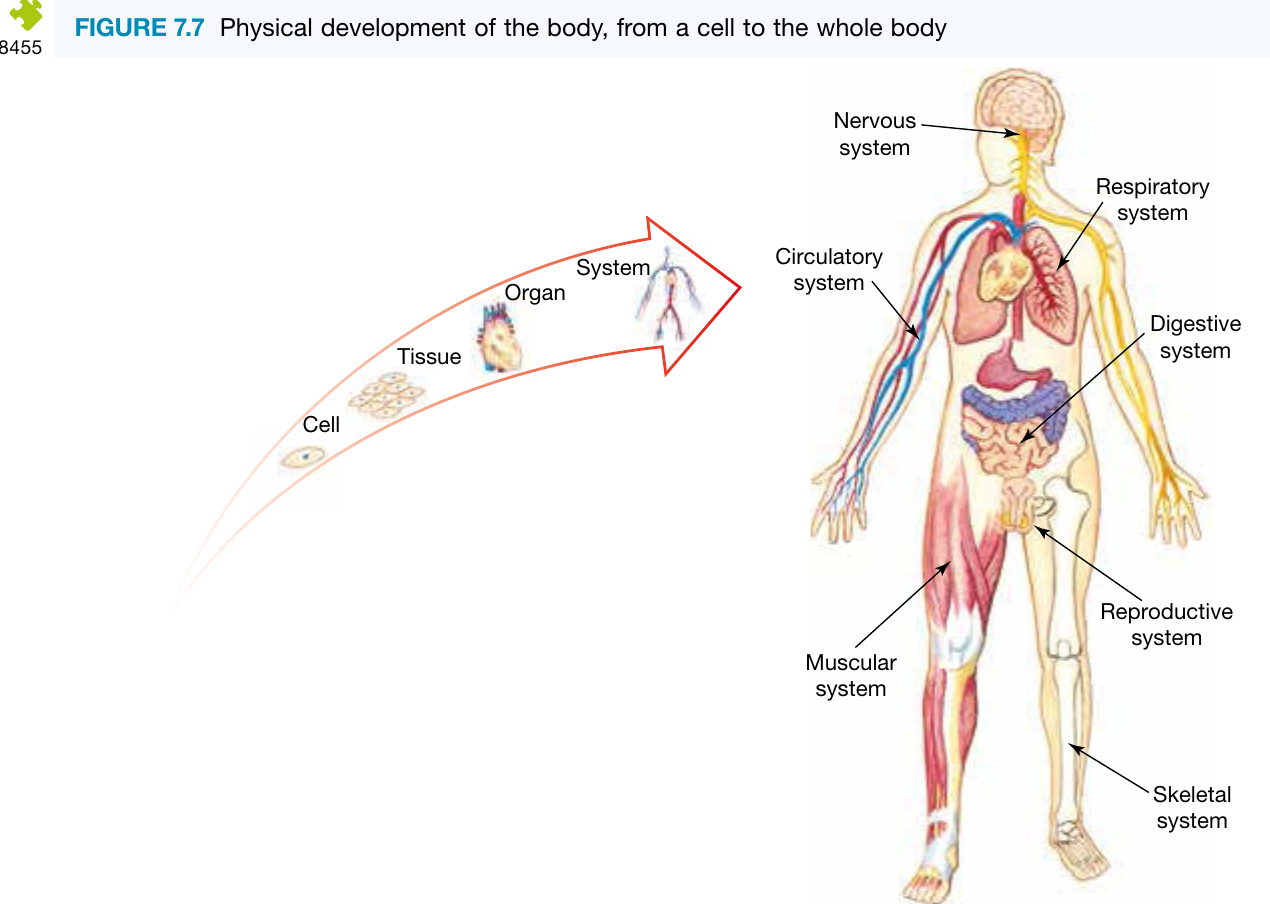
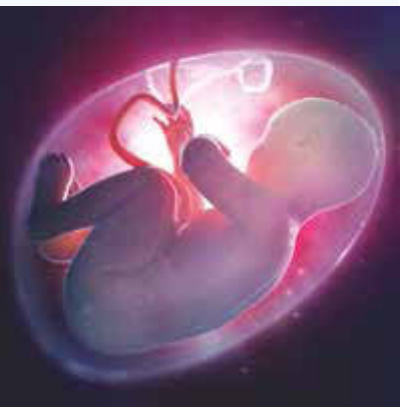
Youth represents one of three rapid growth periods in the human lifespan, alongside the prenatal stage and infancy. During childhood, growth is slow and steady, whilst the three adulthood stages are predominantly characterised by maintenance rather than growth.
Important
Growth vs. Physical Development:
Growth stops at the end of puberty when the epiphyseal plates (cartilage sections at each end of long bones) fuse together. However, physical development continues throughout the entire lifespan. The decline in body systems that people experience in later life stages is also part of physical development - development never stops, even though growth does.
Changes to body systems
Tissues and systems do not just increase in size and mass; they also undergo changes in structure and function. Examples of these changes include:
- Replacement of baby teeth with permanent teeth during childhood
- Hardening (ossification) of bones, which continues until early adulthood
- Changes in how sex organs function during youth
- Development of the immune system, which occurs throughout life
These changes help individuals reach their physical peak, which typically occurs between the early twenties and early thirties. After reaching this peak, most body systems begin to decline at a rate of approximately 0.5 to 2 per cent per year. This decline is a normal part of physical development, though it occurs gradually over a long period, meaning people might not notice the changes until they look back at old photographs.
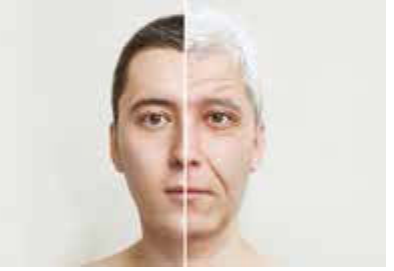
Common changes associated with physical decline include:
- Stiffening of the heart as muscle tissue is replaced by connective tissue
- Thickening of artery walls
- Decrease in aerobic capacity (the maximum amount of oxygen the body can use during exercise), which can decline by up to 70 per cent by age 65
- Gradual loss of bone density
- Decrease in muscular strength
- Decrease in skin elasticity, leading to wrinkles
- Decline in sensory organs, resulting in reduced sight and hearing
Note
Understanding Physical Peak and Decline:
The physical peak in the twenties to thirties represents the point where body systems are functioning at their optimal capacity. The subsequent decline of 0.5-2% per year is gradual and natural, which is why people often don't notice these changes on a day-to-day basis. This is why comparing photographs from different life stages can be quite revealing.
Motor skill development
Motor skills describe the control of muscles in the body. A newborn baby has very underdeveloped motor skills, demonstrated by uncoordinated limb movements. As the infant matures, motor skills develop and movements gradually become more controlled and deliberate.
Motor skills fall into two categories:
Gross motor skills involve the manipulation and coordination of large muscle groups, such as those in the arms and legs. Examples include walking, throwing, skipping, and kicking.
Fine motor skills involve control over smaller muscle groups, such as those in the hands. Examples include writing, tying shoelaces, cutting with scissors, and manipulating the mouth to speak.
Physical changes during the transition from youth to adulthood
The transition from youth to adulthood involves significant physical changes. Young people reach sexual maturity, are recognised as adults legally, finish compulsory education, and gain legal rights to drive, vote, drink alcohol, and make many decisions independently.
The main physical changes characterising this transition include:
- Fusion of epiphyseal plates (growth plates) in bones
- Achievement of sexual maturity
- Changes in body composition and structure
Growth during the transition
The transition to adulthood features significant growth. On average, girls gain approximately 16 centimetres in height and 16 kilograms in weight, whilst boys gain around 20 centimetres in height and 20 kilograms in weight.
By the end of youth or during early adulthood, the epiphyseal plates in long bones fuse together, preventing any further growth in height. These cartilage sections at each end of long bones allow bones to lengthen during earlier life stages. However, bones continue to develop in density and strength for several years after growth in height has stopped, making youth an important time for building strong bones.
Note
Why Bone Health Matters During Youth:
Even though visible growth in height stops when the epiphyseal plates fuse, bones continue developing their density and strength for several more years. This is why maintaining good nutrition, getting adequate calcium and vitamin D, and engaging in weight-bearing exercise during youth is crucial for building strong bones that will last throughout adulthood.
Changes to body systems during the transition
One of the most noticeable changes to body systems during the transition to adulthood involves the reproductive system, including sex organs and their functions. These changes can be classified into two categories: primary and secondary sex characteristics.
Primary sex characteristics are body parts directly involved in reproduction, commonly referred to as genitals or organs of reproduction. Although present at birth, these organs only begin to develop their reproductive functions during puberty.
Secondary sex characteristics are traits that arise from changes during puberty in both males and females. These characteristics are neither directly related to reproduction nor present at birth. By the start of adulthood, these characteristics are usually fully developed.
Important
Understanding the Difference:
Think of primary sex characteristics as "Primary = Procreation" - these are the organs directly involved in making reproduction possible. Secondary sex characteristics are "Secondary = Surface changes" - these are the visible changes to appearance that occur during puberty but aren't directly needed for reproduction (such as facial hair, breast development, voice changes).
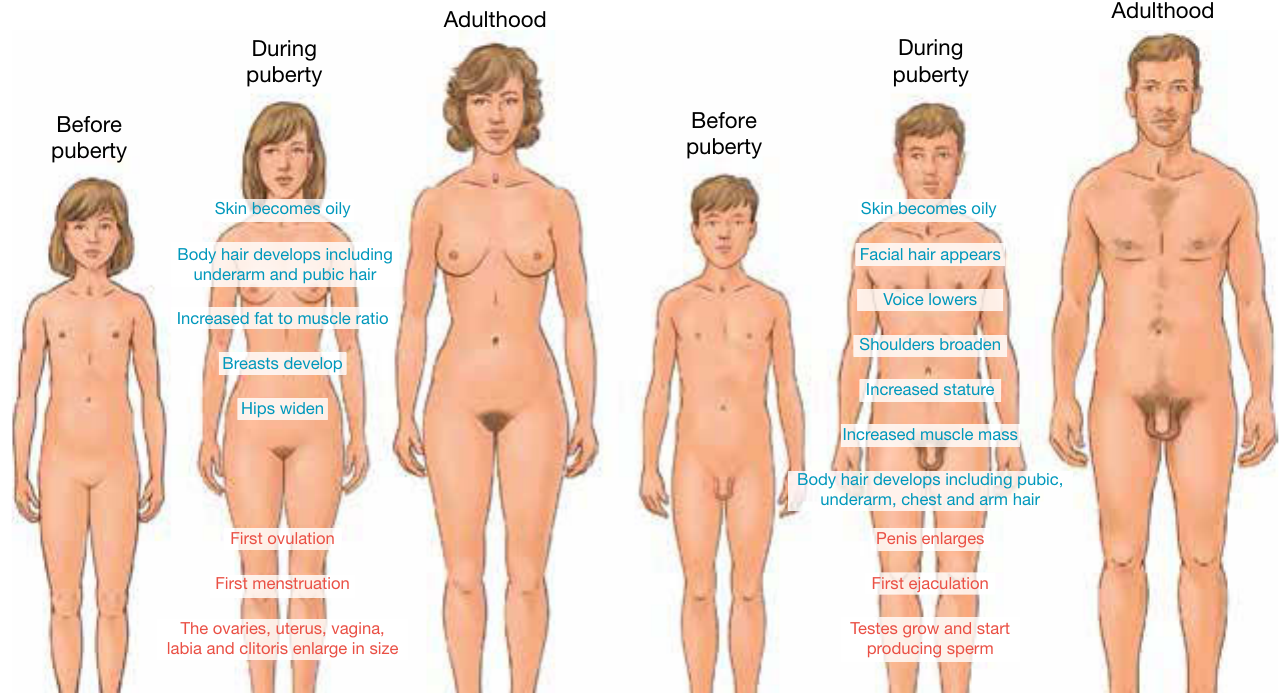
The table below summarises the primary and secondary sex characteristics that develop during the transition from youth to adulthood:
| Characteristic type | Female changes | Male changes |
|---|---|---|
| Primary sex characteristics | Ovaries, uterus, vagina, labia, and clitoris enlarge; First menstruation occurs; First ovulation occurs | Testes grow and start producing sperm; First ejaculation occurs; Penis enlarges |
| Secondary sex characteristics | Hips widen; Breasts develop; Increased fat-to-muscle ratio; Body hair develops (underarm and pubic hair); Skin becomes oily | Increased muscle mass; Increased height; Shoulders broaden; Voice lowers; Facial hair appears; Body hair develops (pubic, underarm, chest, and arm hair); Skin becomes oily |
Beyond changes in height, the transition to adulthood involves significant changes in body composition. In males, increases in muscle mass and broadening of the shoulders relative to the waist create a more triangular body shape. For females, the hips widen and the fat-to-muscle ratio increases. Most fat deposits in the mid-section, including the thighs and hips, resulting in the hourglass figure commonly seen in adult females.
Brain structures also continue to increase in complexity throughout youth and into adulthood. New skills and experiences provide opportunities for different brain structures to develop, impacting brain function and intellectual development.
Motor skill development during the transition
As the body matures during youth, individuals gain greater control over their movements. By the end of puberty, the arms and legs are proportionate to the rest of the body, and coordination generally improves. The extra strength and endurance gained during puberty increase the ability to perform motor skills in adulthood. However, due to differences in muscle mass development, males generally experience greater gains in skills requiring strength.
Reproductive system development
Male reproductive system and sperm production
The male reproductive system consists of internal and external organs responsible for semen production (a substance containing sperm and fluids) and ejaculation (the process of releasing semen from the penis).
The internal reproductive organs include:
- Testes (testicles): Create up to 1,500 sperm each second; sperm mature here for approximately 50 days before release
- Epididymis: Six metres of small tubes coiled behind each testicle where immature sperm spend about two weeks maturing
- Vas deferens: A tube about 30 centimetres long connecting the epididymis to the ejaculatory duct; can store sperm ready for ejaculation
- Seminal vesicles: Produce glucose-rich fluid that mixes with sperm to provide energy
- Prostate gland: A walnut-sized gland producing liquid that mixes with seminal fluid and sperm
- Urethra: A tube in the penis that transports semen out of the body during ejaculation
The external reproductive organs include:
- Penis: The external organ used for sexual intercourse
- Scrotum: A pouch-like sac housing the testicles that assists in temperature control
During puberty, these organs grow and sperm production begins. The onset of sperm production is often marked by spermarche (the first ejaculation), which frequently occurs as a nocturnal emission (commonly called a "wet dream") or through direct stimulation. Sperm are the male sex cells required for reproduction. Once sperm production begins, males are capable of reproduction. Sperm that are not ejaculated eventually die and are reabsorbed by the body.
Note
The Continuous Nature of Sperm Production:
Unlike females who are born with all their egg cells, males continuously produce sperm throughout their reproductive years. The testes can create up to 1,500 sperm per second, and each sperm takes approximately 50 days to fully mature before it's ready for potential fertilisation.
Female reproductive system and menstrual cycle
The menstrual cycle describes the process required to develop an ovum (egg) and signals the ability to reproduce in females. The cycle typically lasts between 24 and 30 days once established.
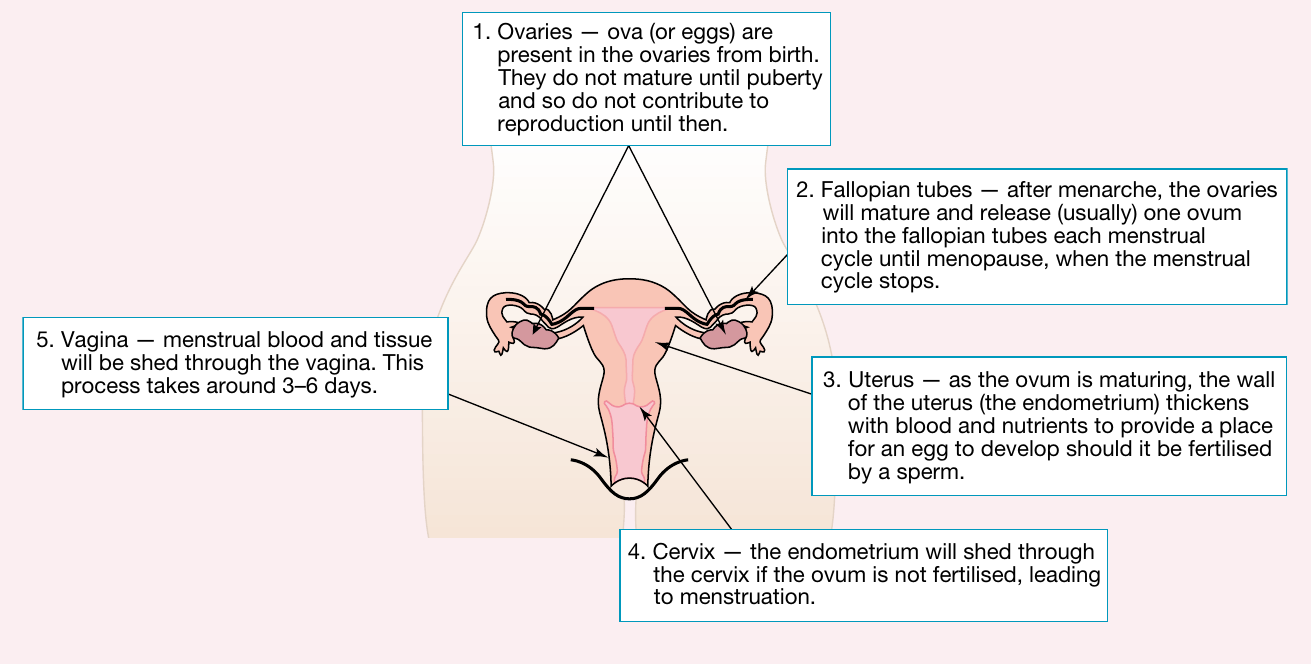
The female reproductive organs include:
- Ovaries: Ova (eggs) are present in the ovaries from birth but do not mature until puberty
- Fallopian tubes: After menarche (the first menstruation), the ovaries mature and release (usually) one ovum into the fallopian tubes each menstrual cycle
- Uterus: As the ovum matures, the uterine wall (endometrium) thickens with blood and nutrients to provide a suitable environment for a fertilised egg to develop
- Cervix: The endometrium sheds through the cervix if the ovum is not fertilised, leading to menstruation
- Vagina: Menstrual blood and tissue are discharged through the vagina over approximately 3-6 days
The first menstrual cycle begins with menarche, which refers to the first menstruation (also called a period) a female experiences. Most girls experience irregular menstrual cycles for the first couple of years after menarche before the cycle becomes more regular and predictable. This process continues until menopause, when menstruation stops.
Note
Understanding the Menstrual Cycle:
The menstrual cycle is a complex process that prepares the body for potential pregnancy each month. If fertilisation doesn't occur, the thickened uterine lining (endometrium) is shed during menstruation. It's normal for cycles to be irregular for the first couple of years after menarche as the body adjusts to this new process. Once established, most cycles settle into a regular pattern of 24-30 days.
Important
Important Exam Guidance:
When discussing developmental changes, remember that whilst these changes are common to most people, there is variation in when they occur and how long they take to complete. Avoid making definite statements such as "by the age of 18, youth have reached sexual maturity," as this may not always be accurate. Instead, use qualifying language such as "by 18, youth will generally have reached sexual maturity" or "most youth reach sexual maturity by 18." This demonstrates understanding that individual variation exists.
Summary
Key Points to Remember:
-
Physical development includes three main components: growth, changes to body systems, and motor skill development, all of which are interrelated with intellectual, emotional, and social development.
-
Growth stops when epiphyseal plates fuse at the end of puberty, but physical development continues throughout life, including the decline of body systems in later stages.
-
The transition from youth to adulthood involves significant physical changes including sexual maturity, fusion of growth plates, and alterations in body composition.
-
Primary sex characteristics are organs directly involved in reproduction that develop during puberty, whilst secondary sex characteristics are visible changes not directly related to reproduction.
-
The male reproductive system begins producing sperm at spermarche, whilst the female reproductive system begins the menstrual cycle at menarche, both signalling reproductive capability.
-
Physical peak occurs in the early twenties to early thirties, after which body systems decline at approximately 0.5-2% per year.
-
Remember the acronym PIES for the four areas of development: Physical, Intellectual, Emotional, and Social.