Culpable Driving Causing Death (VCE SSCE Legal Studies): Revision Notes
📚Revision Notes
Culpable Driving Causing Death
What is culpable driving causing death?
Culpable driving causing death is a serious criminal offence classified as a homicide. This means it involves the unlawful killing of another person. The offence occurs when someone causes another person's death by driving a motor vehicle in a way that is either negligent, reckless, or while impaired by drugs or alcohol.
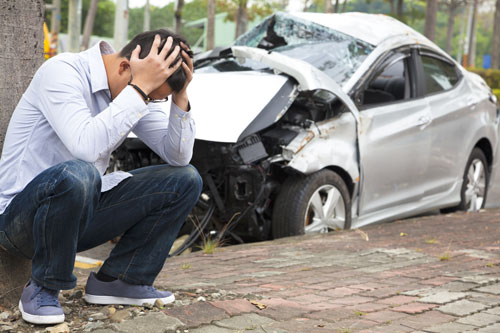
This offence sits at the top of the hierarchy of serious driving offences in Victoria. It is more serious than dangerous driving causing death or dangerous driving causing serious injury. The law recognises the gravity of this offence by classifying it as a category 2 offence under Victorian legislation.
Important
Category 2 classification carries significant consequences: any offender over 18 years old must receive a prison sentence, unless they have impaired mental functioning or provided substantial assistance to police during their investigation.
The legislative framework for this offence is found in section 318 of the Crimes Act 1958 (Vic). The maximum penalty reflects the seriousness of the crime: 20 years' imprisonment and/or a fine of 2400 penalty units (approximately $460,000).
Note
Key point for exams: When discussing culpable driving causing death, always emphasise that it is a homicide offence. This distinguishes it from lesser driving offences and explains why the penalties are so severe. You should also be able to explain how it differs from dangerous driving causing death - culpable driving involves a higher level of fault (negligence, recklessness, or intoxication).
Elements of culpable driving causing death
For the prosecution to successfully prove culpable driving causing death, they must establish three distinct elements beyond reasonable doubt. Each element must be proven independently, and if any element cannot be established, the accused cannot be convicted of this offence (though they may potentially be convicted of a lesser offence).
Element 1: The accused was the driver of a motor vehicle
The first element requires proof that the accused had substantial control over the movement and direction of the motor vehicle at the relevant time. This might seem straightforward, but it can become a contentious issue in certain circumstances.
The concept of "driving" is broader than simply sitting in the driver's seat with the engine running. Courts have had to consider situations where the vehicle wasn't moving, where it was being towed, or where mechanical failures occurred. The key question is whether the accused exercised substantial control over the vehicle's movement and direction.
A motor vehicle is defined as a motorised vehicle designed to be driven on a highway. This includes cars, trucks, buses, and motorbikes. However, certain vehicles are explicitly excluded from this definition:
- Railway and tramway vehicles
- Motorised wheelchairs that cannot exceed 10 kilometres per hour and are used by injured or disabled persons
Note
Exam tip: If a question presents a scenario where it's unclear who was driving (for example, after an accident where both occupants were ejected from the vehicle), recognise this as a potential defence strategy. The accused might argue that the prosecution cannot prove this element beyond reasonable doubt.
Element 2: The accused's driving was culpable
The second element focuses on the manner of driving. "Culpability" refers to being responsible for a wrongful action. For driving to be considered culpable, it must fall into one of three categories:
Negligent driving involves operating a vehicle in a way that falls significantly below the standard of care that a reasonable person would observe in similar circumstances. This isn't about minor mistakes or momentary lapses - it must represent a substantial departure from acceptable driving standards. A practical example is driving while so severely fatigued that the driver should have known they risked falling asleep at the wheel. The law expects drivers to recognise when they are too tired to drive safely, and failure to do so can constitute negligence.
Reckless driving represents a more serious form of culpable driving. It occurs when a driver consciously disregards a substantial risk that their actions could cause death or serious injury to another person. The driver is aware of the danger but proceeds anyway without justification. An example would be deliberately driving at excessive speeds in hazardous weather conditions. The distinguishing feature of recklessness is the driver's awareness of the risk they are creating.
Driving under the influence of alcohol or drugs means operating a vehicle while intoxicated to such a degree that the driver cannot properly control the vehicle. The level of intoxication must be sufficient to impair the driver's ability to maintain proper control - not merely being over the legal blood alcohol limit, but being so affected that safe vehicle operation becomes impossible.
Important
Important distinction for exams: When analysing a scenario involving drugs or alcohol, note that the prosecution only needs to prove the driver was too intoxicated to control the vehicle properly. They do not need to prove the driver was aware of the risks their driving created, unlike cases involving negligence or recklessness.
Element 3: The accused's culpable driving caused the death of another person
The final element requires establishing a causal link between the culpable driving and the victim's death. However, the law recognises that causation can be complex, particularly in motor vehicle accidents where multiple factors might contribute to a fatality.
The prosecution must prove that the accused's culpable driving contributed significantly to the death. Importantly, it doesn't need to be the only cause - other factors can be present. However, the exact requirements for proving causation vary depending on the type of culpable driving involved:
For negligent or reckless driving, the prosecution must demonstrate that the accused realised death or serious bodily harm could result from their driving, and that it was their disregard of this risk that caused the victim's death. This creates a higher burden of proof because it requires evidence of the accused's state of mind.
For driving under the influence, the requirements are less stringent. The prosecution need only prove the accused was so intoxicated they couldn't properly control the vehicle - not that they realised the risks. This reflects the law's recognition that intoxication itself impairs a person's ability to assess risk.
Important
One important legal point: under Victorian law, an unborn child is not considered a "person" for the purposes of this offence. Therefore, causing the death of an unborn child through culpable driving cannot result in a conviction under this section.
Example
Worked Example: DPP v Huby [2018]
Background: A 24-year-old father was driving his four-year-old daughter when he fell asleep at the wheel after three nights of minimal sleep due to caring for his other daughter who suffered from night terrors. His vehicle collided with a tree, killing his daughter. He had a small amount of methamphetamine in his system, but both prosecution and defence agreed the accident resulted solely from fatigue.
Charge: The driver pleaded guilty to culpable driving causing death.
Key consideration: Judge Gaynor noted the circumstances were closer to dangerous driving causing death but proceeded with the culpable driving charge.
Outcome:
- Five years' imprisonment with a 12-month non-parole period
- Driver licence cancelled for two and a half years
- Without the guilty plea, the sentence would have been seven years with a five-year non-parole period
Defences to culpable driving causing death
When facing a charge of culpable driving causing death, an accused person has several potential defensive strategies available. These can be broadly divided into two categories: challenging whether the prosecution has proven the elements of the offence, and raising general defences that may excuse the conduct.
Challenging the elements of the offence
The most straightforward defensive approach involves arguing that the prosecution has failed to prove one or more of the three essential elements beyond reasonable doubt. This isn't technically a "defence" in the legal sense - rather, it's the accused exercising their right to require the prosecution to meet their burden of proof.
The accused was not the driver: In some circumstances, particularly after high-speed collisions where vehicles have rolled or where both occupants were ejected, it may be genuinely unclear who was driving. If the prosecution cannot establish beyond reasonable doubt that the accused was the driver, this element fails. Consider a scenario where two people were in a vehicle that crashed at high speed, both were thrown from the car, one died, and the survivor claims not to remember who was driving. Even if expert evidence suggests a 75% probability the accused was driving based on which side they were ejected from, this may not meet the standard of "beyond reasonable doubt" - particularly if other evidence (such as text messages) contradicts this conclusion.
The driving was not culpable: An accused might argue that while they were driving and a death occurred, their driving wasn't negligent, reckless, or impaired by substances. This defence might succeed if the death resulted from:
- Unexpected and unforeseeable mechanical failure
- Unavoidable environmental conditions
- Actions of another driver or pedestrian that couldn't reasonably have been anticipated
Example
Worked Example: Navarre collision (May 2018)
Background: A 64-year-old woman was charged with four counts of culpable driving causing death after failing to brake at an intersection, causing a collision at approximately 88 km/h in an 80 km/h zone that killed four women aged 64-74. The accused claimed she thought she had applied her brakes but must have inadvertently accelerated.
Defence argument: She was not sufficiently negligent to meet the standard for culpable driving - she wasn't fatigued, intoxicated, or distracted by a phone, and was of exemplary character and genuinely remorseful.
Verdict: The jury found her not guilty of culpable driving causing death but couldn't reach a verdict on dangerous driving causing death.
Final outcome:
- Pleaded guilty to four counts of dangerous driving causing death
- Received a four-year community correction order with 500 hours of community service
- Avoided imprisonment due to the exceptional circumstances
- Licence cancelled for eight years
General defences
Beyond challenging the elements, an accused can raise general defences that acknowledge the elements exist but argue the accused lacked criminal responsibility:
Duress applies when the accused was forced to drive in a culpable manner by threats of death or serious injury. For example, if someone with a gun forced the driver to speed away from a scene, and in doing so the driver killed a pedestrian, duress might be available as a defence. The threat must be immediate and so serious that a person of reasonable firmness would have been unable to resist it.
Sudden and extraordinary emergency may apply where the accused was responding to an unexpected crisis that required immediate action, and their response, while technically culpable, was reasonable in the circumstances.
Automatism involves a complete loss of voluntary control due to an external factor. This is distinct from intoxication or falling asleep - it might involve, for example, an unexpected medical event like a seizure or being rendered unconscious by a collision or attack.
Note
Exam technique: When analysing a problem question, always work through the elements systematically before considering defences. A common error is to jump straight to discussing defences without first establishing whether all elements of the offence are present. Remember: if an element is missing, the prosecution's case fails without needing to consider defences.
Sanctions and sentencing
Understanding the sentencing framework for culpable driving causing death is essential for appreciating how the legal system responds to this serious offence. The sentencing process involves balancing multiple considerations, reflecting both the gravity of the offence and the individual circumstances of each case.
Maximum penalty and standard sentence
The maximum penalty for culpable driving causing death is 20 years' imprisonment and/or a fine of 2400 penalty units (approximately $460,000). This maximum sets the upper boundary but is typically reserved for the most serious instances of the offence.
More significantly, Victoria has established a standard sentence of 8 years' imprisonment for culpable driving causing death. Standard sentences exist for 13 serious indictable offences and serve as a reference point for judges. The standard sentence represents what should be imposed for "middle of the range of seriousness" offending before considering other sentencing factors. This provides consistency in sentencing while allowing judges flexibility to adjust based on individual circumstances.
Important
Because culpable driving causing death is a category 2 offence, imprisonment is mandatory for offenders over 18 years old. The only exceptions are cases involving impaired mental functioning or where the offender has provided substantial assistance to authorities during the investigation.
Factors influencing sentence length
Judges must consider numerous factors when determining the appropriate sentence. These can either increase or decrease the severity of the sentence relative to the standard sentence:
Nature and gravity of the offence: This examines how the offence was committed. Factors that increase seriousness include:
- Extreme recklessness (such as driving at grossly excessive speeds)
- High levels of intoxication
- Clear disregard for obvious dangers (poor weather, heavy traffic, multiple warnings not to drive)
- Deliberate risk-taking behaviour
Conversely, cases at the lower end of culpability might involve factors like momentary lapses in an otherwise careful driver with no aggravating features.
Offender's conduct after the offence: How the offender behaved following the collision significantly impacts sentencing:
- Fleeing the scene without offering assistance aggravates the offence
- Failing to call emergency services demonstrates callousness
- Conversely, immediately calling an ambulance, staying at the scene, cooperating with police, and demonstrating genuine remorse all work in the offender's favour
Impact on victims: The court considers the broader impact of the death on the victim's family and friends. Victims may file a victim impact statement detailing the injury, loss, or damage suffered. These statements can be read aloud in court by the victim or their representative. While the law recognises that every death is tragic, victim impact statements provide judges with insight into the specific consequences of the offending, including emotional trauma, financial hardship, and disruption to family life.
Note
Offender's personal circumstances: The court examines the offender's background, including:
- Mental health issues
- Personal history and upbringing
- Prior good character or previous convictions
- Likelihood of rehabilitation
- Impact of imprisonment on the offender's family
Guilty plea: When an offender pleads guilty, the judge must impose a less severe sentence than would otherwise apply. The timing of the guilty plea matters significantly - the earlier the plea, the greater the reduction in sentence. This reflects several considerations: it spares victims from the trauma of a trial, saves court resources, and demonstrates acceptance of responsibility.
Example
Worked Example: DPP v Hennessy [2022]
Background: A 32-year-old man drove at approximately 134 km/h (in an 80 km/h zone) in the wrong direction on a main highway while drug-affected and without a valid licence, striking and killing a 16-year-old pedestrian on his birthday. The victim was walking with his girlfriend on the footpath.
Charges: Pleaded guilty to culpable driving causing death and seven other charges.
Aggravating factors:
- History of drug addiction and homelessness
- Previous criminal offending, including five licence suspensions
- Absence of evidence of remorse beyond the guilty plea
- Devastating impact on the victim's family and friends
Sentence:
- 15 years' imprisonment (11-year non-parole period)
- Without the guilty plea: would have been 17 years and six months (13.5-year non-parole period)
- This demonstrates the significant reduction earned through the early guilty plea
Community correction orders
While imprisonment is mandatory for category 2 offences, in exceptional cases involving dangerous driving causing death (a lesser offence), courts may impose a community correction order (CCO). This is a flexible, non-custodial sanction served in the community with various conditions attached, such as unpaid community service, treatment programs, or supervision. The Navarre case (discussed earlier) provides an example where exceptional circumstances led to a CCO rather than imprisonment.
Trends and statistics
Understanding statistical trends in culpable driving causing death helps contextualise the offence within the broader criminal justice system and reveals patterns that inform policy responses.
Victorian statistics
The number of people sentenced for culpable driving causing death in Victoria fluctuates annually without showing a clear upward or downward trend:
| Year | Number sentenced (Victoria) |
|---|---|
| 2017-2018 | 14 |
| 2018-2019 | 19 |
| 2019-2020 | 12 |
| 2020-2021 | 15 |
| 2021-2022 | 13 |
Important
Over the five-year period from 2017-2018 to 2021-2022, all 73 offenders (100%) received immediate custodial sentences, reflecting the mandatory imprisonment requirement for this category 2 offence. The average imprisonment length in 2021-2022 was seven years and ten months, slightly higher than the 2019-2020 average of seven years and nine months.
Demographic patterns from July 2016 to June 2021 reveal:
- Approximately 87% of offenders were male
- Approximately 37% were under 25 years old
- 56% were aged between 25 and 54 years
- Approximately 7% were aged 55 or older
The broader category of "driving causing death" offences (including both culpable and dangerous driving causing death) shows variation across recent years:
| Year | Recorded offences (Victoria) | Rate per 100,000 population |
|---|---|---|
| 2018 | 98 | 1.5 |
| 2019 | 82 | 1.3 |
| 2020 | 102 | 1.5 |
| 2021 | 80 | 1.2 |
| 2022 | 83 | 1.3 |
Note
Despite various road safety campaigns designed to reduce fatal collisions, the rate per 100,000 population has not fallen below 1.0 since 2013. The Victorian Government has identified several contributing factors: excessive speed, driving under the influence of alcohol or drugs, fatigue, and distraction (particularly from mobile phones).
Northern Territory comparison
Comparing Victorian statistics with other Australian jurisdictions presents challenges due to differences in how offences are defined, classified, and recorded. The Northern Territory provides an instructive comparison, though the data must be interpreted carefully.
Northern Territory crime statistics use different categorisations than Victoria. "Driving causing death" offences in NT statistics only capture "hit and run" incidents (where the driver fails to stop after causing a death), while other traffic-related deaths fall under "dangerous or negligent acts endangering persons." This definitional difference likely understates NT driving causing death offences compared to Victorian figures, which include both culpable and dangerous driving causing death.
Important
Despite these definitional challenges, the Northern Territory has Australia's highest road fatality rate. In 2022, 52 people died in road accidents in the NT, representing approximately 20.7 deaths per 100,000 population - significantly higher than Victoria (3.6) and the national average (4.5).
| Year | Recorded offences (NT) | Rate per 100,000 population |
|---|---|---|
| 2019 | 5 | 2.0 |
| 2020 | 1 | 0.4 |
| 2021 | 1 | 0.4 |
| 2022 | 7 | 2.8 |
| 2023 | 8 | 3.2 |
The NT rate has generally trended upward from 2019 to 2023, and is approximately three times higher than Victoria's rate. Several factors contribute to these high rates:
- Large proportion of the population living in remote areas requiring long-distance travel
- Poorly maintained roads in remote regions
- Very high or no speed limits on some roads (parts of Stuart Highway have no limit; others have 130 km/h maximum)
- High rates of drivers/passengers not wearing seatbelts (30% of 2022 road deaths involved at least one person not wearing a seatbelt)
- Driving while distracted by mobile phones
- Driving under the influence of drugs or alcohol
- Driver fatigue from long-distance travel
Note
Exam tip: When comparing jurisdictions, always note any definitional differences that might affect the validity of comparisons. Demonstrate critical thinking by acknowledging limitations in the data while still drawing reasonable conclusions about overall trends.
Impact of culpable driving causing death
Culpable driving causing death creates far-reaching consequences that extend well beyond the immediate parties involved. Understanding these impacts is crucial for appreciating why society treats this offence so seriously.
Impact on victims and their families
The most profound impact is, of course, the loss of life itself. Unlike property crimes or even many violent offences, homicide is irreversible and absolute. The victim's family and friends must cope with sudden, traumatic grief. This creates a cascade of consequences:
Emotional and psychological impacts include trauma, grief, complicated bereavement, and ongoing psychological conditions such as depression, anxiety, or post-traumatic stress disorder. Family members often require long-term counselling and mental health support.
Practical and financial consequences are substantial. Families face:
- Funeral costs
- Loss of household income if the deceased was a wage earner
- Loss of labour within the household
- Permanent disruption to family life, particularly where children lose parents or parents lose children
Loss of trust in community values and the safety of public roads can also result, creating broader anxiety about road use.
Impact on the community
Society bears significant costs from culpable driving causing death offences:
Note
Healthcare and emergency services include the cost of publicly funded medical treatment for injured parties, coronial services to investigate the death, and increased need for police, fire, and emergency services. Emergency services workers responding to fatal collisions often experience trauma themselves, requiring ongoing support services.
Economic impacts include:
- Increased insurance premiums for all motorists (as insurers spread the cost of fatal accidents across their customer base)
- Loss of workplace productivity
- Costs associated with damaged community property
Social impacts involve:
- Reduced trust in law and order
- Challenges to community values around road safety and personal responsibility
Impact on offenders
While society rightly focuses primarily on victims, understanding the impact on offenders is important for a complete picture:
Immediate consequences include medical treatment costs if the offender was injured, legal costs (which can be substantial), and the likelihood of a custodial sentence given the category 2 classification.
Personal impacts include:
- Guilt and shame associated with causing a death
- Psychological trauma
- Destruction of their previous life
- Family suffering through association - experiencing social stigma, financial hardship (particularly if the offender was a wage earner), and stress on their health and wellbeing
Practical consequences include:
- Loss of labour and income in the household
- Damage to or impounding of their vehicle
- Long-term licence cancellation making employment and normal life difficult post-release
Example
Real-world Impact: DPP v Huby
The DPP v Huby case illustrates these compounding impacts: the offender had killed his own daughter, experienced severe post-traumatic stress disorder and anxiety, and became the target of "extraordinarily cruel" abuse from the community after media coverage, both in person and via social media. While serving a custodial sentence for his offending, he was also coping with profound personal grief and mental health challenges.
Note
Exam technique: When asked to discuss impacts, use a structured approach covering all three categories (victim/family, community, offender). While it's appropriate to emphasise victim impacts most heavily, demonstrating awareness of the broader social and economic costs shows sophisticated understanding. Avoid being judgmental about impacts on offenders - analysis should be objective while acknowledging that offenders are appropriately punished through the criminal justice system.
Summary
Remember!
Key points:
- Culpable driving causing death is a homicide offence requiring proof of three elements: the accused was the driver of a motor vehicle, their driving was culpable (negligent, reckless, or under the influence), and their culpable driving caused death
- As a category 2 offence, imprisonment is mandatory for offenders over 18 (except in cases of impaired mental functioning or substantial assistance to police)
- The maximum penalty is 20 years' imprisonment and/or $460,000 fine; the standard sentence is 8 years' imprisonment
- Defences include challenging whether the prosecution has proven the elements beyond reasonable doubt, or raising general defences such as duress, sudden emergency, or automatism
- Sentencing considers multiple factors including the nature and gravity of the offence, the offender's conduct afterwards, victim impact, the offender's personal circumstances, and whether they pleaded guilty
Key terms:
- Culpable driving causing death - causing death by driving negligently, recklessly, or while under the influence of drugs/alcohol
- Negligent driving - driving that fails to an unacceptable degree to meet the standard a reasonable person would observe
- Reckless driving - consciously and unjustifiably disregarding a substantial risk of death or serious injury
- Standard sentence - the sentence for "middle of the range" offending before considering other factors (8 years for this offence)
- Victim impact statement - a statement filed with the court detailing injury, loss, or damage suffered by victims
- Community correction order (CCO) - a non-custodial sanction served in the community with conditions
Critical framework: Always analyse using the DMC structure - Driver (was the accused driving?), Manner (was the driving culpable?), Causation (did the culpable driving cause death?). If any element cannot be proven beyond reasonable doubt, the offence is not established.