Addition of Ordinates for Circular Functions (VCE SSCE Mathematical Methods): Revision Notes
📚Revision Notes
Addition of Ordinates for Circular Functions
Introduction
Sums of trigonometric functions are fundamental in mathematics and have numerous practical applications, including audio compression and signal processing. When we need to sketch the graph of a function that is the sum of two simpler functions, we use a technique called addition of ordinates.
Note
Addition of ordinates is a graphical method where we add the -values (ordinates) of two functions at various -values to obtain points on the graph of their sum.
Key principles for sketching sum functions
When sketching , the following principles help us understand how the combined graph relates to the individual functions:
Important
When one function equals zero:
- If at a particular point, then at that point. The sum function passes through the same point as .
- If at a particular point, then at that point. The sum function passes through the same point as .
When both functions have the same sign:
- If both and are positive, then and . The sum is greater than either individual function.
- If both and are negative, then and . The sum is more negative than either individual function.
When functions have opposite signs:
- If is positive and is negative, then . The sum lies between the two functions.
Finding zeros:
- Look for values of where . These are the x-intercepts of the sum function.
Worked example
Example
Worked Example: Sketching Sum Functions
Problem: Using the same scale and axes, sketch the graphs of and for . Use addition of ordinates to sketch the graph of .
Solution:
First, we sketch the two component functions and on the same axes.
To construct the sum function , we create a table of values at key points. We choose values of where the functions take on important values (maxima, minima, zeros).
The table shows:
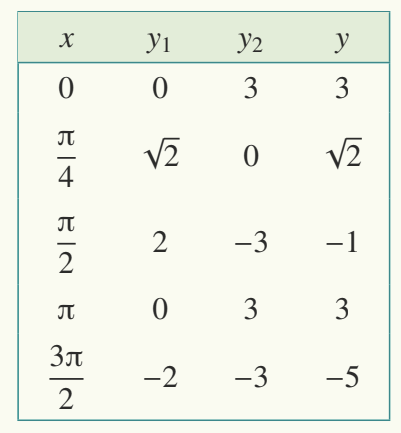
At each -value:
- We read the -value from
- We read the -value from
- We add these values to get the -value for the sum function
For example:
- At : , , so
- At : , , so
- At : , , so
- At : , , so
The complete graph shows all three functions:
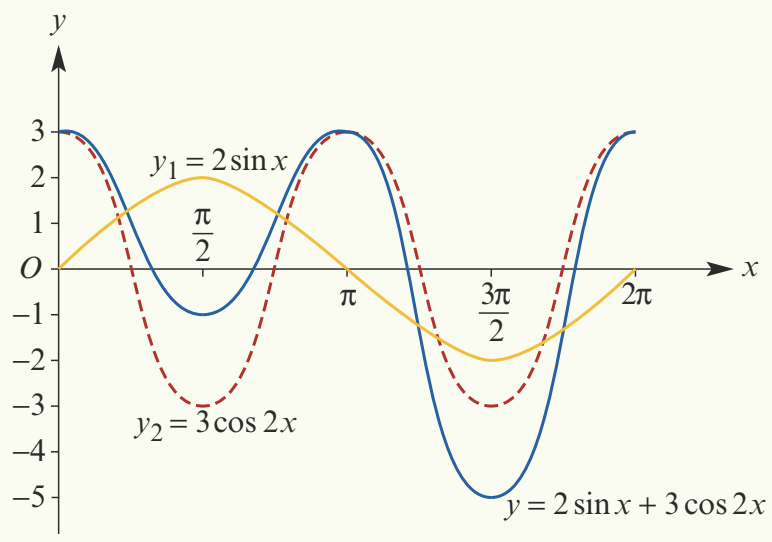
Notice how the blue curve (the sum) relates to the component functions according to our key principles. For instance, at where , the sum equals . At where both functions are negative, the sum is more negative than either individual function.
Summary
Key Points to Remember:
- Addition of ordinates means adding the y-values of two functions at each -value to create their sum
- When one function equals zero, the sum equals the other function
- When both functions are positive, their sum is greater than either function alone
- When both functions are negative, their sum is more negative than either function alone
- When functions have opposite signs, the sum lies between them
- Creating a table of values at key points helps sketch the sum function accurately