Further Symmetry Properties and the Pythagorean Identity (VCE SSCE Mathematical Methods): Revision Notes
📚Revision Notes
Further Symmetry Properties and the Pythagorean Identity
Complementary relationships
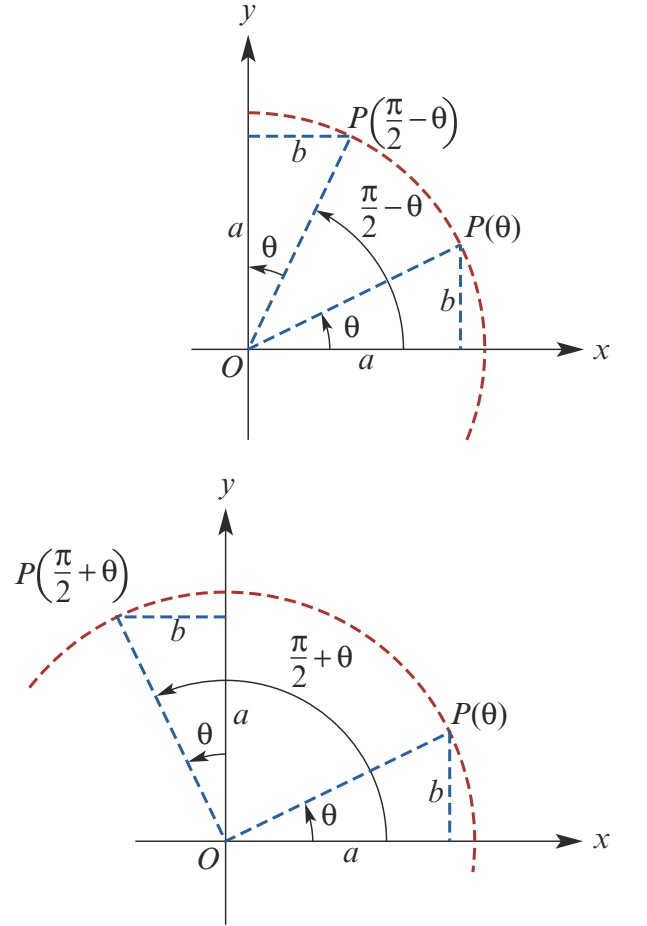
Complementary relationships, also known as cofunction identities, show how sine and cosine are related when angles differ by radians (90°). These relationships are powerful tools for simplifying trigonometric expressions.
Angles of the form
Examining the unit circle, we can establish the following relationships:
These identities tell us that the sine of an angle equals the cosine of its complement, and vice versa. This is why sine and cosine are called cofunctions.
Note
Think of it this way: when angles are complementary (add up to ), sine and cosine "swap" their roles. This relationship is fundamental to understanding how these functions relate to each other.
Angles of the form
Similarly, for angles that exceed by an amount :
Notice that the sine relationship remains the same, but the cosine relationship introduces a negative sign.
Important
The negative sign in is crucial! This is due to the point's position on the unit circle moving into the second quadrant where cosine values are negative.
Example
Worked Example: Using Complementary Relationships
Problem: If and , find the value of:
a)
b)
Solution:
Part a:
Using the complementary relationship:
Part b:
Using the complementary relationship:
The Pythagorean identity
The Pythagorean identity is one of the most important relationships in trigonometry. It connects the sine and cosine of any angle through the equation:
Important
This identity holds true for all values of , making it one of the most versatile tools in trigonometry.
Derivation of the Pythagorean identity
We can derive this identity by considering a point located on the unit circle.
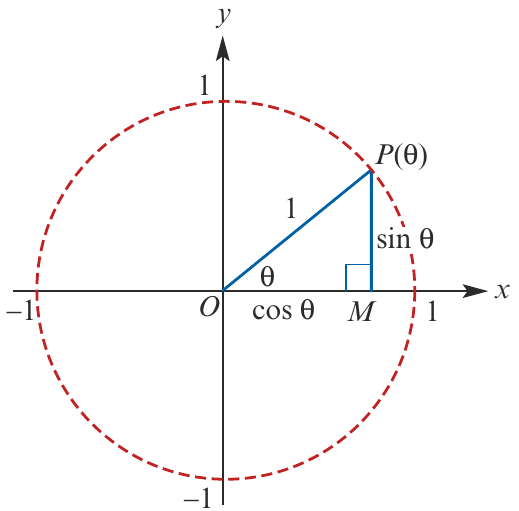
Let be a point on the unit circle, where the circle has radius 1. The coordinates of this point are .
Using Pythagoras' theorem on the right triangle formed:
Since the radius , and the horizontal distance and vertical distance :
We can write as and as . Therefore:
This is the Pythagorean identity, derived directly from the geometry of the unit circle.
Note
The beauty of this derivation is that it shows how Pythagoras' theorem directly translates to trigonometry. On the unit circle, the equation becomes when we recognize that the coordinates are .
Using the Pythagorean identity
The Pythagorean identity is extremely useful for finding one trigonometric ratio when another is known, especially when combined with quadrant information.
Example
Worked Example: Using the Pythagorean Identity to Find Trigonometric Values
Problem: Given that and , find:
a)
b)
Solution:
Part a:
Substitute into the Pythagorean identity:
Therefore .
Since is in the second quadrant (where ), and cosine is negative in the second quadrant:
Part b:
Using the result from part a:
Exam tip: Always consider which quadrant the angle is in when determining the sign of your answer. This is crucial for selecting the correct value when taking square roots.
Summary
Key Points to Remember:
-
Complementary relationships show that sine and cosine swap when the angle changes by : and
-
When adding to an angle: but (note the negative sign)
-
The Pythagorean identity is valid for all values of and is derived from Pythagoras' theorem applied to the unit circle
-
When using the Pythagorean identity to find a trigonometric ratio, always check the quadrant to determine the correct sign
-
The Pythagorean identity can be rearranged to find either or