Solution of Trigonometric Equations (VCE SSCE Mathematical Methods): Revision Notes
📚Revision Notes
Solution of Trigonometric Equations
Introduction
In this topic, we examine methods for solving trigonometric equations of the form and . These techniques rely on understanding exact values, symmetry properties of trigonometric functions, and the periodic nature of sine and cosine.
Note
Mastering these solution techniques is essential for solving more complex trigonometric problems. The methods you learn here apply to both radians and degrees, making them versatile tools in your mathematical toolkit.
Solving equations of the form and
Understanding the method
When solving basic trigonometric equations, we follow a systematic approach:
- Sketch a graph to visualise how many solutions exist in the given interval
- Find the reference angle (the acute angle in the first quadrant)
- Determine which quadrants contain solutions based on the sign of the value
- Use symmetry properties to find all solutions within the interval
Important
Quadrant Rules for Solutions
The sign of the trigonometric value tells us which quadrants to consider:
- Positive sine: 1st and 2nd quadrants
- Negative sine: 3rd and 4th quadrants
- Positive cosine: 1st and 4th quadrants
- Negative cosine: 2nd and 3rd quadrants
A helpful mnemonic: "All Students Take Calculus" - All functions positive in 1st quadrant, Sine in 2nd, Tangent in 3rd, Cosine in 4th.
Worked example: Finding solutions using exact values
Example
Worked Example: Solving for
Question: Find all solutions of the equation for .
Solution:
First, we sketch a graph to determine how many solutions exist. The graph shows the sine curve intersecting the horizontal line at four points within the interval .
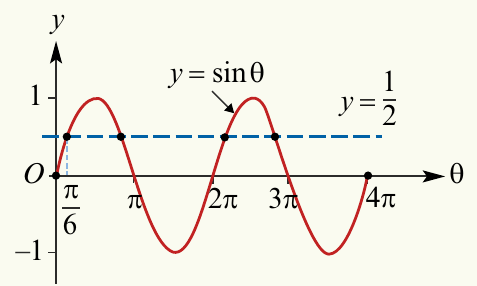
The reference angle (first quadrant solution) is . This can be found from knowledge of exact values or using on a calculator.
Since sine is positive, solutions occur in the 1st and 2nd quadrants. Using the symmetry property , the second solution in the first cycle is:
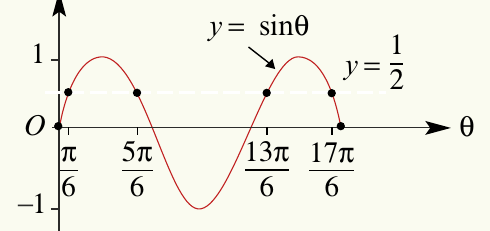
The sine function has period , meaning . Therefore, we can find additional solutions by adding :
Third solution:
Fourth solution:
These four solutions are shown on the graph below:
We can also visualise these solutions on the unit circle:
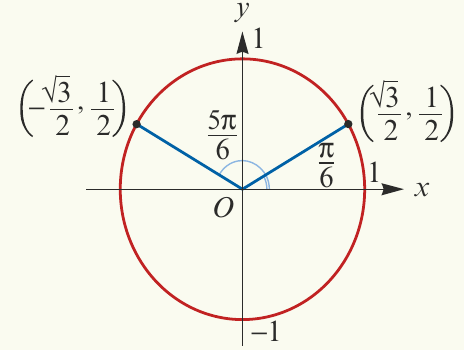
The diagram shows the two angles in the first period: and , both giving a y-coordinate of .
Answer:
Worked example: Finding solutions with decimal values
Example
Worked Example: Solving equations with decimal values
Question: Find two values of x:
a) with
b) with
Solution:
a) First, we find the reference angle by considering the positive version of the equation. For with in the first quadrant:
(using a calculator)
Since is negative, solutions occur in the 3rd and 4th quadrants.
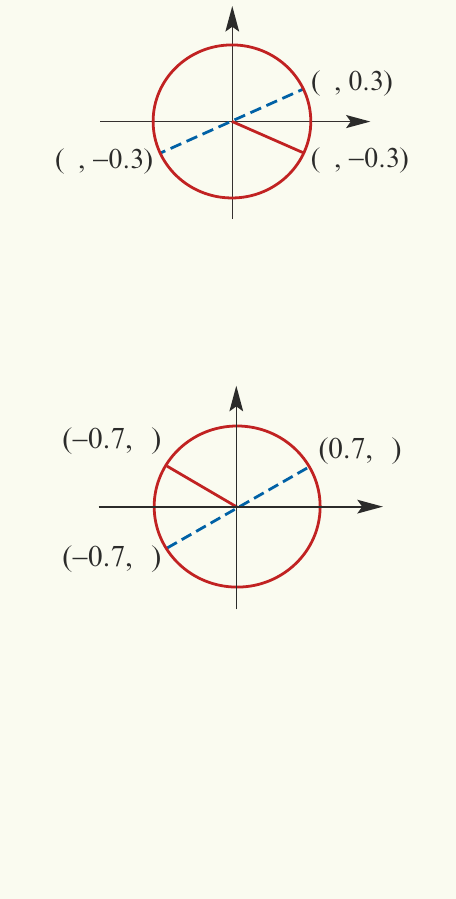
For the 3rd quadrant, we use (or in radians, ):
(to 3 decimal places)
For the 4th quadrant, we use (or in radians, ):
(to 3 decimal places)
Answer: and
b) First, find the reference angle for with in the first quadrant:
(using a calculator)
Since is negative, solutions occur in the 2nd and 3rd quadrants.
For the 2nd quadrant:
For the 3rd quadrant:
Answer: and
Note
When working with decimal values, always keep extra decimal places during calculations and only round at the final answer to avoid accumulation of rounding errors.
Worked example: Equations with exact values
Example
Worked Example: Solving equations with exact trigonometric values
Question: Find all values of between and for which:
a)
b)
c)
Solution:
a) Since is positive, solutions are in the 1st and 4th quadrants.
The reference angle is
Using :
Answer: or
b) Since is negative, solutions are in the 3rd and 4th quadrants.
The reference angle is (since )
Using and :
Answer: or
c) First, rearrange the equation:
Since is positive, solutions are in the 1st and 4th quadrants.
The reference angle is
Answer: or
Using technology to solve trigonometric equations
Modern calculators can solve these equations directly, which is particularly useful for checking your work or solving equations that don't have exact values.
Note
TI-Nspire Calculator Method
Ensure the calculator is in degree mode, then enter the equation with the domain constraint.
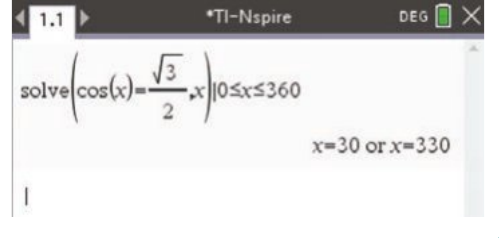
Note
Casio ClassPad Method
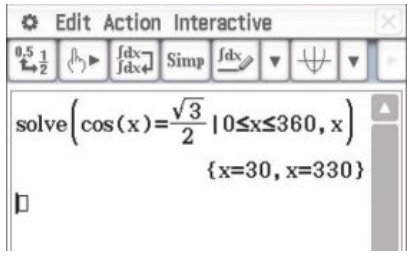
Both calculators will display all solutions within the specified domain.
Important
Calculator Mode Warning
Always check whether your calculator is in degree mode or radian mode before solving. Using the wrong mode will give incorrect answers!
Solving equations of the form and
The substitution method
When the equation involves a multiple of the variable (such as or ), we use a substitution to transform it into a simpler form.
The key steps are:
- Make a substitution
- Determine the new interval for by multiplying the original interval by
- Solve the equation for using the methods from the previous section
- Convert back to find values of by dividing the solutions by
Note
The substitution method works because it transforms a complicated equation into a simpler one that we already know how to solve. The key is remembering to adjust the interval when you make the substitution, and then divide by n to get back to the original variable.
Worked example: Solving with substitution
Example
Worked Example: Solving for
Question: Solve the equation for .
Solution:
First, sketch a graph to see how many solutions exist:
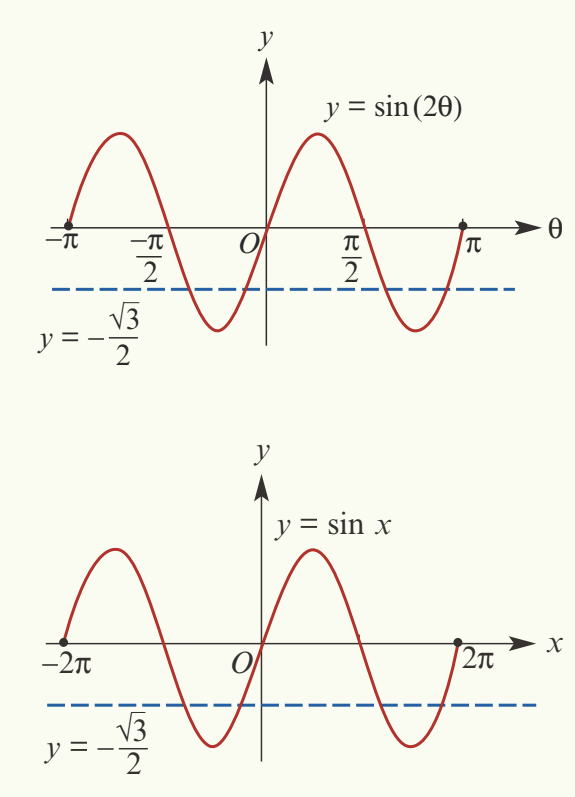
The graph shows there are four solutions in the interval .
Step 1: Make the substitution
Let
If , then
Step 2: Solve for x
We now solve: for
The reference angle is (since )
Since sine is negative, solutions are in the 3rd and 4th quadrants.
For :
To find solutions in the negative part of the interval, subtract :
The solutions for are:
Step 3: Convert back to θ
Since , we divide by 2 to find :
Answer:
This can be verified using a calculator in radian mode:
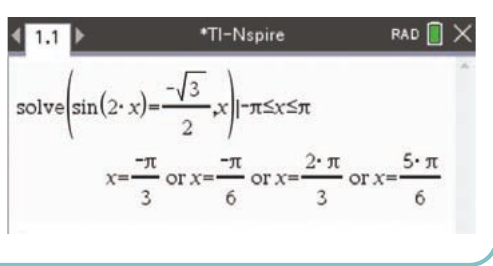
Key symmetry properties
Understanding these symmetry relationships is essential for finding all solutions to trigonometric equations. These formulas allow you to find solutions in different quadrants based on the reference angle.
Important
Essential Symmetry Properties
For sine:
- (2nd quadrant symmetry)
- (3rd quadrant)
- (4th quadrant)
- (periodicity)
For cosine:
- (4th quadrant symmetry)
- (periodicity)
In degrees:
Summary of solution techniques
Summary
Key Solution Methods
For equations of the form and :
- Find solutions in the interval using exact values, symmetry properties, or a calculator
- Additional solutions can be found by adding or subtracting multiples of
For equations of the form and :
- Substitute and determine the corresponding interval for
- Solve the equation for using the basic method
- Convert back to find by dividing the solutions by
Example: To solve for :
- Let , so
- Solve in the interval
- Divide all solutions by 3 to find the values of
Remember!
Summary
Key Points to Remember:
- Always sketch a graph to visualise the number of solutions in the given interval
- The sign of the value determines which quadrants contain solutions (positive sine in 1st and 2nd, negative sine in 3rd and 4th, etc.)
- Use symmetry properties to find solutions in different quadrants from the reference angle
- For equations with coefficients like , use substitution to create a simpler equation
- Periodicity allows you to find additional solutions by adding or subtracting multiples of (or )
- Check your calculator mode - ensure it's in radians or degrees as required by the question