The Tangent Function (VCE SSCE Mathematical Methods): Revision Notes
📚Revision Notes
The Tangent Function
Introduction to the tangent function
The tangent of an angle is defined in terms of sine and cosine:
This definition is only valid when , as division by zero is undefined. This restriction creates vertical asymptotes in the graph of the tangent function.
Important
The tangent function is undefined wherever the cosine equals zero. This fundamental restriction determines the location of all vertical asymptotes in tangent graphs.
The basic tangent function
Table of values
The following table shows key values of the tangent function:

Notice that the function is undefined (ud) at , which is where .
Graph of
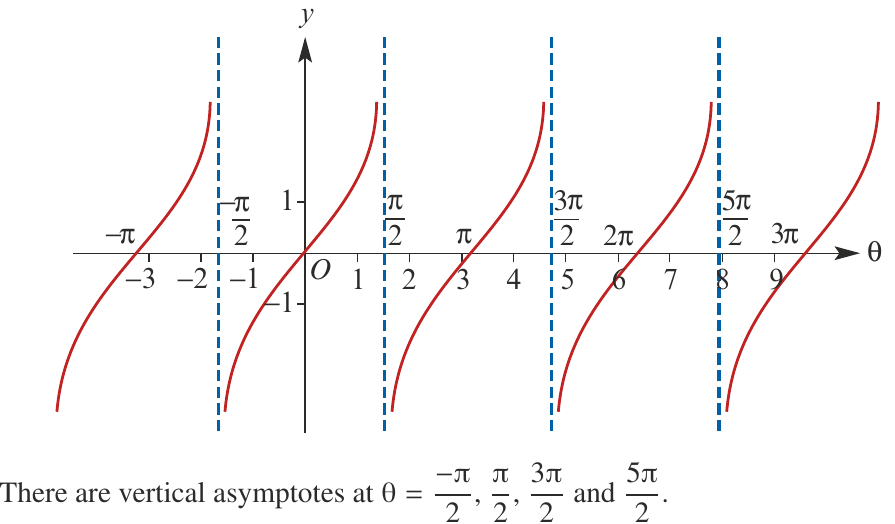
The graph shows several important features:
Vertical asymptotes: These occur at , and generally at all odd multiples of .
Repeating pattern: The graph has a periodic structure, repeating every units along the -axis.
Unbounded values: Unlike sine and cosine, the tangent function can take any real value, approaching positive or negative infinity near the asymptotes.
Note
Unlike sine and cosine functions which are bounded between -1 and 1, the tangent function has no upper or lower bounds. This is why it can approach infinity near its asymptotes.
Key properties of
Period: The tangent function repeats every units. This is half the period of sine and cosine functions.
Range: The range is all real numbers, . The function can take any value from negative infinity to positive infinity.
Vertical asymptotes: These occur at where (i.e., is any integer). This formula represents all odd multiples of .
Axis intercepts: The graph crosses the -axis at where (i.e., at integer multiples of ).
Transformations: the function
When we apply transformations to the basic tangent function, we obtain where and are positive numbers.
How to obtain the graph
The graph of is created from the graph of by applying:
- A dilation of factor from the -axis (vertical stretch)
- A dilation of factor from the -axis (horizontal compression)
Properties of
Period:
The coefficient affects the period. A larger value of means a shorter period (more cycles in the same interval).
Range:
The range remains all real numbers regardless of the transformations.
Vertical asymptotes: where
The asymptotes become closer together as increases.
Axis intercepts: where
The zeros become closer together as increases.
Note
When the coefficient increases, both the asymptotes and zeros become more frequent (closer together), while the period decreases. The vertical stretch factor affects the steepness of the curve but does not change the period or the locations of asymptotes.
Worked example: sketching transformed tangent graphs
Example
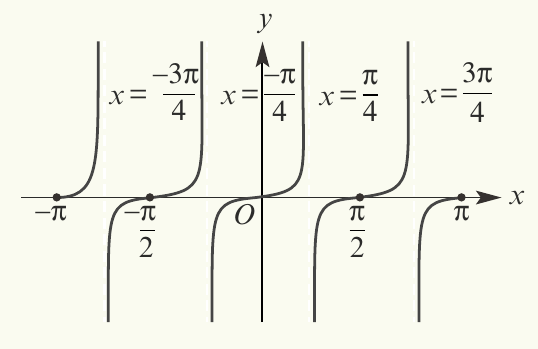
Worked Example: Sketch for
Step 1: Identify the period
Period
Step 2: Find the asymptotes
Asymptotes occur at where
For the given interval, asymptotes are at
Step 3: Find the axis intercepts
Axis intercepts occur at where
For the given interval, intercepts are at
Step 4: Sketch the graph
The factor of 3 stretches the graph vertically, making it steeper between asymptotes.
Example
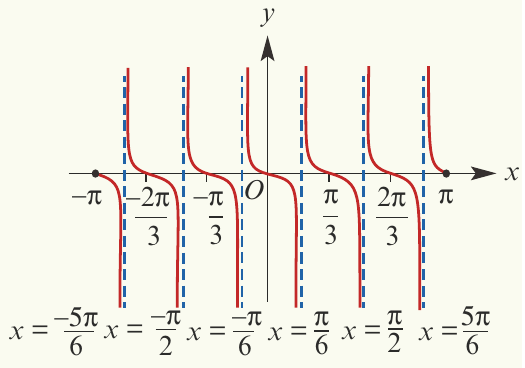
Worked Example: Sketch for
Step 1: Identify the period
Period
Step 2: Find the asymptotes
Asymptotes occur at where
Step 3: Find the axis intercepts
Axis intercepts occur at where
Step 4: Note the reflection
The negative sign reflects the graph in the -axis, so the curves slope downward instead of upward.
Horizontal translations
When the tangent function includes a horizontal shift, we write it as or equivalently where .
Example
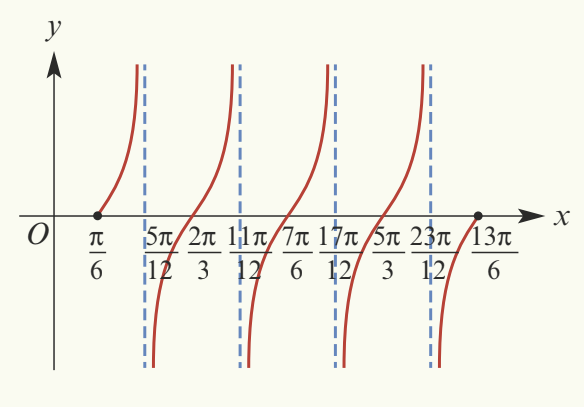
Worked Example: Sketch for
Step 1: Rewrite in factored form
Step 2: Identify the transformations
The graph of undergoes:
- A dilation of factor 3 from the -axis
- A dilation of factor from the -axis
- A translation of units in the positive -direction
Step 3: Calculate the period
Period
Step 4: Find the asymptotes
Asymptotes: where
Step 5: Find the axis intercepts
Axis intercepts: where
Vertical translations
When we add a constant to the tangent function, we shift it vertically.
Example
Worked Example: Sketch for
Step 1: Rewrite in factored form
Step 2: Identify the transformations
Starting from , apply:
- A dilation of factor 3 from the -axis
- A dilation of factor from the -axis
- A translation of units in the positive -direction
- A translation of units in the positive -direction
Step 3: Note about asymptotes
The vertical translation does NOT affect the positions of the vertical asymptotes. They remain at the same -values.
Step 4: Find the -axis intercepts
To find where the graph crosses the -axis, solve:
The -axis intercepts are at , and .
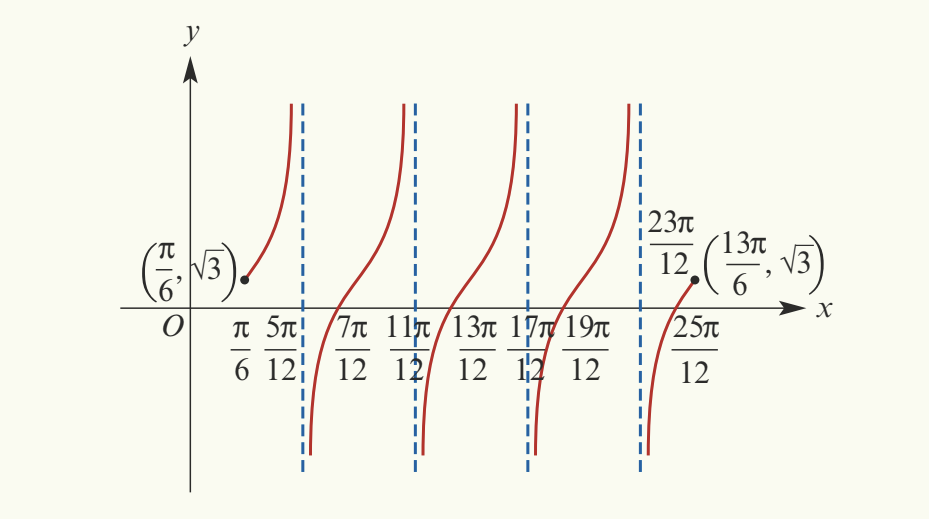
Important
Common Mistake Alert
Vertical translations shift the entire graph up or down but do NOT change the positions of the vertical asymptotes. Only horizontal transformations (scaling or translations) affect where the asymptotes occur.
Solving equations involving the tangent function
Exact values to remember
These fundamental values are essential for solving tangent equations:
Note
Memorizing these exact values will make solving tangent equations much faster. They correspond to the special angles that appear frequently in trigonometry problems.
Symmetry properties
Periodic property:
This reflects the fact that the tangent function has period .
Odd function property:
The tangent function is an odd function, meaning its graph is symmetric about the origin.
Example
Worked Example: Solve for
Step 1: Isolate the tangent
Step 2: Find the reference solution
Since , we have as one solution.
Step 3: Find all solutions for
We need solutions for in , which means is in .
Using the period of , we add multiples of :
Step 4: Solve for
Example
Worked Example: Solve for
Step 1: Find the reference solution
Since , and we need , we use the odd function property:
Also,
Step 2: Set up the equation
Step 3: Solve for the transformed variable
Step 4: Solve for
Note: We need to check which solutions fall within the given domain. For , this means , which means .
Solving equations of the form
When solving equations where sine equals a constant times cosine, we can use a useful technique.
Key principle
If , then .
This is obtained by dividing both sides by (provided ).
Note
This technique allows us to find the intersection points of sine and cosine curves by converting to a tangent equation. This conversion simplifies the problem significantly.
Example
Worked Example: Find where and intersect for
Step 1: Set up the equation
Step 2: Convert to tangent
Step 3: Solve
Since , and using the period of :
Step 4: Find the coordinates
When :
When :
The points of intersection are and .
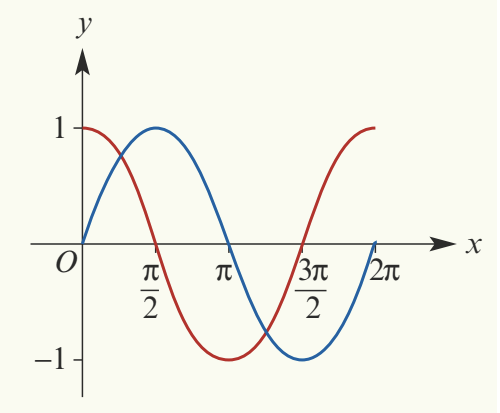
Example
Worked Example: Solve for
Step 1: Convert to tangent
Step 2: Find all solutions for
Since is in , we need in .
Step 3: Solve for
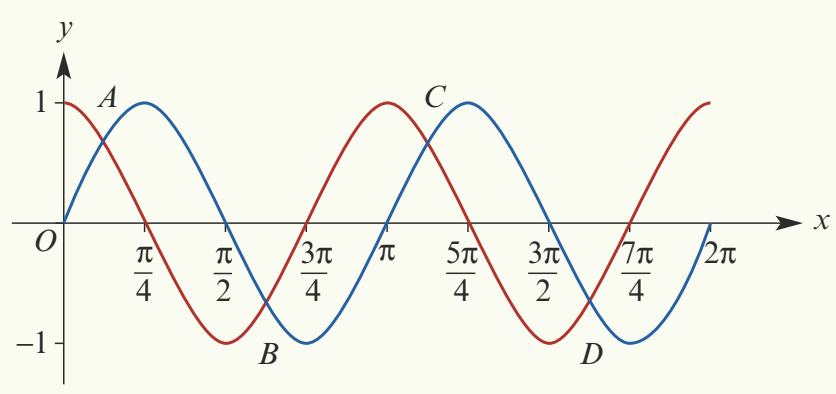
The graph shows the four intersection points labeled A, B, C, and D occurring at these -values.
Remember!
Summary
Key Points to Remember:
-
The tangent function is defined as where .
-
The basic tangent function has period , range , vertical asymptotes at (odd multiples of ), and axis intercepts at (integer multiples of ).
-
For the transformed function , the period is , asymptotes occur at , and intercepts occur at .
-
Key symmetry properties: (periodic) and (odd function).
-
When solving equations of the form , convert to for easier solution.