Cumulative Distribution Functions (VCE SSCE Mathematical Methods): Revision Notes
📚Revision Notes
Cumulative Distribution Functions
What is a cumulative distribution function?
The cumulative distribution function (often abbreviated as CDF) is another important way to describe a continuous random variable. While the probability density function (PDF) tells us about the distribution of probabilities, the CDF tells us about accumulated probabilities up to a certain point.
For a continuous random variable with probability density function defined on the interval , the cumulative distribution function is defined as:
where is the variable of integration.
Note
The CDF at a particular value gives us the probability that the random variable takes a value less than or equal to . It represents the total accumulated probability from the start of the distribution up to the point .
Understanding the formula
Let's break down what this formula means:
- represents the cumulative distribution function evaluated at
- is the probability that our random variable is at most
- The integral calculates the area under the probability density function from the lower bound up to the value
- We use as the variable of integration (rather than ) because appears as the upper limit of the integral
Important
The CDF is calculated by integrating the PDF from the lower bound of the domain up to the value of interest. This integration process accumulates all the probability from the start of the distribution up to that point.
Visualizing the relationship between PDF and CDF
The diagram below illustrates the connection between the probability density function and the cumulative distribution function:
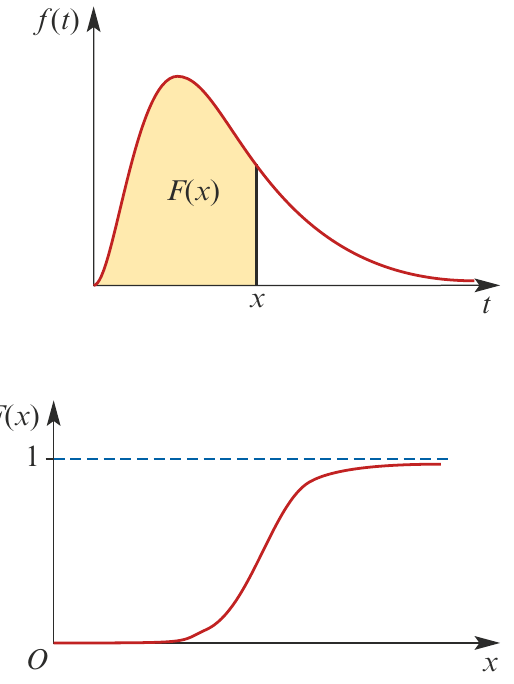
The top panel shows the probability density function . The shaded yellow area under the curve from the lower bound (in this case, 0) up to the value represents .
The bottom panel shows the corresponding cumulative distribution function . Notice how it:
- Starts near 0 at the origin
- Increases in an S-shaped curve
- Approaches 1 asymptotically (shown by the horizontal dashed line)
Note
This S-shape is characteristic of cumulative distribution functions. The function accumulates probability as increases, which is why it's called "cumulative". The steeper parts of the CDF correspond to regions where the PDF has higher values.
Properties of cumulative distribution functions
There are three fundamental properties that every cumulative distribution function must satisfy. For a continuous random variable with domain :
Property 1: The CDF starts at zero
At the lower bound of the domain, the probability that takes a value less than or equal to is 0. This makes sense because is the smallest possible value.
Property 2: The CDF ends at one
At the upper bound of the domain, the probability that takes a value less than or equal to is 1. This is certain because is the largest possible value.
Property 3: The CDF never decreases
If , then
In other words: implies
This means is a non-decreasing function. As increases, the cumulative probability either stays the same or increases, but it never decreases. This is logical because we're accumulating more probability as we move to larger values of .
Important
Key Properties to Remember:
These three properties ensure that is a valid cumulative distribution function:
- — no probability accumulated at the start
- — all probability accumulated at the end
- never decreases — probabilities can only accumulate, never diminish
Connection to the probability density function
There's an important mathematical relationship between the CDF and the PDF:
The cumulative distribution function is always continuous for any continuous random variable .
Using the fundamental theorem of calculus, we can show that the derivative of the cumulative distribution function equals the probability density function:
This holds for each value of where is continuous. This relationship tells us that:
- Integrating the PDF gives us the CDF
- Differentiating the CDF gives us the PDF
Note
This bidirectional relationship between the PDF and CDF is incredibly useful. If you know one function, you can always find the other through either integration or differentiation. The CDF is guaranteed to be continuous, even if the PDF has discontinuities at certain points.
CDFs for probability density functions defined on all real numbers
When the probability density function is defined on all real numbers (denoted by ), the cumulative distribution function is given by:
In this case, the integral extends from negative infinity up to . The properties are slightly modified:
- as
- as
Note
When the domain extends to all real numbers, the CDF doesn't start exactly at 0 or end exactly at 1. Instead, it approaches these values asymptotically as goes to negative or positive infinity.
Worked example
Example
Worked Example: Finding a CDF from a PDF
Question: The time, seconds, that it takes a student to complete a puzzle is a random variable with density function given by:
Find , the cumulative distribution function of .
Solution:
We need to find by integrating the probability density function from the lower bound up to .
To integrate, we rewrite as :
Evaluating at the limits:
Therefore, for .
Important
The cumulative distribution function allows us to compute probabilities for various intervals directly. Once we have , we can easily find probabilities like , , or using the CDF values.
Remember!
Summary
Key Takeaways:
- The cumulative distribution function gives the probability that a random variable is at most
- The CDF is found by integrating the PDF:
- Three key properties: , , and is non-decreasing
- The CDF is always continuous for continuous random variables
- The derivative of the CDF equals the PDF: