Applications of Linear Functions (VCE SSCE Mathematical Methods): Revision Notes
📚Revision Notes
Applications of Linear Functions
Introduction
Linear functions are powerful mathematical tools that can model many real-world situations. When we apply linear functions to practical problems, we often need to compare different options or pricing structures to make informed decisions. This involves setting up equations, solving them, and interpreting the results in context.
Note
Understanding how to apply linear functions to real-world problems is a crucial skill that bridges mathematics and everyday decision-making. These techniques are used extensively in business, economics, and personal finance.
Real-world modelling with linear equations
Many everyday situations involve costs that have two parts:
- A fixed charge - a constant amount that doesn't change (the -intercept)
- A variable charge - an amount that depends on usage (the gradient or slope)
Together, these create a linear function of the form , where:
- is the total cost
- is the fixed charge
- is the rate per unit
- is the number of units used
Note
Understanding the Structure
The equation mirrors the general form :
- The constant term () represents costs you pay regardless of usage
- The coefficient of x () represents the rate at which costs increase with each additional unit
Worked example: Comparing gas bill payment methods
Example
Worked Example: Gas Bill Payment Methods
Let's look at a practical problem comparing two different payment structures for gas bills.
The problem:
Two methods are available for paying quarterly gas bills:
- Method A: A fixed charge of $25 per quarter plus 50 cents per unit of gas used
- Method B: A fixed charge of $50 per quarter plus 25 cents per unit of gas used
Find how many units must be used before Method B becomes cheaper than Method A.
Setting up the problem:
First, we need to define our variables clearly:
Let = cost in dollars for Method A
Let = cost in dollars for Method B
Let = number of units of gas used
Creating the linear equations:
For Method A, the total cost equals the fixed charge plus the variable charge:
For Method B, similarly:
Notice that Method A has a lower fixed charge ($25) but a higher rate per unit (50 cents), while Method B has a higher fixed charge ($50) but a lower rate per unit (25 cents).
Graphical solution:
We can visualise these two cost functions by plotting them on the same set of axes. The horizontal axis represents the number of units of gas used, and the vertical axis represents the cost in dollars.
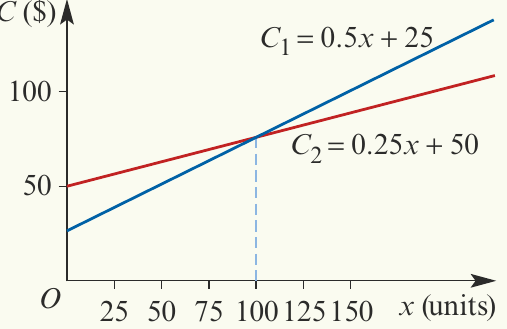
The graph shows that the two lines intersect at units. This is the break-even point where both methods cost exactly the same amount.
Looking at the graph reveals that:
- For usage less than 100 units, the blue line () is below the red line (), meaning Method A is cheaper
- For usage greater than 100 units, the red line () is below the blue line (), meaning Method B is cheaper
Therefore, Method B becomes cheaper when the number of units exceeds 100.
Algebraic solution:
We can also solve this problem using simultaneous equations. At the break-even point, the costs are equal, so:
Substituting our expressions:
Rearranging to collect like terms:
Dividing both sides by 0.25:
This confirms our graphical result. When exactly 100 units are used, both methods cost the same. For any usage above 100 units, Method B is the cheaper option.
Understanding break-even points
Important
Break-even Point Definition
The break-even point is where two options cost exactly the same amount. It's the point of intersection when we graph two linear functions. This concept is crucial in business and economics for comparing different pricing structures or cost models.
To find a break-even point:
- Graphically: Look for where the two lines intersect on a graph
- Algebraically: Set the two expressions equal and solve for the variable
Both methods will give you the same answer, but the graphical method often provides better visual understanding of which option is better for different ranges of values.
Key strategies for solving application problems
Note
Step-by-Step Approach to Application Problems
When working with linear function applications:
- Define your variables clearly - State what each letter represents, including units
- Identify the fixed and variable components - Look for constant charges and rates
- Write the equations - Express each option as a linear function
- Choose your solution method - Both graphical and algebraic methods are valid
- Interpret your answer in context - Don't just find a number; explain what it means for the situation
Remember that the coefficient (gradient) tells you the rate of change, while the constant term tells you the starting value when .
Important
Common Mistakes to Avoid
- Forgetting to define variables with their units
- Mixing up the fixed and variable charges
- Finding the intersection point but not interpreting what it means
- Ignoring which option is better on either side of the break-even point
Remember!
Summary
Key Points to Remember:
- Linear functions can model real-world situations with a fixed charge plus a variable rate
- The break-even point is where two options cost the same and can be found graphically (intersection point) or algebraically (solving simultaneous equations)
- A steeper gradient means the cost increases more quickly as usage increases
- When comparing options, consider both the fixed charge and the variable rate - the cheaper option depends on how much you use
- Always interpret your mathematical answer in the context of the original problem