Families of Straight Lines (VCE SSCE Mathematical Methods): Revision Notes
📚Revision Notes
Families of Straight Lines
What are families of straight lines?
A family of straight lines is a collection of lines that share a common property. For example, all lines passing through a particular point, or all lines with the same gradient. We describe these families using equations that contain a parameter - a variable that can take different values to generate different members of the family.
Note
Think of a family as a group with something in common - just like members of a human family might share traits, lines in a mathematical family share properties like the same gradient or the same intercept.
Understanding parameters
A parameter is a variable that we allow to change in order to create different lines within a family. When we write an equation like , the letter is the parameter. As we change the value of , we get different lines, but all these lines share the property of having a -intercept of .
Important
The parameter is the "variable variable" - it varies to create different family members while keeping other properties fixed. Understanding which quantity is the parameter and which is fixed is crucial for working with families of lines.
Three important families of straight lines
Family 1: Lines through the origin
Equation form:
In this family, the gradient acts as the parameter. As we change , we get different straight lines, but they all pass through the origin .
Key features:
- All lines pass through the point
- Different values of give different gradients
- When , the line slopes upward
- When , the line slopes downward
- When , the line is horizontal (the -axis)
Family 2: Lines with the same gradient
Equation form:
Here, the -intercept is the parameter. All lines in this family have gradient , but they cross the -axis at different points.
Key features:
- All lines are parallel to each other (same gradient)
- Different values of give different -intercepts
- The lines never intersect each other
Note
Since all lines in this family have the same gradient, they maintain the same angle of slope but are shifted vertically by different amounts depending on the value of .
Family 3: Lines with the same y-intercept
Equation form:
In this family, the gradient is the parameter. All lines pass through the point on the -axis, but they have different gradients.
Key features:
-
All lines intersect at the point
-
Different values of give different gradients
-
The lines radiate out from the common point like spokes on a wheel
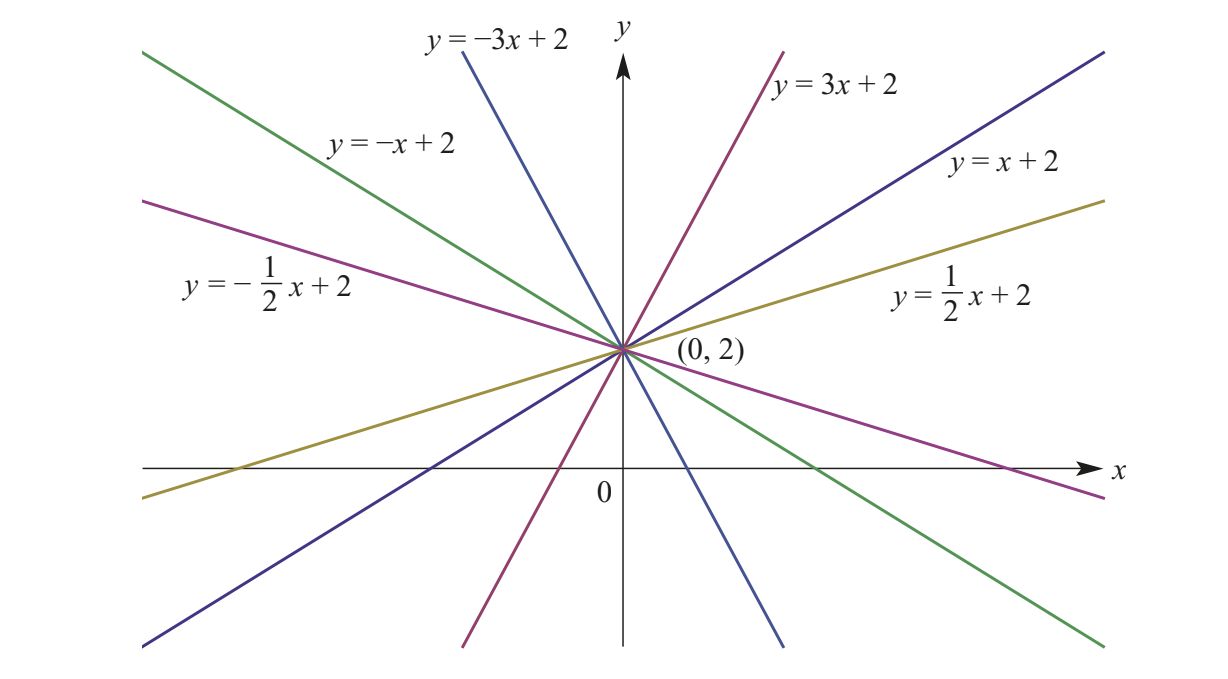
The diagram above shows several members of the family . Notice how all the lines meet at the point , but have different slopes depending on the value of .
Worked example: Finding a parameter value
Example
Worked Example: Finding the Parameter Value
Question: Find the value of if the line passes through the point .
Solution:
If the line goes through , then when , we must have .
Substituting into the equation:
Therefore, the line is .
Key Strategy: When a line passes through a specific point, substitute the coordinates into the equation to find the parameter value.
Worked example: Intercepts and perpendicular lines
Example
Worked Example: Intercepts, Inequalities, and Perpendicular Lines
Question: A family of lines have equations of the form , where is a negative number.
a) Find the -axis intercept of a line in this family in terms of .
b) For which values of is the -axis intercept greater than ?
c) Find the equation of the line perpendicular to at the point .
Solution:
Part a: Finding the x-axis intercept
To find where the line crosses the -axis, we set :
The -axis intercept is .
Part b: When is the x-intercept greater than 3?
We need:
Now we multiply both sides by . Since we're told that is negative, multiplying by a negative number reverses the inequality sign:
Dividing both sides by :
Since must be negative (given in the question), we have:
Part c: Finding the perpendicular line
The gradient of the original line is .
The gradient of the perpendicular line is .
The perpendicular line passes through , so its -intercept is .
Using the gradient-intercept form:
Or in point-gradient form:
Important
Critical Rules to Remember:
- Always reverse the inequality sign when multiplying or dividing by a negative number
- For perpendicular lines, if one line has gradient , the perpendicular line has gradient - think "flip the fraction and change the sign"
Other families of straight lines
Families can be defined in various ways. For example:
- Lines with -intercept : These have the form , where is a non-zero parameter. Different values of give different lines, but they all cross the -axis at .
- Lines perpendicular to a given line: If we have a line with gradient , all perpendicular lines have gradient .
Note
The form is called the intercept form of a line, where is the -intercept and is the -intercept. This form is particularly useful when you know both intercepts.
Summary
Summary
Key Points to Remember:
- A family of straight lines is a collection of lines sharing a common property
- A parameter is a variable in an equation that can take different values to generate different members of the family
- represents all lines through the origin (parameter is , the gradient)
- represents all lines with gradient (parameter is , the -intercept)
- represents all lines passing through (parameter is , the gradient)
- To find a parameter value, substitute the coordinates of a given point into the equation
- When working with inequalities involving negative parameters, remember to reverse the inequality sign when multiplying or dividing
- For perpendicular lines: if one has gradient , the other has gradient