Parallel and Perpendicular Lines (VCE SSCE Mathematical Methods): Revision Notes
📚Revision Notes
Parallel and Perpendicular Lines
Understanding the relationship between lines and their gradients is fundamental to coordinate geometry. This note explores how we can determine whether two lines are parallel or perpendicular by examining their gradients, and how to find equations of lines with specific relationships to other lines.
Parallel lines
When two non-vertical lines share identical gradients, they are parallel to each other. This means they will never intersect, no matter how far they are extended in either direction.
The reverse is also true: if two non-vertical lines are parallel, they must have the same gradient. This relationship can be proven by considering the angles of inclination that these lines make with the positive -axis.
Understanding the geometric basis
We can prove the parallel line rule using two key geometric principles:
Note
Principle 1: Two non-vertical lines are parallel if and only if they make equal angles ( and ) with the positive direction of the -axis.
Principle 2: When two angles and are acute, obtuse, or zero, the equation means that .
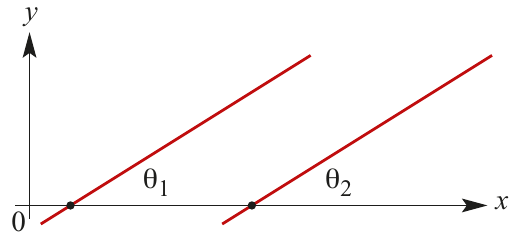
Since the gradient of a line equals (where is the angle of inclination), parallel lines must have equal gradients.
Example of parallel lines
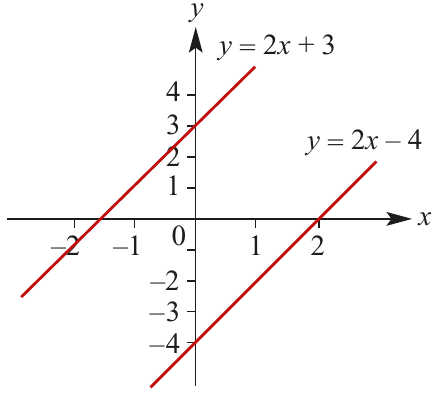
Consider these two linear equations:
Both equations have a gradient of 2. Since their gradients are equal, the lines are parallel to each other. Notice that they have different -intercepts ( and ), which means they are shifted vertically but maintain the same steepness.
Perpendicular lines
Two lines are perpendicular when they meet at a right angle (). For non-vertical lines, there is a special relationship between their gradients that allows us to determine perpendicularity.
Important
Key rule: Two lines with gradients and (both non-zero) are perpendicular if and only if .
In other words, the product of the gradients of perpendicular lines equals . This can also be expressed by saying that one gradient is the negative reciprocal of the other: if one line has gradient , a perpendicular line has gradient .
Proof of the perpendicular gradient rule
The proof involves four steps, starting with lines through the origin and then generalising to any lines in the plane.
Step 1: Setting up the construction
We begin by drawing two lines through the origin , one with positive gradient and one with negative gradient . We construct right-angled triangles and where .
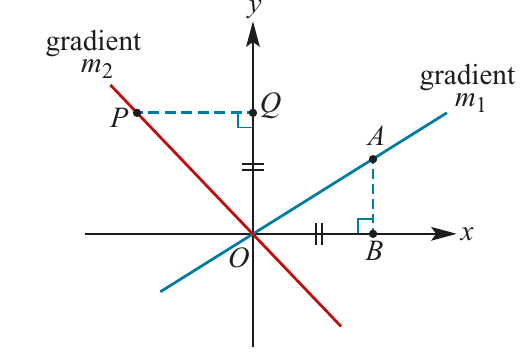
Gradient
Gradient
Therefore, the product of the gradients is:
Step 2: Proving perpendicular lines have product -1
If the two lines are perpendicular, then angle equals angle . This means triangles and are congruent (they have the same shape and size).
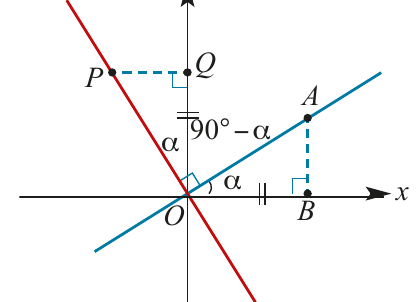
Since the triangles are congruent, . Substituting this into our product:
Step 3: Proving the converse
We now prove the reverse: if the product of gradients equals , then the lines are perpendicular.
If , then . This means triangles and are congruent. Therefore, angle equals angle , which means angle . The lines are perpendicular.
Note
Step 4: Generalising to any lines
The proof so far applies to lines passing through the origin. However, if we have two lines anywhere in the coordinate plane, we can draw parallel lines through the origin. Since parallel lines have the same gradients, the perpendicularity rule applies to any pair of lines, not just those through the origin.
Worked example: Finding parallel and perpendicular lines
Example
Worked Example: Finding Parallel and Perpendicular Lines
Problem: Find the equation of the straight line which passes through and is:
a) parallel to the line with equation
b) perpendicular to the line with equation
Solution:
First, we rearrange the given equation into gradient-intercept form: becomes . This tells us the gradient is 2.
Part a) Finding the parallel line
A line parallel to must have the same gradient, which is .
We use the point-slope form where the point is and the gradient is :
The equation of the parallel line is .
Part b) Finding the perpendicular line
A line perpendicular to a line with gradient has gradient .
Using the point-slope form with and :
Multiplying both sides by :
The equation of the perpendicular line is (or equivalently ).
Worked example: Proving perpendicularity in triangles
Example
Worked Example: Proving Perpendicularity in Triangles
Problem: The coordinates of the vertices of triangle are , and . Show that side is perpendicular to side .
Solution:
To prove perpendicularity, we need to show that the product of the gradients equals .
Let be the gradient of line :
Let be the gradient of line :
Now we check the product:
Since the product of the gradients equals , the lines and are perpendicular to each other. This means angle is a right angle.
Exam tips
Note
Exam Tips:
- Always rearrange equations into the form to clearly identify the gradient
- For perpendicular lines, remember the negative reciprocal: if , then
- When proving perpendicularity, calculate both gradients first, then check if their product equals
- Use the point-slope form when you know a point and a gradient
- Check your final answer by verifying it satisfies the given conditions
Remember!
Summary
Key Points to Remember:
- Parallel lines have identical gradients: if line 1 has gradient and line 2 has gradient , they are parallel
- Perpendicular lines have gradients whose product is : if , the lines are perpendicular
- The perpendicular gradient is the negative reciprocal: if one line has gradient , the perpendicular line has gradient
- Use the point-slope form when finding equations of lines through a specific point
- To prove perpendicularity in geometric problems, calculate both gradients and verify their product equals