Simultaneous Linear Equations with More Than Two Variables (VCE SSCE Mathematical Methods): Revision Notes
📚Revision Notes
Simultaneous Linear Equations with More Than Two Variables
Understanding systems with three variables
When working with simultaneous equations, we can extend our methods beyond two variables to solve systems involving three or more unknowns. This becomes particularly useful in real-world applications involving three-dimensional space.
Note
The methods you learned for solving two-variable systems can be adapted to work with three variables. The key difference is that we need an extra step to reduce the problem to something familiar.
A system of three linear equations with three unknowns can be written in the general form:
In this system, we need to find values of , , and that satisfy all three equations simultaneously.
Solving by elimination
The elimination method remains one of the most reliable techniques for solving systems with three variables. The key strategy is to reduce the three-variable system to a two-variable system, then solve as usual.
Important
Strategy for Elimination with Three Variables:
The goal is to eliminate the same variable from two different pairs of equations, creating two new equations with only two variables. Then solve this simpler system using familiar methods.
Example
Worked Example: Solving a Three-Variable System
Solve the following system of three equations:
Solution:
Begin by eliminating variable from two pairs of equations to create two new equations containing only and .
Take equation (3) minus equation (1):
Now eliminate from equations (2) and (3). Multiply equation (3) by 4:
Subtract equation (2) from this:
Simplify by dividing by 3:
Now we have two equations with just and . Subtract equation (4) from equation (5):
Therefore
Substitute into equation (4):
Finally, substitute into equation (3) to find :
The solution is , , .
Example
Worked Example: Another Elimination Approach
Solve the simultaneous linear equations:
Solution:
Label the equations:
Eliminate to create two equations in and only.
Take equation (2) minus equation (1):
Add equation (2) to equation (3):
Now solve equations (4) and (5) for and .
From equation (4):
Substitute into equation (5):
Therefore:
Substitute back into equation (2):
The solution is , , .
Using a CAS calculator
For more complex systems, using a CAS calculator can save time and reduce errors. Both the TI-Nspire and Casio ClassPad have built-in functions for solving simultaneous equations.
Note
When to Use a Calculator:
While it's important to understand the elimination method, CAS calculators are particularly helpful for:
- Checking your manual calculations
- Solving systems with complicated coefficients or fractions
- Exploring systems with parameters or infinitely many solutions
TI-Nspire method
Use the simultaneous equations template by selecting: menu > Algebra > Solve System of Equations > Solve System of Linear Equations.
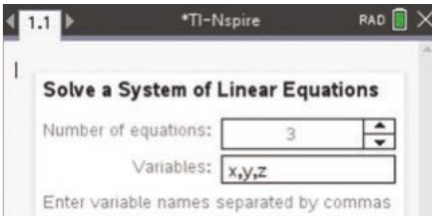
Alternatively, use the solve command directly:
Casio ClassPad method
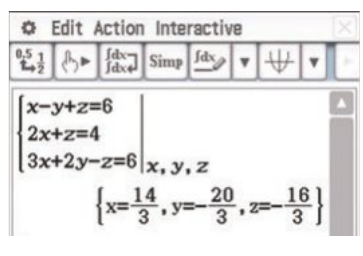
From the Math1 keyboard, tap the simultaneous equation template button twice to create a template for three equations. Enter your equations using the Var keyboard to input variables.
Geometric interpretation: planes in three dimensions
Just as a linear equation in two variables defines a line, a linear equation in three variables defines a plane in three-dimensional space.
Important
Geometric Meaning:
The equation represents a plane in three-dimensional space. When we solve a system of three equations, we're finding where three planes intersect.
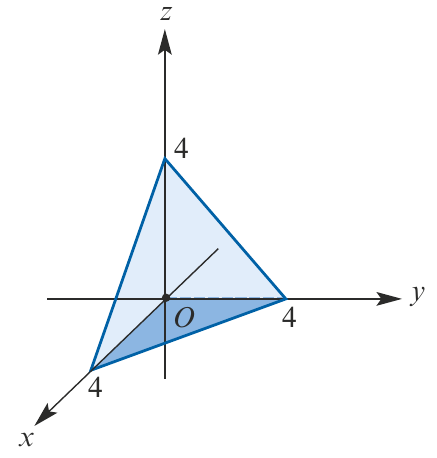
In three-dimensional coordinate geometry, we use three perpendicular axes labelled , , and .
Visualising a plane
Consider the plane .
We can visualise this plane by finding where it intersects each axis:
- When and : (point on z-axis)
- When and : (point on y-axis)
- When and : (point on x-axis)
Note
These three points determine a triangular region that represents part of the plane. The plane actually extends infinitely in all directions, but these three points help us visualize its position and orientation.
Types of solutions
When solving three simultaneous linear equations, the solution can take several different forms:
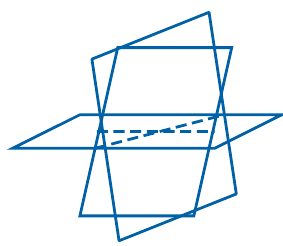
1. Intersection at a point (unique solution)
The three planes intersect at exactly one point, giving a unique solution . This is the most common case, illustrated in our worked examples.
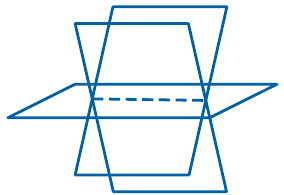
2. Intersection along a line (infinitely many solutions)
The three planes intersect along a common line. This gives infinitely many solutions that can be described using a parameter.
3. Three parallel planes (no solution)
If the planes are parallel and distinct, there is no point that lies on all three planes.
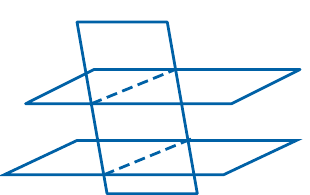
4. Other cases with no common intersection
Planes may intersect in pairs but have no common point where all three meet.
Note
Understanding the geometric interpretation helps explain why different types of solutions occur. The algebraic methods we use to solve the equations will reveal which type of solution exists.
Parametric solutions for infinitely many solutions
When a system has infinitely many solutions, we express the solution using a parameter (often denoted by the Greek letter , pronounced "lambda").
Important
What Parametric Solutions Mean:
When we express a solution using a parameter like , each value of gives us a different point on the line of intersection. The parameter acts like a "slider" that moves us along the line of solutions.
Example
Worked Example: Describing Infinitely Many Solutions
The simultaneous equations , , and have infinitely many solutions. Describe these solutions using a parameter.
Solution:
We can verify that the point satisfies all three equations, but this is not the only solution.
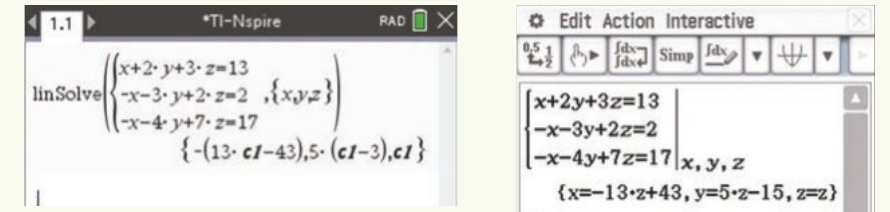
Using a CAS calculator with parameter (or cf for calculator format), we obtain:
Let
Then:
This parametric form describes all solutions. For any value of , we get a point that satisfies all three equations.
For example, when :
Notice that as increases by 1 (that is, increases by 1), decreases by 13 and increases by 5. All points that satisfy the equations lie on a straight line in three-dimensional space.
Summary
Key Points to Remember:
- A system of three linear equations with three variables can be solved by elimination, reducing it to a two-variable system first
- Each linear equation in three variables represents a plane in three-dimensional space
- Solutions can be: a unique point, infinitely many points forming a line, infinitely many points forming a plane, or no solution at all
- CAS calculators are particularly helpful for complex systems or when checking your work
- When there are infinitely many solutions, we express them using a parameter such as