The Equation of a Straight Line (VCE SSCE Mathematical Methods): Revision Notes
📚Revision Notes
The Equation of a Straight Line
Introduction
When working with straight lines in coordinate geometry, we need to determine their equations. To find the equation of a straight line, you generally need two independent pieces of information. This note covers different methods based on what information is given:
- Gradient and -axis intercept
- Gradient and a point on the line
- Two points on the line
Each method leads to a specific form of the linear equation.
Note
The key to finding any straight line equation is having sufficient information to determine both the line's slope and position. Different forms of the equation are suited to different types of given information.
Gradient-intercept form
The gradient-intercept form is one of the most commonly used ways to express the equation of a straight line. Let's explore how this form works.
Understanding the form
Consider a line with gradient and -axis intercept . This line passes through point on the -axis. If we take any other point on this line, we can use the gradient formula to establish a relationship.
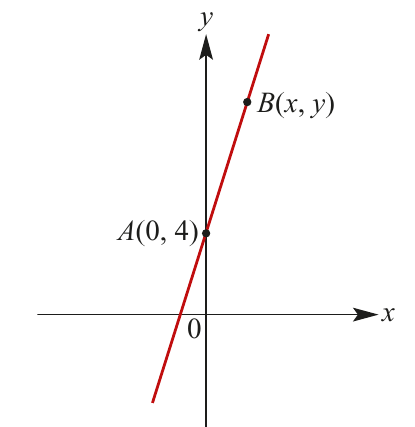
The gradient of line segment is:
Since we know the gradient equals , we can write:
Rearranging this equation:
This shows that any point on the line satisfies the equation .
Conversely, if a point satisfies , then , which means the gradient of the line through and is , confirming the point lies on our line.
The general gradient-intercept form
Using the same reasoning as above, we can establish the general result:
Important
The line with gradient and -axis intercept has equation:
Conversely, the line with equation has gradient and -axis intercept .
This is called the gradient-intercept form.
Worked examples with gradient-intercept form
Example
Worked Example: Finding gradient and intercept from an equation
Find the gradient and -axis intercept of the line .
Solution:
The equation is already in the form , where m = 3 and c = -4.
Therefore, the gradient is 3 and the -axis intercept is -4.
Example
Worked Example: Writing an equation given gradient and intercept
Find the equation of the line with gradient and -axis intercept .
Solution:
Using the form with and :
Example
Worked Example: Rearranging to find gradient and intercept
State the gradient and -axis intercept of the line .
Solution:
First, rearrange the equation into gradient-intercept form:
Now we can read the gradient and intercept directly: m = -2 and c = 3.
Therefore, the gradient is -2 and the -axis intercept is 3.
Point-gradient form
Sometimes you know a point on the line and its gradient, but not the -axis intercept. The point-gradient form is ideal for this situation.
Deriving the point-gradient form
If is a known point on a line with gradient , and is any other point on the line, then:
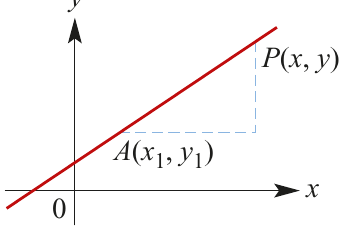
Rearranging this equation gives us:
Important
The point-gradient form of the equation of a straight line is:
where is a point on the line and is the gradient.
Worked examples with point-gradient form
Example
Worked Example: Using point-gradient form
Find the equation of the line which passes through the point and has gradient .
Solution:
Method 1 (using point-gradient form directly):
We have and .
Using the equation :
Method 2 (using gradient-intercept form):
Since , the equation has the form .
The point lies on the line, so when , :
Therefore, the equation is y = 4x + 7.
Note
Both methods give the same result. The point-gradient form is often quicker when you don't know the -intercept, while the gradient-intercept form can be useful if you prefer working with that format.
Example
Worked Example: Line with negative gradient
Find the equation of the line that passes through the point and has a gradient of .
Solution:
Using the point-gradient form with and :
The equation can also be expressed as 2x + y - 8 = 0 in general form.
A line through two points
When you know two points on a line but not the gradient directly, you can still find the equation by first calculating the gradient.
Method for two points
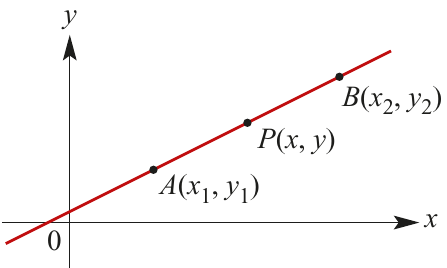
To find the equation of the line through points and :
Step 1: Calculate the gradient using:
Step 2: Use the point-gradient form with either point:
Note
Alternatively, you can find the equation directly by noting that for any point on the line:
This combines both steps into one equation.
Worked examples with two points
Example
Worked Example: Standard two-point problem
Find the equation of the straight line passing through the points and .
Solution:
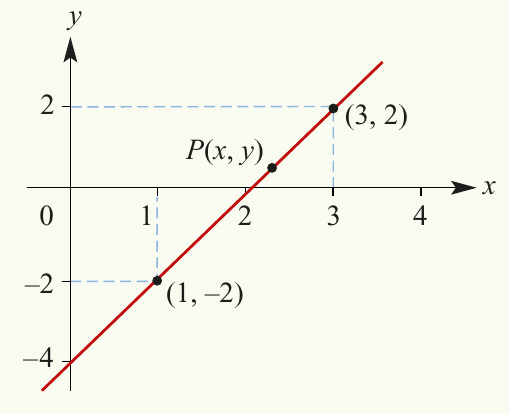
First, find the gradient:
Now use with the point :
Example
Worked Example: Using y-intercept as one point
Find the equation of the straight line with -axis intercept which passes through the point .
Solution:
The -axis intercept tells us the line passes through (0, -3).
Using and :
Since we know the -intercept is , we can write directly:
Alternatively, we recognise that a line with -axis intercept has the form , and we just need to find using the given point.
Two intercepts (intercept form)
A special case occurs when you know both the x-axis intercept and the y-axis intercept. This leads to a particularly useful form of the equation.
Deriving the intercept form
Consider a line passing through and , where .
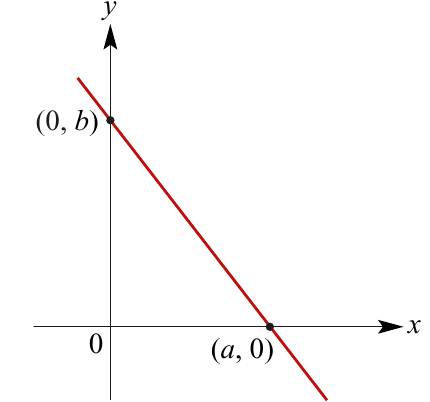
The gradient is:
Using the point-gradient form with the point :
Multiplying both sides by :
Dividing both sides by :
Important
The intercept form of the equation of a straight line is:
where is the -axis intercept and is the -axis intercept.
Worked example with intercept form
Example
Worked Example: Using the intercept form
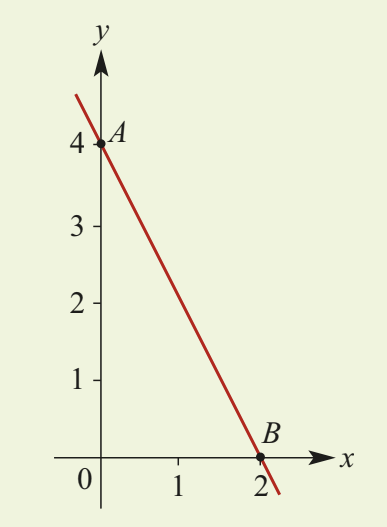
Find the equation of the line shown in the graph.
Solution:
From the graph, we can see that point is at and point is at .
Therefore, the x-axis intercept is a = 2 and the y-axis intercept is b = 4.
Using the intercept form:
Multiplying both sides by :
Rearranging to gradient-intercept form:
Vertical and horizontal lines
These are special cases where the gradient is either zero or undefined.
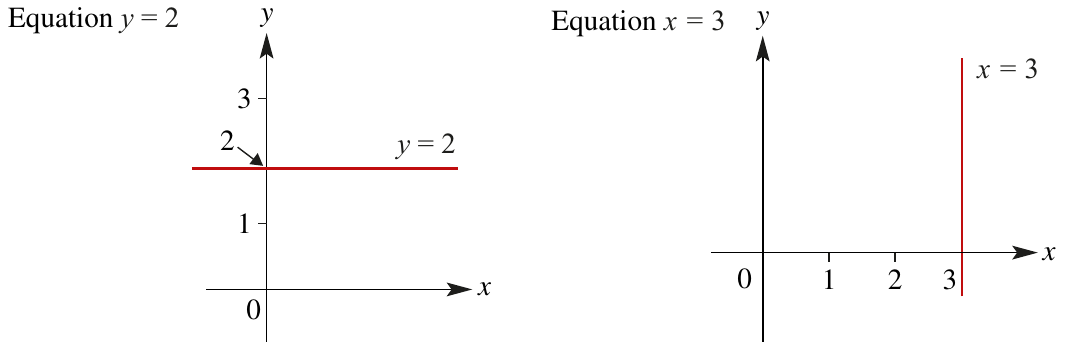
Horizontal lines
A horizontal line has gradient . Its equation is simply:
where is the -axis intercept. Every point on the line has the same y-coordinate.
Vertical lines
A vertical line has an undefined gradient. Its equation is:
where is the -axis intercept. Every point on the line has the same x-coordinate.
Important
The equation of a vertical line cannot be written in the form because its gradient is undefined. This is a common source of confusion - remember that vertical lines are a special case requiring the form .
General form of the equation of a straight line
We've seen that all straight lines can be represented by different forms of equations. These can all be rearranged into a common general form.
Note
The general form of the equation of a straight line is:
where and are not both zero.
Conversely, any linear equation of the form represents a straight line.
Remember!
Summary
Key Points to Remember:
-
Gradient-intercept form (): Use when you know the gradient and -intercept . This is the most common form.
-
Point-gradient form (): Use when you know a point on the line and the gradient .
-
Two points: First calculate the gradient using , then use the point-gradient form.
-
Intercept form (): Use when you know both axis intercepts, where is the -intercept and is the -intercept.
-
Special cases: Horizontal lines have equation (gradient = 0), and vertical lines have equation (undefined gradient).