The Gradient of a Straight Line (VCE SSCE Mathematical Methods): Revision Notes
📚Revision Notes
The Gradient of a Straight Line
What is a gradient?
The gradient of a straight line is a measure of its steepness or slope. It tells us how much the line rises (or falls) for every unit we move horizontally.
Note
An important fact to remember: through any two points, you can only draw one unique straight line. This means a straight line can be completely defined by knowing just two points on it.
Understanding rise and run
To understand gradient, we need to know two key terms:
Rise: The vertical change in -values as you move from one point to another on the line.
Run: The horizontal change in -values as you move from one point to another on the line.
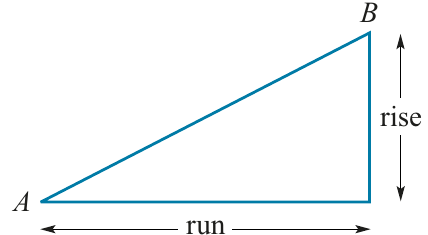
The gradient is the ratio of rise to run:
Note
The gradient tells us how steep a line is by comparing how much it rises vertically to how much it runs horizontally. A larger gradient means a steeper line!
The gradient formula
For any two points on a line, and , the gradient can be calculated using:
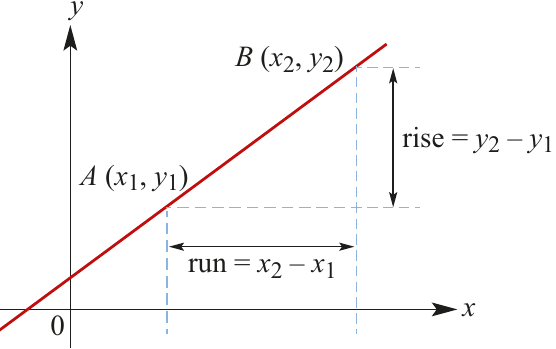
Important
It doesn't matter which point you label as the first point and which as the second. This is because:
Both expressions give you the same gradient value.
Properties of gradients
Understanding what different gradient values mean:
Positive gradient: When a line slopes upward from left to right, the gradient is positive. This happens when both the rise and run have the same sign (both positive or both negative).
Negative gradient: When a line slopes downward from left to right, the gradient is negative. This happens when the rise and run have opposite signs.
Zero gradient: A horizontal line (parallel to the -axis) has a gradient of zero. This is because , so the rise is zero.
Undefined gradient: A vertical line (parallel to the -axis) has an undefined gradient. This is because , and we cannot divide by zero.
Note
Think of gradient as describing the direction of a line:
- Positive gradients go "uphill" from left to right
- Negative gradients go "downhill" from left to right
- Zero gradients are flat (horizontal)
- Undefined gradients are completely vertical
Worked example: Finding gradient from a graph
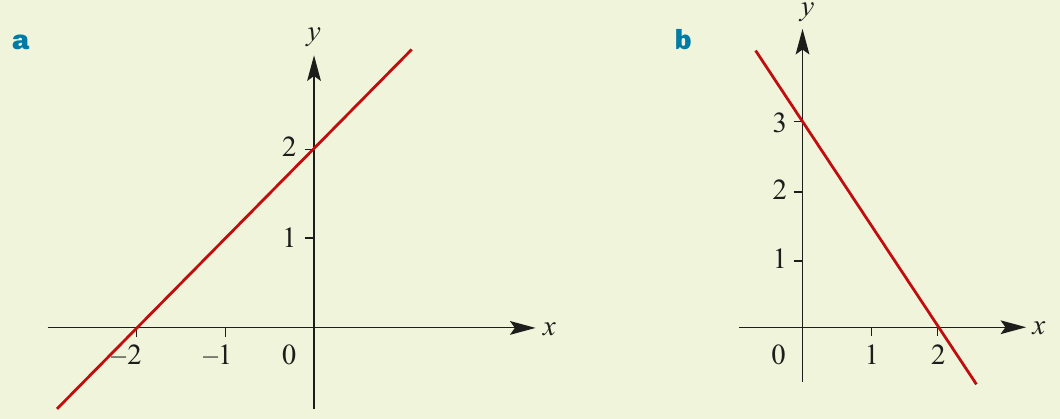
Find the gradient of each line:
Example
Worked Example: Finding Gradient from a Graph
Part a:
Let and
Using the gradient formula:
The gradient is . Notice this line slopes upward from left to right, giving a positive gradient.
Part b:
Let and
Using the gradient formula:
The gradient is . This line slopes downward from left to right, giving a negative gradient.
Worked example: Finding gradient from coordinates
Find the gradient of the line that passes through the points and .
Example
Worked Example: Finding Gradient from Coordinates
Solution:
Using the gradient formula:
Alternative approach: We could also calculate using:
Both methods give the same answer: .
The angle of slope
The gradient of a line is closely related to the angle the line makes with the positive -axis.
Positive gradients and acute angles
When a line has a positive gradient, it forms an acute angle (less than ) with the positive direction of the -axis.
First, recall the trigonometric ratio for tangent from Year 10:
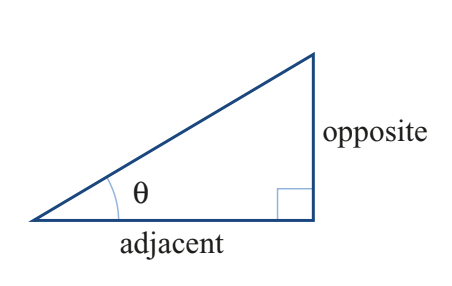
For a line with positive gradient, the relationship between gradient and angle is:
where is the acute angle the line makes with the positive -axis.
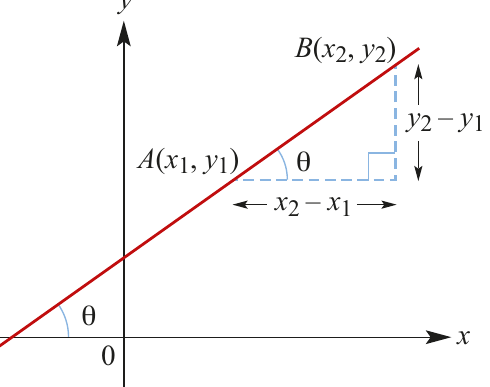
From the diagram, we can see that:
Important
The key relationship to remember: gradient equals the tangent of the angle.
This formula connects the algebraic concept of gradient with the geometric concept of angle.
Worked example: Finding gradient and angle (positive gradient)
Determine the gradient of the line passing through the points and and the angle that the line makes with the positive direction of the -axis.
Example
Worked Example: Finding Gradient and Angle (Positive Gradient)
Solution:
First, find the gradient:
Since the gradient is positive, the angle is acute. Using the relationship :
(correct to two decimal places)
Exam tip: Use your calculator's inverse tangent function to find the angle. Make sure your calculator is in degree mode.
Negative gradients and obtuse angles
When a line has a negative gradient, it forms an obtuse angle (greater than but less than ) with the positive direction of the -axis.
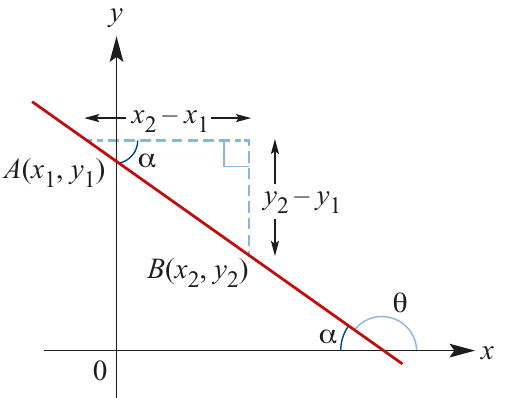
The line forms an acute angle with the negative direction of the -axis, and we have:
The gradient can be expressed as:
Using the tangent identity for supplementary angles:
Therefore:
Note
This formula works for both positive and negative gradients. The difference is just in how we interpret the angle:
- Positive gradient → acute angle (less than )
- Negative gradient → obtuse angle (between and )
Worked example: Finding gradient and angle (negative gradient)
Determine the gradient of the line passing through the points and and the angle that the line makes with the positive direction of the -axis.
Example
Worked Example: Finding Gradient and Angle (Negative Gradient)
Solution:
First, find the gradient:
Since the gradient is negative, the angle is obtuse.
To find , first find the acute angle using:
Now find the obtuse angle :
(correct to two decimal places)
Exam tip: For negative gradients, use your calculator to find the inverse tangent of the positive value (without the negative sign), then subtract this from to get the obtuse angle.
Remember!
Summary
Key Points to Remember:
-
The gradient formula is where and are any two points on the line.
-
Lines sloping upward from left to right have positive gradients; lines sloping downward from left to right have negative gradients.
-
Horizontal lines have a gradient of zero (no vertical change), while vertical lines have undefined gradient (no horizontal change, division by zero).
-
The gradient equals the tangent of the angle with the positive -axis: .
-
For positive gradients, is acute (less than ). For negative gradients, is obtuse (between and ), and you calculate it using where is the acute angle found from the positive gradient value.