Simultaneous Equations (VCE SSCE Mathematical Methods): Revision Notes
📚Revision Notes
Simultaneous Equations
What are simultaneous equations?
A linear equation with two unknowns, such as , does not have a single unique solution. Instead, this equation represents a relationship between pairs of numbers that satisfy the equation. When we plot all possible pairs of numbers that satisfy the equation on a graph, the result is a straight line. This is why we call it a linear relation.
When we have two linear equations and we graph them on the same set of axes, one of three things can happen. If the lines are not parallel, they will intersect at exactly one point. This intersection point represents the one unique pair of values that satisfies both equations at the same time - hence the term simultaneous equations.
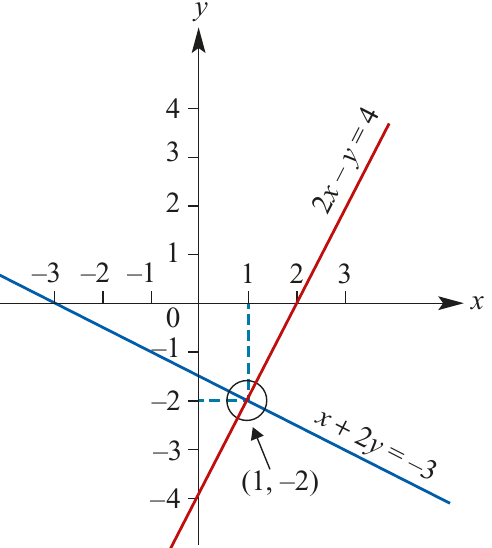
Note
The intersection point can be found in three ways:
- Graphically - by drawing both lines and identifying where they meet (though this method's accuracy depends on how carefully the graphs are drawn)
- Algebraically - by solving the pair of equations using the substitution method or the elimination method (more accurate)
We will focus on the two algebraic techniques for solving simultaneous equations.
Method 1: Substitution method
The substitution method involves expressing one variable in terms of the other variable, then substituting this expression into the second equation. This reduces the problem to a single equation with one unknown, which can then be solved.
Steps for the substitution method
Note
Follow these steps to use the substitution method:
- Choose one of the two equations and rearrange it to make one variable the subject
- Substitute this expression into the other equation
- Solve the resulting equation (which now contains only one variable)
- Substitute the value you found back into one of the original equations to find the other variable
- Check your answer by substituting both values into the equation you didn't use in step 4
Example
Worked Example: Solving Using Substitution
Solve the equations and
Solution:
Let's label the equations:
From equation (2), we can rearrange to express in terms of :
Now substitute this expression for into equation (1):
Expand the brackets:
Simplify:
Now substitute into equation (2) to find :
Finally, check this solution using equation (1):
Left side: ✓
Right side: ✓
The solution is x = 1 and y = -2, or we can write this as the point .
Method 2: Elimination method
The elimination method involves adding or subtracting the two equations to eliminate one of the variables. This requires making the coefficients of one variable the same (or opposite) in both equations.
Steps for the elimination method
Note
Follow these steps to use the elimination method:
- Choose which variable you want to eliminate
- If necessary, multiply one or both equations by a number to make the coefficients of that variable equal or opposite
- Add or subtract the equations to eliminate the chosen variable
- Solve the resulting equation for the remaining variable
- Substitute this value back into one of the original equations to find the other variable
- Check your answer using the other equation
Example
Worked Example: Solving Using Elimination
Solve the equations and
Solution:
Let's label the equations:
To eliminate , we need the coefficients of to be the same in both equations. Multiply equation (2) by 2:
Now subtract equation (2') from equation (1):
Now substitute into equation (2) to find :
The solution is x = 1 and y = -2, which is the same answer we obtained using the substitution method. This point is where the two lines intersect on a graph.
The geometry of simultaneous equations
Two distinct straight lines can either be parallel to each other or meet at a single point. When we solve a system of two linear equations with two variables, there are three possible outcomes, each corresponding to a different geometric situation.
Important
Three Possible Cases for Simultaneous Equations:
Understanding the geometric interpretation helps explain why systems of equations can have different types of solutions.
Case 1: Unique solution (intersecting lines)
When two lines have different gradients, they intersect at exactly one point. This gives us a unique solution to the system of equations.
Example: and
Solution: ,
Geometry: Two lines meeting at a point
Case 2: No solutions (parallel lines)
When two lines have the same gradient but different -intercepts, they are parallel and never meet. This system has no solutions.
Example: and
These equations cannot both be true at the same time.
Geometry: Distinct parallel lines
Case 3: Infinitely many solutions (coincident lines)
When two equations represent the exact same line (one equation is just a multiple of the other), every point on the line is a solution. This system has infinitely many solutions.
Example: and
The second equation is just the first equation multiplied by 2, so they represent the same line.
Geometry: Two copies of the same line (coincident lines)
Word problems involving simultaneous equations
Many real-world problems involve finding two unknown quantities. We can solve these by setting up a system of simultaneous equations. The key is to carefully define your variables and translate the information in the problem into mathematical equations.
Example
Worked Example: Finding Two Numbers
The sum of two numbers is 24 and their difference is 96. Find the two numbers.
Solution:
Step 1: Define variables
Let and be the two numbers.
Step 2: Set up equations
The sum is 24:
The difference is 96:
Step 3: Solve using elimination
Add equations (1) and (2):
Step 4: Find the other variable
Substitute into equation (1):
Step 5: State the answer and check
The two numbers are 60 and -36.
Check in equation (2): ✓
Example
Worked Example: Cost Problems
3 kg of jam and 2 kg of butter cost $29, and 6 kg of jam and 3 kg of butter cost $54. Find the cost per kilogram of jam and butter.
Solution:
Step 1: Define variables
Let = cost of 1 kg of jam (in dollars)
Let = cost of 1 kg of butter (in dollars)
Step 2: Set up equations
From the first purchase:
From the second purchase:
Step 3: Solve using elimination
Multiply equation (1) by 2:
Subtract equation (2) from equation (1'):
Step 4: Find the other variable
Substitute into equation (2):
Step 5: State the answer and check
Jam costs $7 per kg and butter costs $4 per kg.
Check with the original problem:
- First purchase: ✓
- Second purchase: ✓
Summary
Key Points to Remember:
- Simultaneous equations are pairs of equations with two unknowns that we solve together to find values that satisfy both equations
- Substitution method: Rearrange one equation to express one variable in terms of the other, then substitute into the second equation
- Elimination method: Multiply equations if needed to make coefficients equal, then add or subtract to eliminate one variable
- Three possible outcomes: One solution (lines intersect), no solutions (lines are parallel), or infinitely many solutions (same line)
- Word problems: Carefully define your variables, translate the problem into equations, solve, and always check your answer against the original problem