Solving Linear Inequalities (VCE SSCE Mathematical Methods): Revision Notes
📚Revision Notes
Solving Linear Inequalities
What are linear inequalities?
An inequality is a mathematical statement that uses an inequality symbol instead of an equals sign. For example, is an inequality.
When you solve an inequality like , you're finding all values of that make the statement true. In other words, which values of make less than ?
Note
Unlike equations, inequalities usually have infinitely many solutions. This is why we need a different way to represent the answer - we can't just list all the solutions!
For example, these values all satisfy :
- gives ✓
- gives ✓
- gives ✓
- gives ✓
Because there are infinitely many solutions, we represent them using a number line rather than listing individual values.
How to solve linear inequalities
Solving inequalities is very similar to solving equations. You can add, subtract, multiply or divide both sides to isolate the variable. However, there is one crucial rule to remember:
Important
When you multiply or divide both sides by a negative number, you must reverse the direction of the inequality symbol.
This means:
- becomes
- becomes
- becomes
- becomes
This is the most common mistake students make with inequalities - don't forget to flip the sign!
Number line notation
When representing solutions on a number line:
Note
- Use a closed circle (•) when the endpoint is included in the solution (symbols or )
- Use an open circle (○) when the endpoint is not included (symbols or )
Memory tip: Think of an open circle as an "open door" - you can't stay at that point!
Worked examples
Example
Worked Example: Basic Inequality
Solve the inequality .
Solution:
Subtract from both sides:
Divide both sides by :
This means can be any value less than .
On a number line, we show this with an open circle at and shade to the left.
The open circle shows that is not included in the solution.
Example
Worked Example: Reversing the Inequality
Solve the inequality .
Solution:
Subtract from both sides:
Divide both sides by . Remember: dividing by a negative number reverses the inequality symbol:
This means can be any value greater than or equal to .
On the number line, we use a closed circle at (because it's included) and shade to the right.
Example
Worked Example: Inequalities with Fractions
Solve the inequality .
Solution:
Multiply both sides by (the lowest common denominator of and ):
Collect terms containing on the left-hand side:
Expand the brackets:
Simplify:
Add to both sides:
Divide both sides by :
Simplify the fraction:
Note
Exam tip: When working with fractions in inequalities, multiply both sides by the lowest common denominator to clear the fractions first. This makes the problem much easier to solve.
Using technology
You can check your solutions using a calculator. Most scientific calculators have a solve function that can handle inequalities.
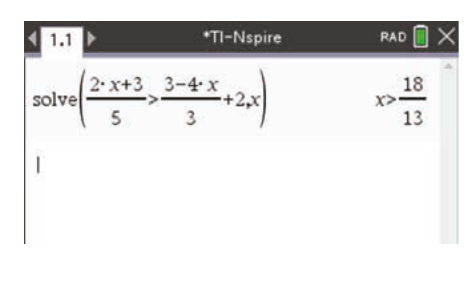
The calculator confirms our solution: .
Summary
Key Points to Remember:
- An inequality uses symbols like , , , or instead of an equals sign
- Solve inequalities the same way as equations, with one key exception
- When multiplying or dividing by a negative number, flip the inequality symbol
- Use a number line to represent solutions – there are usually infinitely many
- Closed circles (•) mean the endpoint is included; open circles (○) mean it's not included