Using and Transposing Formulas (VCE SSCE Mathematical Methods): Revision Notes
📚Revision Notes
Using and Transposing Formulas
What is a formula?
A formula is a mathematical relationship that uses symbols to connect two or more quantities. Formulas allow us to calculate unknown values when we know the values of other variables in the relationship.
Note
For example, the formula expresses the relationship between the area of a rectangle and its dimensions. Here, represents area, represents length, and represents width.
The subject of a formula
The subject of a formula is the variable that we are calculating. It is typically written alone on the left-hand side of the equation. In the formula , the variable is the subject because we can find its value by substituting known values for and .
Example
Worked Example: Finding the area of a rectangle
Find the area of a rectangle with length cm and width cm.
Solution:
Substitute and .
This example demonstrates basic substitution - replacing variables with their given numerical values to calculate the subject of the formula.
Transposing formulas
Sometimes we need to rearrange a formula to make a different variable the subject. This process is called transposing the formula. Transposing uses the same algebraic techniques you learned for solving linear equations - you perform inverse operations to both sides of the equation to isolate the desired variable.
Important
The key principle is maintaining balance: whatever operation you perform on one side of the equation, you must perform on the other side as well.
Example
Worked Example: Transposing a kinematic equation
Transpose the formula to make the subject.
Solution:
Subtract from both sides.
Divide both sides by .
Notice how we reversed the operations: was being multiplied by and then was being added, so we first subtracted , then divided by .
Evaluating unknowns: Two methods
When you need to find the value of a variable that is not currently the subject of the formula, you have two approaches:
- Method 1: Substitute then solve - Replace all known variables with their values first, then solve the resulting equation for the unknown.
- Method 2: Transpose then substitute - Rearrange the formula to make the unknown variable the subject first, then substitute the known values.
Note
Both methods will give you the same answer. Choose the method that feels most comfortable or that makes the calculation simpler.
Example
Worked Example: Comparing both methods
Evaluate if , and , , and .
Method 1: Substitute then solve
First substitute , , and .
Then solve for .
Method 2: Transpose then substitute
First, we rearrange the formula to make the subject:
Now substitute the known values:
Both methods produce the same answer. Method 1 can be quicker for simple calculations, while Method 2 gives you a general formula you can reuse.
Example
Worked Example: Path around a rectangular lawn
A path metres wide surrounds a rectangular lawn. The lawn is metres long and metres wide. The total area of the path is m².
a) Find in terms of , , and .
b) Find in terms of , , and .
c) Find the value of if , , and .
Solution:
a) First, visualise the problem:
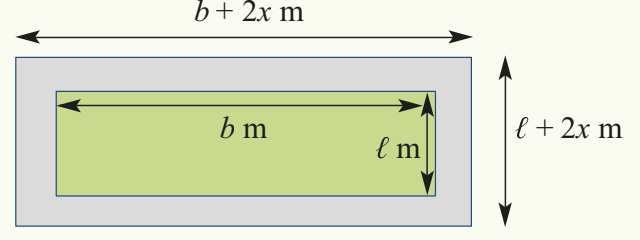
The overall dimensions are by because the path adds metres on each side.
The area of the path equals the total area minus the lawn area:
Expanding the brackets:
The terms cancel:
b) To make the subject, we need to isolate terms containing :
Therefore:
c) Substitute the given values into the expression for :
Therefore, the width of the lawn is 15 metres.
Advanced transposing techniques
More complex formulas may involve square roots, fractions, or reciprocals. The key is to identify which operations have been applied to the variable you want to isolate, then undo those operations in reverse order.
Example
Worked Example: Transposing formulas with square roots and fractions
For each of the following, make the subject of the formula:
a)
b)
Solution:
a)
To eliminate the square root, square both sides of the equation:
Now isolate :
b)
First, establish a common denominator on the left-hand side:
Take the reciprocal of both sides (flip both fractions):
Therefore:
This example shows how reciprocals can be useful when dealing with fractions. When you have a fraction equal to another fraction, taking reciprocals of both sides can simplify the equation.
Using technology for complex transposing
While understanding the manual process of transposing formulas is essential, technology can help verify your work or assist with particularly complex rearrangements.
Note
Exam tip: CAS calculators can verify your work or help with particularly complex rearrangements.
On the TI-Nspire:
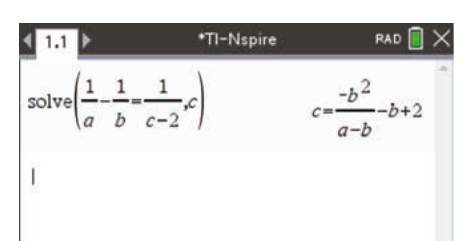
Use the solve() function from the Algebra menu to make a variable the subject of a formula.
On the Casio ClassPad:
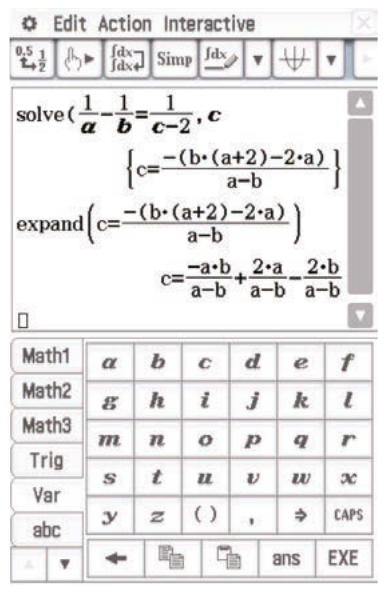
Use the solve function followed by the variable you want to isolate (e.g., , c). The expand function under Interactive > Transformation can produce neater answers.
Summary
Key Points to Remember:
- A formula is a mathematical relationship between two or more variables expressed using symbols
- The subject of a formula is the variable being calculated, typically isolated on one side of the equation
- Transposing means rearranging a formula to make a different variable the subject
- When transposing, use inverse operations in reverse order: if something was added, subtract it; if something was multiplied, divide by it
- You can evaluate unknowns using two methods: substitute then solve, or transpose then substitute - both give the same answer
- For complex formulas involving square roots, square both sides; for fractions, consider using common denominators or reciprocals