Particle-Like Properties of Light (VCE SSCE Physics): Revision Notes
📚Revision Notes
Particle-Like Properties of Light
Introduction to quantum physics
Modern technology depends heavily on quantum physics. Devices such as silicon chips, lasers, optical fibres, GPS and MRI scanners all rely on applications of quantum theory.
In the late 19th century, physicists believed they had solved most of the major problems in physics. However, a few puzzling phenomena remained unexplained:
- The blackbody problem: How hot objects emit electromagnetic radiation
- The photoelectric effect: How light can cause electrons to be ejected from metal surfaces
Classical physics could not explain these observations. Max Planck solved the blackbody problem by proposing that energy comes in discrete quantities called quanta. Albert Einstein then applied this idea to explain the photoelectric effect, marking a crucial step in the development of quantum physics.
The photoelectric effect
What is the photoelectric effect?
The photoelectric effect occurs when light shining onto a metal surface causes electrons to be ejected from that surface. This phenomenon was first observed by Heinrich Hertz in 1887, and Philipp Lenard identified in 1902 that the emitted particles were electrons.
Demonstration with simple apparatus
The photoelectric effect can be demonstrated using basic equipment.
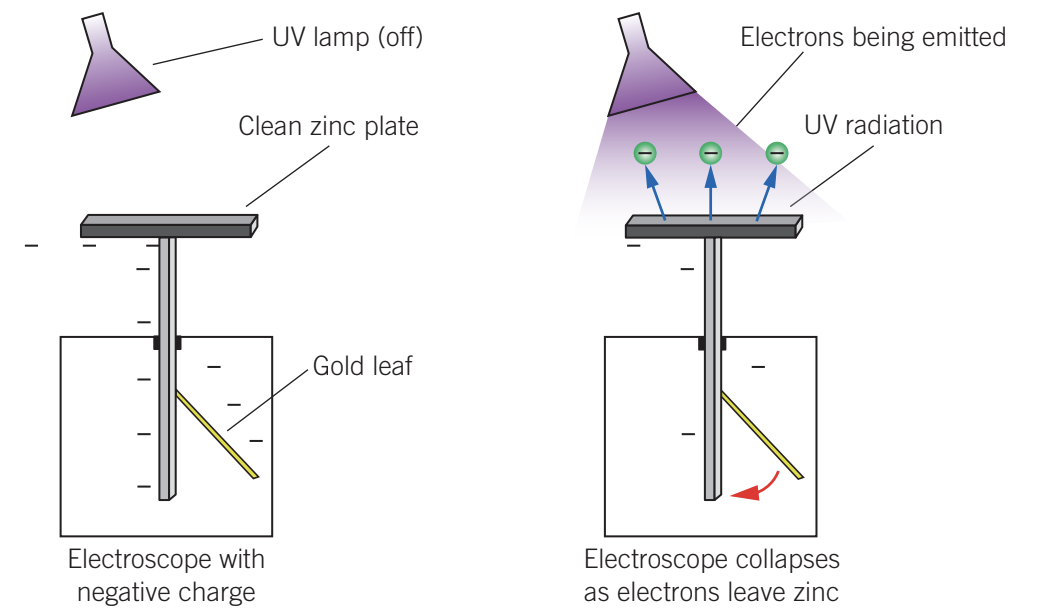
In this demonstration:
- A clean zinc plate is placed on top of a negatively charged electroscope (a device that detects electric charge)
- When ultraviolet (UV) light shines on the zinc plate, electrons are ejected
- The loss of negative charge causes the gold leaf to collapse back towards the stand
- This rapid discharge indicates electrons are escaping from the metal surface
Note
The electroscope provides a simple visual demonstration of the photoelectric effect. The collapse of the gold leaf directly shows the loss of electrons from the zinc surface when UV light strikes it.
A more sophisticated setup
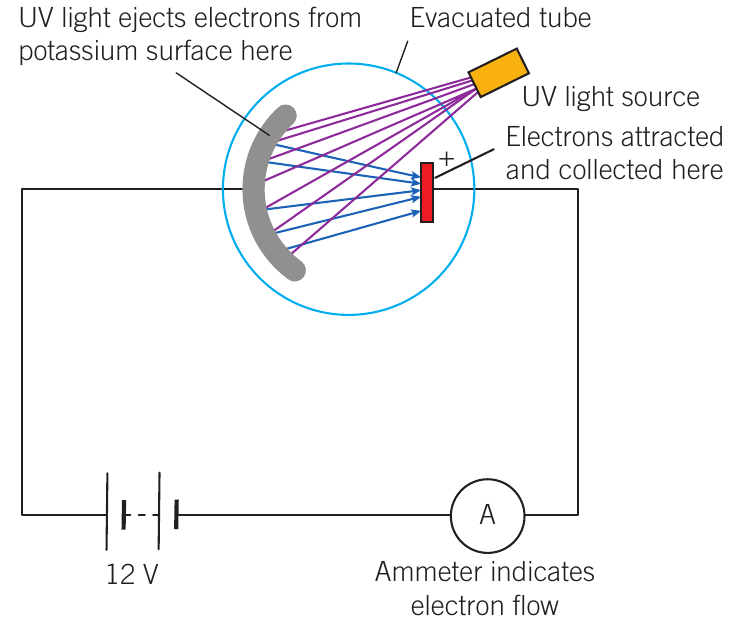
This apparatus uses potassium as the metal surface. When light strikes the potassium:
- Electrons are emitted from the metal
- They travel across the evacuated tube to the positive electrode
- This completes the circuit, and current flows through the ammeter
Key experimental observations
Early experiments revealed several important features:
Important
- Threshold frequency exists: Below a certain frequency of light, no electrons are emitted, regardless of light intensity
- Different metals have different thresholds: For example, zinc requires UV light, while potassium emits electrons with visible light
- Frequency matters more than intensity: The threshold frequency varies between metals
Measuring photoelectron energy
Experimental apparatus
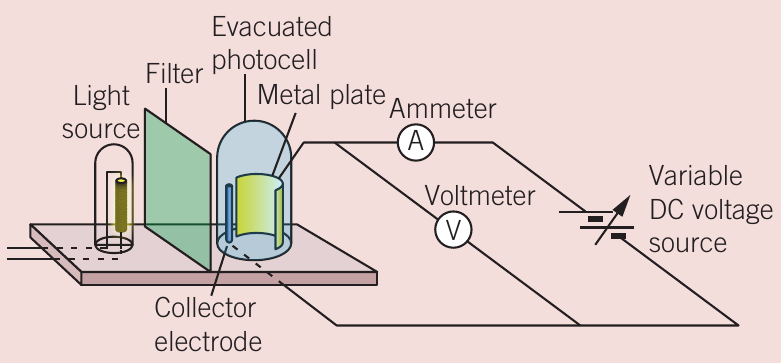
To measure the energy of emitted electrons (called photoelectrons), more complex equipment is needed.
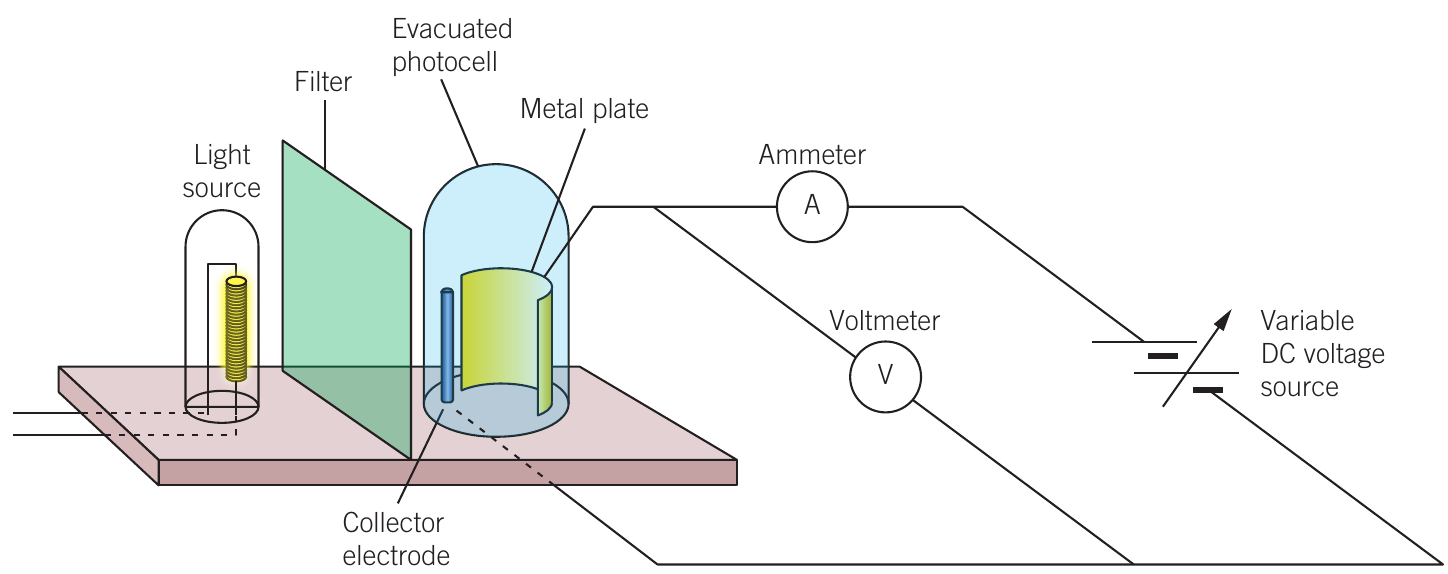
This apparatus includes:
- Light source: A hot filament producing white light
- Filter: Allows nearly monochromatic (single-frequency) light to pass
- Photocell: An evacuated glass tube protecting the metal plate from oxidation
- Metal plate: Surface from which photoelectrons are emitted
- Collector electrode: Captures the emitted photoelectrons
- Variable DC voltage source: Creates a retarding potential to oppose electron movement
- Ammeter: Measures current
- Voltmeter: Measures potential difference
Note
The photocell is evacuated (contains no air) to allow free movement of photoelectrons and to prevent the metal surface from oxidising. This ensures accurate measurements and maintains the metal's properties throughout the experiment.
Energy units: the electronvolt
Photoelectron energies are conveniently measured in electronvolts (eV):
- is the energy an electron gains or loses when moving through a potential difference of volt
- In joules:
- Common multiples: and
- Conversion:
Note
The electronvolt is particularly useful in quantum physics because it provides convenient numbers when dealing with atomic and subatomic energies. Working in joules would require constantly managing very small powers of ten.
Understanding stopping potential
The DC voltage source is connected to oppose the motion of electrons (retarding potential). By gradually increasing this voltage:
- Less energetic electrons are turned back
- The ammeter current decreases
- Eventually the current reaches zero
At this point, the voltage reading gives the maximum kinetic energy of the photoelectrons in eV. A reading of V means the maximum electron kinetic energy is eV.
The stopping potential () is the minimum potential difference needed to just stop the most energetic photoelectrons.
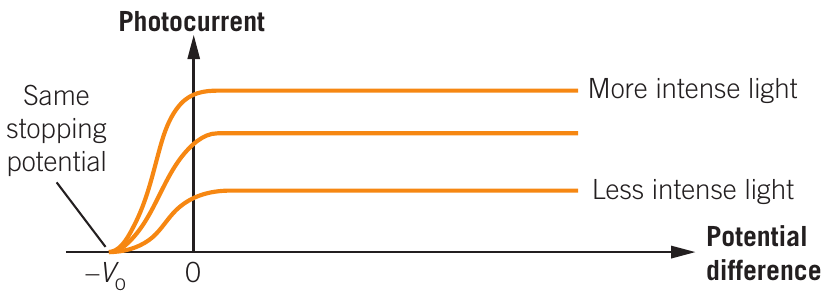
Photocurrent versus potential difference
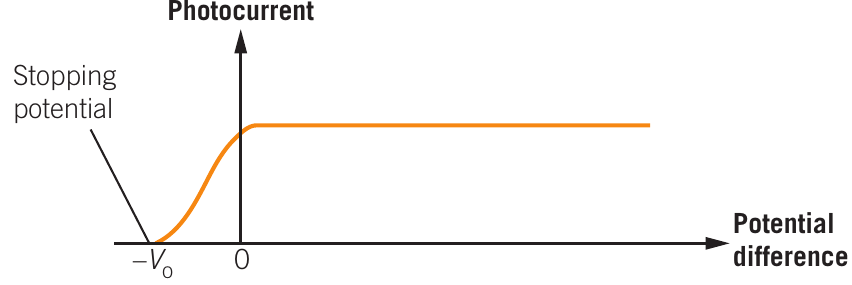
This graph shows typical behaviour:
- At the stopping potential (), current just reaches zero
- The stopping potential gives the maximum kinetic energy of photoelectrons in eV
- When the potential is attractive (positive), the graph levels off as all photoelectrons are collected
- The flat region indicates saturation - all emitted electrons are being captured
Effect of light intensity
Surprising results
When investigating how light intensity affects photoelectron energy, researchers made surprising discoveries:
At constant frequency:
- More intense light produces more photoelectrons
- However, their kinetic energy does not increase
- The stopping potential remains the same
- There is no time delay in photoelectron emission, even with very dim light
Important
This graph demonstrates that changing intensity (at fixed frequency) affects the number of photoelectrons emitted (photocurrent) but not their maximum energy (same stopping potential).
These results contradicted the wave model of light, which predicted that more intense light should transfer more energy to electrons.
Effect of light frequency
Millikan's experiments
Robert Millikan conducted careful measurements showing that frequency directly affects photoelectron kinetic energy.
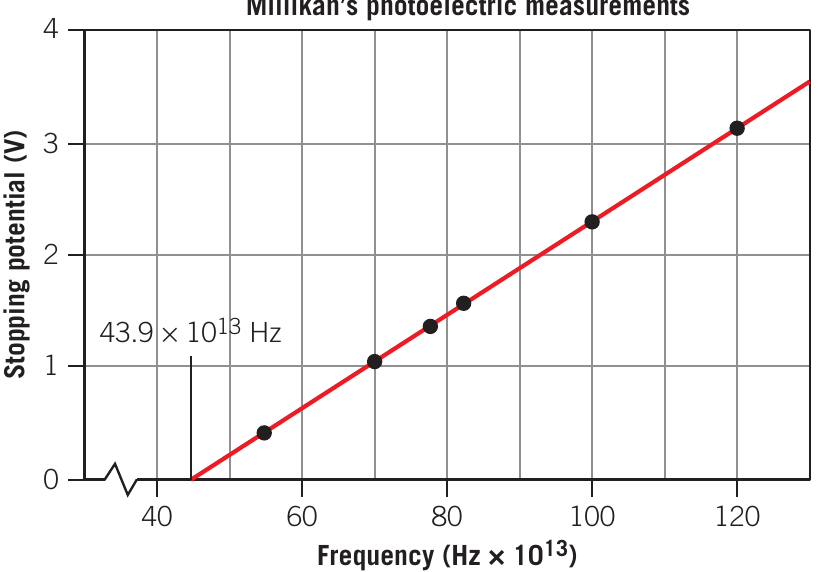
His results for potassium showed:
- A linear relationship between frequency and stopping potential
- Below Hz, no electrons are ejected
- Higher frequencies produce photoelectrons with greater kinetic energy
Comparing different metals
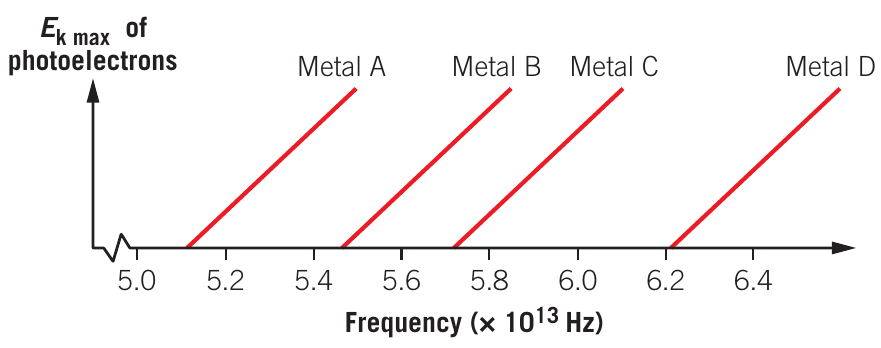
This graph compares four different metals:
- All show the same gradient (slope)
- Each metal has a different threshold frequency (x-intercept)
- Different metals require different minimum energies to release electrons
Note
Photoelectrons from Metal D at frequency Hz have much less kinetic energy than those from other metals at the same frequency. This indicates that some metals hold their electrons more tightly than others - a property we'll see is related to the work function.
Einstein's explanation
The photon model
In 1905, Einstein proposed a revolutionary explanation using Planck's idea of energy quantisation. He suggested that light consists of discrete packets of energy called quanta (later renamed photons).
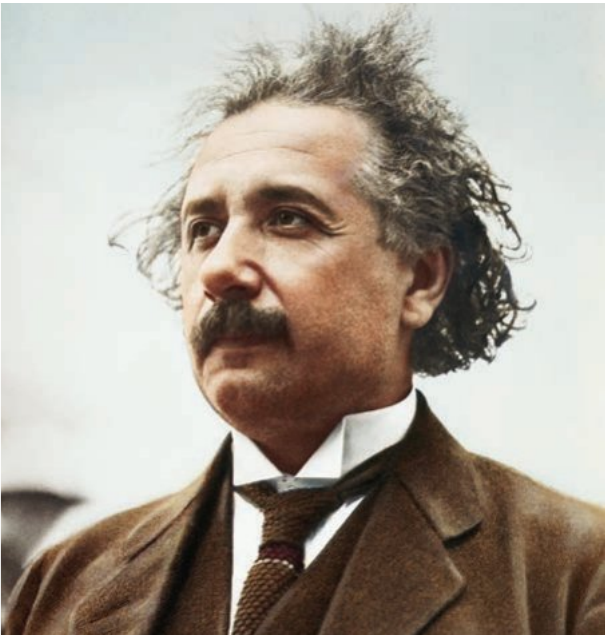
Einstein received the Nobel Prize in 1921 for this work, which was initially controversial as it contradicted the well-established wave model of light.
Energy of a photon
Einstein proposed that each photon carries energy given by:
Where:
- = energy of the photon (J or eV)
- = Planck's constant = J s (or eV s)
- = frequency of the light (Hz)
- = speed of light =
- = wavelength of the photon (m)
This formula shows that:
- Higher frequency light carries more energy per photon
- Energy is directly proportional to frequency
- Energy is inversely proportional to wavelength
The photoelectric effect equation
Einstein proposed that when a photon strikes a metal surface:
- An electron absorbs the entire photon energy
- Some energy is used to escape the metal (the work function, )
- The remaining energy becomes the electron's kinetic energy
This is expressed mathematically as:
Where:
- = maximum kinetic energy of emitted photoelectrons (J or eV)
- = Planck's constant
- = frequency of incident light (Hz)
- = work function of the metal (J or eV)
Work function
The work function () is:
- The minimum energy required to release a photoelectron from a metal surface
- A property of the metal, independent of the light source
- Different for each type of metal
Threshold frequency
From Einstein's equation, we can find the threshold frequency - the minimum frequency needed to emit photoelectrons:
At threshold:
Therefore:
Important
Below this frequency, photons don't have enough energy to overcome the work function, so no photoelectrons are emitted regardless of the light intensity.
Graphical representation
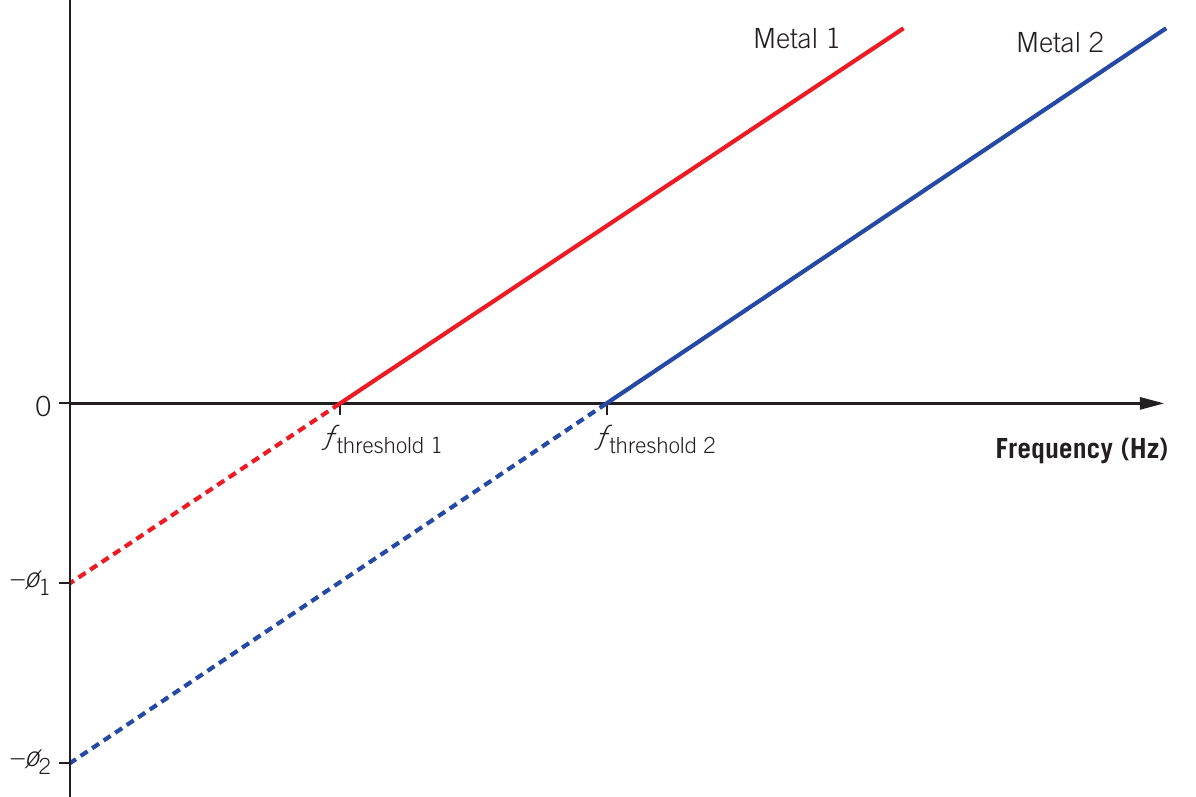
Einstein's equation can be graphed as a straight line for any metal:
- Gradient: equals Planck's constant, (in J s or eV s)
- x-intercept: gives the threshold frequency (Hz)
- y-intercept: gives the negative work function, (J or eV)
Note
Different metals produce parallel lines (same gradient) with different intercepts, reflecting their different work functions and threshold frequencies. The fact that all metals show the same gradient provides strong evidence for the universality of Planck's constant.
Worked example: photoelectric calculations
Consider a photoelectric experiment using a caesium metal plate.
Example
Worked Example: Photoelectric Calculations with Caesium
Part a: Green light with frequency Hz passes through the filter. Calculate the photon energy in electronvolts.
Solution: Using with eV s:
Part b: The work function of caesium is eV. Calculate the maximum kinetic energy of photoelectrons in joules.
Solution: Using :
Converting to joules:
Part c: The filter is changed to allow violet photons with energy eV. Calculate the maximum speed of emitted photoelectrons. (Electron mass = kg)
Solution: First find maximum kinetic energy:
Converting to joules:
Using , rearrange for speed:
Limitations of the wave model
Why classical wave theory fails
The photoelectric effect revealed several experimental observations that classical wave theory could not explain:
1. No time delay with dim light
Wave prediction: Dim light has low energy wavefronts, so electrons should need time to accumulate enough energy to escape.
Observation: Photoelectrons are emitted instantly, even with extremely faint light.
Photon explanation: Each electron receives energy from a single photon in one interaction - no accumulation time needed.
2. Existence of threshold frequency
Wave prediction: Sufficiently intense light of any frequency should eventually provide enough energy to liberate electrons.
Observation: Below the threshold frequency, no photoelectrons are emitted, regardless of light intensity.
Photon explanation: Each photon must have energy . Low-frequency photons never have enough individual energy.
3. Intensity affects number, not energy
Wave prediction: More intense light should transfer more energy to electrons, increasing their kinetic energy.
Observation: More intense light produces more photoelectrons, but their maximum kinetic energy remains unchanged.
Photon explanation: Intensity depends on the number of photons. More photons mean more interactions, but each interaction transfers the same energy .
4. Photoelectron energy depends on frequency
Wave prediction: Wave energy depends on both amplitude and frequency, but the clear linear relationship with frequency alone is difficult to explain.
Observation: Maximum photoelectron kinetic energy increases linearly with frequency above threshold.
Photon explanation: Each photon's energy is , so higher frequency directly means more energy per photon, giving electrons more kinetic energy after escaping.
Important
Why the wave model fails:
The wave model predicts that energy is distributed continuously across the wavefront, so all of these observations contradict fundamental wave principles. The photon model successfully explains all experimental observations by treating light as discrete packets of energy.
Understanding intensity in the photon model
Intensity is the product of:
- The number of photons per second
- The energy of each photon ()
Important consequence: If intensity is kept constant while frequency changes:
- Increasing frequency → fewer photons (to maintain constant total energy)
- Decreasing frequency → more photons (to maintain constant total energy)
Note
This relationship explains why changing frequency affects photoelectron energy while changing intensity (at constant frequency) only affects the number of photoelectrons emitted.
Summary
Key Points to Remember:
-
The photoelectric effect occurs when light causes electrons to be ejected from metal surfaces, providing key evidence for the particle nature of light
-
Threshold frequency is the minimum frequency required to emit photoelectrons; it varies between different metals
-
Photon energy is given by , showing that energy increases with frequency
-
Einstein's photoelectric equation is , where is the work function
-
The work function is the minimum energy needed to release an electron from a specific metal surface
-
Stopping potential (in volts) numerically equals the maximum photoelectron kinetic energy (in eV)
-
Increasing light intensity at fixed frequency produces more photoelectrons but does not increase their kinetic energy
-
The wave model of light cannot explain the threshold frequency, instantaneous emission, or why photoelectron energy depends on frequency rather than intensity