Springs (VCE SSCE Physics): Revision Notes
📚Revision Notes
Springs
Introduction: Elasticity in nature
Springs are found throughout nature and technology. One remarkable example is in animal tendons, which are connective tissues made mainly of collagen fibres that attach muscles to bones.

When animals move at high speeds, they use elastic energy storage in tendons and ligaments to conserve energy. When a runner's foot strikes the ground, their Achilles tendon stretches and stores elastic potential energy. As the runner pushes off, this stored energy is released, helping propel them forward. This energy recovery system is remarkably efficient, typically returning 5-13% of the mechanical energy used in movement.

Note
Kangaroos and wallabies are exceptional at this energy storage mechanism. Their unusually long tendons can store much larger amounts of elastic potential energy than human tendons. This allows kangaroos to hop at high speeds whilst using very little energy, making them more than twice as mechanically efficient as humans when running.
What is elasticity?
Elastic materials
When you compress, extend or twist certain materials, they store energy by changing shape. If these materials then return to their original shape when you release them, we call them elastic materials. An elastic material is one that can store elastic potential energy and return to its original shape once the energy is released.
Many solid materials demonstrate elastic behaviour, including rubber, neoprene and steel. These materials are used extensively in engineering and everyday applications because of their ability to store and release energy predictably.

In contrast, plastic materials are those that deform permanently when stressed, even slightly. Mud, clay and plasticine are examples of plastic materials that do not return to their original shape after being deformed.
Elastic limit
Every elastic material has an elastic limit. This is the maximum stress or deformation that the material can withstand without causing permanent deformation. If you stretch or compress an elastic material beyond its elastic limit, it will not return to its original shape and may be permanently damaged.
Important
Understanding the elastic limit is crucial in engineering applications. For example, vehicle suspension springs must operate well within their elastic limits to ensure they function properly over many cycles of compression and extension.
Hooke's law
Springs have been used in machines and devices for over 300 years. They appear in toys, pens, electronics, mattresses, medical devices, automatic watches, mining equipment and vehicles. We can use springs so effectively because we understand their predictable behaviour.
The relationship between force and extension
In 1676, British physicist Robert Hooke discovered a fundamental property of springs. Hooke's law states that in an ideal spring, the force applied to the spring is directly proportional to its extension or compression.
An ideal spring is a theoretical concept - a spring that is frictionless, has no mass, and perfectly obeys Hooke's law. Whilst no real spring is truly ideal, many springs behave very close to this ideal model within their working range.
To understand Hooke's law, imagine a spring resting horizontally with no force applied. The spring has zero extension. Now apply different forces:
- When you apply 50 N of force, the spring extends by 0.2 m
- When you apply 100 N of force, the spring extends by 0.4 m
- When you apply 150 N of force, the spring extends by 0.6 m
Notice the pattern: doubling the force doubles the extension. This linear relationship is the essence of Hooke's law.
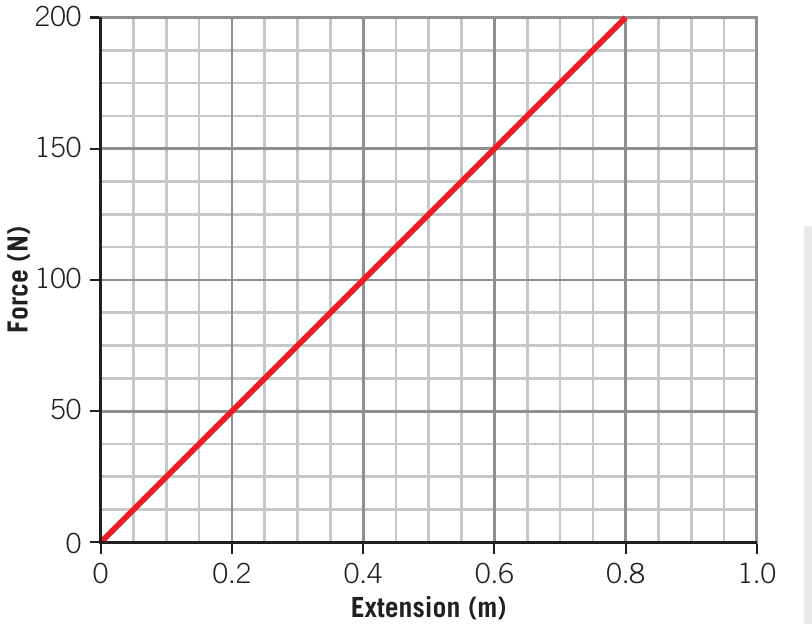
Understanding force-extension graphs
When we plot force against extension for an ideal spring, we get a straight line passing through the origin. This straight line demonstrates that force is directly proportional to extension - the key principle of Hooke's law.
The spring constant
The gradient (slope) of a force-extension graph is called the spring constant, represented by the symbol . The spring constant tells us about the stiffness of a spring.
Since we calculate the gradient by dividing force (in newtons) by extension (in metres), the unit for spring constant is N m (newtons per metre).
For the graph shown above, we can calculate the spring constant:
What does spring constant tell us?
The spring constant gives us a measure of how stiff a spring is:
- A higher spring constant means the spring is stiffer - it requires more force to produce the same extension
- A lower spring constant means the spring is less stiff - it requires less force to produce the same extension
For example, a spring with N m is twice as stiff as a spring with N m. To extend both springs by the same amount, you would need twice as much force for the stiffer spring.
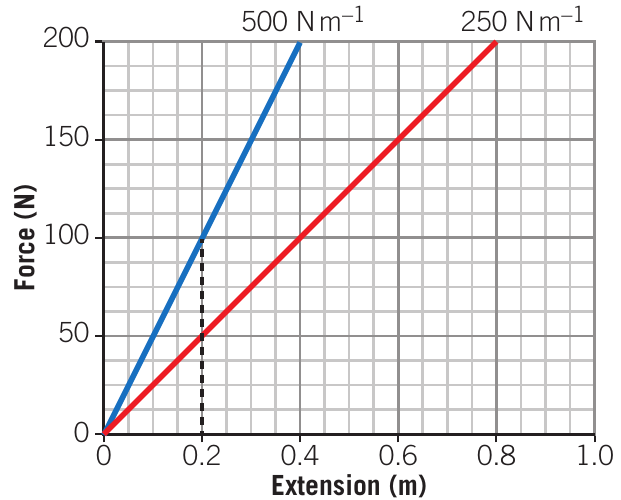
The graph above compares two springs. The steeper blue line represents the stiffer spring ( N m), whilst the gentler red line represents the less stiff spring ( N m).
Mathematical formula for Hooke's law
We can express Hooke's law mathematically:
Formula:
Where:
- = Force applied to the spring (N)
- = Spring constant (N m)
- = Extension or compression of the spring (m)
Note
The negative sign indicates that the spring's restoring force acts in the opposite direction to the extension or compression. When you pull a spring to extend it, the spring pulls back. When you push a spring to compress it, the spring pushes back. For most calculations in this course, we work with the magnitude of the force and can omit the negative sign:
This formula works not just for springs, but for all solid elastic materials within their elastic limits.
Example
Worked Example: Hooke's Law and Suspension
Problem: A car drives over a speed bump, applying a force of 750 N to the shock-absorbing spring. The spring has a spring constant of N m. Calculate the compression of the spring.
Solution:
Starting with Hooke's law:
Rearrange to make the subject:
Substitute the values:
The spring compresses by 0.0560 m (or 5.60 cm).
Example
Worked Example: Reading a Force-Compression Graph
Problem: Engineers test two springs (A and B) for mining equipment. The force-compression graph is shown below.
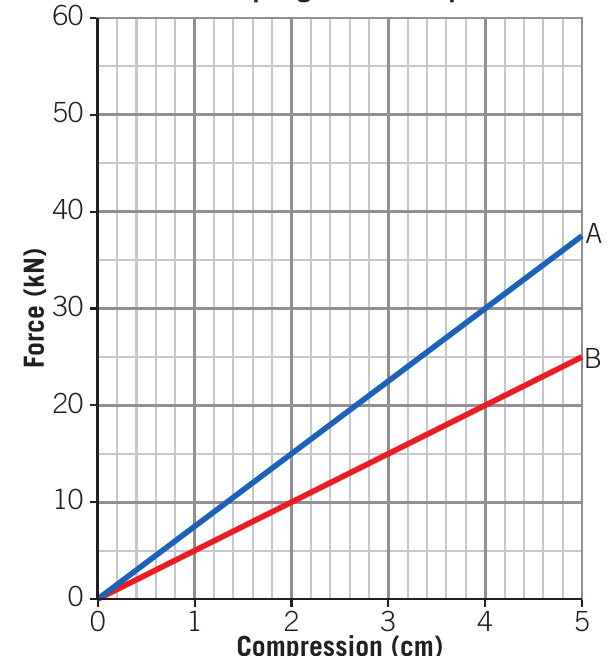
(a) Calculate the spring constant of each spring and identify which is stiffer.
(b) The engineers need a spring that compresses by 70-80 cm when 500 kN is applied. Which spring is appropriate?
Solution:
(a) First, convert units to SI standard (kN to N, cm to m).
For spring A:
For spring B:
Spring A is stiffer because it has a greater spring constant.
(b) Rearrange Hooke's law to find compression:
For spring A:
For spring B:
Only spring A meets the requirement of 70-80 cm compression at 500 kN, so spring A is appropriate.
Elastic potential energy
What is elastic potential energy?
When you compress, extend or twist an elastic material, you store energy in it. This stored energy is called elastic potential energy (sometimes called spring potential energy). When you release the elastic material, it returns to its original shape and the stored energy is released.
Deriving the elastic potential energy formula
Understanding where the elastic potential energy formula comes from helps you remember and use it correctly. Let's think about a force-compression graph:
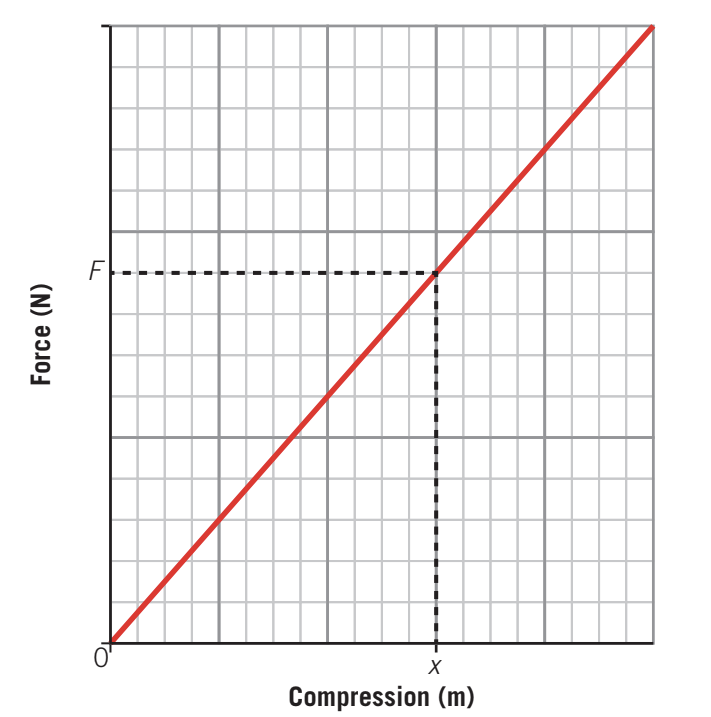
The y-axis shows force (measured in newtons), and the x-axis shows distance (compression or extension, measured in metres). This type of graph is actually a special case of a force-distance graph.
Important
From earlier physics, you may remember that the area under a force-distance graph represents work done. Therefore, the area under a force-compression (or force-extension) graph represents:
- The work done to compress or extend the spring
- The elastic potential energy stored in the spring
For a linear force-extension graph (which we get for an ideal spring obeying Hooke's law), the area under the graph forms a triangle. The area of a triangle is:
where is the extension/compression and is the force.
From Hooke's law, we know that . Substituting this into our area equation:
Formula:
Where:
- = Elastic potential energy (J)
- = Spring constant (N m)
- = Extension or compression of the spring (m)
Example
Worked Example: Elastic Energy of a Spring
Problem: A spring initially at rest has a force of 3.44 kN applied to it. The spring has a spring constant of 2500 N m.
(a) Calculate the extension of the spring.
(b) Calculate the elastic potential energy stored in the spring.
Solution:
(a) First, convert units: N
Using Hooke's law, rearrange to find extension:
(b) Using the elastic potential energy formula:
Example
Worked Example: Calculating Energy from a Graph
Problem: A spring for a medical device is tested and produces the following force-extension data:
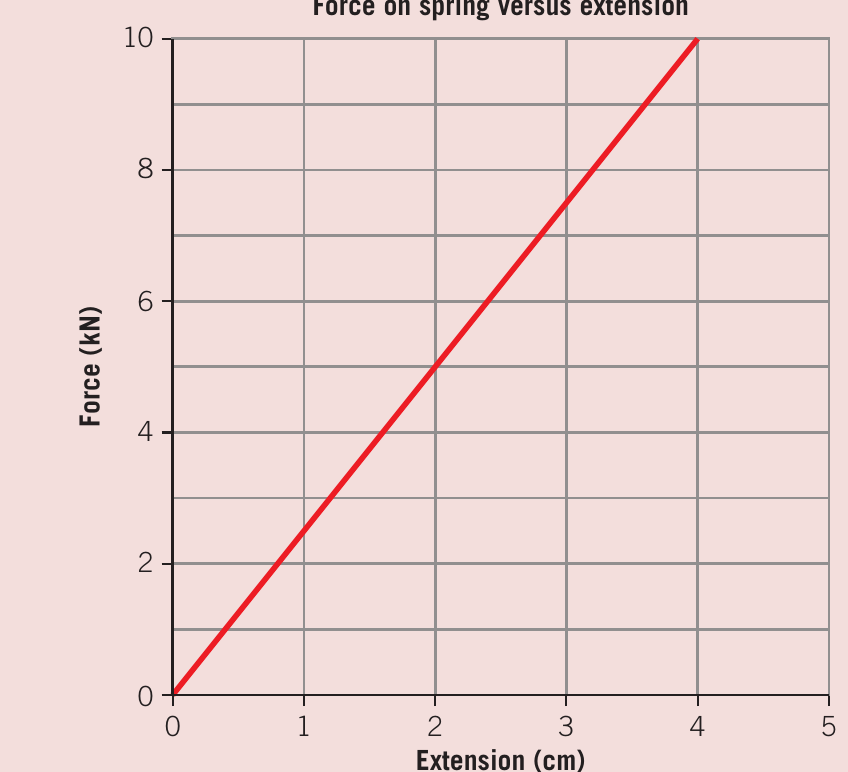
Calculate the elastic potential energy stored when the spring is extended by 2 cm.
Solution:
The elastic potential energy equals the area under the graph up to 2 cm extension.
First, convert units to SI: N, m
The area under the graph forms a triangle:
Alternative method: Find the spring constant from the graph gradient, then use .
Energy required to extend springs
An important concept to understand is that extending a spring requires more energy the more it's already stretched. To extend a spring by 1 cm when it's at rest requires less energy than extending the same spring by 1 cm when it's already stretched.
Note
Why? As the spring extends, the restoring force becomes greater (remember ). To extend the spring further, you must overcome this greater force, which requires more energy.
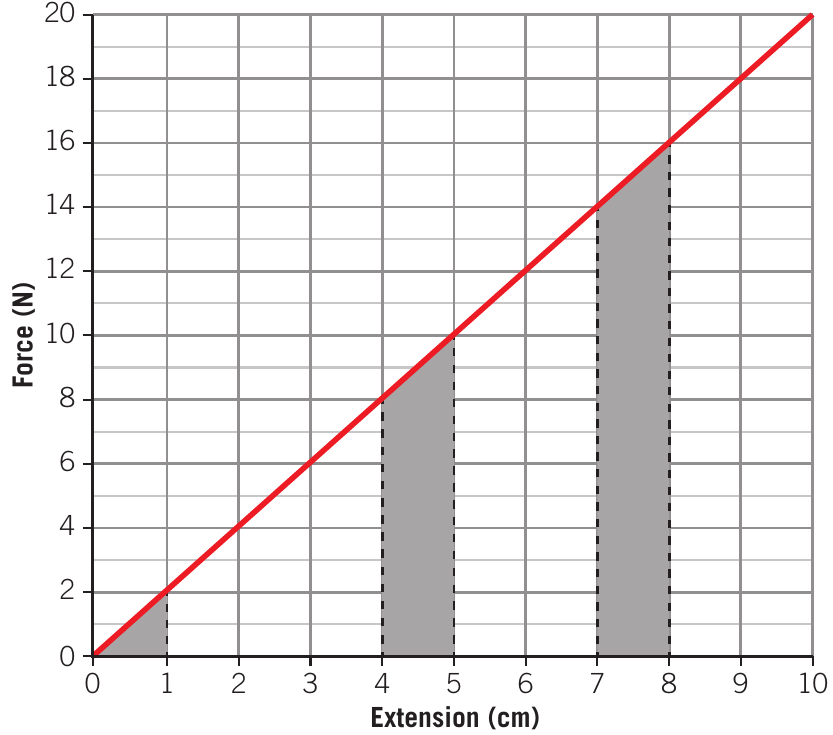
The graph above shows force versus extension for a spring with N m. The shaded regions represent the energy needed to extend the spring by 1 cm at different points. Notice how the shaded area (and therefore the energy required) increases as the spring becomes more extended.
Change in elastic potential energy
When calculating the change in elastic potential energy as a spring moves from one extension to another, you can either:
- Find the area under the graph between the two positions, or
- Calculate the difference:
where is the final extension and is the initial extension.
Example
Worked Example: Energy Released by a Compressed Spring
Problem: A spring of length 40 cm with spring constant 43.5 N m is initially compressed to 30 cm. It is then released back to a length of 35 cm. Calculate the energy released.
Solution:
Initial compression: cm m
Final compression: cm m
Using the change in elastic potential energy:
The negative sign indicates energy is being released (given out) by the spring. The spring does 0.163 J of work as it returns towards its natural length.
Energy transformations in horizontal spring systems
The equilibrium position
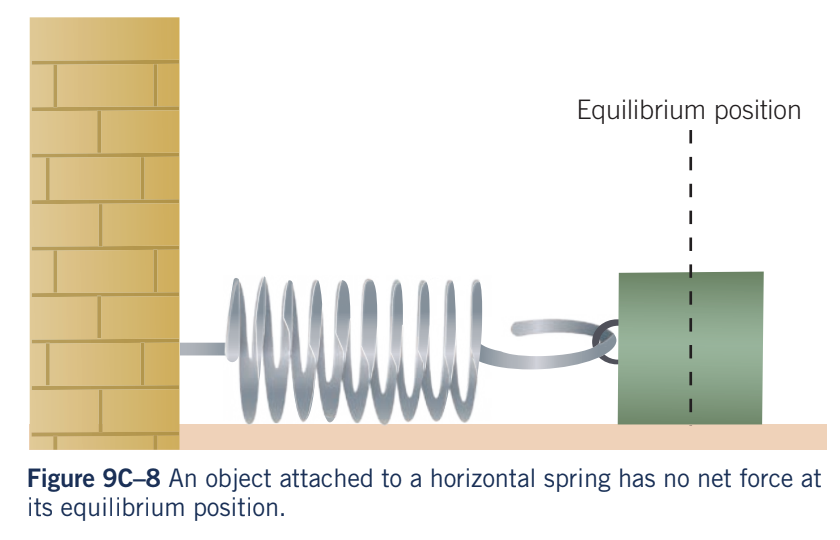
Imagine an ideal spring lying horizontally on a frictionless surface. One end is fixed to a wall, and the other end is attached to an object that can move freely. If you pull the object back and release it, the system will oscillate.
The equilibrium position is where the object has no net force acting on it. For a horizontal spring, this occurs when the spring is at its natural length (neither compressed nor extended). At this position, there is no spring force, and any other forces (like friction, if present) are balanced.
Energy during oscillation
As the spring oscillates, energy continuously transforms between kinetic energy and elastic potential energy. The total energy remains constant (assuming no friction or air resistance).
At any point during oscillation:
or in full:
Where:
- = Total energy (J)
- = Mass of the object (kg)
- = Velocity of the object (m s)
- = Spring constant (N m)
- = Extension or compression from the natural length (m)
The oscillation cycle
Let's follow one complete oscillation, starting when the spring is fully extended:
Position 1 (Maximum extension):
- Spring is fully extended
- Elastic potential energy is maximum
- Kinetic energy is zero (object momentarily at rest)
- Spring force pulls object back towards equilibrium
Moving from Position 1 to Position 2:
- Spring begins to contract
- Elastic potential energy decreases
- Kinetic energy increases
- Object accelerates towards equilibrium
Position 2 (Equilibrium):
- Spring at natural length
- Elastic potential energy is zero
- Kinetic energy is maximum (fastest speed)
- Object continues moving due to momentum
Moving from Position 2 to Position 3:
- Spring begins to compress
- Elastic potential energy increases
- Kinetic energy decreases
- Object slows down
Position 3 (Maximum compression):
- Spring is fully compressed
- Elastic potential energy is maximum
- Kinetic energy is zero (object momentarily at rest)
- Spring force pushes object back towards equilibrium
Returning to Position 1: The cycle then repeats in reverse, with the object accelerating back through the equilibrium position and returning to maximum extension.
Note
Key insight: Maximum speed always occurs at the equilibrium position, where all the energy is kinetic. At maximum extension or compression, all the energy is elastic potential energy and the object is momentarily at rest.
Energy transformations in vertical spring systems
Equilibrium in a vertical spring
For a vertical spring with one end fixed to a ceiling and a mass hanging from the other end, the equilibrium position is different from a horizontal spring. At equilibrium, the spring must be extended enough so that the upward spring force exactly balances the downward weight force.
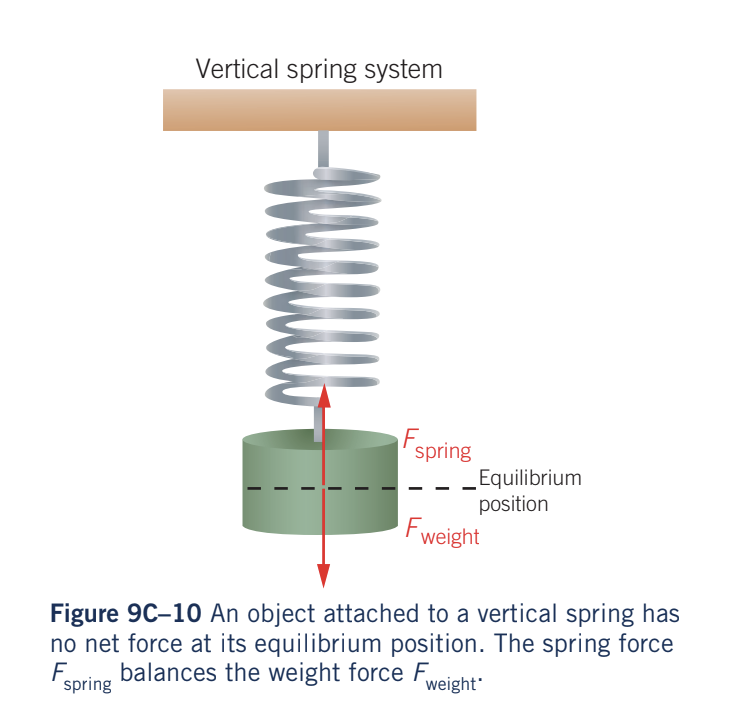
At equilibrium, the forces balance:
Using Hooke's law () and the weight formula ():
Where:
- = Spring constant (N m)
- = Extension of spring at equilibrium (m)
- = Mass (kg)
- = Gravitational field strength (9.8 N kg on Earth)
Energy during vertical oscillation
In a vertical spring system, three forms of energy are important:
- Gravitational potential energy
- Elastic potential energy
- Kinetic energy
As the spring oscillates, energy transforms between these three forms, but the total energy remains constant.
Important
Defining zero gravitational potential energy
Before analyzing a vertical spring system, you must choose where to measure gravitational potential energy from. A convenient choice is to set the zero point at the lowest position of the oscillation. This simplifies calculations.
The oscillation cycle in a vertical spring
Position 1 (Starting point, natural length): When the mass is initially dropped from the spring's natural length:
- Spring potential energy = zero (spring at natural length)
- Kinetic energy = zero (object starts from rest)
- Gravitational potential energy = maximum
- Weight force pulls object downward
Positions 1 to 2 (Moving towards equilibrium):
- Object accelerates downward due to gravity
- Spring potential energy increases (spring extends)
- Kinetic energy increases (object speeds up)
- Gravitational potential energy decreases (object moves down)
Position 2 (Equilibrium):
- Kinetic energy is maximum (fastest speed)
- Spring force balances weight force
- Object continues moving downward due to momentum
Positions 2 to 3 (Beyond equilibrium):
- Object continues moving down but slowing
- Spring potential energy continues to increase
- Kinetic energy decreases
- Gravitational potential energy continues to decrease
- Net force is now upward (spring force > weight)
Position 3 (Lowest point):
- Kinetic energy = zero (object momentarily at rest)
- Gravitational potential energy = zero (by our chosen reference)
- Spring potential energy = maximum
- Spring force pulls object upward
Positions 3 to 4 (Moving upward):
- Spring contracts
- Spring potential energy decreases
- Kinetic energy increases
- Gravitational potential energy increases
Position 4 (Equilibrium again):
- Kinetic energy is maximum
- Object passes through equilibrium moving upward
Returning to Position 1: The object continues upward, slowing down, until it returns to the starting position, and the cycle repeats.
Mathematical relationship for vertical springs
The gravitational potential energy lost by the object transforms into elastic potential energy and kinetic energy:
Where:
- = Mass (kg)
- = Gravitational field strength (9.8 N kg)
- = Change in height = change in spring length (m)
- = Spring constant (N m)
- = Velocity (m s)
This formula allows you to calculate velocities, positions, or spring constants in vertical spring systems.
Exam skills: How to 'explain' your answer
Note
Understanding 'Explain' Questions
Many exam questions ask you to 'explain' your answer. To explain means to present accurate and concise evidence that supports your answer. Let's look at an example:
Question: A mass attached to an ideal spring is dropped and oscillates freely in the vertical direction. When is the velocity of the mass at a maximum? Explain your answer. (3 marks)
Strong answer:
- The velocity is maximum at the equilibrium point, where the spring force balances the weight force. (1 mark)
- At this point, the net force is zero, so acceleration is zero. (1 mark)
- Before this point, the mass accelerates in its direction of travel; after this point, it decelerates. (1 mark)
Key points for explaining answers:
- Look at the mark allocation - this tells you how many distinct points to make
- Answer the specific question asked, not a pre-prepared general answer
- Be clear and concise
- Use bullet points to structure your answer - you won't lose marks for this
- Include relevant physics principles and reasoning
- Link your evidence to your conclusion
Remember!
Summary
Key Concepts to Remember:
-
Hooke's law states that force is directly proportional to extension for an ideal spring:
-
The spring constant () indicates stiffness - higher values mean stiffer springs that require more force for the same extension
-
Elastic potential energy stored in a spring is given by , where the energy increases with the square of the extension
-
In horizontal spring systems, energy oscillates between kinetic energy and elastic potential energy, with maximum speed occurring at the equilibrium position
-
In vertical spring systems, energy transforms between gravitational potential energy, elastic potential energy, and kinetic energy. The equilibrium position occurs where the spring force balances the weight:
-
When extending a spring, more energy is required for each additional unit of extension because you must overcome an increasing restoring force