Momentum and Impulse (VCE SSCE Physics): Revision Notes
📚Revision Notes
Momentum and Impulse
Introduction
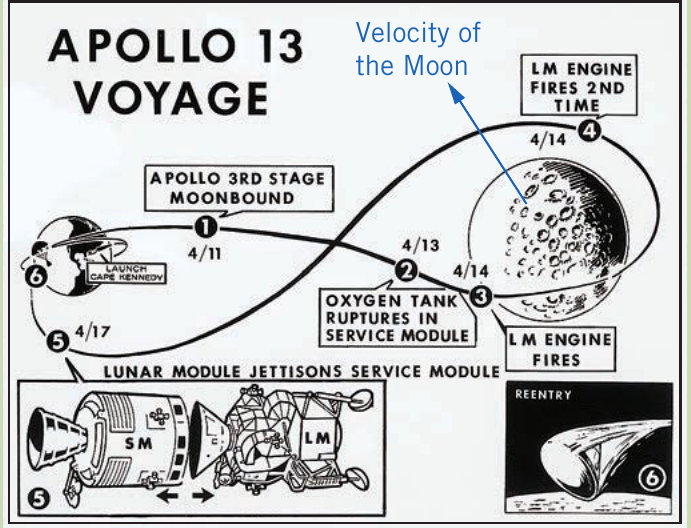
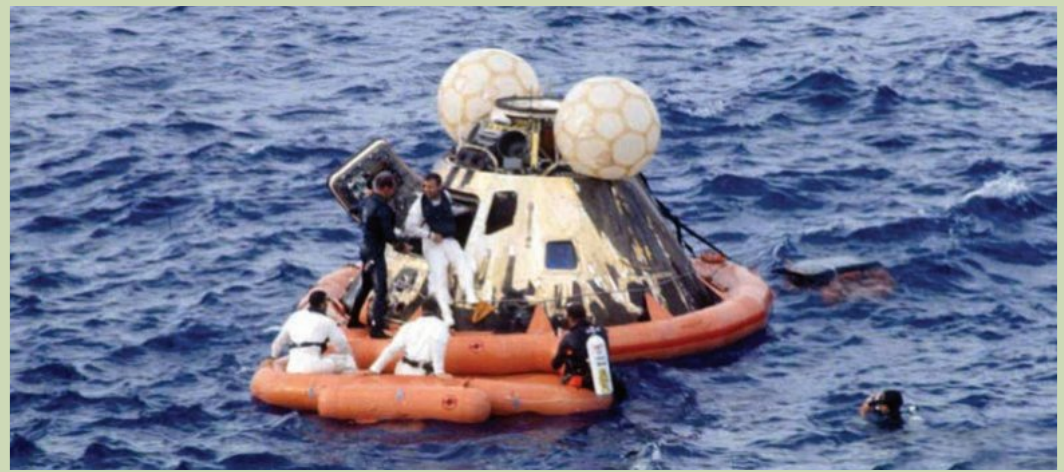
During the Apollo 13 mission, an oxygen tank explosion forced NASA to find an innovative solution to bring the astronauts home safely. The mission control team used a gravitational slingshot manoeuvre around the Moon, which works by transferring some of the Moon's orbital momentum to the spacecraft. This demonstrates momentum in action on a cosmic scale.
Note
The gravitational slingshot manoeuvre is a technique still used today in space exploration. By carefully timing the spacecraft's approach to a celestial body, engineers can use the body's gravity and momentum to alter the spacecraft's trajectory and speed without using fuel. This same principle helped save the Apollo 13 crew.
The successful return of Apollo 13 shows how understanding momentum can solve real-world problems, even in the most challenging circumstances.
Momentum
Momentum describes how much motion an object has. It depends on both how massive the object is and how fast it's moving. A heavy object moving slowly can have the same momentum as a light object moving quickly.
Momentum is defined as the product of an object's mass and its velocity.
Formula for momentum
Where:
- = momentum (kg m s)
- = mass (kg)
- = velocity (m s)
Key properties of momentum
Momentum is a vector quantity, which means it has both magnitude and direction. The direction of momentum is always the same as the direction of velocity. Since momentum depends on velocity, the only way to change an object's momentum is to apply a net force.
Important
Remember: Because momentum is a vector quantity, you must always include direction in your answer. If you only state the magnitude, your answer is incomplete!
Example
Worked Example: Calculating Momentum
Question: Calculate the momentum of a 2450 kg car driving at 81 km h north.
Solution:
First, convert the velocity to SI units:
Now apply the formula:
Conservation of momentum
One of the most important principles in physics is that momentum is always conserved when objects collide, provided there are no external forces acting on the system. This means the total momentum before a collision equals the total momentum after the collision.
Formula for conservation of momentum
Where:
- = mass of the first object (kg)
- = mass of the second object (kg)
- = initial velocity of the first object (m s)
- = initial velocity of the second object (m s)
- = final velocity of the first object (m s)
- = final velocity of the second object (m s)
Important
External Forces: Momentum is only conserved when there are no external forces acting on the system. External forces like friction or air resistance can cause the total momentum to change. Always check whether you can assume these forces are negligible!
Sign convention for one-dimensional collisions
When dealing with collisions in one dimension (objects moving in a straight line), you must use positive and negative signs to indicate direction. Choose one direction as positive and the opposite as negative. If a diagram isn't provided, draw your own to help visualise the problem.
Note
Tip for Success: Always establish your sign convention at the start of the problem by stating which direction is positive. This prevents sign errors and makes your working clearer. For example, write "Let north be positive" or "Let movement to the right be positive."
Example
Worked Example: Collision Between Two People
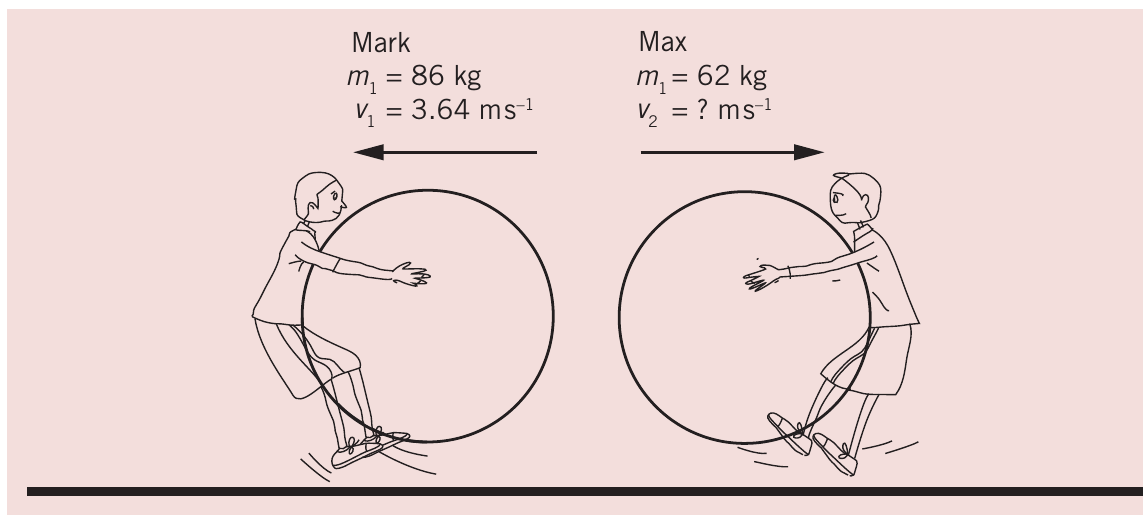
Question: In a physical education class, Mark (86 kg) and Max (62 kg) hold inflatable fit balls and run towards each other. Mark runs at 4.35 m s north, and Max runs at 5.55 m s south. After the collision, Mark moves at 3.64 m s south. Calculate Max's velocity after the collision.
Solution:
Let north be positive. This means south is negative.
Before the collision:
- Mark: m s
- Max: m s
After the collision:
- Mark: m s
- Max:
Apply conservation of momentum:
The positive value indicates Max is moving north.
Sticky collisions (perfectly inelastic)
Sometimes two objects collide and stick together, moving as a single combined mass after the collision. In these cases, the final mass equals the sum of the initial masses:
where
Example
Worked Example: Sticky Collision
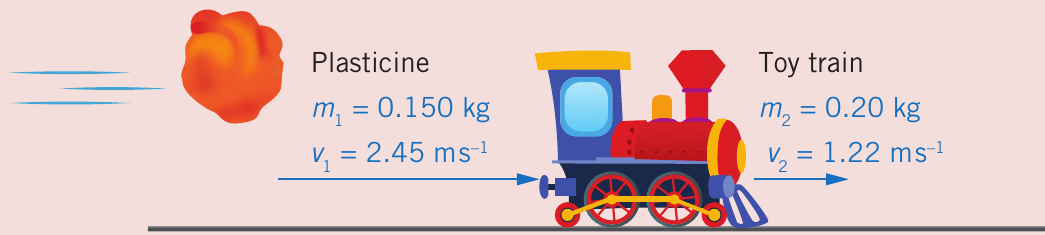
Question: A 200 g toy train moves at 1.22 m s south when a 150 g piece of plasticine is thrown at it, travelling at 2.45 m s south. The plasticine sticks to the train. Calculate the velocity of the combined system after the collision.

Solution:
Convert masses to SI units: kg, kg
Let south be positive.
The positive value indicates the direction is south.
Explosive collisions
In explosive collisions, a single object breaks apart into two or more pieces. Conservation of momentum still applies:
where
Note
Explosive collisions include scenarios like:
- Firing a projectile from a launcher
- A person jumping off a skateboard
- Throwing an object while moving
- Actual explosions where objects fragment
In all these cases, the total momentum before equals the total momentum after.
Example
Worked Example: Explosive Collision
Question: Shen rides a bicycle at 18 km h west when he throws a 500 g football at 36 km h west. Calculate Shen's final velocity, given that he and the bicycle have a combined mass of 59 kg.
Solution:
Convert to SI units:
- m s
- m s
- kg
Let west be positive.
Inertia
Inertia is a body's tendency to resist changes in its state of motion. This could mean staying at rest or continuing to move at constant velocity.
Key differences between momentum and inertia
It's crucial to understand that momentum and inertia are different concepts:
- An object at rest has zero momentum but still has inertia
- Inertia depends only on mass - the greater the mass, the greater the inertia
- Momentum depends on both mass and velocity
Important
Common Misconception: Many students confuse inertia with momentum. Remember: a stationary object has NO momentum (because ), but it DOES have inertia (resistance to changes in motion). Inertia is why it's harder to push a heavy object than a light one, even when both are stationary.
For example, an 80 kg person travelling at 0.175 m s has the same momentum as a 0.02 kg bullet travelling at 700 m s, but the person has much greater inertia due to their larger mass.
Change in momentum and impulse
When an object's velocity changes, its momentum changes too. An increase in velocity means an increase in momentum, whilst a decrease in velocity means a decrease in momentum.
Formula for change in momentum
Where:
- = change in momentum (kg m s or N s)
- = mass (kg)
- = final velocity (m s)
- = initial velocity (m s)
Change in momentum is a vector quantity, so it always needs both magnitude and direction.
Example
Worked Example: Calculating Change in Momentum
Question: An archer fires a 32.0 g arrow at 79.0 m s east towards a stationary target. When the arrow hits the target, it takes 0.1 ms to stop. Calculate the change in momentum of the arrow.
Solution:
Convert to SI units: kg
Let east be positive.
The negative sign indicates the direction of the change in momentum is west.
Impulse
Remember that the only way to change an object's momentum is to apply a net force. If you want to find the average force during the time the force is applied, you can use:
Replacing with :
Therefore:
This change in momentum can also be called impulse, represented by .
Impulse is the change in momentum of an object, caused by a force acting for a certain amount of time.
Formula for impulse
Where:
- = impulse (kg m s or N s)
- = average force applied (N)
- = time that the force is applied (s)
- = change in momentum (kg m s or N s)
Note
Impulse is a vector quantity with units of N s, which is equivalent to kg m s. These units can be used interchangeably - they represent the same physical quantity!
Example
Worked Example: Impulse
Question: A driver travels at 54 km h north, then slows to 9 km h over a speed bump. The braking takes 3.45 s, and the car and its contents have a mass of 1650 kg.
a) Calculate the change in momentum of the car.
b) Calculate the average force on the car as it slowed down, including direction.
Solution:
a) Convert to SI units:
Let north be positive.
The negative sign indicates the direction is south.
b) Using impulse formula:
The negative sign indicates the direction is south.
Elastic and inelastic collisions
Collisions can be classified based on whether kinetic energy is conserved.
Elastic collisions
In elastic collisions, total kinetic energy is conserved. The total kinetic energy before the collision equals the total kinetic energy after the collision. Elastic collisions commonly occur between gas molecules. However, perfectly elastic collisions are rare for larger objects, as some energy is usually converted to heat, sound, and deformation.
Inelastic collisions
In inelastic collisions, the total kinetic energy before the collision is greater than the total kinetic energy after. Some energy is converted to heat, sound, and deformation of materials. In a 100% inelastic collision, the two objects stick together and all kinetic energy is transformed.
Important
Key Distinction: While momentum is ALWAYS conserved in collisions (assuming no external forces), kinetic energy is only conserved in elastic collisions. This is a crucial difference that many students overlook!
Determining collision type
To determine whether a collision is elastic or inelastic:
- Calculate the total kinetic energy before the collision
- Calculate the total kinetic energy after the collision
- Compare the values:
- If equal: elastic collision
- If : inelastic collision
Example
Worked Example: Inelastic Collision
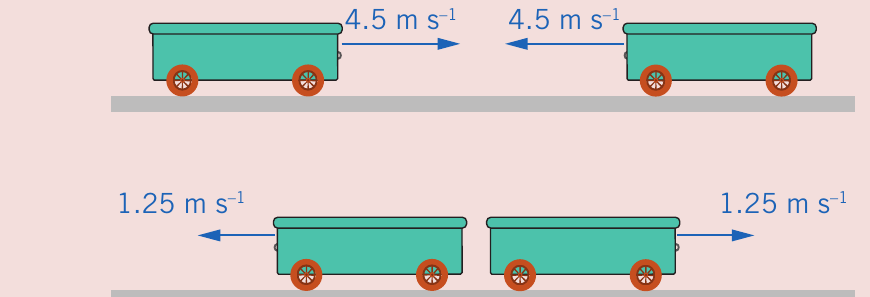
Question: Two carts on a track, each with mass 0.150 kg, collide head-on at 4.5 m s. After the collision, they move away from each other at 1.25 m s.
a) Show that momentum is conserved.
b) Show that this collision is inelastic.
Solution:
a) Let movement to the right be positive.
Since , momentum is conserved.
b) Note that kinetic energy is a scalar quantity, so there are no negative signs.
Since , this collision is inelastic.
Graphing change in momentum (impulse)
The area under a force-time graph equals the impulse. This can be proven because the area under any graph is the product of the average y-value and the x-value. Since the y-axis shows force and the x-axis shows time, the area equals average force times time, which is impulse.
Note
Understanding the Graph: Force-time graphs are powerful tools for analysing collisions. The total area under the curve represents the impulse delivered, regardless of how the force varies with time. This works for constant forces, changing forces, or any complex force profile.
Constant force
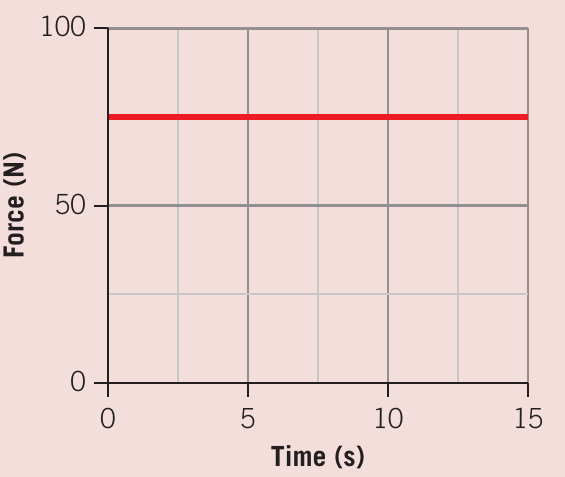
When a constant force is applied, the force-time graph is a horizontal line (rectangle).
Example
Worked Example: Constant Force Graph
Question: A box is pushed with a force of 75 N for 15 s. Calculate the impulse given to the box.
Solution:
The impulse equals the area under the graph:
Changing force (triangular profile)
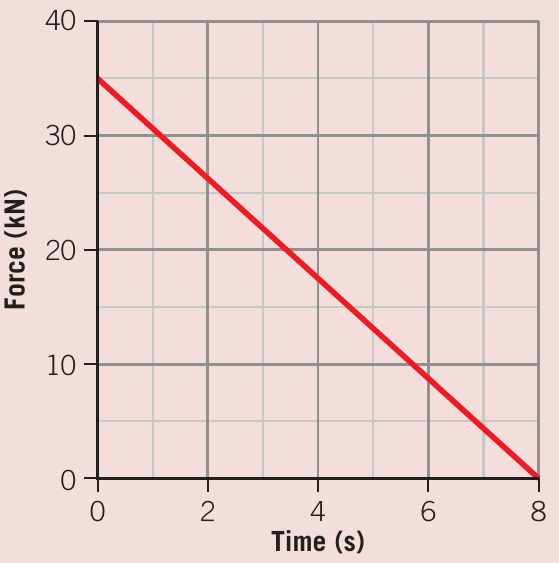
When force increases or decreases at a constant rate, the graph shows a diagonal line. The area can be calculated using the triangle formula.
Example
Worked Example: Changing Force
Question: A car is accelerated by an initial force of 35 kN, which decreases at a constant rate to zero over 8 s. Calculate the impulse given to the car.
Solution:
Convert to SI units: N
The area under the graph forms a triangle:
Complex force-time graphs
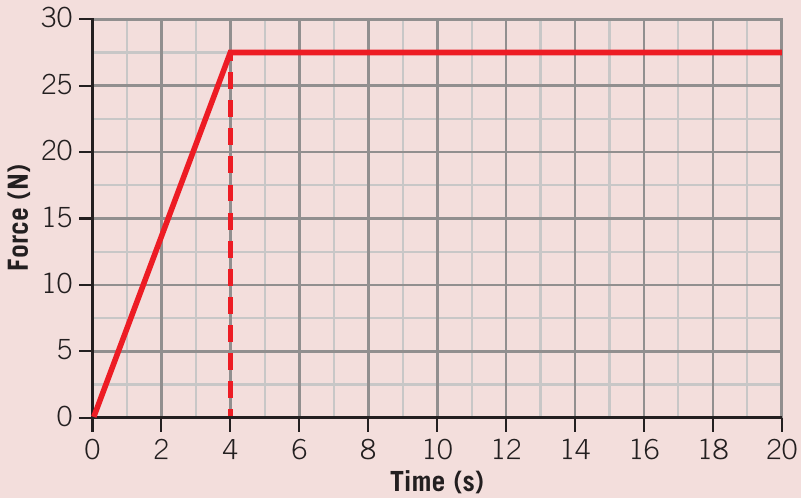
Sometimes you need to break the graph into multiple shapes (rectangles, triangles, trapeziums) to calculate the total area.
Example
Worked Example: Complex Graph
Question: A person pushes a 30 kg sled through snow. The force-time graph is shown below. Calculate the change in momentum given to the sled in the 20 s journey. Assume friction is negligible.
Solution:
Recall that impulse equals change in momentum.
Break the graph into a rectangle and triangle:
Alternatively, use the trapezium formula:
Note
Exam Tip: Area of Trapezium
The trapezium formula can be very helpful when dealing with forces that gradually increase or decrease:
where and are the parallel sides and is the height.
Equating change in momentum and impulse
The equivalent equations for impulse and change in momentum are:
Knowing that impulse and change in momentum are equal helps you find unknown values such as average force, time, mass, final velocity, or initial velocity in collision problems.
Important
Unit Equivalence: The units N s (impulse) and kg m s (change in momentum) are interchangeable. They represent the same physical quantity expressed in different but equivalent units.
Example
Worked Example: Combining Impulse and Momentum
Question: Scientists test a new material for a super high bounce ball. The ball has mass 10 g and is fired horizontally north at 17.5 m s into a wall. A detector measures the force on the ball over time.
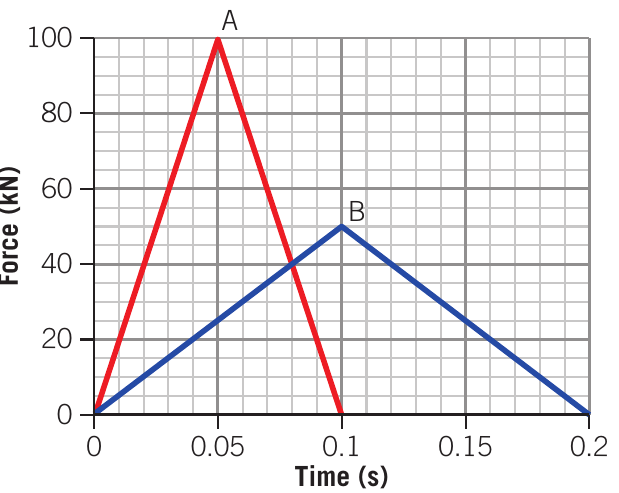
a) Calculate the average force on the ball.
b) Calculate the final velocity of the ball after the collision.
Solution:
a) First, calculate the impulse from the area under the force-time graph:
Then find average force:
b) Let south be positive. Use impulse equals change in momentum:
The positive answer indicates the direction is south.
Remember!
Summary
Key Points to Remember:
-
Momentum is mass times velocity: . It's a vector quantity, so direction matters.
-
Momentum is always conserved in collisions when there are no external forces:
-
Impulse equals change in momentum: . Both are measured in N s or kg m s.
-
Inertia is different from momentum: Inertia depends only on mass and describes resistance to changes in motion. A stationary object has inertia but zero momentum.
-
Elastic collisions conserve kinetic energy, whilst inelastic collisions do not. In inelastic collisions, some energy is converted to heat, sound, and deformation.
-
The area under a force-time graph equals impulse. Break complex graphs into simple shapes (rectangles, triangles, trapeziums) to calculate the area.