Work and Energy (VCE SSCE Physics): Revision Notes
📚Revision Notes
Work and Energy
Introduction
Work and energy are fundamental concepts in physics that describe how forces transfer energy between objects and how energy transforms between different forms. Understanding these principles helps explain everything from simple machines to complex systems like bungee jumping.
When a bungee jumper leaps from a platform, they experience a fascinating transformation of energy. Initially, they possess maximum gravitational potential energy. As they fall, this converts to kinetic energy (energy of motion). When the cord begins to stretch, energy transfers into elastic potential energy in the cord. This interplay between different energy forms demonstrates the law of conservation of energy in action.
Note
The bungee jumping example demonstrates how energy continuously transforms between different forms. At any moment, the total energy remains constant (assuming negligible air resistance), but it shifts between gravitational potential, kinetic, and elastic potential energy throughout the jump.
Work
What is work?
In physics, work represents the amount of energy transferred between objects or transformed from one form to another through the action of a force.
When a force causes an object to move in the direction of that force, work is done. The amount of work depends on both the magnitude of the force and the distance moved.
Formula for work
When a force acts in the same direction as the displacement , work is calculated as:
Where:
- = Work (measured in joules, J)
- = Force (measured in newtons, N)
- = Displacement (measured in metres, m)
Important
One joule of work is done when a force of newton causes a displacement of metre in the same direction as the force.
Work when force acts at an angle
Often, forces don't act exactly in the direction of movement. For example, when pulling a cart with a rope at an angle, only the component of force parallel to the motion does work.
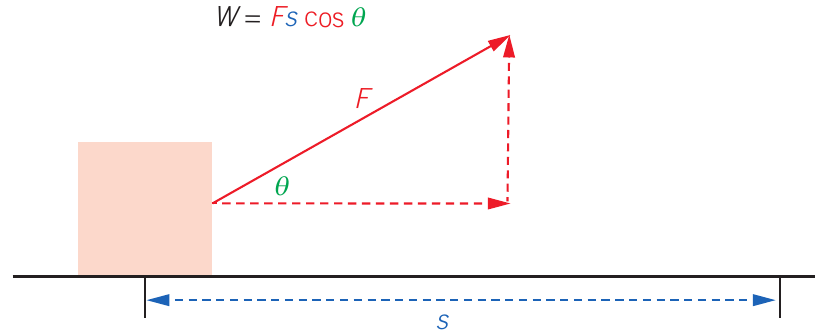
When force acts at an angle to the direction of displacement :
Where:
- = Work (J)
- = Net force (N)
- = Displacement (m)
- = Angle between the force and displacement direction (degrees)
Note
Work is a scalar quantity, meaning it has magnitude but no direction. This is different from vector quantities like force or displacement which have both magnitude and direction.
Special case: perpendicular forces
An important principle states that when a force acts perpendicular to the direction of displacement, no work is done.
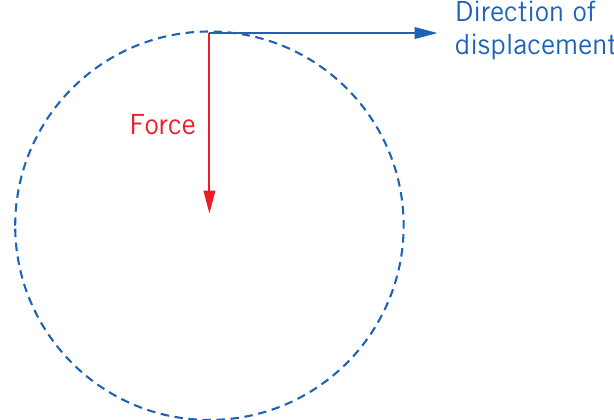
This explains why objects in uniform circular motion maintain constant kinetic energy. The centripetal force acts perpendicular to the velocity vector, so despite a force being present, no energy is transferred to increase or decrease the object's speed.
Example
Worked Example: Calculating Work
Question: A person pushes a kg car a distance of m at constant velocity with a force of N in the direction of displacement. A friction force of N opposes the motion.
a) Calculate the work done on the car by the person.
b) What is the increase in kinetic energy of the car?
c) Determine the energy lost due to friction.
Solution:
a) Using the work formula:
Since the force is parallel to displacement, :
b) Zero. The kinetic energy doesn't increase because the car travels at constant velocity.
c) Since the car gains no energy, all the work done must equal the energy lost to friction: J.
Example
Worked Example: Work at an Angle
Question: A child pulls a cart m using a string at to the horizontal. The string has constant tension of N. Calculate the work done.
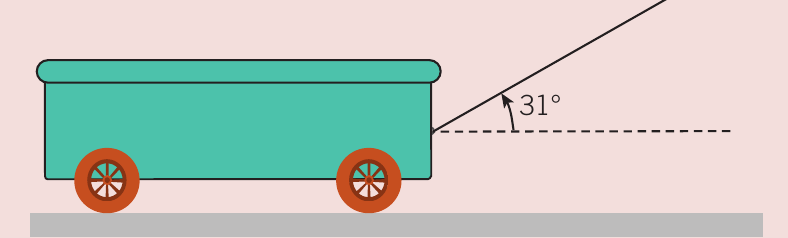
Solution:
Using the angled force formula:
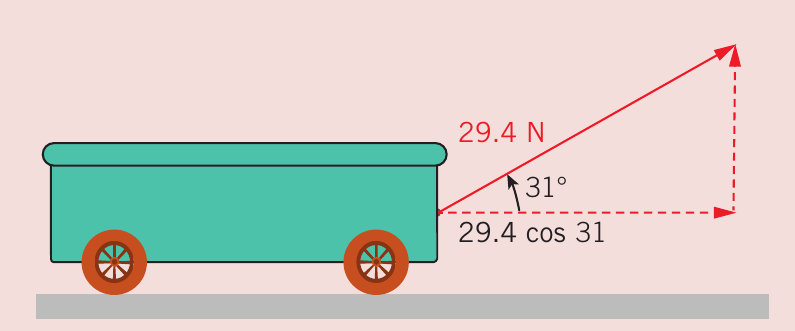
Exam tip: Always identify whether the force acts at an angle to displacement. If so, you must use the component.
Calculating work from force-distance graphs
Force-distance graphs provide a visual way to analyse how force varies with distance. A powerful principle states that the area under a force-distance graph equals the work done.
Constant force
When a constant force of N pushes a box for m:
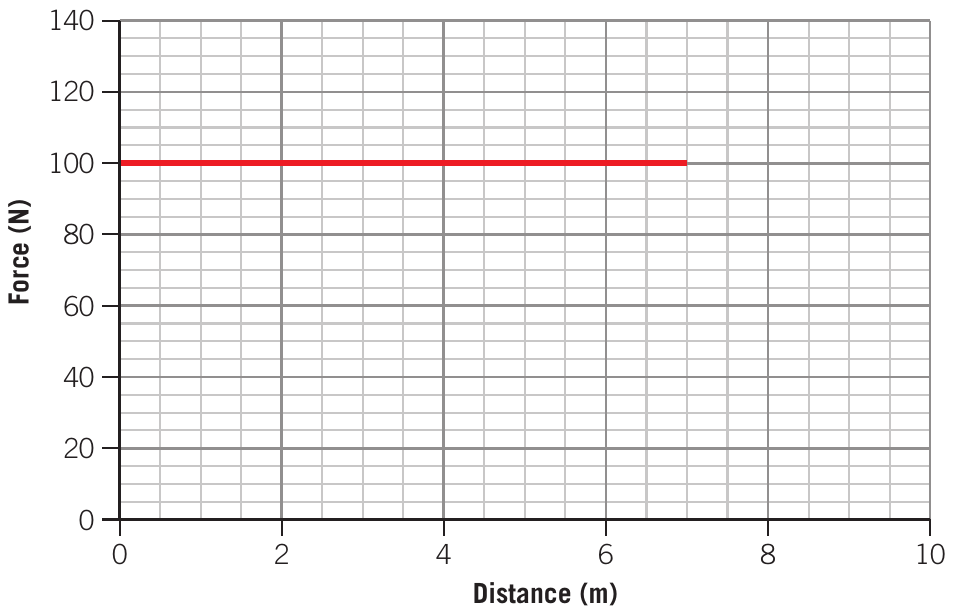
The work done equals the rectangular area under the graph:
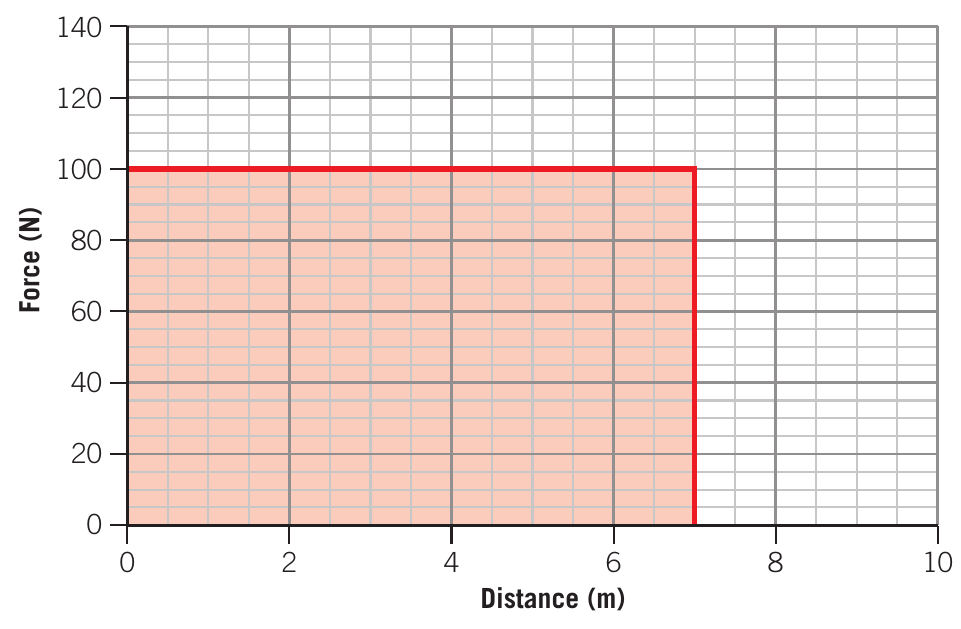
Variable force
When force changes with distance, the area calculation becomes more interesting. Consider a force decreasing linearly from N to zero over m:
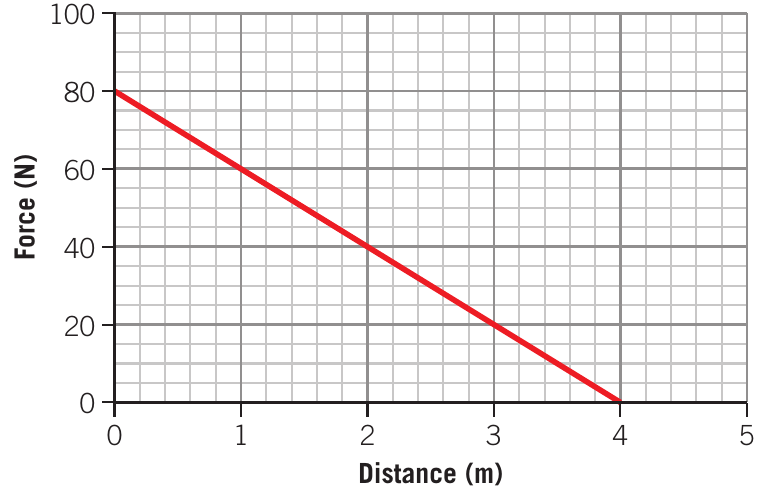
The area forms a triangle:
Example
Worked Example: Drawing and Using Force-Distance Graphs
Question: A person pushes a car m. Initially they apply N, reducing this at a constant rate until at m there's no net force. Draw a force-distance graph and calculate the work done.
Solution:
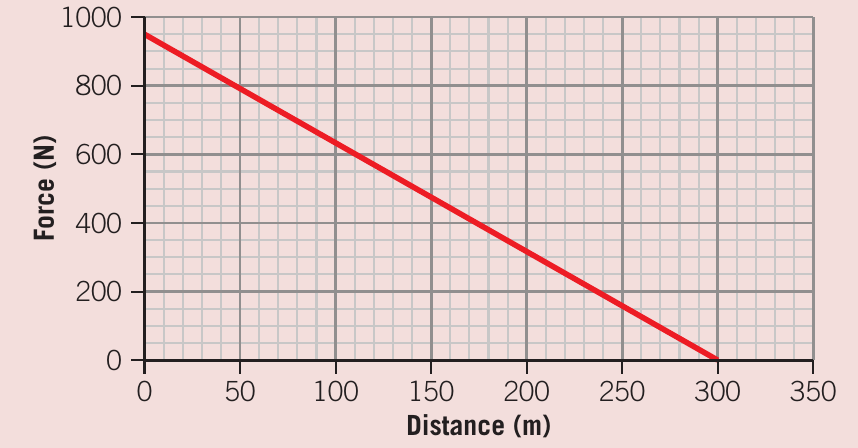
Exam tip: For force-distance graphs, identify the shape (rectangle, triangle, trapezoid) and use the appropriate area formula.
Practice questions - Set 1
Question 1: A person moves a couch cm to the right by applying N parallel to the motion at constant velocity. A friction force of N opposes this.
a) Calculate the work done to move the couch.
b) Determine the change in kinetic energy.
c) Determine the energy lost to friction.
Question 2: A person pulls a golf cart m horizontally. They pull with an average force of N at to the horizontal. Calculate the work done.
Question 3: Students test two materials A and B by compressing them mm. Study the force-displacement graph below:
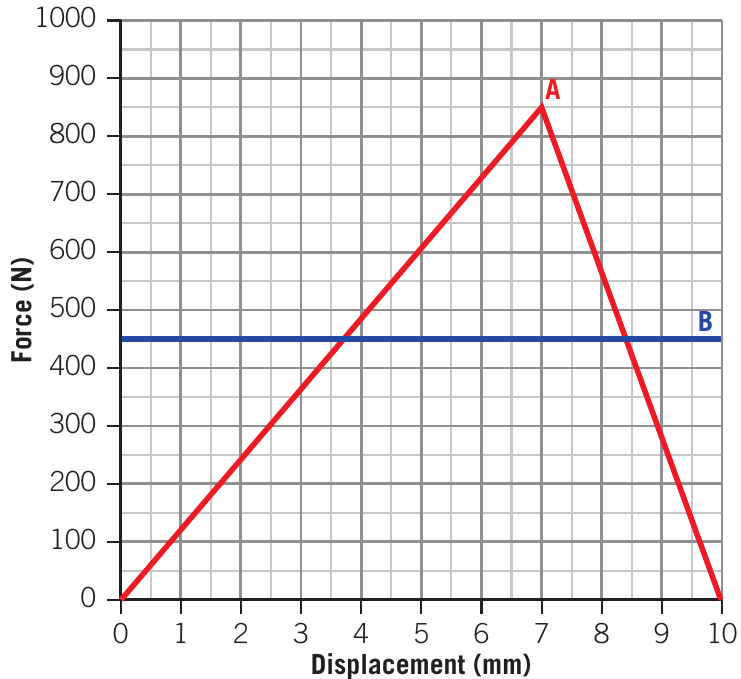
Which material required more energy to compress by mm?
Energy transfers and transformations
Energy cannot be created or destroyed, only transferred between objects or transformed between forms. This is the law of conservation of energy.
Systems: open and closed
A system represents a collection of interacting objects being studied.
A closed system doesn't allow energy or mass to transfer to the surroundings. In closed systems, total energy remains constant.
An open system allows energy or mass transfer to the surroundings. Energy can be lost as heat, sound, or material deformation.
Note
Understanding Systems:
Subatomic collisions in the Large Hadron Collider approximate closed systems where energy stays within the collision. In contrast, car crashes are open systems where energy dissipates as heat, sound, and material deformation to the surroundings.
Friction and energy
When friction opposes motion, it converts kinetic energy into thermal energy and sound. This energy isn't lost from the universe, but it's transferred to the surroundings.
Consider pushing a box m across carpet with N force at constant velocity (friction also equals N):
When you stop pushing, the box becomes stationary (zero kinetic energy). The J has been transformed into thermal energy in both the carpet and box, plus some sound energy.
Important
We don't say friction does "negative work" because the carpet isn't giving energy to the box. Instead, friction converts the box's energy into other forms - primarily thermal energy and sound.
Gravitational potential energy
Gravitational potential energy represents the energy an object possesses due to its position in a gravitational field.
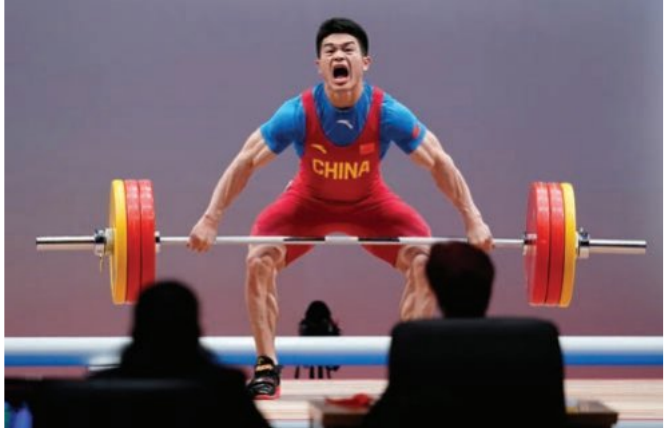
When a weightlifter raises a weight, they do work against gravity. This work becomes stored as gravitational potential energy.
Formula for gravitational potential energy
Where:
- = Gravitational potential energy (J)
- = Mass (kg)
- = Gravitational field strength ( N kg at Earth's surface)
- = Change in height (m)
Note
We can either calculate the change in gravitational potential energy between two points, or define a reference point of zero gravitational potential energy and calculate relative to that point. The choice of reference point is arbitrary - what matters is the change in height.
Example
Worked Example: Gravitational Potential Energy
Question: An kg builder climbs a m ladder. Calculate the change in gravitational potential energy.
Solution:
The builder gains approximately J of gravitational potential energy.
Kinetic energy
Kinetic energy describes the energy an object possesses due to its motion relative to another object.
Formula for kinetic energy
Where:
- = Kinetic energy (J)
- = Mass (kg)
- = Velocity (m s)
Converting speed units
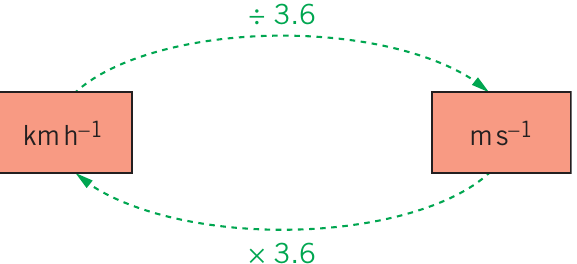
Speed is often given in kilometres per hour (km h) but physics formulas require metres per second (m s).
Important
Conversion rules:
- km h to m s: divide by
- m s to km h: multiply by
Example: Highway speed limits of km h equal approximately m s.
Example
Worked Example: Calculating Kinetic Energy
Question: A tennis ball of mass g travels at m s. Calculate its kinetic energy.
Solution:
First convert mass to kilograms: g kg
The kinetic energy-velocity relationship
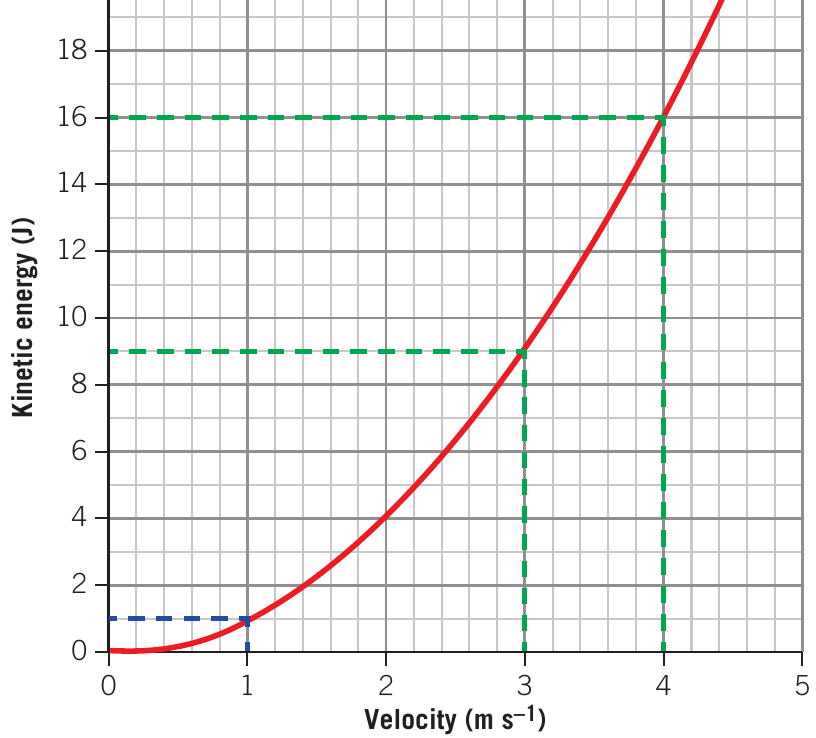
The relationship between kinetic energy and velocity is quadratic, not linear. This means doubling velocity quadruples kinetic energy.
Important
Important insight: Changing velocity from to m s requires much less energy than changing from to m s for the same mass object.
For a kg object:
- m s: requires J
- m s: requires J
This quadratic relationship explains why high-speed collisions are so much more dangerous than low-speed ones.
Relationship between work and kinetic energy
When work is done on a point-like object with no other forces present, the work changes the object's kinetic energy:
This can be proven using kinematic equations and Newton's second law.
Example
Worked Example: Change in Kinetic Energy
Question: A cyclist travels at km h then brakes to km h. The combined mass of cyclist and bicycle is kg. Calculate the decrease in kinetic energy.
Solution:
First convert speeds to m s:
Calculate the change:
The negative sign indicates energy was lost from the bicycle to the surroundings as heat and sound.
Practice questions - Set 2
Question 1: When a diver climbs to the top of a m diving board, their gravitational potential energy increases by J. What is the diver's mass?
Question 2: Calculate the kinetic energy of a kg motorbike travelling at km h.
Question 3: A kg runner travelling at m s has J of kinetic energy. If they doubled their kinetic energy to J, what would their new speed be?
Conservation of energy: gravitational potential and kinetic energy
In many physics problems, energy transforms between gravitational potential energy and kinetic energy. Understanding these transformations is crucial for solving energy problems.
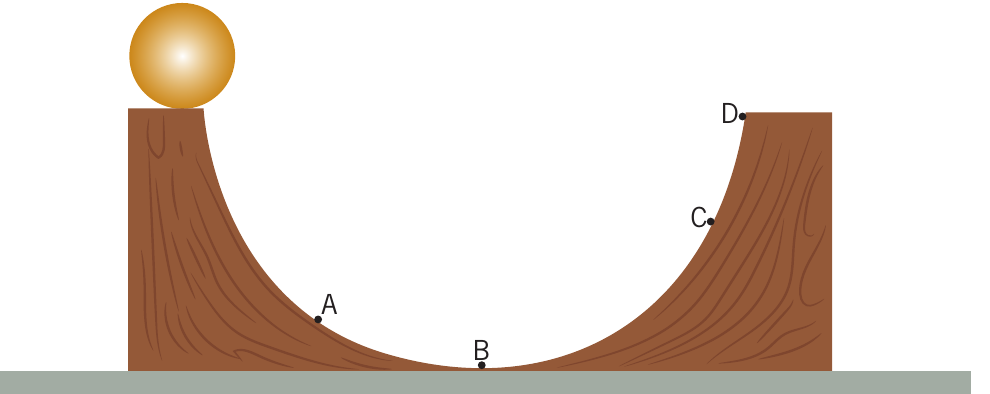
Energy transformation on a ramp
Consider a ball starting at point A on a ramp with no initial speed:
At point A (top):
- Maximum gravitational potential energy
- Zero kinetic energy
At point B (bottom):
- Zero gravitational potential energy (reference point)
- Maximum kinetic energy (all GPE converted to KE)
At point C (halfway up):
- Half the total energy as gravitational potential energy
- Half the total energy as kinetic energy
At point D (same height as A):
- Maximum gravitational potential energy again
- Zero kinetic energy
If no friction or air resistance exists, the ball reaches the same height as it started.
Conservation equation
For closed systems where only gravitational potential energy and kinetic energy transform:
Written with formulas:
Example
Worked Example: Energy Transformations
Question: A swimmer stands on a m diving platform before stepping off. Calculate their velocity when hitting the water. Ignore air resistance.
Solution:
All gravitational potential energy converts to kinetic energy:
Initial velocity is zero, final height is zero:
Note: Mass cancels out - the final velocity doesn't depend on the diver's mass.
Example
Worked Example: Energy Transformation Down a Slope
Question: A snowboarder passes point A ( m above ground) at m s. Calculate their velocity at point B ( m above ground). Assume friction and air resistance are negligible.
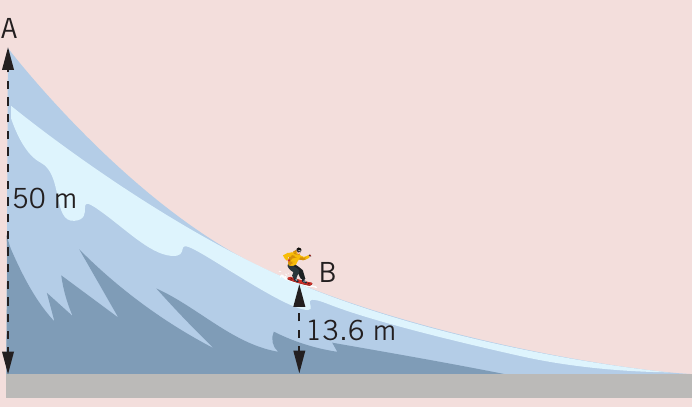
Substitute values (mass cancels):
Exam tip: When using conservation of energy, clearly identify your reference point for zero gravitational potential energy (usually ground level). Remember that mass often cancels out when dealing with energy per unit mass.
Understanding how variables relate to each other
An important physics skill involves recognizing how variables in formulas relate through proportionality.
Direct proportionality
When one variable is directly proportional to another, as one increases, the other increases. We use the symbol to represent "is proportional to".
Example: In the gravitational potential energy formula :
- (GPE is directly proportional to mass)
- (GPE is directly proportional to height change)
For direct proportionality: (constant)
Inverse proportionality
When one variable is inversely proportional to another, as one increases, the other decreases.
Example: In the centripetal force formula :
- (centripetal force is inversely proportional to radius)
For inverse proportionality: (constant)
Powers and proportionality
Variables with powers follow special proportionality rules:
- means centripetal force is proportional to velocity squared
- Doubling velocity quadruples the force
Example
Worked Example: Using Proportionality
Question: A car turns a corner at constant speed . If it takes the same corner at speed , by what factor does centripetal force increase?
Solution:
Since :
For the new situation:
Since is constant:
The centripetal force increases by a factor of .
Exam tip: Understanding proportionality helps you solve problems without needing to know all values. It's particularly useful for multiple-choice questions.
Summary
Key Points to Remember:
-
Work measures energy transfer when a force causes displacement: . When force is perpendicular to displacement, no work is done.
-
The area under a force-distance graph equals the work done. Use appropriate geometric formulas (rectangle, triangle, trapezoid) to calculate this area.
-
Gravitational potential energy depends on height: . Always define your reference point (usually ground level = zero GPE).
-
Kinetic energy depends on velocity squared: . Doubling velocity quadruples kinetic energy due to this quadratic relationship.
-
Energy is conserved in closed systems. It can transform between different forms (gravitational potential ↔ kinetic) but the total remains constant:
-
Always convert units properly: km h to m s by dividing by ; masses to kilograms; distances to metres.
-
Understanding variable relationships (direct and inverse proportionality) helps solve problems efficiently without needing all numerical values.