Solar Panels: Generating Electricity From Photovoltaic Cells (VCE SSCE Physics): Revision Notes
📚Revision Notes
Solar Panels: Generating Electricity From Photovoltaic Cells
Introduction to solar panels
Solar panels convert sunlight into electrical energy using photovoltaic cells. Modern solar panels achieve approximately 25% efficiency when new, meaning they convert about 25% of incoming sunlight into electrical energy, with power outputs up to 420 W per panel. The remaining energy is either reflected or converted to unwanted thermal energy.
Several factors affect the efficiency of solar panels:
- Age of the panel (efficiency decreases over time)
- Temperature (higher temperatures reduce efficiency)
- Amount of solar energy received
- Cell type and connections
- Orientation and positioning
Note
To maximise energy capture, panels are typically oriented facing north in Australia, accounting for the varying angle of sunlight throughout the day and year. In solar farms, motors can be used to track the sun's movement during the day, further improving efficiency.
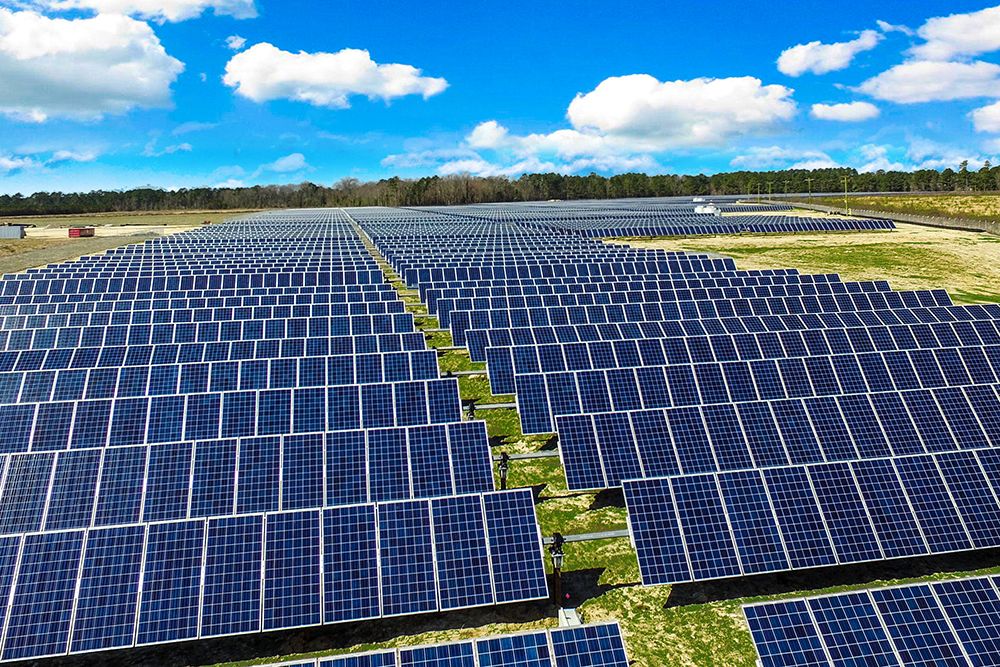
Modern solar panel technology is advancing rapidly, with various types being developed including mono-crystalline, poly-crystalline, PERC (Passive Emitter and Rear Contact), thin film, and flexible experimental designs.
How solar panels work
Structure of photovoltaic cells
Each solar panel contains an array of photovoltaic (pv) cells. A photovoltaic cell (also called a solar cell) converts light energy into electrical energy through the photovoltaic effect.
Note
Understanding Semiconductor Types
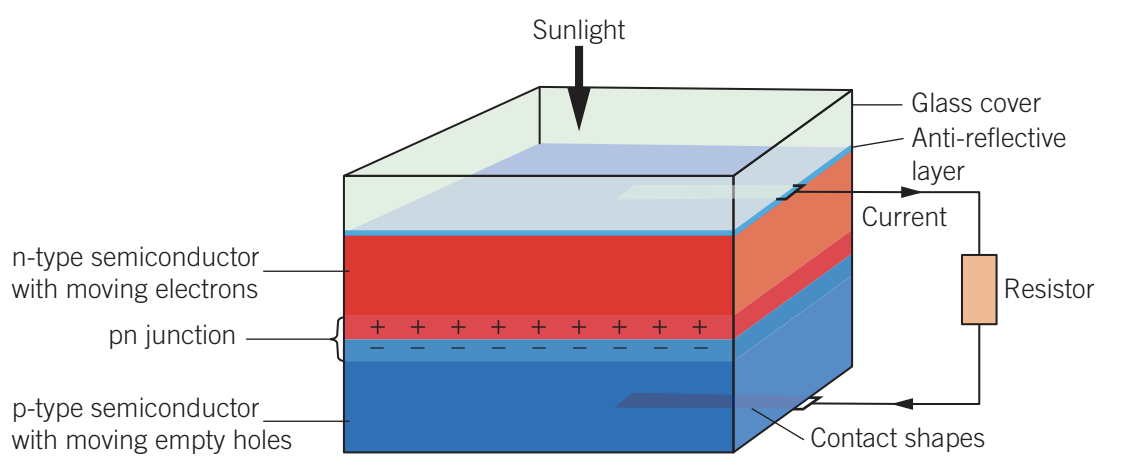
Each pv cell consists of two semiconductor slices, usually silicon:
- p-type semiconductor: has a lack of electrons (contains 'holes')
- n-type semiconductor: has excess electrons
A semiconductor is a material that conducts electricity only under particular conditions. Its conducting properties fall between those of a conductor and an insulator.
The two semiconductor slices are joined together to create a pn junction, which is the boundary between the two different types of semiconductor materials. To create these different types, the silicon is 'doped' by adding small amounts of other materials such as phosphorus or boron.
The photovoltaic effect
When the two different semiconductors are bonded together, an electric field forms across the pn junction. Here's how electricity generation occurs:
- Sunlight strikes the n-type semiconductor surface
- The light energy causes electrons to be released from the n-type material
- The electric field at the pn junction traps these electrons on the p-type side
- This creates a potential difference (voltage) across the cell
- When connected to an external circuit, current flows
Important
The Photovoltaic Effect
This process is called the photovoltaic effect: when a photovoltaic cell is exposed to sunlight, electrons move from the n-type side and become trapped by the pn junction, creating a potential difference across the junction and generating current.
Wiring configurations: Series and parallel
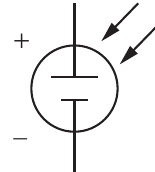
Solar panels have positive and negative terminals and can be wired in different configurations depending on the required output voltage and current.
Series connection
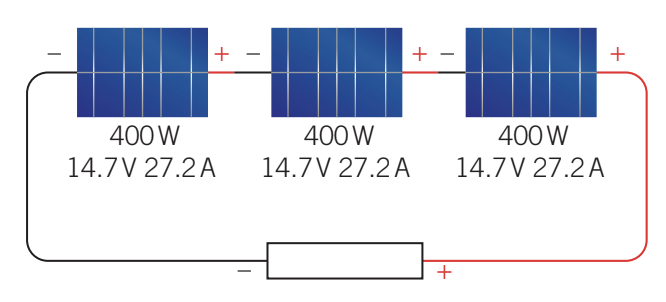
When panels are wired in series (sometimes called a 'string'), the behavior of voltage and current follows specific rules:
- The voltage from each panel adds up
- The current remains the same through each panel
Example
Worked Example: Series Connection Calculation
Three 400 W panels (each 14.7 V, 27.2 A) wired in series:
Total voltage =
Total current =
Total power =
Parallel connection
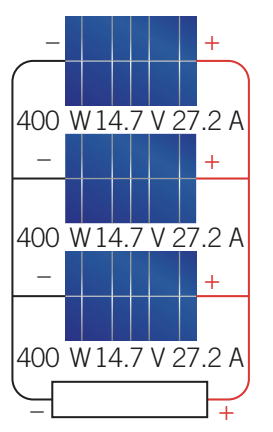
When panels are wired in parallel, the opposite pattern occurs:
- The voltage remains the same across all panels
- The current from each panel adds up
Example
Worked Example: Parallel Connection Calculation
Three 400 W panels (each 14.7 V, 27.2 A) wired in parallel:
Total voltage =
Total current =
Total power =
Combination configurations
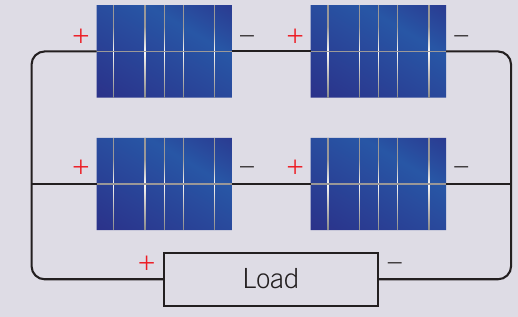
Often, solar panel installations use a combination approach, with strings of panels (series) connected in parallel. This allows for flexibility in achieving the desired voltage and current outputs.
Important
Exam tip: When analysing solar panel circuits, always identify whether panels are in series or parallel first, then apply the appropriate rules for voltage and current before calculating total power.
DC versus AC: Understanding the difference
Direct current (DC)
In a direct current (DC) circuit, the polarity of the potential difference stays constant. The positive terminal remains positive and the negative terminal remains negative. Current flows continuously in the same direction along the wire. Solar panels and batteries produce DC.
Alternating current (AC)
In an alternating current (AC) circuit, the polarity of the potential difference changes regularly, causing the current to flow first in one direction, then in the other. In Australia, mains electricity is AC with a frequency of 50 Hz (changing direction 50 times per second).
Note
When plotted against time, AC voltage follows a sinusoidal wave pattern (sine wave shape).
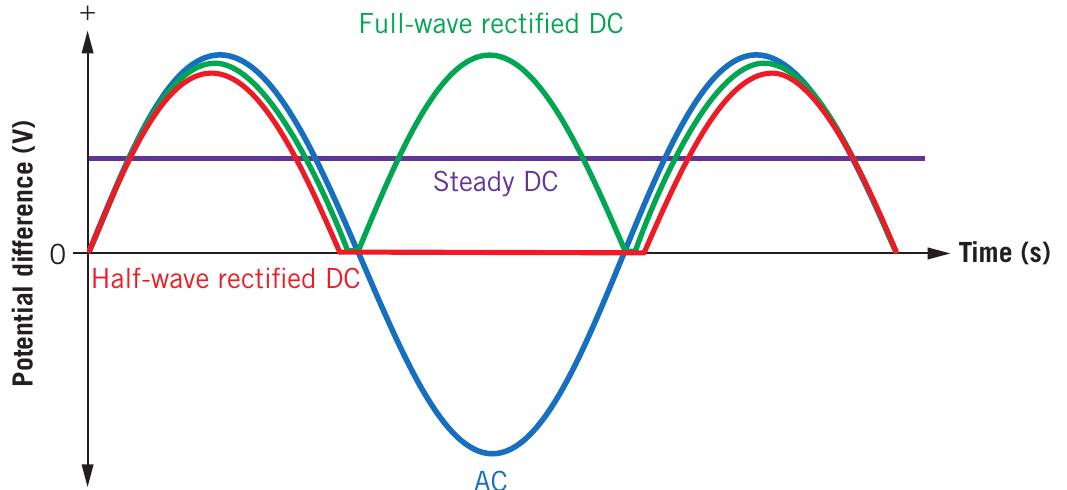
The graph above shows:
- Blue wave: AC with its characteristic sinusoidal pattern
- Purple line: Steady DC from a battery or solar panel
- Red wave: Half-wave rectified DC
- Green wave: Full-wave rectified DC
Inverters: Converting DC to AC
Why inverters are needed
Solar panels produce DC electricity, but most household appliances and the electricity grid operate on AC. An inverter is a device that converts DC into AC using an electronic circuit.
Buildings with solar panels require inverters to:
- Convert DC from panels to AC for household appliances
- Enable electricity to be fed back into the grid
- Earn payment from power companies for excess generation
Types of inverters
There are three main types of inverters for solar installations:
- Single box inverter: Located near the meter box, connects all panels to one inverter
- String inverters: Connect a set of panels (a string) to one inverter
- Microinverters: Individual inverters attached to each solar panel
Note
Advantages of microinverters:
- If one panel is shaded or damaged, other panels continue producing at full capacity
- Suitable for roofs with panels on different orientations
Disadvantage of microinverters:
- More expensive to install initially
Important
Disadvantage of string inverters:
If one panel in the string is shaded, the entire string's output is significantly reduced. This is a critical consideration when choosing inverter types for installations where shading may occur.
How inverters work
Modern inverters use electronic circuits (solid state semiconductors like transistors) to rapidly switch the direction of DC input back and forth. This switching creates an AC output from a DC input. These devices have no moving parts and also help maintain grid stability, particularly important as solar generation increases.
Calculations with solar panels
Power formula
The fundamental formula for calculating power in solar panel systems is:
where:
- = power (watts, W)
- = current (amperes, A)
- = voltage (volts, V)
Note
Voltage is another name for potential difference, derived from its unit, the volt.
Example
Worked Example: Basic Power Calculation
A solar panel produces a maximum voltage of 14.7 V at a current of 27.2 A. What is its maximum power output?
Solution:
Using :
Example
Worked Example: Series-Parallel Combination
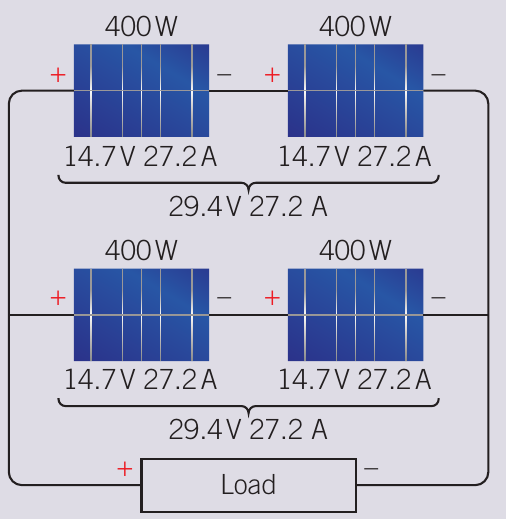
Four solar panels, each with power 400 W, voltage 14.7 V and current 27.2 A, are wired with two pairs in series, and the pairs connected in parallel. Calculate total voltage, current and power.
Solution:
First, analyse the circuit structure: two pairs of panels in series, with the pairs in parallel.
For panels in series (each pair):
- Voltage adds: per pair
- Current stays same: per pair
For the two pairs in parallel:
- Total voltage = (same as each pair)
- Total current = (adds)
- Total power =
Example
Worked Example: Inverter Power Consumption
You want to power a laptop on a caravan trip using solar panels and an inverter. The laptop charger draws 50 W continuously and is rated at 4 A at 12 V.
a) What is the maximum power provided to the laptop from the charger?
b) A 1000 W inverter with 12 V input draws around 1 A on standby. How much power does it consume?
c) Each solar panel produces 3 A at 19 V at maximum. How many panels are needed to supply the inverter with the laptop?
Solution:
a)
b)
c) Total power required =
Power from one panel =
Since maximum figures are typically lower in real conditions, you would need at least two panels.
Important
Exam tip: Always show your working clearly in calculations. State the formula first, substitute values, then calculate the answer. Round sensibly to appropriate significant figures based on the given data.
Summary
Key Points to Remember:
- Photovoltaic cells convert light energy into electrical energy through the photovoltaic effect in a pn junction made of p-type and n-type semiconductors
- Series wiring: voltages add, current stays the same; Parallel wiring: voltage stays the same, currents add
- Solar panels produce DC electricity, but most appliances and the grid use AC, requiring an inverter to convert between them
- Power formula: where power equals current multiplied by voltage
- Modern solar panels achieve approximately 25% efficiency, with various factors affecting performance including temperature, orientation, and shading