Gravitational Potential Energy (VCE SSCE Physics): Revision Notes
📚Revision Notes
Gravitational Potential Energy
Introduction
Understanding gravitational potential energy is essential for explaining many phenomena in physics, from simple everyday activities to complex space missions. This concept helps us understand how roller-coasters work, how satellites orbit Earth, and why lifting objects requires energy.
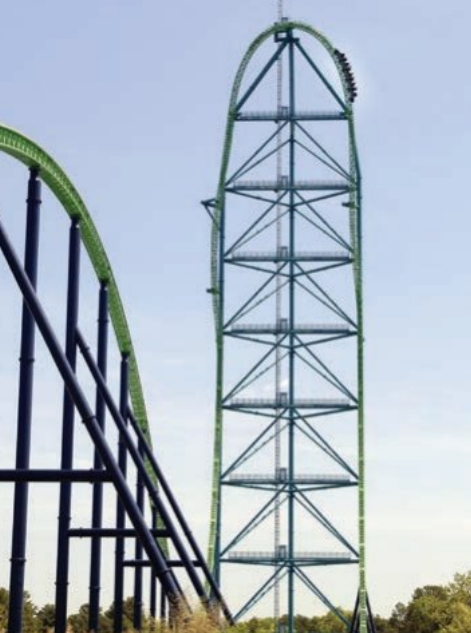
Consider a roller-coaster like the Kingda Ka, one of the world's tallest and fastest rides. It accelerates from rest to 200 km h⁻¹ in just 3.5 seconds, then climbs to a height of 142 metres before plummeting back down. Throughout this thrilling journey, the roller-coaster constantly exchanges kinetic energy and gravitational potential energy, whilst also losing some energy to friction.
Note
As the roller-coaster climbs, kinetic energy is converted to gravitational potential energy. As it descends, this stored energy transforms back into kinetic energy, creating the thrilling acceleration that riders experience.
Gravitational potential energy in uniform fields
What is gravitational potential energy?
Gravitational potential energy is the amount of energy an object possesses due to its position within a gravitational field. The higher an object is positioned in a gravitational field, the more gravitational potential energy it stores.
Think of it this way: when you lift a book onto a shelf, you are transferring energy to the book. This energy becomes stored as gravitational potential energy, ready to be released if the book falls.
The formula for uniform fields
When working close to Earth's surface (or any planetary surface), the gravitational field can be considered uniform - meaning the acceleration due to gravity remains constant. In these situations, we can calculate gravitational potential energy using a straightforward formula:
Where:
- = Gravitational potential energy measured in joules (J)
- = Mass of the object in kilograms (kg)
- = Acceleration due to gravity in metres per second squared (m s⁻²)
- On Earth's surface: m s⁻²
- On the Moon's surface: m s⁻²
- = Change in height in metres (m)
Important
This formula works effectively when the gravitational field strength doesn't vary significantly over the distance involved - typically within a few kilometres of a planetary surface. For larger distances, we must use different methods (covered later in these notes).
Real-world example: land divers
On Pentecost Island in Vanuatu, men perform a traditional ritual called land diving. They jump from wooden towers reaching heights of 30 metres, with only two tree vines attached to their ankles to arrest their fall just before they hit the ground. The higher the platform, the more gravitational potential energy the diver possesses at the start of their jump.
Example
Worked Example: Calculating Gravitational Potential Energy
Let's examine three land divers climbing to different heights on a 30-metre tower:
- Kaikoa (mass 80 kg) climbs to the 10 m platform
- Aukia (mass 40 kg) climbs to the 20 m platform
- Laki (mass 60 kg) climbs to the 30 m platform
Using m s⁻² for simplicity:
For Kaikoa:
For Aukia:
For Laki:
Key observation: Although Aukia is at twice the height of Kaikoa, they both have the same gravitational potential energy. This occurs because Aukia has half the mass of Kaikoa. Gravitational potential energy depends on both height and mass - doubling the height whilst halving the mass results in the same total energy.
The connection between work and gravitational potential energy
Understanding work
Work represents the amount of energy transferred from one object or system to another. When you lift an object against gravity, you perform work on that object. This work done against the gravitational force becomes stored as gravitational potential energy.
The relationship between work and gravitational potential energy is expressed as:
Where:
- = Change in gravitational potential energy (J)
- = Work done (J)
- = Gravitational force acting on the object (N)
- = Distance moved through the gravitational field (m)
- = Mass (kg)
- = Acceleration due to gravity (m s⁻²)
Visualising work with force-distance graphs
We can represent this relationship graphically. Consider Laki, the 60 kg land diver, climbing to the 30 m platform. The gravitational force acting on him is:
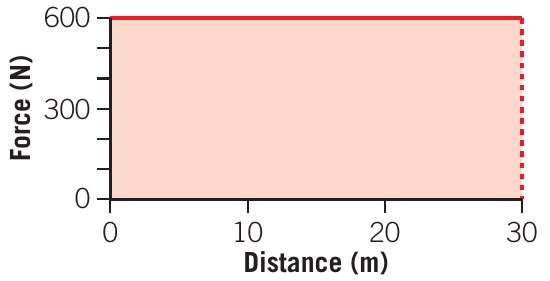
The graph shows a constant force of 600 N over a distance of 30 m. The area under this graph (the shaded rectangle) equals:
Note
Important Principle: Area Represents Energy
The area under a force-distance graph equals both the work done and the change in gravitational potential energy. This graphical method becomes particularly useful when dealing with varying forces in non-uniform gravitational fields.
Remember: Area = Work = Energy Change
Gravitational potential energy in non-uniform fields
When gravitational fields become non-uniform
As an object moves significant distances away from a planet's surface, the gravitational field can no longer be considered uniform. The strength of gravity decreases with distance from the planet's centre, following an inverse square relationship. This situation applies to:
- Spacecraft travelling to high altitudes
- Satellites in orbit
- The Moon orbiting Earth
- Interplanetary missions
Important
When to Use Non-Uniform Field Methods
In these cases, we cannot use the simple formula because is not constant. Instead, we must use graphical methods to determine the change in gravitational potential energy.
The key indicator: if the distance travelled is comparable to the planet's radius, the field is non-uniform.
Method 1: using force-distance graphs
When the gravitational force varies with distance, we can find the change in gravitational potential energy by calculating the area under a force-distance graph.
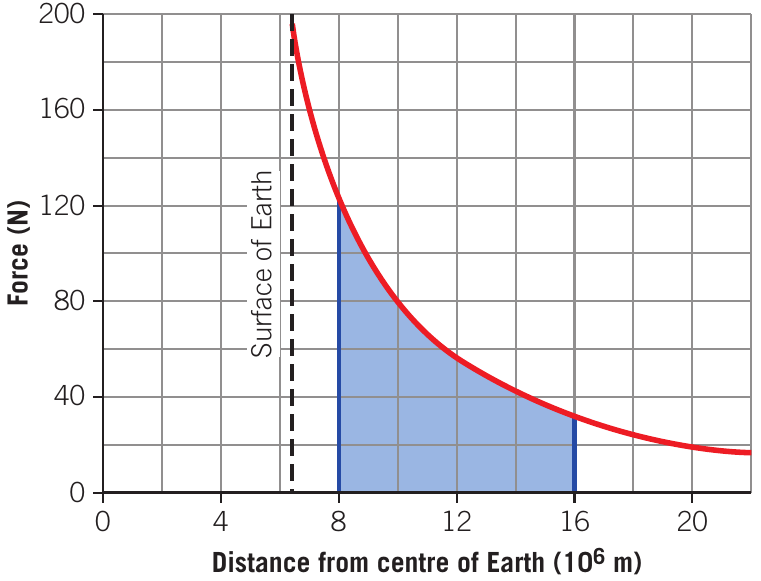
This graph shows the gravitational force acting on a 20 kg mass as it moves away from Earth's centre. The vertical dashed line marks Earth's surface (radius approximately 6.4 × 10⁶ m). As distance increases, the force decreases following the inverse square law.
To find the change in gravitational potential energy between two points, we count the squares under the curve between those points. Each square represents a specific amount of energy (force × distance).
Procedure:
- Identify the region of interest on the graph
- Count whole squares under the curve
- Estimate partial squares (e.g., half-squares, quarter-squares)
- Calculate the energy value of each square (force increment × distance increment)
- Multiply the total square count by the energy per square
Example
Using the Square Counting Method
If a 20 kg mass moves from 8000 km to 16000 km from Earth's centre, counting the squares in the shaded blue region gives approximately 12.5 squares. If each square represents 40 MJ, then:
Typically, slight variations in square counting are acceptable (e.g., 450-550 MJ would be reasonable).
Method 2: using field-distance graphs
Alternatively, we can calculate the change in gravitational potential energy using a field-distance graph, which shows how the gravitational field strength varies with distance.
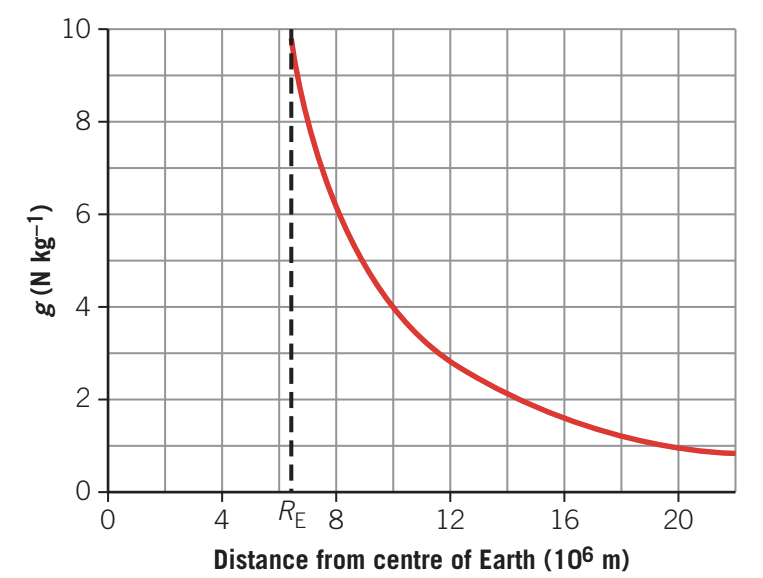
This graph displays gravitational field strength () plotted against distance from Earth's centre. The key advantage of field-distance graphs is that they are independent of the object's mass - they only depend on the mass of the planet creating the field.
To find the change in gravitational potential energy using this method:
- Calculate the area under the field-distance graph (using the same square-counting technique)
- Multiply this area by the mass of the object moving through the field
Note
Two-Step Process Advantage
This two-step process separates the field properties (determined by the planet) from the object's properties (its mass). This means the same field-distance graph can be used for any object, regardless of its mass - you simply multiply the area by the specific mass of your object.
Worked example: spacecraft launch energy
Let's apply these concepts to a realistic scenario involving a spacecraft launch.
Example
Worked Example: Spacecraft Launch Energy Calculation
Problem: A 700 kg spacecraft launches from Earth on an interplanetary mission. We need to determine: a) The gravitational force acting on the spacecraft at a specific height b) The minimum energy required for the spacecraft to escape Earth's gravitational influence
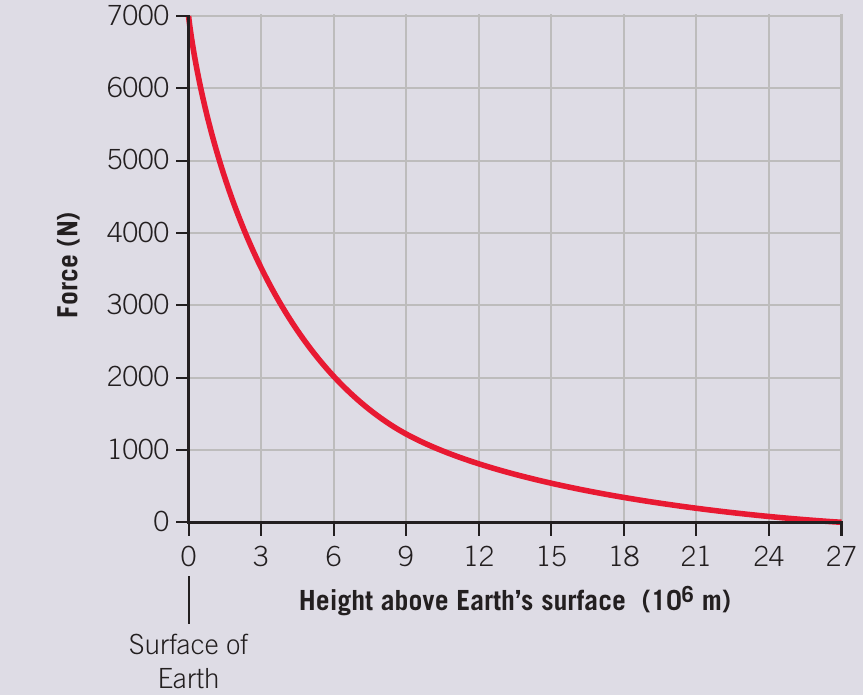
Part a: Finding the force at a specific height
To find the gravitational force at a height of 1.5 × 10⁷ m (15 × 10⁶ m), we locate this position on the horizontal axis and read the corresponding force value on the vertical axis.
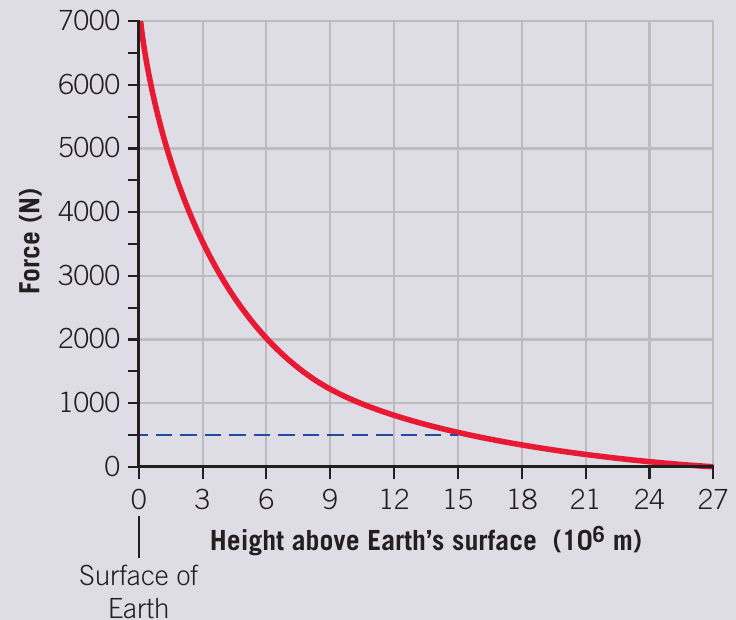
Following the dashed line, we can read that the force is approximately 500 N at this height.
Part b: Calculating the minimum launch energy
The minimum energy needed to escape Earth's gravitational attraction equals the change in gravitational potential energy from Earth's surface to a distance where gravitational effects become negligible. This is represented by the total area under the force-distance graph.
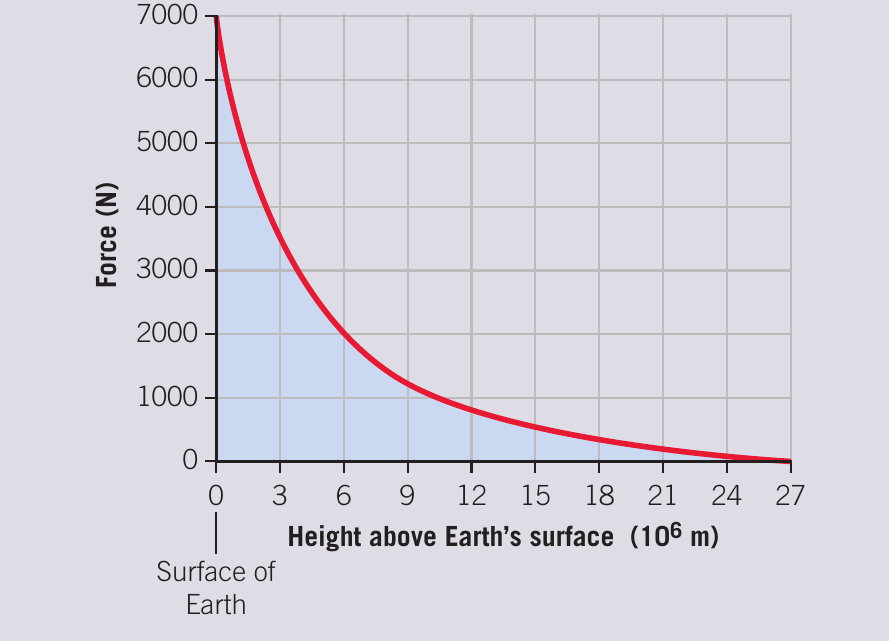
Calculation steps:
-
Count the squares under the curve: approximately 13 squares
-
Determine the energy represented by each square:
- Force increment per square: 1000 N
- Distance increment per square: 3 × 10⁶ m
- Energy per square: J = 3 GJ
-
Calculate total energy:
Given the uncertainty in square counting, an acceptable range would be 3.3 × 10¹⁰ J to 4.4 × 10¹⁰ J (approximately 33-44 GJ).
This enormous energy requirement explains why spacecraft launches require powerful rockets and careful fuel management.
Practice questions
Question 1: A weightlifter lifts a 20.0 kg barbell vertically upward by 2.00 m at Earth's surface. Calculate the increase in gravitational potential energy.
(Use m s⁻²)
Note
Solution:
Question 2: Consider a 20 kg mass moving from 12 × 10⁶ m to 20 × 10⁶ m from Earth's centre. Using the field-distance graph principles, explain how you would estimate the change in gravitational potential energy.
Note
Solution approach:
- Identify the region between 12 × 10⁶ m and 20 × 10⁶ m on a field-distance graph
- Count squares under the curve in this region
- Determine the value represented by each square (field strength × distance)
- Multiply the total area by the mass (20 kg) to get
Summary
Summary
Key Points to Remember:
-
Gravitational potential energy is the energy stored in an object due to its position in a gravitational field
-
For uniform fields (near planetary surfaces), use the formula:
-
For non-uniform fields (large distances from a planet), calculate energy changes using the area under force-distance or field-distance graphs
-
The area under a force-distance graph equals both the work done and the change in gravitational potential energy
-
When using field-distance graphs, remember to multiply the area by the object's mass to obtain the energy change
-
Higher positions in a gravitational field store more gravitational potential energy - this energy can be converted to kinetic energy when the object falls
-
The choice between uniform and non-uniform field methods depends on the distance scale: use uniform fields for distances small compared to the planet's radius, and non-uniform methods for distances comparable to or larger than the planet's radius