Orbiting Satellites (VCE SSCE Physics): Revision Notes
📚Revision Notes
Orbiting Satellites
Introduction: Newton and orbital motion
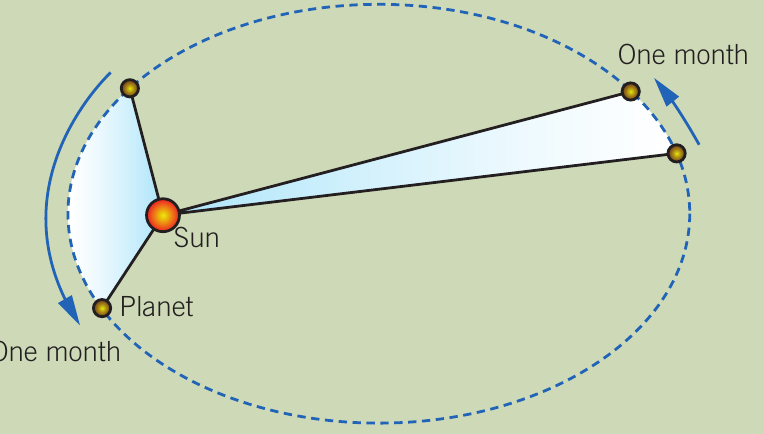
In the 17th century, scientists struggled to explain why planets orbited the Sun. Nicolaus Copernicus had proposed in 1542 that planets moved in circular orbits around the Sun. Later, in 1609, Johannes Kepler used accurate astronomical data to discover that planetary orbits were actually elliptical, not circular.
Note
Kepler also determined that planets sweep out equal areas in equal times as they orbit. Additionally, he found that for each planet, the ratio of the cube of the average orbital radius to the square of the orbital period () remained constant. This relationship became known as Kepler's Third Law.
Isaac Newton realised that both planetary motion and the Moon's orbit around Earth required some force acting toward the central body. His breakthrough was connecting "heavenly motion" (the Moon orbiting Earth) with everyday motion (an apple falling to Earth). This insight led to his universal law of gravitation and our understanding of how satellites orbit.
Newton's thought experiment
In his 1687 work System of the World, Newton described a thought experiment involving a cannonball fired horizontally from a high mountain, assuming no air resistance.
Newton's reasoning worked as follows:
- A cannonball fired with a certain velocity would follow a curved path and land at some point on Earth
- Cannonballs fired with progressively greater velocities would travel farther before landing
- At a sufficiently high velocity, the cannonball would travel all the way around Earth and return to its starting point
- The cannonball would then become a satellite of Earth, just like the Moon
Important
Key Insight: Satellites Are Always Falling
This thought experiment shows that an orbiting satellite is simply an object that is continuously falling toward Earth whilst moving fast enough sideways that it continuously "misses" hitting the surface. This is the fundamental principle behind all orbital motion.
The physics of satellite motion
Gravitational force as the centripetal force
When a satellite orbits a planet, the force due to gravity is the only force acting on it. For example, the Moon constantly falls toward Earth due to gravity, but it never hits Earth because it has a velocity perpendicular to the gravitational field that is large enough to maintain a circular orbit.
For any object moving in a circular path, the net force is the centripetal force, which always acts radially inward (toward the centre of the circle). For a satellite in orbit, the gravitational force provides this centripetal force.
Force due to gravity:
Where:
- = force due to gravity (N)
- = universal gravitational constant = Nm²kg⁻²
- = mass of satellite (kg)
- = mass of the planet or central body (kg)
- = distance between the centres of mass of and (m)
Centripetal force:
Where:
- = centripetal force (N)
- = mass of satellite (kg)
- = orbital speed (m s⁻¹)
- = orbital radius (m)
- = orbital period (s)
Deriving orbital motion formulas
By equating the gravitational force to the centripetal force, we can derive several useful formulas for satellite motion.
Orbital speed:
Starting with
Cancelling from both sides and rearranging:
Important
Mass Independence
Notice that the orbital speed is independent of the satellite's mass (). This means that a small satellite and a large satellite at the same orbital radius will have the same orbital speed.
Orbital period:
Starting with
Rearranging for :
The orbital period is also independent of the satellite's mass.
Orbital radius:
We can also rearrange the period equation to find the orbital radius:
Finding the orbital radius requires taking a cube root.
Note
Important Relationships Between Orbital Parameters
- If a satellite's orbital radius increases, its period increases whilst its speed decreases
- Mathematically: and
- A satellite in a higher orbit moves more slowly and takes longer to complete each orbit
Think of it as: bigger orbit, slower speed, longer period.
Calculating the mass of a planet
We can rearrange our equations to find the mass of a planet or central body if we know the orbital parameters of one of its satellites:
This method allows us to calculate planetary masses by observing their moons.
Example
Worked Example: Mass of Jupiter
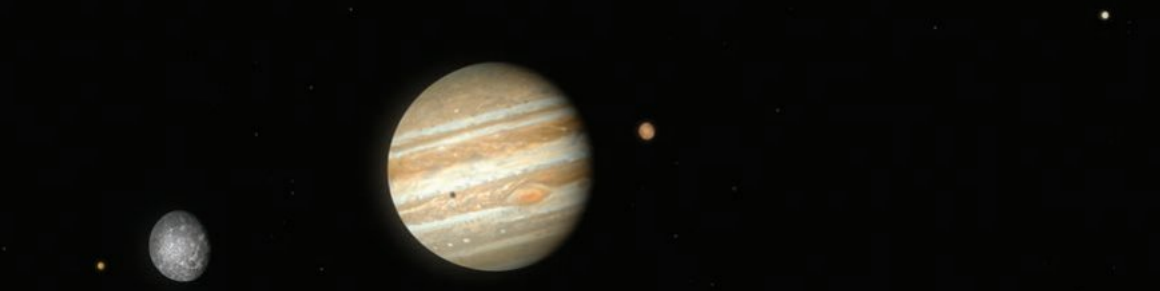
Calculate the mass of Jupiter using data from its moon Callisto.
Given:
- Period of Callisto: 16.7 days = s
- Mean orbital radius: m
- Nm²kg⁻²
Solution:
Substitute into the equation for mass:
Therefore, the mass of Jupiter is kg.
Artificial satellites
An artificial satellite is any human-made structure placed in orbit around a planet or moon. Examples include Sputnik, the Hubble Space Telescope, the International Space Station, and the Mars Orbiter.
The space age began on 4 October 1957 when the Soviet Union launched Sputnik 1, the world's first artificial Earth satellite.
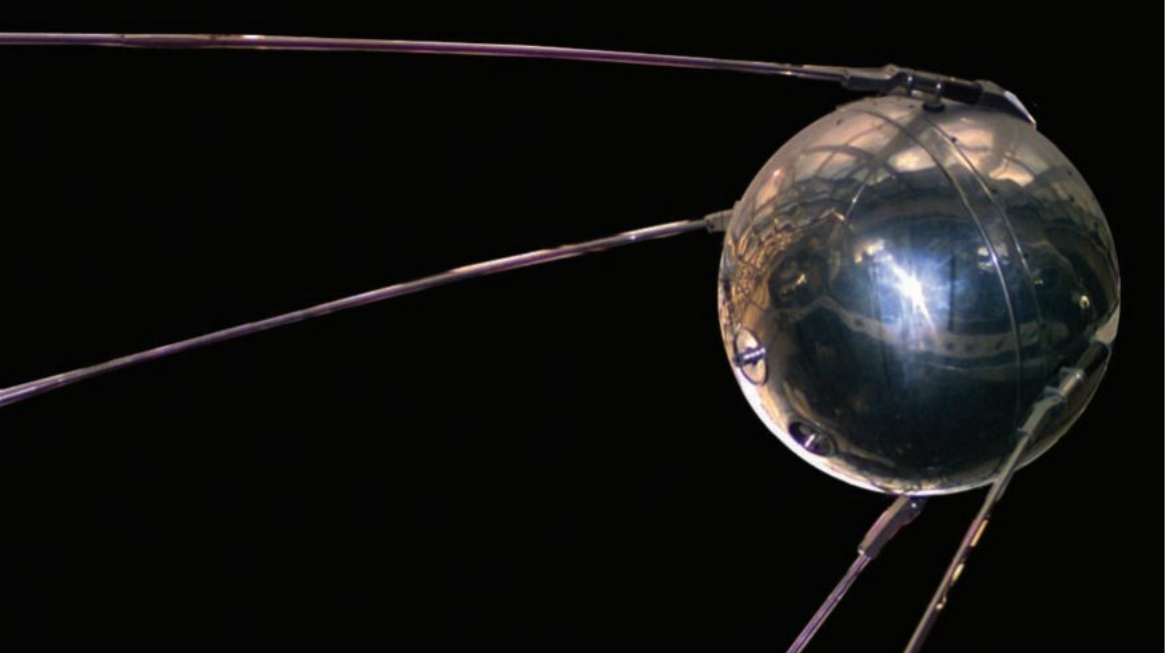
Sputnik 1 was launched into an elliptical low Earth orbit with:
- Mass: 84 kg
- Orbital period: 96.2 minutes
- Total orbits completed: 1440 before burning up on 4 January 1958
Note
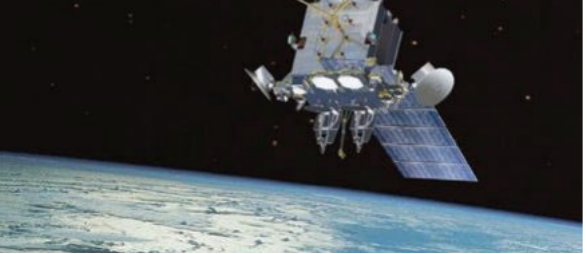
Today, approximately 5000 active artificial satellites orbit Earth, serving many purposes:
- Weather monitoring
- Navigation and GPS
- Commercial communications
- Astronomical observations
- Scientific research
Modern satellites use solar panels to power their batteries and electronic systems.
Geostationary satellites
A geostationary satellite is a special type of satellite whose orbit keeps it fixed relative to the same point on Earth's surface at all times.
Important
Requirements for Geostationary Orbit
For a satellite to be geostationary, it must:
- Orbit directly above the equator
- Travel in the same direction as Earth's rotation
- Have an orbital period of exactly 24 hours (matching Earth's rotation period)
If a satellite's orbit is inclined or polar, it will not remain above the same point on Earth's surface.
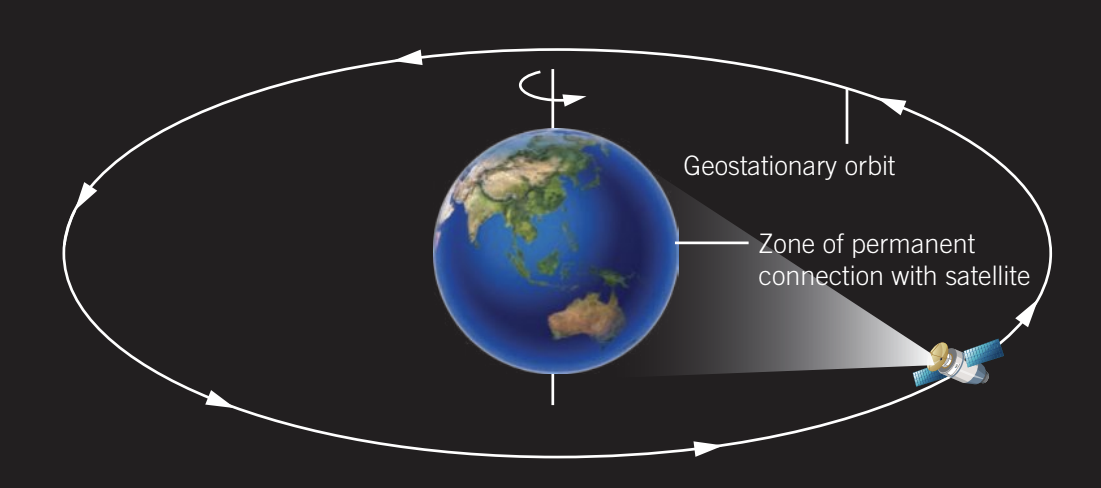
Calculating the geostationary orbit:
Using the orbital radius formula with hours s:
Since Earth's radius is approximately m, the altitude above Earth's surface is:
Altitude m km
Note
Key Facts About Geostationary Satellites
- All geostationary satellites orbit at an altitude of 36,000 km above Earth's equator
- Approximately 400 geostationary satellites currently orbit Earth
- They are extremely useful for telecommunications and weather monitoring
- Satellites must be spaced at least 1000 km (2 degrees) apart to avoid collisions
- There are only about 1800 available "parking spots" for geostationary satellites
When geostationary satellites reach the end of their operational life (typically 7-10 years), they are moved to "graveyard orbits" beyond the geostationary ring to reduce the risk of collisions with active satellites.
Normal force on astronauts in orbiting satellites
Important
Common Misconception
A common misconception is that gravity doesn't act on astronauts in orbit. This is incorrect.
At the International Space Station, which orbits at an altitude of 408 km above Earth's surface, the gravitational field strength is 8.67 N kg⁻¹ (approximately 88% of Earth's surface value). This means both the astronauts and the ISS are accelerating toward Earth at 8.67 m s⁻².
However, orbiting astronauts don't feel gravity because:
- Gravity is the only force constantly acting on them
- They experience no normal force ()
- They are continually falling toward Earth under the influence of gravity
On Earth's surface, we feel gravity because the floor provides a normal force that prevents us from falling. This normal force creates the sensation of weight. In orbit, there is no floor pushing up, so there is no normal force and astronauts feel weightless.
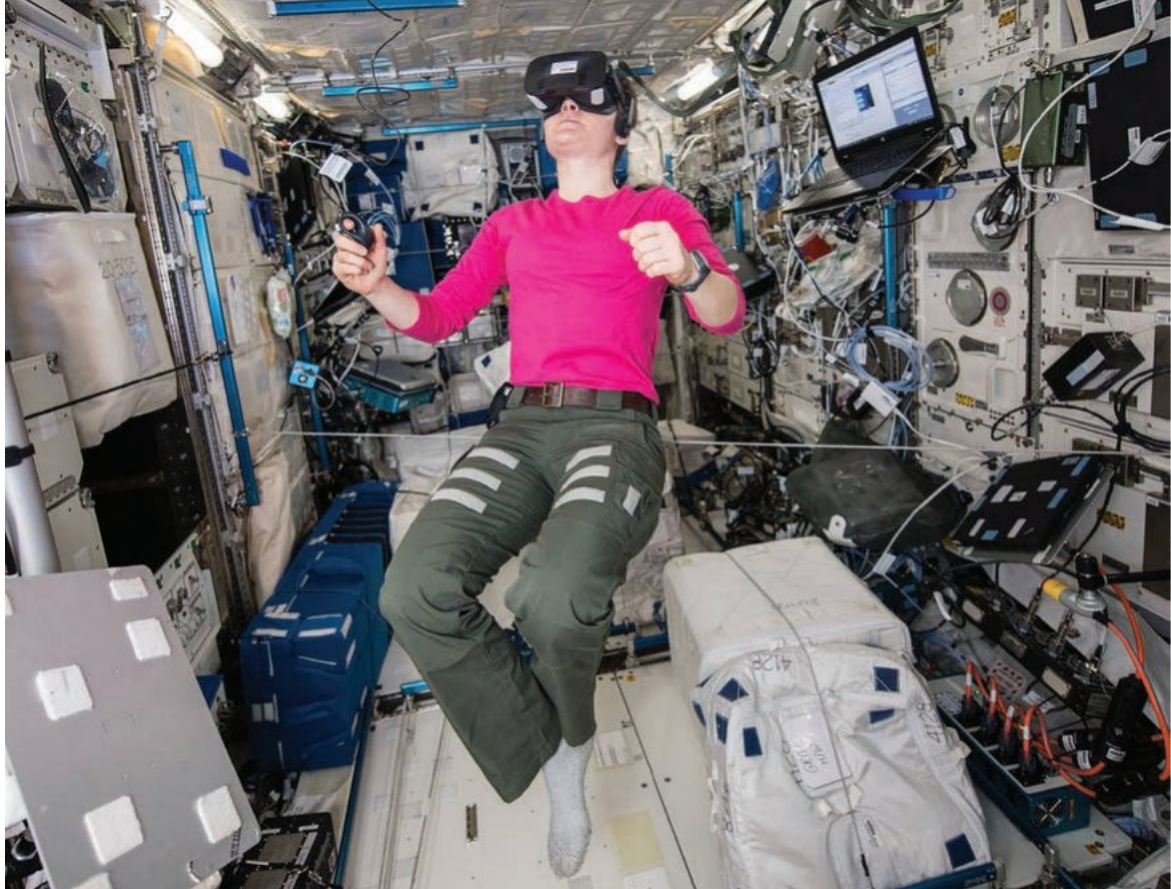
Since the ISS accelerates toward Earth at exactly the same rate as the astronauts inside, objects appear to float relative to the space station. Both the station and everything inside it are in free fall together.
Remember!
Summary
Key Points to Remember:
- Satellites orbit by continuously falling - Gravitational force provides the centripetal force needed for circular motion
- Orbital parameters are independent of satellite mass - The mass of the satellite doesn't affect its orbital speed, period, or radius
- Higher orbits mean slower speeds and longer periods - As orbital radius increases, orbital speed decreases and orbital period increases
- Geostationary satellites always orbit at 36,000 km altitude - This specific altitude gives a 24-hour period matching Earth's rotation
- Weightlessness results from the absence of normal force - Astronauts in orbit still experience gravity; they just don't feel it because there's no normal force acting on them