Concepts Used to Model Motion (VCE SSCE Physics): Revision Notes
📚Revision Notes
Concepts Used to Model Motion
Understanding vectors and scalars
In physics, every measurement we make falls into one of two categories: vectors or scalars. Understanding the difference between these is essential for accurately describing motion.
A vector is a quantity that must be described using both a magnitude (size) and a direction. When giving directions to a location, you wouldn't just say it's 500 m away - you'd specify it's 500 m to the north. This combination of distance and direction makes position a vector quantity.
A scalar is a quantity that only needs a magnitude - no direction is required. For example, when measuring 500 mL of milk for a recipe, you only need to know the amount. The concept of direction doesn't apply to volume.
Magnitude refers to the numerical value that defines the size of a quantity, without any directional information.
Note
The key difference is that vectors require both "how much" and "which way", while scalars only need "how much".
Examples of vectors and scalars
| Vector | Scalar |
|---|---|
| Displacement | Distance |
| Velocity | Speed |
| Acceleration | Mass |
| Force | Volume |
| Momentum | Area |
| Impulse | Energy |
| Torque | Power |
| Electrical field | Temperature |
| Magnetic field | Time |
Vector addition
Important
When working with vectors, you can only add vectors of the same type together. For instance, you can combine two velocity vectors, but you cannot add a velocity vector to an acceleration vector.
Vectors are commonly represented by arrows, where the arrow's direction shows the vector's direction, and its length represents the vector's magnitude.
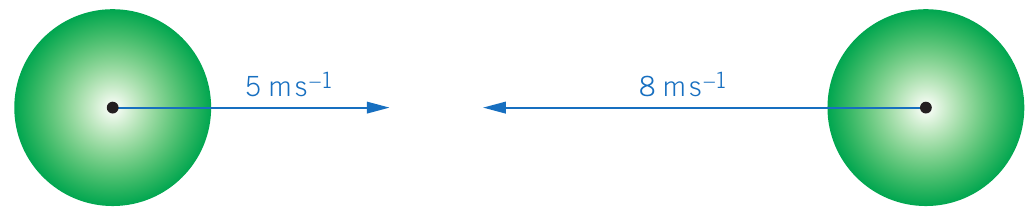
Vector addition in one dimension
When adding vectors in one dimension, direction can be represented using positive and negative signs. In the diagram above, you could represent the left ball's velocity as 5 m·s⁻¹ and the right ball's velocity as -8 m·s⁻¹ if we choose rightward as positive. Alternatively, you could make leftward positive, giving -5 m·s⁻¹ and 8 m·s⁻¹. The choice is yours, but you must remain consistent throughout your calculation.
To add vectors, you must place them head-to-tail. This means the vector you're adding should start where the previous vector finished. The resultant vector is then drawn from the tail (start) of the first vector to the head (end) of the final vector. The order in which you add the vectors doesn't change the result.
Example
Worked Example: Vector addition in one dimension
A person walks 200 m east and then turns around and walks 50 m west.
Part a: Draw a vector diagram for this situation.
Let east be to the right. The 200 m east vector points to the right. The 50 m west vector starts at the end of the previous vector and points to the left (indicating west).
Part b: Calculate how far the person is from their starting point.
The resultant vector runs from the start of the first vector to the end of the final vector. The magnitude is:
The positive sign indicates the direction is east. Therefore, the person is 150 m to the east of their starting point.
Vector addition in two dimensions
The same head-to-tail principle applies when adding vectors in two dimensions. The resultant vector extends from the start of the first vector to the head of the last vector. However, calculating the magnitude and direction requires trigonometry.
Example
Worked Example: Vector addition in two dimensions
A boat moves north at 10 m·s⁻¹ through a lake that has a current of 3 m·s⁻¹ east. Calculate the net velocity of the boat, including its direction.
First, draw a vector diagram showing both vectors. The boat's northward velocity and the eastward current form a right-angled triangle.
Using Pythagoras' theorem to find the magnitude:
To find the direction, use the tangent function:
The angle is measured from the north towards the east, written as N16.7°E. Therefore, the final velocity is 10.4 m·s⁻¹ N16.7°E.
Displacement
Displacement is the shortest straight-line distance from one point to another. Unlike distance, which is a scalar representing the total path travelled, displacement is a vector that only considers the start and end positions.
Note
Displacement only considers where you started and where you ended, not the path taken in between. This makes it fundamentally different from distance travelled.
Example
Worked Example: Finding total displacement
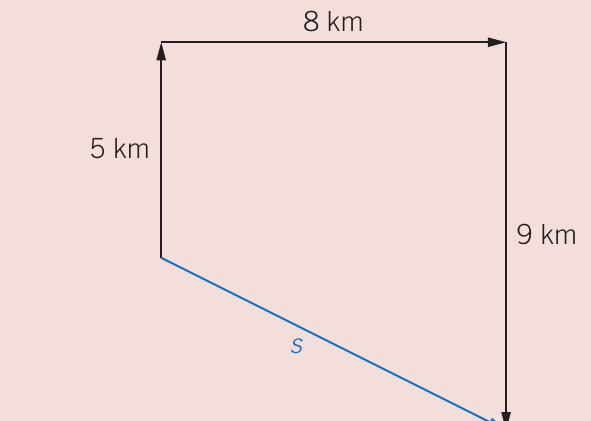
A hiker walks 5 km north, then 8 km east, and finally 9 km south. What is the displacement from their starting point?
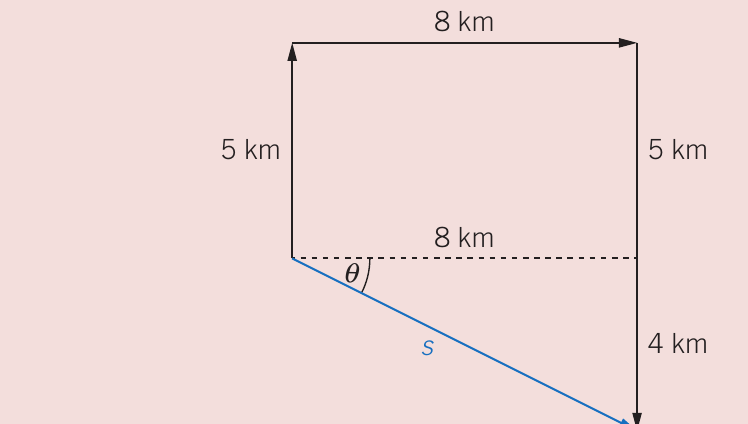
From the diagram, the 5 km north partially cancels the 9 km south, leaving a net 4 km south. This forms a right-angled triangle with sides of 8 km (east) and 4 km (south).
Using Pythagoras' theorem:
Finding the angle:
The displacement is 8.94 km at E26.6°S (26.6° from east towards south).
Friction
Friction is a force that opposes the relative motion of surfaces and fluid layers sliding against each other. This force always acts parallel to the surface in contact.
Static friction
Static friction is the force that prevents motion from starting. This type of friction is what allows you to walk - your foot pushes backwards against the ground, and static friction pushes forwards on your foot, propelling you forward.
Note
Static friction is essential for everyday movement. Car tyres rely on static friction with the road to move the vehicle forward. Without sufficient static friction (such as on ice), your feet would slip and car wheels would spin without moving the vehicle forward.

Kinetic friction
Kinetic friction opposes the motion of one object sliding over another. This friction always acts in the direction opposite to the relative motion. When pushing a box across the floor, you must apply force to overcome kinetic friction.
Drag forces
When objects move through fluids (liquids and gases), they experience frictional forces called drag forces. While the mechanism differs from solid-on-solid friction, drag forces also oppose motion through the fluid.
Component vectors
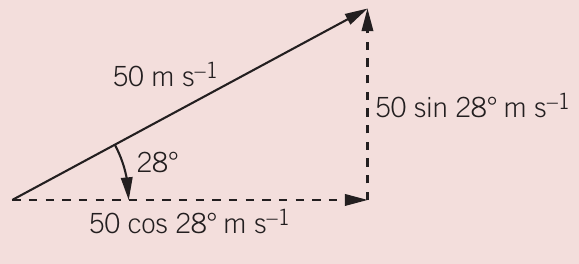
Breaking vectors into their components is often useful in physics problems. For example, when a projectile is launched at an angle, separating the velocity into horizontal and vertical components helps analyse the motion.
Important
If air resistance is ignored, the horizontal component remains constant, while the vertical component changes due to gravity. This separation allows us to analyze motion in each direction independently.
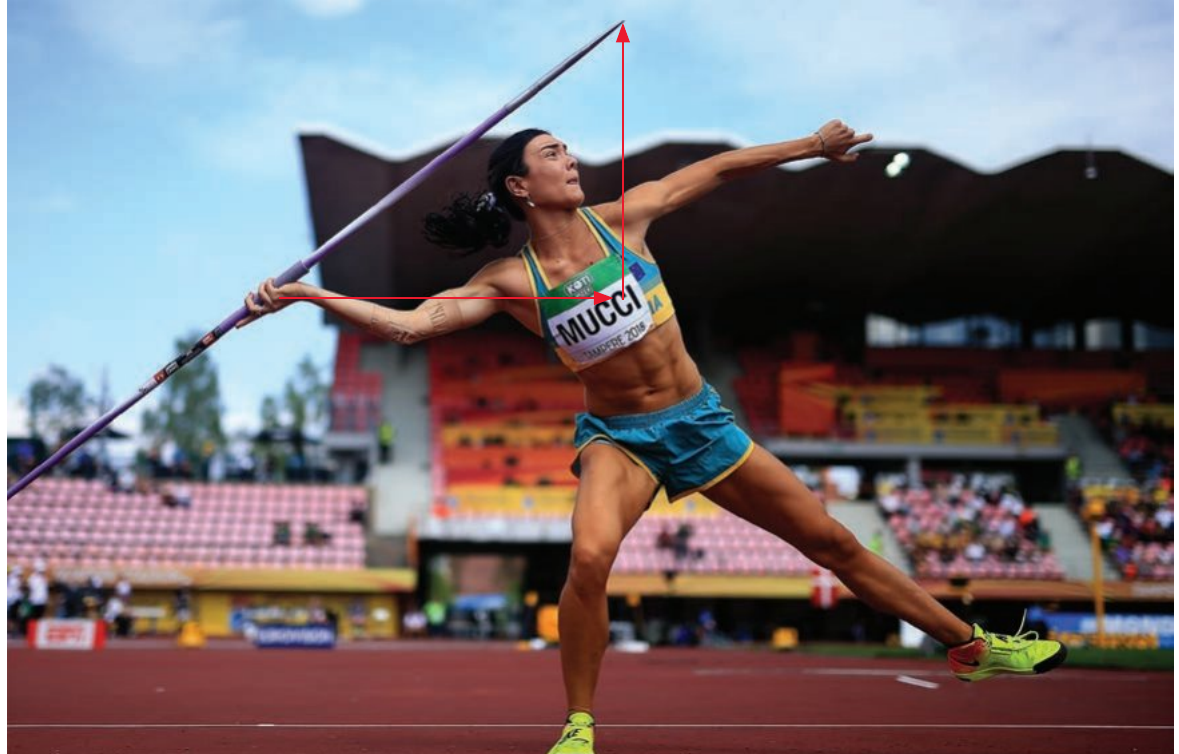
Any vector can be decomposed into perpendicular components by forming a right-angled triangle and using trigonometric functions.
Example
Worked Example: Finding vector components
A cannon fires a cannonball at an angle of 28° to the horizontal with an initial velocity of 50 m·s⁻¹. Calculate the horizontal and vertical components of the cannonball's initial velocity.
Draw the velocity vector at the given angle, then apply trigonometric functions:
Horizontal component =
Vertical component =
The horizontal component represents the cannonball's sideways motion, while the vertical component represents its upward motion at launch.
Solving for unknown vectors
Sometimes you'll need to find an unknown vector when given the resultant vector. The unknown vector, when added to the initial vector, produces the resultant vector. The general equation is:
Where:
- = Unknown vector (also called the change in the initial vector)
- = Final vector
- = Initial vector
Example
Worked Example: Change in velocity
A ball is thrown north against a wall with a velocity of 5 m·s⁻¹. It rebounds at a velocity of 3 m·s⁻¹ south. Calculate the magnitude and direction of the change in velocity.
Let north be positive:
The negative sign indicates the direction is south.
Alternatively, you can solve this using a vector diagram. Draw the initial velocity (5 m·s⁻¹ north), then draw the final velocity (3 m·s⁻¹ south) from the tail of the first vector. The change in velocity is the vector connecting the end of the initial velocity to the end of the final velocity, which gives 8 m·s⁻¹ south.
Using direction in equations
Important
When solving problems involving vectors, you must incorporate direction into your calculations. This is typically done by assigning positive and negative signs to represent different directions.
Before solving any vector problem, decide which direction will be positive and which will be negative. Write this choice down - it helps you interpret your final answer correctly.
Example
A jet plane moves through the air with a velocity of 150 m·s⁻¹ south when it encounters a headwind blowing 25 m·s⁻¹ northerly (from north towards south). What is the velocity of the jet plane relative to the ground?
Solution 1: Let south be positive
Solution 2: Let south be negative
The negative sign indicates south. Both approaches give the same answer: 125 m·s⁻¹ south.
Summary
Key Points to Remember:
- Vectors have both magnitude and direction; scalars have magnitude only
- Add vectors head-to-tail, with the resultant vector drawn from the start of the first to the end of the last
- Use Pythagoras' theorem and trigonometric functions to solve two-dimensional vector problems
- Displacement is the shortest straight-line distance between two points, not the total distance travelled
- Friction opposes motion: static friction prevents motion from starting, kinetic friction opposes ongoing motion
- Break vectors into components using for adjacent sides and for opposite sides
- Always establish a positive direction convention before solving vector equations