Thermal Energy, Electromagnetic Radiation, and Global Warming (VCE SSCE Physics): Revision Notes
📚Revision Notes
Thermal Energy, Electromagnetic Radiation, and Global Warming
Introduction to energy transfer and warming
Understanding how energy is transferred and trapped is fundamental to comprehending global warming. A familiar example is a horticultural greenhouse, which demonstrates the key principles at work in Earth's atmosphere.

A traditional greenhouse is made primarily of glass or clear plastic. It can keep plants warm even on cold, sunny days through several energy transfer mechanisms. The glass allows light of visible and near-infrared wavelengths to pass through. Once inside, this light energy is converted into thermal energy, warming the interior surfaces and air.
Note
The warmed contents of the greenhouse then re-radiate energy as long-wavelength infrared radiation. This longer wavelength radiation cannot easily pass back through the glass or plastic, so it becomes trapped inside, causing further warming. This is the fundamental principle behind the greenhouse effect.
Energy losses can be minimised by keeping windows closed (reducing convection) and using double glazing (reducing conduction through the glass).
Solar radiation and Earth's temperature
The surface of Earth is almost entirely warmed by electromagnetic energy from the Sun. Our planet receives a total of watts () continuously - more than 10,000 times the power needs of all its inhabitants.
Note
Remember that power is a measure of energy per second. This continuous flow of energy from the Sun is what sustains life on Earth and drives our climate system.
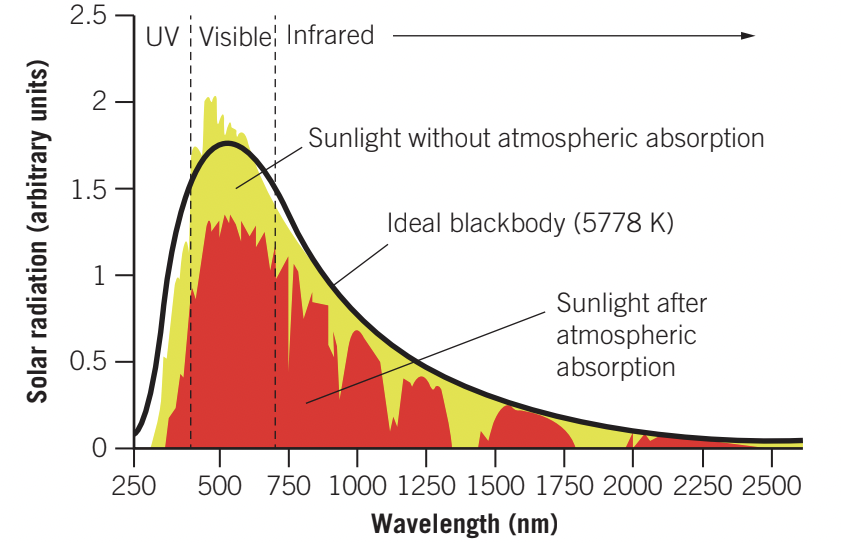
To understand how solar energy affects our planet, we need to examine the spectrum of solar radiation. The graph above shows how much power is radiated at different wavelengths. The yellow and red regions together represent the power reaching the top of the atmosphere, whilst the red regions alone show the power at ground level. The black curve represents the theoretical emission from an ideal blackbody at a temperature of K.
Blackbody radiators and blackbody radiation
All objects above K emit electromagnetic radiation. The energy for this radiation comes from the internal thermal energy of the object. However, different surfaces emit radiation with varying efficiency. For example, objects with matt black surfaces emit radiation more efficiently than those with shiny white or metallic surfaces.
Note
Blackbody: A theoretical object that perfectly absorbs all radiation falling on it and emits all frequencies produced by its thermal energy with maximum efficiency.
Blackbody radiation: The electromagnetic radiation emitted by a blackbody. Importantly, blackbodies also absorb all frequencies of radiation that fall upon them.
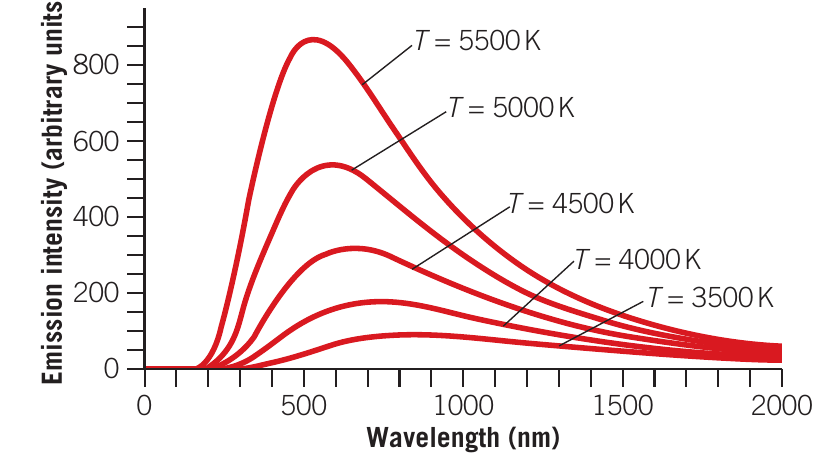
The blackbody radiation emission curves for objects at different temperatures show some important patterns. The shape of these curves varies with temperature, and two blackbodies at the same temperature will have identically shaped curves, regardless of the materials they are made from.
Key observations about blackbody radiation
- Total emitted power: The total power emitted by a blackbody is represented by the total area under the emission intensity versus wavelength curve. As temperature increases, the total power across the electromagnetic spectrum emitted by an object increases significantly.
- Peak wavelength shift: As temperature increases, the peak of the emission curve shifts to shorter wavelengths. This relationship is described by Wien's law.
- Material independence: Since the shape of any curve depends only on temperature (not on the material), we can estimate an object's temperature from the shape of its emission spectrum.
Wien's law
Wien's law provides a mathematical relationship between the peak wavelength emitted by a blackbody and its temperature.
Formula
Where:
- = Peak wavelength emitted by the blackbody (m)
- = Temperature of the blackbody (K)
- = Wien's constant, m K (or m K)
This equation allows us to estimate the temperature or total emitted energy of distant objects (modelled as blackbodies) by observing their peak wavelength. Wien's law is routinely used to estimate the effective temperature of visible stars and has practical applications such as in infrared thermometers that measure human forehead temperatures.

Practical example: The Sun's temperature
Using Wien's law for the surface of the Sun, which approximates closely to a blackbody with a peak wavelength of nm, we can calculate the surface temperature:
This corresponds to approximately .
Example
Worked Example: Peak wavelength of a human
Question: The human body can be modelled as a blackbody with a temperature of K. What region of the electromagnetic spectrum would the peak wavelength of its emitted radiation be located in?
Solution:
Using Wien's law:
Answer: This wavelength is in the infrared region of the electromagnetic spectrum.
Comparing radiation from the Sun and Earth
Both the Sun and Earth emit electromagnetic radiation, but their emissions differ dramatically due to their vastly different temperatures.
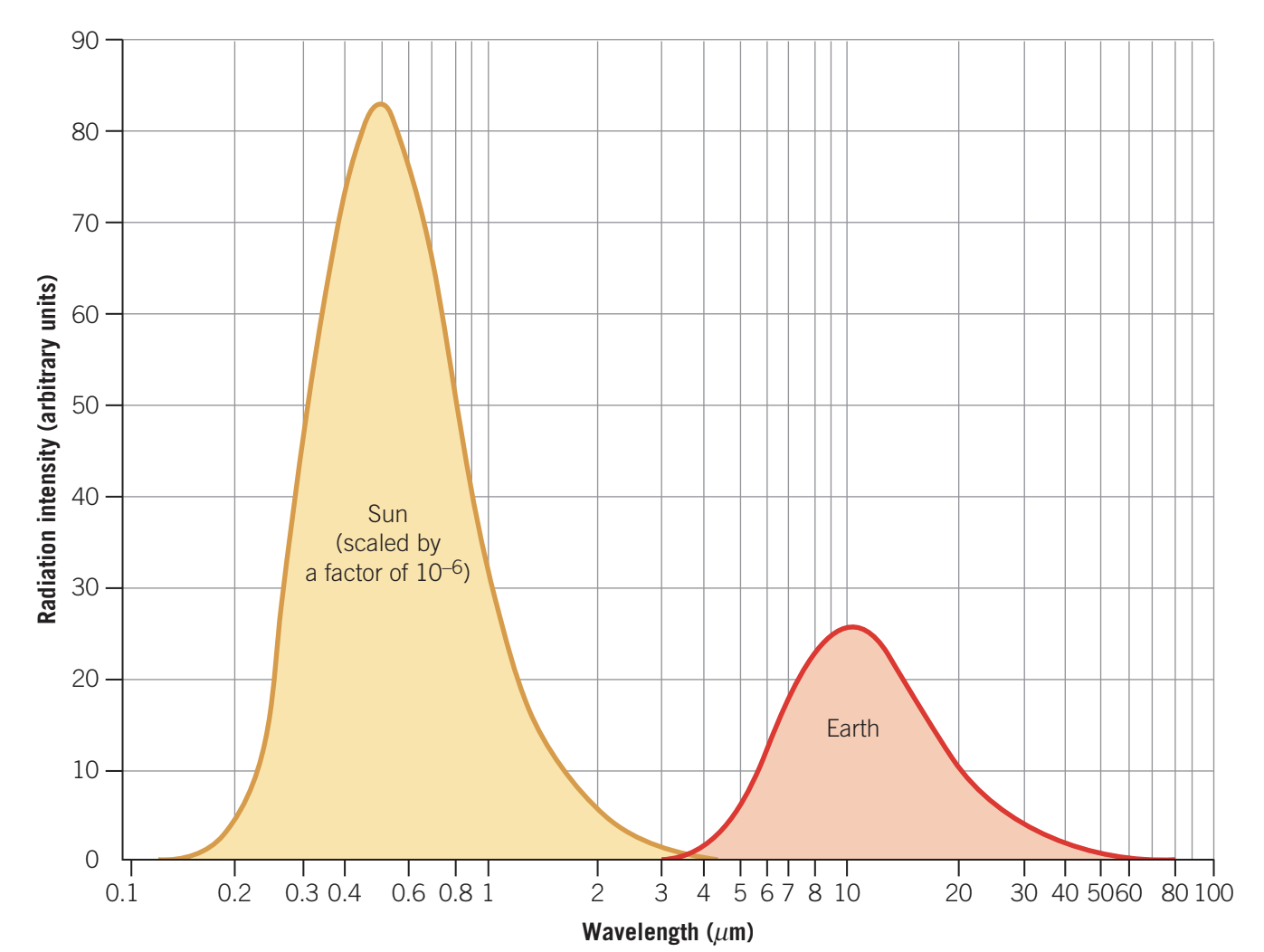
This graph compares the blackbody emission spectra of the Sun and Earth. Note that the Sun's radiation intensity has been scaled down by a factor of (one million) to fit on the same graph. Several crucial differences are apparent:
- Total radiated power: The area under each curve represents total radiated power. Even when scaled down by a factor of one million, the Sun's emissions dwarf Earth's emissions. The total radiated power increases sharply as temperature increases.
- Wavelength differences: The Sun's emissions peak in the visible light region (around micrometres), whilst Earth's emissions peak in the infrared region (around micrometres).
- Energy comparison: Earth clearly emits much less radiation energy than the Sun, and the wavelengths of Earth's emissions are all much longer, located in the infrared region of the electromagnetic spectrum.
Example
Worked Example: Peak wavelength emitted by Earth
Question: What is the peak wavelength emitted by Earth modelled as a blackbody?
Solution:
First, convert Celsius to kelvin: K
Now, using Wien's law:
Answer: This corresponds to approximately micrometres, which is in the infrared region.
Understanding global warming and climate change
Important
Our lives on Earth depend on an equilibrium between the energy received from the Sun and the energy that Earth reflects and radiates back into space. When this equilibrium is disturbed, the planet either warms or cools. Currently, our planet is undergoing global warming.
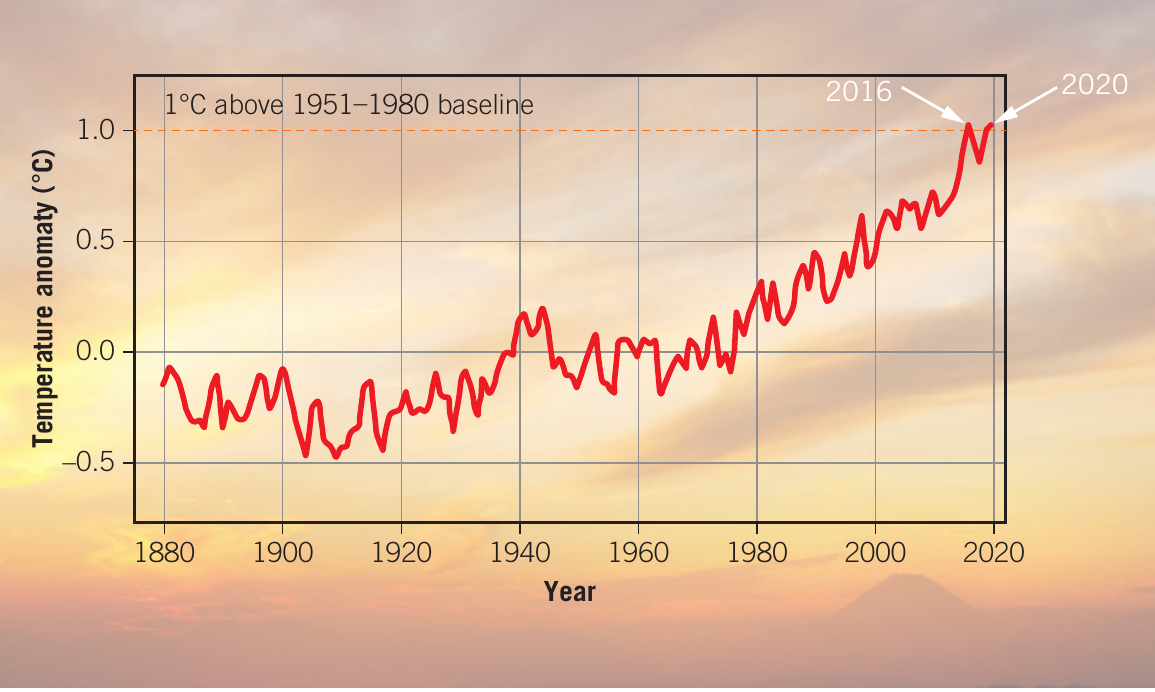
This graph shows the mean global temperature anomaly from 1880 to 2020, based on data from NASA (National Aeronautics and Space Administration). The anomaly (deviation from what is considered normal) is measured as the difference in mean global temperature for each year compared to the calculated 1951-1980 mean global temperature, which is selected as the baseline (labelled on the graph).
Key observations from the data:
- Up to 1940, global temperatures were fractionally below the baseline
- From about 1970 onwards, temperatures have been rising
- In 2016 and 2020, temperatures were approximately higher than the baseline
Climate change impacts
Climate refers to the long-term weather patterns or average weather in an area, typically measured over a period of 30 years.
Note
Even global warming of only one or two degrees causes significant changes in climate, including:
- Land, sea, and air temperature increases
- Higher sea levels
- Loss of ice from glaciers and polar ice caps
- More frequent extreme weather events (cyclones, heatwaves, bushfires, droughts, floods)
- Shifts in rainfall patterns, affecting agriculture and animal habitats
- Rising sea levels making lower-lying areas uninhabitable (e.g., islands like the Maldives, delta communities such as the Nile and Bangladesh)
Earth's energy budget
The term "budget" refers to a reckoning of inputs (incoming energy) and outputs (outgoing energy). Almost all energy in Earth's climate system comes from solar radiation, with a tiny amount from Earth's interior.
Incoming solar radiation
On average, Earth receives energy at a rate of W m from the Sun. This energy is distributed as follows:
Reflection: About W m is reflected straight back into space by:
- Clouds
- Dust and aerosols
- Earth's surface (particularly ice, snow, and desert areas)
Absorption: The remaining W m is absorbed directly by the atmosphere and surface, where it is converted to thermal energy.
The atmosphere receives energy through multiple mechanisms:
- Direct radiation absorption
- Convection from Earth's surface
- Evaporation
- Infrared radiation from Earth's surface
Outgoing radiation and the energy imbalance
Important
Earth radiates infrared radiation back into space, but importantly, it does not radiate quite as much as it receives. A small residual amount - about W m according to a recent IPCC (Intergovernmental Panel on Climate Change) report - contributes to global warming. Most of this excess energy is stored as increased thermal energy in the oceans.
This residual energy has been growing according to NASA research. Because the Earth-atmosphere system is out of balance, Earth's temperature will increase to restore equilibrium, since an increased temperature will increase heat loss through all available processes.
Earth's infrared emissions
Earth's surface radiates about W m of infrared radiation. Of this:
Atmospheric window: About W m lies in the atmospheric window - the range of wavelengths that experience little to no absorption by atmospheric gases - and escapes directly to space.
Atmospheric absorption: Most of the surface radiation ( W m) is absorbed by the atmosphere, particularly by greenhouse gases.
Greenhouse gases and back radiation
Greenhouse gases are gases that absorb and emit radiation in the infrared range. The main greenhouse gases are:
Note
Water vapour (HO): The most abundant greenhouse gas in the atmosphere
Carbon dioxide (CO): A common gas in the atmosphere that contributes to back radiation. It is produced by many chemical processes, especially combustion, and is absorbed by photosynthetic plants and microorganisms.
Methane (CH): A gas that occurs in relatively small quantities in the atmosphere but contributes a large amount to back radiation. It is the main component of natural gas and is commonly produced by cattle.
These greenhouse gases absorb infrared radiation from Earth's surface and then re-radiate energy. This results in back radiation - the amount of radiation emitted from the atmosphere back towards Earth's surface.
Important
As the percentage of greenhouse gases in the atmosphere increases, back radiation increases. This further increases the residual energy and consequently accelerates global warming.
Summary
Key Points to Remember:
- Wien's law relates peak wavelength to temperature: m K
- Objects at higher temperatures emit more total energy and have shorter peak wavelengths
- Earth receives approximately W m from the Sun; about W m is reflected, and W m is absorbed
- A small energy imbalance (about W m) is causing global warming
- Greenhouse gases (HO, CO, CH) absorb infrared radiation and create back radiation, trapping heat in the atmosphere
- Global warming of even - causes significant climate changes including sea level rise, extreme weather, and habitat disruption