The Fallibility of Visual Perception (VCE SSCE Psychology): Revision Notes
📚Revision Notes
The Fallibility of Visual Perception
Introduction
Visual perception is generally accurate and reliable, but it is not infallible. Our perceptual systems can make mistakes in two main ways: through visual illusions (where the stimulus itself tricks our brain) and through neurological conditions such as agnosia (where the brain's processing systems fail). These errors demonstrate that what we see is not always an accurate representation of reality.
Note
Our perceptual systems demonstrate fallibility in two distinct ways:
- Visual illusions: The stimulus itself creates the misperception
- Neurological conditions: The brain's processing systems fail to interpret correctly
Both types reveal that perception is not simply a passive recording of reality, but an active construction by the brain.
Visual illusions
What are visual illusions?
A visual illusion occurs when our perception of a stimulus consistently differs from objective reality. The key characteristics of visual illusions are:
- The misinterpretation is caused by a distortion or mistake in how we perceive visual stimuli
- The illusory effect is unavoidable—even when we know we are looking at an illusion, our perception remains confused
- Most people perceive the same illusion in the same way
- The stimuli themselves trick our visual perceptual system
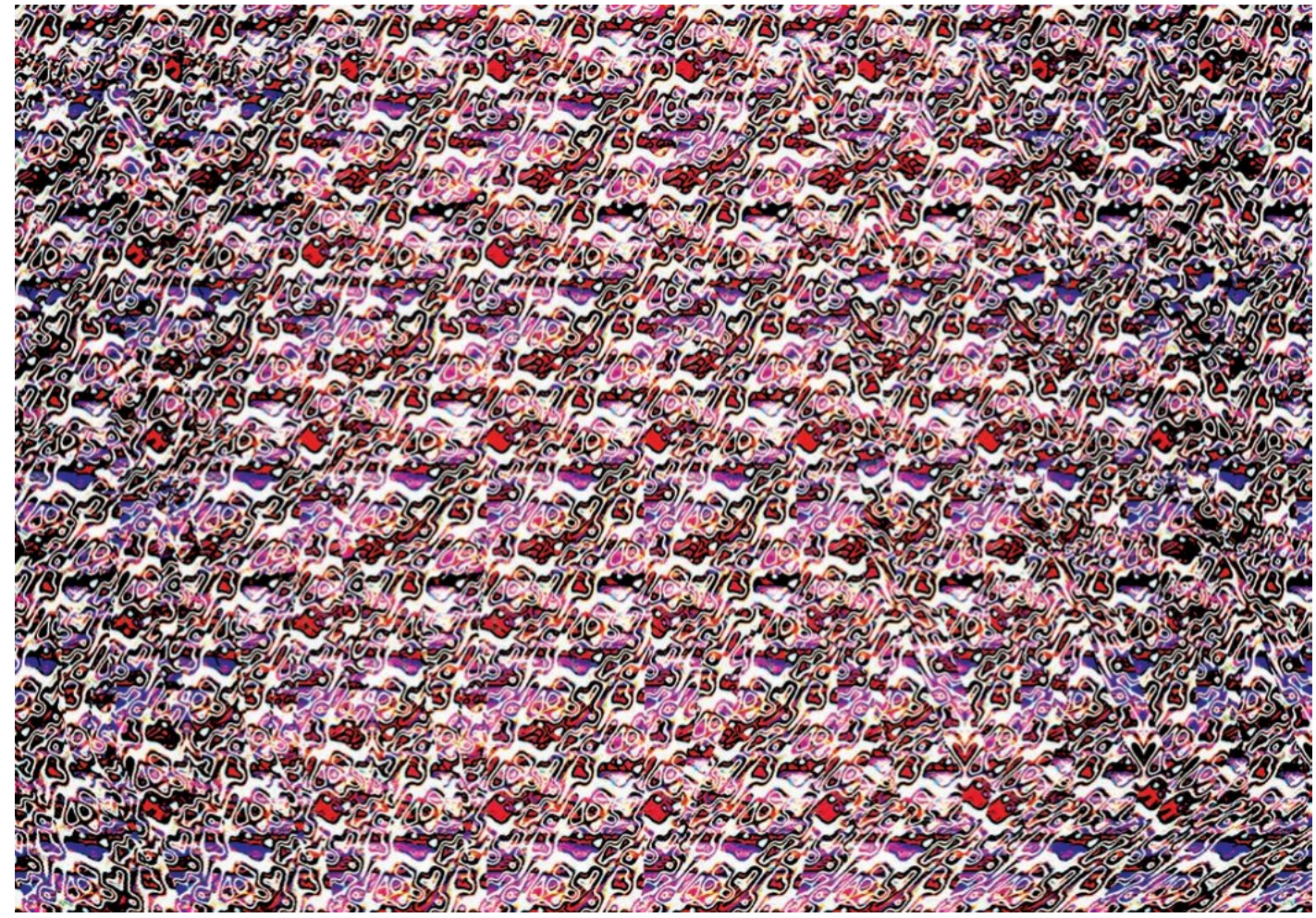
Visual illusions can range from complex creations like Magic Eye 3D images to naturally occurring phenomena. They demonstrate the important role the brain plays in constructing our view of the world, rather than simply recording what is 'out there'.
Important
Even when we are consciously aware that we are viewing an illusion, our perceptual system continues to be tricked. This demonstrates that perception operates at a level beyond conscious control and awareness.
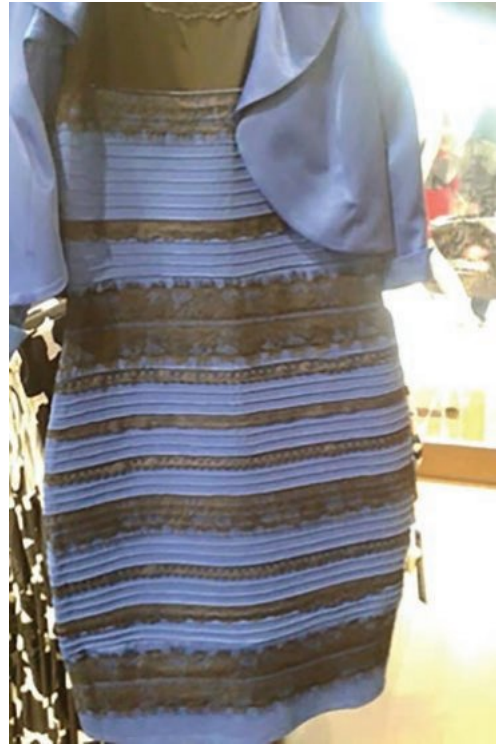
The dress phenomenon
Example
Worked Example: The Dress Illusion
A striking example of visual perception's fallibility is the 2015 photograph of #thedress, which became a viral internet phenomenon. This image shows a dress that some people perceive as blue and black, whilst others see it as white and gold. The actual dress is blue and black, yet the ambiguous lighting in the photograph creates different perceptions.
How perception differs:
- Some observers interpret the lighting as artificial (indoor) light → perceive white and gold
- Other observers interpret the lighting as natural (outdoor) light → perceive blue and black
Key insight: This demonstrates how our brain's interpretation of context influences what we consciously perceive, showing that perception is not purely bottom-up but involves top-down processing based on assumptions.
Research suggests that people's assumptions about the lighting conditions under which the dress was photographed (artificial versus natural light) affect their perception of its colour.
Müller-Lyer illusion
The Müller-Lyer illusion involves two lines of equal length, each with different-shaped ends. One line has arrowheads pointing inwards at each end, whilst the other has feathertails pointing outwards at each end. Despite being identical in length, most people perceive the feathertail line as longer than the arrowhead line.
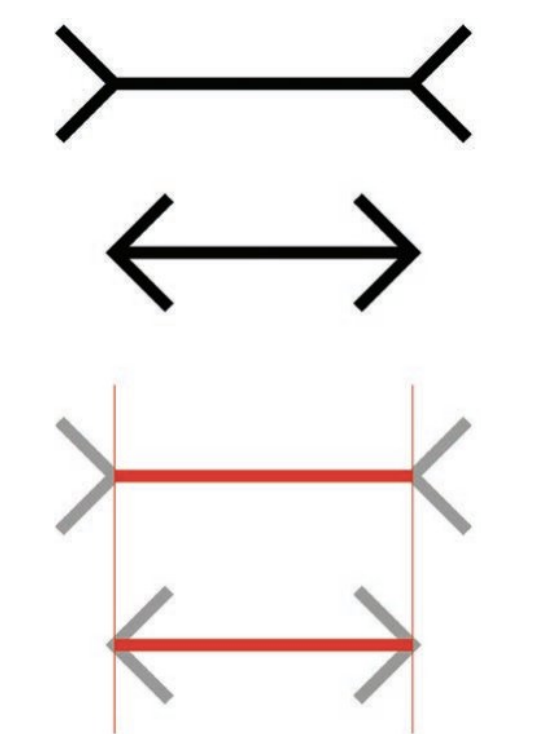
Explanations of the Müller-Lyer illusion
Several theories attempt to explain this illusion:
Convergence theory (biological explanation)
Note
This theory suggested that the line with arrowheads causes the eyes to turn inwards, creating more tension in the muscles surrounding the eyes. This increased tension was thought to make us perceive the line as closer to us. Conversely, the feathertail line causes the eyes to turn outwards, creating less tension and leading us to perceive it as further away (and therefore longer).
However, research has shown that the Müller-Lyer illusion persists even when there is no eye movement, so this theory is no longer supported.
Carpentered-world hypothesis (social/cultural explanation)
This theory, proposed by William Hudson, suggests that perception of the Müller-Lyer illusion is influenced by one's familiarity with modern, Western building designs featuring regular rectangular shapes and right angles.

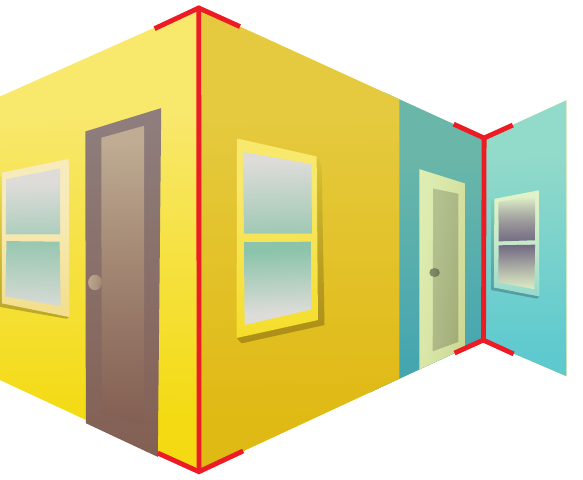
The hypothesis states that:
- People raised in cultures with rectangular internal walls (common in Western architecture) are more likely to perceive the Müller-Lyer illusion
- Those who have grown up with non-rectangular building designs (such as circular traditional huts) are less likely to be tricked by this illusion
- We tend to perceive internal building walls (represented by the feathertail line) as being further away than external building walls (represented by the arrowhead line)
Apparent distance theory
This theory builds upon the carpentered-world hypothesis by incorporating the concept of size constancy. Size constancy is our ability to perceive an object's actual size despite changes in our retinal images of the object—the image of the object projected onto the retina at the back of the eye.
Note
The Size Constancy Principle:
If two objects cast the same-sized retinal image, but one is perceived to be further away, our brain interprets the more distant object as being larger.
This principle explains why we can accurately judge object sizes despite changes in viewing distance—our brain automatically compensates based on perceived depth.
The theory states that if two objects cast the same-sized retinal image, but one is perceived to be further away, our brain interprets the more distant object as being larger.
In the Müller-Lyer illusion, both lines produce the same-sized retinal images. However, the feathertail line is perceived as further away (like an internal corner of a room). According to size constancy principles, if an object further away produces the same-sized retinal image as a closer object, it must actually be larger. Therefore, our brain uses top-down processing (past experience and memory) to determine that the more distant feathertail line must be longer in the first place. Hence, we incorrectly perceive the arrowhead line as shorter and the feathertail line as longer.
Limitations of these explanations
Important
Critical Limitations:
Both the carpentered-world theory and the apparent distance theory are limited in explaining the Müller-Lyer illusion because:
- The illusion persists even when the feathertails and arrowheads are replaced with differently shaped ends
- The illusion still occurs when the lines are turned on their side, which would not create perceived depth from familiarity with Western building design
These limitations make the Müller-Lyer illusion particularly intriguing—we still do not fully understand why it works so consistently.
Ames room illusion
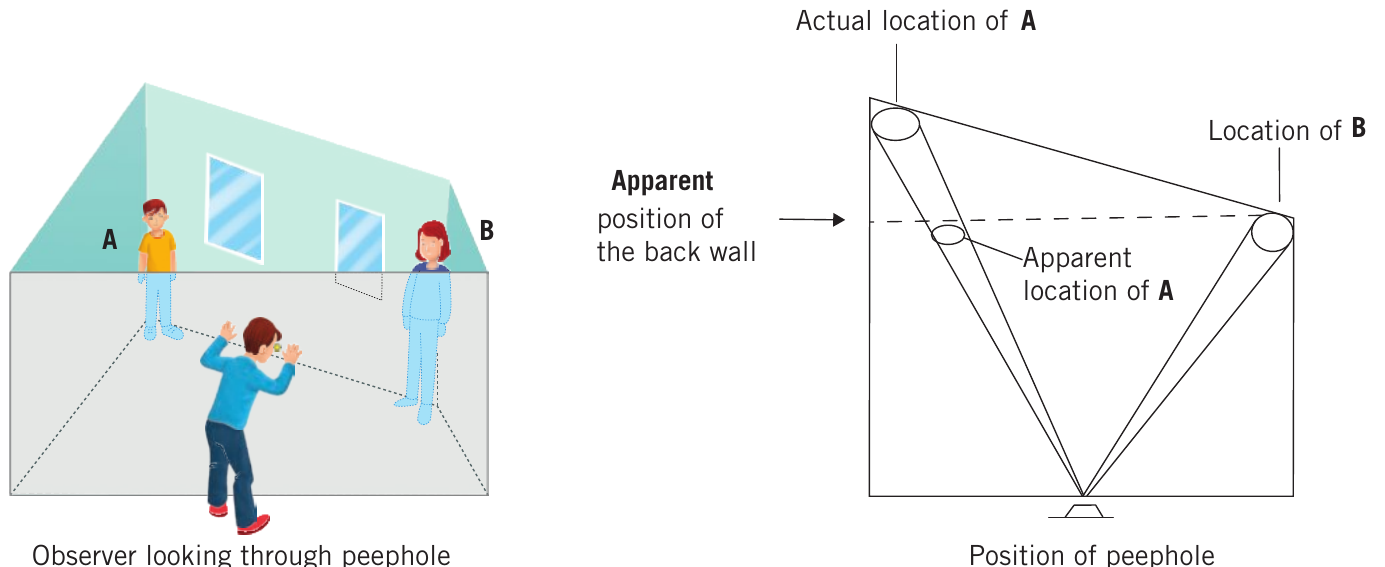
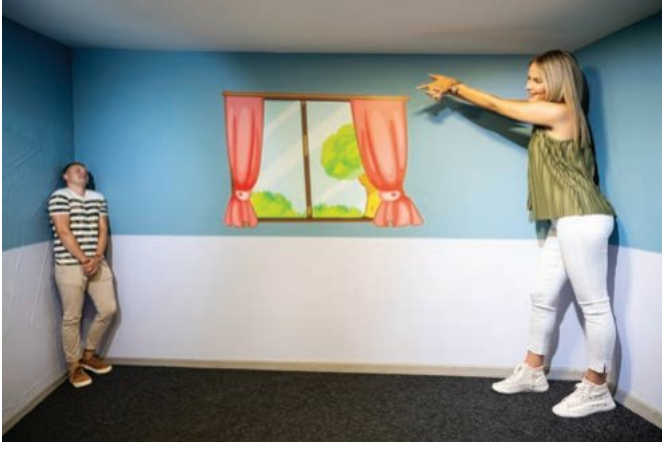
An Ames room is a specially constructed physical room designed to create a powerful visual illusion for an observer viewing through a peephole. Whilst it appears to be a normal rectangular room, the Ames room is actually trapezoid-shaped.
Construction of the Ames room
The Ames room has the following features:
- The floor plan is a right trapezoid (a trapezium with two right angles)
- The back wall is positioned at an oblique angle
- The back left-hand corner is double the height and double the distance from the peephole compared to the back right-hand corner
- To accommodate these dimensions, the room has a sloping floor and sloping ceiling
- Special flooring and wall decorations enhance the illusion
How the Ames room creates the illusion
The illusion relies on several perceptual principles:
Restriction of depth cues
Note
To view the room, the observer must look through a peephole, which means they can only use one eye at a time. This prevents them from using binocular depth cues (such as convergence and retinal disparity) that require both eyes to send information to the brain to perceive depth.
Whilst depth can be perceived to some degree with monocular depth cues (such as accommodation), these are much less effective when not supported by binocular depth cues. The Ames room illusion depends on the observer's inability to perceive depth and thus recognise that the far left corner of the room is actually further away.
Perceptual constancy
The Ames room illusion is explained by perceptual constancy—the mind's ability to perceive a visual stimulus as remaining constant even though the visual information sent to the brain shows changes. Two types of perceptual constancy are particularly relevant:
- Shape constancy: The ability to perceive an object's actual shape despite changes in the retinal image. The observer maintains the shape of the room as rectangular because this is what they expect to see based on past experience.
- Size constancy: The ability to perceive an object's actual size despite changes in retinal images. When two people of similar height stand in opposite corners of the room, the illusion becomes apparent.
Example
Worked Example: How Size Distortion Occurs
Because the far left corner is double the height of the far right corner, and both corners cast the same-sized retinal image, a person standing in the far left corner appears half the size of someone standing in the far right corner.
Step-by-step explanation:
- Both corners create equal-sized retinal images
- Observer maintains shape constancy (assumes rectangular room)
- To account for people's sizes relative to wall heights, brain must adjust size perception
- Result: People appear to shrink or grow as they move around the room
This confuses our ability to maintain size constancy—we hold the shape of the room constant but must account for the size of the people relative to the height of the walls.
Top-down processing
The illusion is reinforced by top-down processing, where observers who have been raised in cultures where rooms tend to be rectangular expect to see a rectangular room. This expectation influences their perception.
Spinning dancer illusion
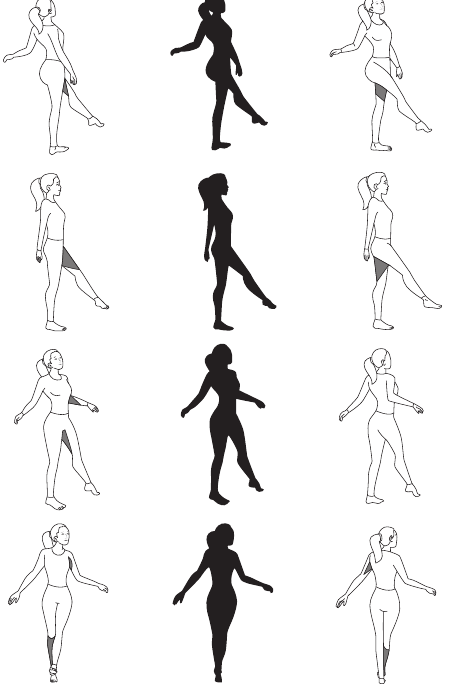
The spinning dancer illusion is a GIF image of a dancer pirouetting on one foot on a vertical axis. The illusory effect is that the dancer can be perceived as spinning either clockwise or anticlockwise, and the same viewer can alternate between perceiving different directions of spin.
How the spinning dancer illusion works
The illusion occurs because:
- The direction of spin you perceive depends on whether you interpret the dancer as standing on her left or right leg
- Both clockwise and anticlockwise interpretations are equally plausible for the same silhouette
- The lack of depth cues (due to the silhouetted nature of the figure) makes both interpretations equally valid
- The angle from which you view the image and the features you focus on at any given moment can change your interpretation
Note
Bistable Perception:
This ability to spontaneously switch between two different interpretations of the same ambiguous visual stimulus is called bistable perception. It demonstrates that perception is not fixed but can fluctuate based on how our brain interprets ambiguous information.
Research findings
Studies of the spinning dancer illusion have found that:
- People are more likely to perceive the dancer as spinning clockwise initially
- If someone sees the dancer spinning anticlockwise initially, they are more likely to then reverse the perceived spin to clockwise
- Clockwise spin is more likely to be perceived when the image is viewed from above
- Anticlockwise spin is more likely to be perceived when the image is viewed from below
Visual agnosia
Whilst visual illusions demonstrate how stimuli themselves can trick our perceptual system, agnosia shows what happens when the problem lies in how stimuli are processed in the brain.
What is agnosia?
Agnosia is a brain disorder that interferes with one's ability to recognise or identify objects, people or sounds using one or more of the senses. The term comes from classical Greek, where the prefix 'a-' means 'without', 'gnos' comes from 'gnosis' meaning 'knowledge', and the suffix '-ia' signifies a condition. Therefore, agnosia literally means 'a condition without knowledge'.
Important
Key Characteristics of Agnosia:
- The sensory system affected by the processing problem is otherwise fully functioning
- The distortion of perception cannot be explained by memory problems, attention issues, language difficulties, or a lack of familiarity with the stimuli
- It can affect the visual, auditory, or somatosensory (tactile) perceptual systems
- It is typically caused by brain injury
The crucial point: The sensory organs work properly, but the brain cannot make sense of the sensory information.
Apperceptive visual agnosia
Someone with apperceptive visual agnosia cannot process or perceive certain stimuli, such as familiar objects or familiar places. This failure to perceive occurs in the early stages of processing. Because no perception has taken place, people with apperceptive visual agnosia cannot even copy a drawing of the stimulus. The problem is not just in recognising it, but in perceiving it at all.
Example
Worked Example: Living with Apperceptive Visual Agnosia
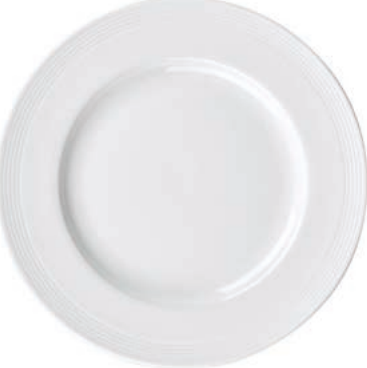
A person with apperceptive visual agnosia may look at a dinner plate and not be able to recognise it as 'a dinner plate'. If you asked them what a dinner plate was, they could describe it to you (because their memory is intact), but if you showed them a picture of a dinner plate, they could not tell you what it was.
Alternative strategies:
- If you asked them to get a dinner plate for you, they would likely use their sense of touch to identify the required item, using the shape and texture of the object
- If you asked this person to copy an image of a dinner plate, the outcome would likely be a series of concentric scribbles
This demonstrates that the problem lies in visual perception, not memory or understanding of the concept.
Causes
Apperceptive visual agnosia is a neurological disorder typically caused by brain injury, particularly of the parietal and occipital lobes. Common causes of brain injury include:
- Physical injury
- Dementia and other degenerative brain diseases (such as Alzheimer's disease)
- Oxygen deprivation (such as from stroke)
- Carbon monoxide poisoning
- Brain tumours
Associative visual agnosia
Someone with associative visual agnosia can perceive familiar objects but cannot translate that perception into recognition. Unlike those with apperceptive visual agnosia, if asked to copy an image of a familiar object, they can complete this task successfully. However, they still cannot identify what the object is.
Example
Worked Example: Living with Associative Visual Agnosia
Using the dinner plate example, a person with associative visual agnosia could tell you what a dinner plate is, and they might use their other senses to locate a dinner plate in their kitchen. The key difference is that if given a drawing of a dinner plate to copy, they could draw the dinner plate accurately. However, if you then asked them to say what they had just drawn, they could not name the object in the drawing.
For this reason, associative visual agnosia can be described as normal perception stripped of meaning.
Causes
Like apperceptive visual agnosia, associative visual agnosia is a neurological disorder typically caused by brain injury. The difference lies in the area of the brain affected. Whilst apperceptive agnosia is related to lesions in the parietal and occipital lobes, associative agnosia is more often associated with lesions in the temporal lobe.
Comparison of apperceptive and associative visual agnosia
| Feature | Apperceptive visual agnosia | Associative visual agnosia |
|---|---|---|
| Brain regions affected | Parietal and occipital lobes | Temporal lobe |
| Processing of stimuli | Unable to process or perceive certain stimuli | Able to process and perceive certain stimuli |
| Recognition | Unable to recognise stimulus | Unable to translate perception into recognition |
| Drawing ability | Unable to draw or copy a drawing of a stimulus | Able to draw or copy a drawing of a stimulus |
| Naming ability | Unable to name the stimulus | Unable to name the stimulus in the drawing |
Note
Key Distinction:
The fundamental difference between the two types lies in the stage of processing where the breakdown occurs:
- Apperceptive: Breakdown occurs during perception (early stage)
- Associative: Breakdown occurs during recognition (later stage)
Prosopagnosia (face blindness)
Prosopagnosia is a specific type of visual agnosia involving an inability to recognise the faces of familiar people, despite having no memory dysfunction, memory loss or impaired visual sensation. People with this condition cannot perceive facial expressions and rely on other cues, such as hair, clothing, voice, or distinctive features, to identify people.
Characteristics
- Cannot recognise familiar faces
- May have difficulty telling faces apart, recognising one's own face, or even distinguishing faces from objects (depending on severity)
- Cannot perceive facial expressions
- Must rely on non-facial cues for identification (hair, clothing, voice, distinctive features)
- Can be apperceptive or associative
Causes
Prosopagnosia can be:
- Congenital (present from birth), associated with developmental differences such as autism spectrum disorder
- Acquired through brain injury, resulting from abnormalities or lesions in the occipital and temporal lobes, specifically in the neural systems that control facial perception and memory
Loss of the ability to recognise familiar faces can also occur in Alzheimer's disease.
Example
Case Example: Dr P
A famous case of prosopagnosia was described by neurologist Oliver Sacks in his book The Man Who Mistook His Wife for a Hat. Dr P was a singer and music teacher who noticed that he could no longer recognise his students. He had to rely on their voices or how they played instruments to identify them.
Notable behaviors:
- Dr P would see faces where there were none—he was known to pat fire hydrants, thinking they were children, only to be confused when 'they' did not respond
- Dr P had no issues with his memory or eyes; he had prosopagnosia
Sacks' findings:
- Dr P could recognise individual features of people (such as his brother's large teeth) and use those to guess at someone's identity
- However, he could not combine those visual sensory stimuli into a meaningful whole, as would be required to truly 'recognise' someone
This case demonstrates that prosopagnosia involves a specific deficit in facial recognition, not a general problem with vision or memory.
Summary
Key Points to Remember:
-
Visual illusions consistently trick our perception despite us knowing they are illusions, demonstrating that our perceptual system is fallible.
-
The Müller-Lyer illusion shows how two equal lines can appear different in length due to different end shapes, possibly explained by cultural familiarity with rectangular buildings and size constancy principles.
-
The Ames room creates the illusion of a rectangular room through clever construction and restriction of binocular depth cues, making people appear to grow or shrink as they move around.
-
Bistable perception, as seen in the spinning dancer illusion, demonstrates our ability to switch between different interpretations of the same ambiguous stimulus.
-
Agnosia is a brain disorder affecting recognition despite intact sensory systems: apperceptive agnosia involves failure to perceive stimuli, whilst associative agnosia involves failure to recognise perceived stimuli.
-
Prosopagnosia (face blindness) is a specific form of visual agnosia affecting facial recognition, caused by damage to occipital and temporal lobes or present from birth.