Perception (VCE SSCE Psychology): Revision Notes
📚Revision Notes
Applying the Biopsychosocial Model to Visual Perception
Introduction to the biopsychosocial model
The biopsychosocial model is an interdisciplinary approach that examines how biology, psychology and social factors interconnect to influence a person's perceptions. This model helps us understand that visual perception is not determined by one single factor, but rather by the combined influence of multiple factors working together.
Note
The biopsychosocial model recognises that human perception is complex and multifaceted. Rather than viewing perception through a single lens, this model acknowledges that biological, psychological and social factors work in combination to create our unique perceptual experiences.
When applied to visual perception, the biopsychosocial model considers:
- Biological factors: physiological functions of the body
- Psychological factors: learned mental processes
- Social factors: cultural influences and societal norms
These factors often work in combination, rather than in isolation, to shape how we perceive the visual world around us.
Biological factors affecting visual perception
Biological factors affecting visual perception are grounded in physiology (the functions of the body). These factors are generally similar for most people, except where individual differences arise due to genetics, injury, age or other biological reasons.
Colour vision deficiency
One example of a biological factor is colour blindness, also known as colour vision deficiency. The most common type is red-green colour blindness, which prevents a person from distinguishing between reds, greens, browns and oranges, or accurately differentiating between blue and purple hues. This biological difference affects how individuals perceive visual stimuli in their environment, such as traffic lights or the ripeness of fruit.
Depth perception
Depth perception is the ability to judge distances and see the world in three dimensions. This relies on our ability to correctly process biological depth cues, which are physiological signals that help us determine how near or far an object is from another object or ourselves.
Note
Our eyes receive visual stimuli as two-dimensional images on the retina, which are then converted into a three-dimensional reality using depth cues. This remarkable transformation allows us to navigate and interact with our environment effectively.
There are two main types of depth cues: binocular depth cues and monocular depth cues.
Binocular depth cues
Binocular depth cues require both eyes to send information to the brain to perceive depth. Individuals with sight in only one eye cannot use these depth cues and therefore cannot perceive depth in the same way. The two main binocular depth cues are convergence and retinal disparity.
Convergence
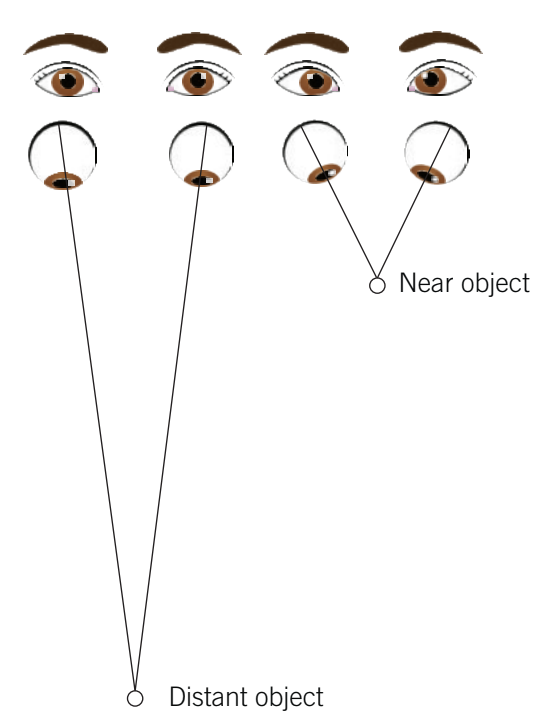
Convergence involves the inward turning of the eyes, which is detected by the brain as tension changes in the muscles surrounding the eye. When we focus on objects that are close, our eyes turn inwards. The brain detects this increase in muscle tension in both eyes, and the visual cortex uses this information to help determine the depth and distance of the object.
Important
Key features of convergence:
- The closer an object, the greater the inward turning of the eyes and the stronger the muscle tension
- The further away an object, the less inward turning and less muscle tension
- Convergence occurs when an object is within approximately seven metres of the viewer
- Beyond seven metres, convergence does not take place as the eyes remain parallel
Retinal disparity
Retinal disparity refers to the brain detecting similarities and differences between the information being sent from each eye. This occurs because our pupils are spaced 6-7 cm apart, meaning each eye receives slightly different visual information about the same object.
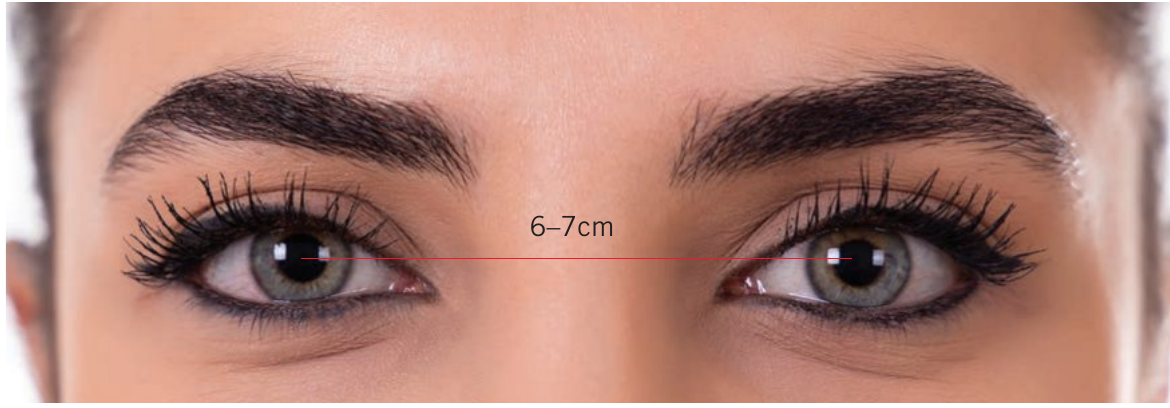
The mismatch between the sensory information from each eye provides cues about the object's depth and distance:
- When the disparity (difference) between the images is greatest, the object is perceived as close to the observer
- Less disparity between the two images indicates that the object is further away
- Retinal disparity can be used on objects up to 10 metres away from the viewer
- Beyond 10 metres, the images received on each retina are virtually the same, making it difficult to detect depth in distant objects
Monocular depth cues
Monocular depth cues require only one eye to send information to the brain to perceive depth. Unlike convergence and retinal disparity, monocular depth cues can be used by people with vision in only one eye, although perceiving depth is more difficult without binocular cues.
Accommodation
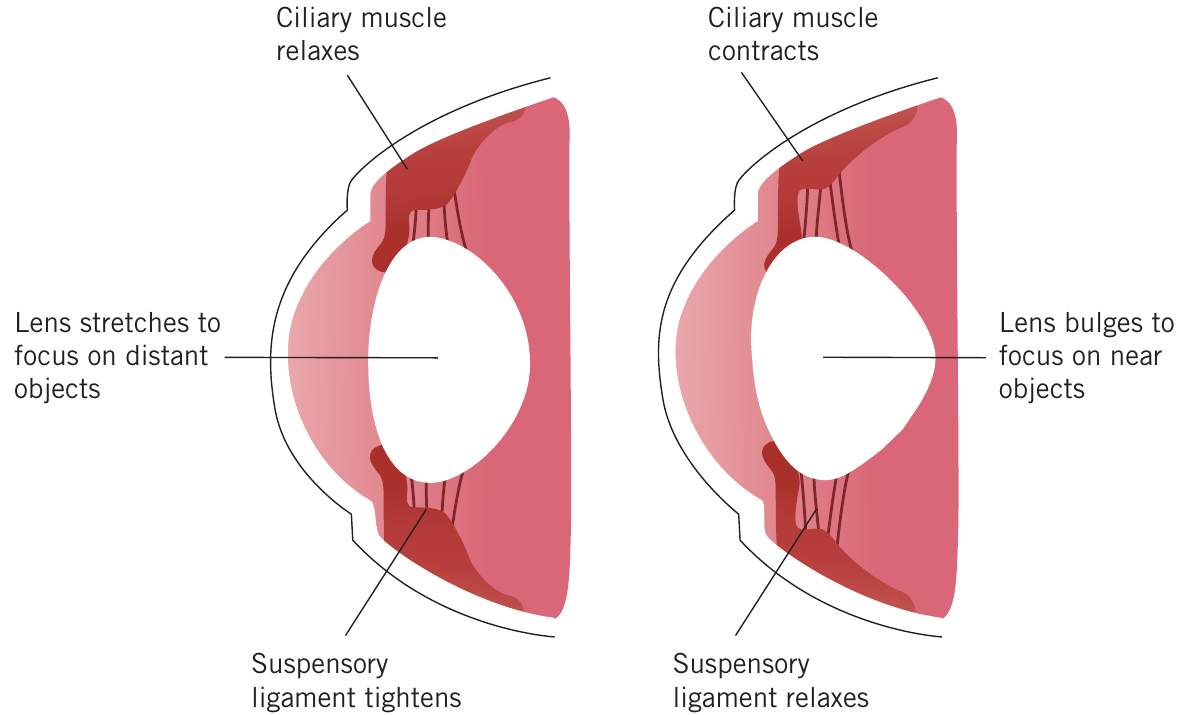
Accommodation is the ability of the eye to change focus from near to distant objects and back again. Through accommodation, the brain detects movement in the muscles of the eye as it changes the shape of the lens to focus on nearby or distant objects.
Note
How accommodation works:
- For nearby objects: The lens bulges as the ciliary muscle contracts (shortens) and the suspensory ligament relaxes
- For distant objects: The lens stretches as the ciliary muscle relaxes and the suspensory ligament tightens
The brain receives information about the shape of the lens from the muscle tension surrounding the eye, which assists in its interpretation of an object's distance.
Accommodation occurs when an object is within three metres of the viewer. Beyond three metres, the shape of the lens does not change significantly.
Psychological factors affecting visual perception
Psychological factors are learned mental processes that shape how we perceive visual sensations. Unlike biological factors associated with physiological function, psychological factors are unique to each individual, causing people to interpret environmental stimuli in highly personal ways.
Important
This explains why no two people interpret visual information in exactly the same way. Each person's unique combination of experiences, memories, motivations and contexts creates a distinctive perceptual filter through which they view the world.
The main psychological factors include:
- Perceptual set
- Visual perceptual principles (including Gestalt principles)
- Perceptual constancy
Perceptual set
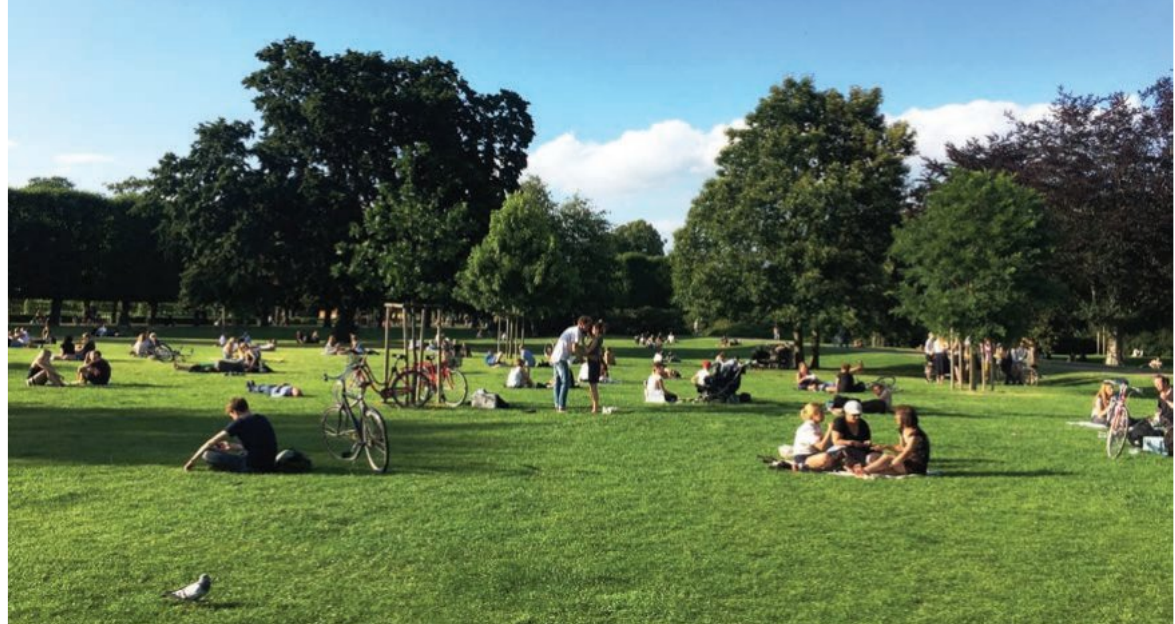
Perceptual set is the tendency to view things in a certain way due to a readiness to receive certain stimuli. Your perceptual set leads you to perceive stimuli in particular ways based on your expectations. It is informed by:
- Past experiences and memory
- Motivations
- The context in which you are experiencing the stimuli
Past experience
Past experience refers to the situations and events we have encountered throughout our lives prior to the present. Our experiences are influenced by numerous factors, including:
- Physiology
- Cultural and social background
- Familial and friendship relationships
- Education
- Conversations we have had
- Places we have been
- Texts we have consumed
Note
In short, past experience is the sum of our life experiences. Since every person has had a unique set of life experiences, no two people will have the same set of past experiences. This uniqueness is fundamental to understanding why perception is so individual.
Past experiences are an important component of our perceptual sets because they:
- Inform our ideas and expectations about the world
- Shape how we process stimuli from the top down
- Determine which stimuli appear most salient, affecting bottom-up processing

Example
Worked Example: The Tent Perception
Consider an image of a tent. How might different people perceive this stimulus based on their past experiences?
Person A: Might perceive it positively if they have fond memories of family camping trips Person B: Might perceive it negatively if they associate tents with a difficult period of homelessness Person C: Might have negative associations if they were forced to volunteer at a welcome tent for a local event
Conclusion: The same visual stimulus is perceived differently based on each person's unique past experiences, demonstrating how past experience shapes perception.
Memory
Memory is an information processing system that actively receives, organises, stores and recovers information. Our memory is shaped by our experiences of the world and helps us understand how our world works. It plays an important role in our expectations of how the world should operate.
Example
Worked Example: The Plane in the Cloud
If you watch a plane fly into a cloud and become obscured from view, your memory helps you track where the plane should be in the sky even though you cannot see it.
Your expectation is that the plane will become visible again once it emerges from behind the cloud. This expectation is based on your knowledge of planes and their movement, and your memory of where the plane was when you last saw it.
Motivation
Motivation refers to our individual desires, which cause us to perceive certain stimuli that align with our goals as more salient than others. The stimuli that become salient are directed by our past experiences and expectations through top-down processing.

Example
Worked Example: Shopping with Purpose
If you are shopping in a large department store with the aim of finding a present for someone important in your life, your perceptions will differ from if you entered the store merely to browse.
You will have past experiences of what the person likes and dislikes, and your own ideas about what makes a good gift. Certain items will emerge as salient, drawing your attention, while your eyes pass over other items that do not fit your motivation for shopping.
If you enter the store knowing exactly what you want to buy, you will pass by most items without really seeing them, scanning only the relevant shelf for the specific product you wish to purchase.
Context
Context is the situation or conditions in which something occurs. For our purposes, it is the location and circumstances in which visual stimuli are being processed. Context informs our perceptual set, affecting how stimuli are perceived.
Note
Context and Perception Example
Consider the visual stimulus of a bright light in the sky with a tail streaking behind it. How this stimulus is perceived depends on context:
- In the context of New Year's Eve, it might be perceived as a firework
- In the context of a war zone, it might be perceived as a missile
- In the context of a clear night sky away from city lights, it might be perceived as a meteor
This demonstrates how the same stimulus can be interpreted completely differently depending on the surrounding context.
Our past experiences shape our expectations of what we will perceive in a given context. In turn, the context determines which experiences and expectations we bring to mind when presented with a stimulus. This often improves the accuracy and speed of our interpretation of visual information.
Important
An interesting effect occurs when a familiar stimulus is encountered outside its usual context. For instance, you might have difficulty immediately recognising a teacher when you see them in a supermarket rather than at school, even though you would recognise them instantly in the school context. This demonstrates the powerful influence of context on perception.
Bruner and Minturn (1955) conducted a study investigating the effect of context on visual perception. Participants were shown either a series of letters or a series of numbers, with both series including an ambiguous B/13 figure. The ambiguous figure could be perceived as either a B or a 13.
When participants saw this figure within a series of letters, 92% identified it as a B. However, when seen within a series of numbers, 83% of participants interpreted it as 13. This study demonstrated how context sets us up to expect certain stimuli, directly shaping our perception.
Perceptual constancy
In a dynamic and ever-moving world, the visual information sent to our brains is constantly changing. However, to function effectively, our brains need to perceive our visual world with consistency and without distortion.
Perceptual constancy is the mind's ability to perceive a visual stimulus as remaining constant even though the visual information sent to the brain shows changes in shape, size, brightness and orientation. We rely heavily on our perceptual set to keep our perception of the world constant as we interact with it.
Note
There are four types of perceptual constancy: size constancy, shape constancy, orientation constancy and brightness constancy. These allow us to maintain a stable perception of objects despite constantly changing sensory input.
Size constancy
Size constancy occurs when an individual recognises that a stimulus's actual size remains the same despite changes in the information sent to the brain about the size of the stimulus.

Example
Worked Example: The Shrinking Car
When we observe a car driving down a street, our retinal image of the car becomes progressively smaller the further away the car gets.
However, we do not perceive the car to be shrinking in size. Instead, we perceive the car's size as remaining stable and unchanging. This is size constancy in action, allowing us to maintain a realistic understanding of object sizes in our environment.
Shape constancy
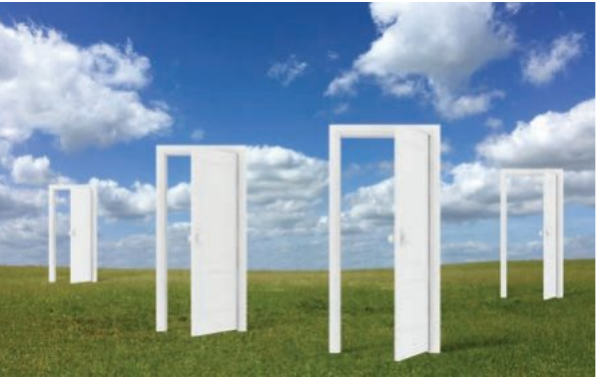
Shape constancy occurs when an individual recognises that a stimulus's actual shape remains the same despite changes in the shape of the retinal images sent to the brain.
Example
Worked Example: The Changing Book
When you view a book from different angles, the shape of the book appears to change on your retina:
- Large rectangle when viewed from the front
- Narrow rectangle if viewed from the spine
- The shape of a 'V' if the book is open
However, we do not perceive the book to be changing shape. In all cases, the book's actual shape is perceived as remaining constant and unvarying.
Orientation constancy
Orientation constancy occurs when an individual recognises that a stimulus's actual orientation remains the same despite changes in the orientation of the retinal images sent to the brain.

Example
Worked Example: Watching TV While Lying Down
Think about the last time you lay down to watch television. When you viewed the screen at a 90° angle compared to your normal upright position, you probably did not think that the whole world had tilted.
While the orientation of the retinal images sent to your brain changed, you would have continued to perceive the world as constant in its orientation. This demonstrates orientation constancy maintaining our stable perception of the world.
Gestalt principles
The way visual information is organised, grouped together and given meaning partly relies on our application of visual perceptual principles. Visual perceptual principles are a set of consistent instructions that enable us to organise and interpret visual information in a reliable and meaningful way.
Visual perceptual principles enable the brain to:
- Group together information into a recognisable whole
- Identify an object's actual size, shape and orientation
- Determine the depth and distance of an object in our environment
Note
Visual perceptual principles are a set of mental rules applied in the same way by all people, providing the eye, brain and associated pathways are intact and healthy. We use visual perceptual principles automatically and unconsciously, and they help improve the efficiency with which we perceive our visual world.
The Gestalt principles are a particular set of visual perceptual principles. 'Gestalt' is the German word for form, shape, organisation or configuration. The Gestalt principles hold that we interpret visual information most efficiently by grouping individual elements together to perceive a whole object.
Important
Gestalt theory states: 'The whole is greater than the sum of its parts.'
This fundamental principle means that we naturally perceive complete objects and patterns rather than just collections of individual elements.
The main Gestalt principles are: figure-ground, closure, proximity and similarity.
Figure-ground
The Gestalt principle of figure-ground describes the tendency to perceive part of a visual stimulus as more relevant (the figure) and standing out against its less relevant surroundings (the ground). The line of separation between the figure and the ground is termed the contour, and it helps to differentiate the figure from the ground.

Note
Characteristics of the figure:
- Has more relevance and meaning for the individual
- Is perceived as closer than the ground
- Is perceived as brighter than the ground
Traffic signs and photographs apply the figure-ground principle. The viewer's attention is drawn to the prominent figure in the image, allowing for an efficient interpretation of the image.
Just as the principle of figure-ground can be used to help features stand out, it can also be used to hide features. Camouflage is a famous example of this. When an otherwise prominent object is similar in colour to its surroundings, the contour vanishes, confusing our interpretation of figure compared to ground.

Camouflage is used:
- Throughout the animal kingdom for survival
- By backstage crew wanting to blend into the background at stage performances
- By military personnel attempting to avoid detection
Closure
The Gestalt principle of closure refers to our ability to close up, fill in or ignore gaps in visual stimuli and perceive objects as a meaningful whole. It helps us to perceive incomplete stimuli, potentially reducing the mental effort required.

Example
Worked Example: The Cat Behind the Fence
We mentally join the parts of a visual stimulus to perceive it as a complete image. When we see a cat standing behind a paling fence, we do not perceive the cat as a series of separate sections (the ones visible through the fence).
Rather, we perceive it as a whole cat. Our brain automatically fills in the gaps, demonstrating the principle of closure in action.
Similarity
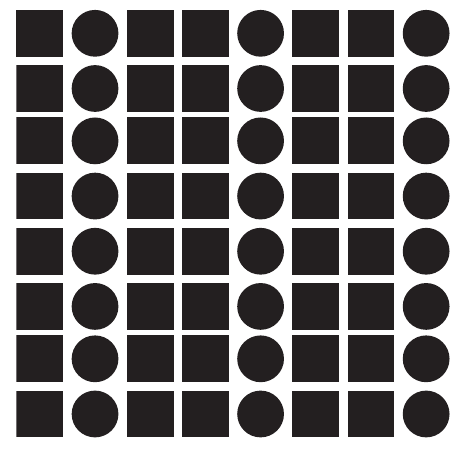
The Gestalt principle of similarity holds that we tend to group together as a whole any stimuli that are alike in size, shape or colour.
Note
Applications of similarity include:
- Teachers supervising students on excursions can quickly distinguish and group their students together based on their uniforms
- The Ishihara test for colour blindness uses this principle
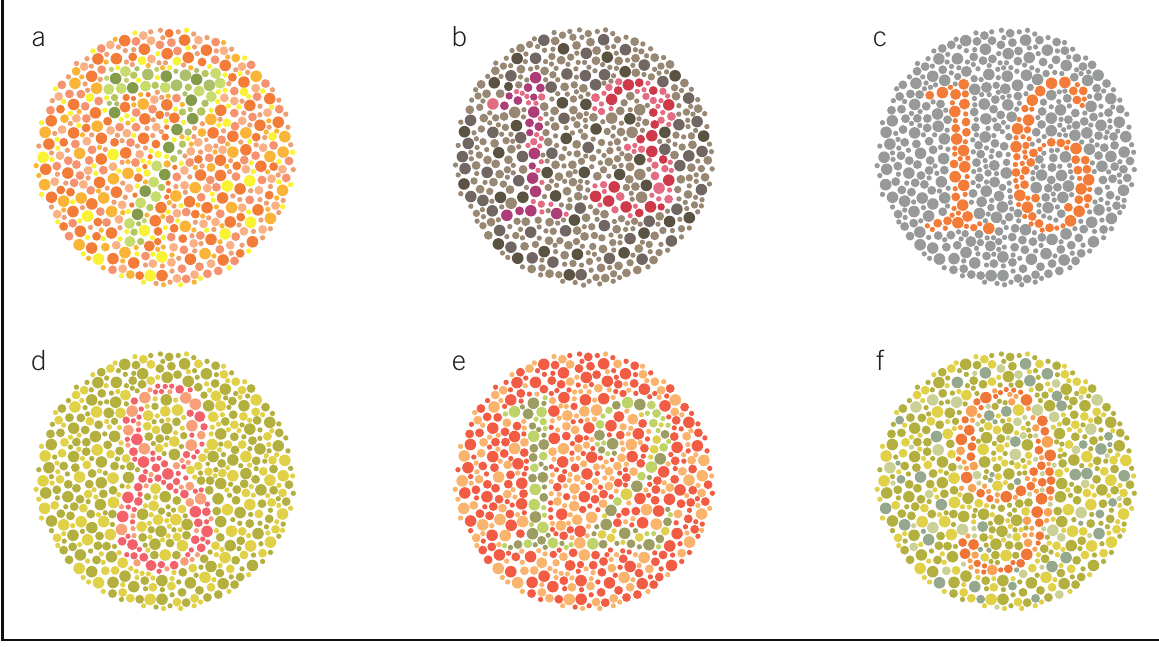
The Ishihara test comprises a series of images made up of coloured dots. To read the numbers, the viewer needs to be able to group similar colours together. If the person is not colour blind, they will perceive one colour group as the figure (a number) and the other colour group as the background. If they are colour blind, they will not be able to group the coloured dots in this way.
Proximity
The Gestalt principle of proximity is the tendency to perceive the parts of a visual stimulus that are close together, rather than spaced far apart, as belonging to a group.
Example
Worked Example: Finding Friends at a Festival
If you are at a music festival trying to find your friends who are sitting in a group near the main stage, the principle of proximity helps you perceive groups of people (rather than a sea of individuals) based on how close they are to one another.
This allows you to look at one person in each group until you find your friends, rather than having to examine each individual person. This demonstrates how proximity improves the efficiency of visual perception.
Social factors affecting visual perception
Social factors affecting visual perception are unique to our culture(s) and the norms of that society. Unlike biological factors (associated with physiological function) and psychological factors (learned mental processes), social factors relate to the cultural context in which we live.
Culture
Culture refers to the many characteristics of a group of people, including their attitudes, behaviours, customs and values that are transmitted from one generation to the next. The community in which we live, including the people we are surrounded by and associate with, helps to shape how we see the world.
This influence can take the form of:
- Traditions
- Value systems
- Attitudes and beliefs
- Traditional practices (passed down through generations)
- Modern influences (e.g. popular culture)
Note
Our perceptual set is shaped by our culture, which causes us to see the world in a particular way. Each culture has a unique way of perceiving visual stimuli, demonstrating the profound influence of social factors on perception.

Example
Worked Example: Cultural Perception of a Cow
Consider an image of a cow. How might people from different cultures perceive this stimulus?
Indian or Balinese culture: Someone from a culture in which cows are sacred would perceive the image as showing an object of veneration
Australian culture: Someone from a culture in which beef features prominently in the diet might perceive the image as showing a source of food
This demonstrates how cultural background fundamentally shapes our perception of the same visual stimulus.
Our culture can also affect how we attend to and perceive images. Two examples demonstrate this:
Reading direction and visual perception
The direction in which we read (left to right or right to left) can affect our visual perception. Research using an ambiguous rabbit-duck image found that:
- People from English-speaking cultures (or those reading left to right) were more likely to see a rabbit first
- People from Hebrew-speaking cultures (reading right to left) were more likely to see the duck first
This occurs because our eyes are accustomed to moving in particular directions when we read, making us more likely to perceive images from one direction or the other.
Cultural differences in depth perception
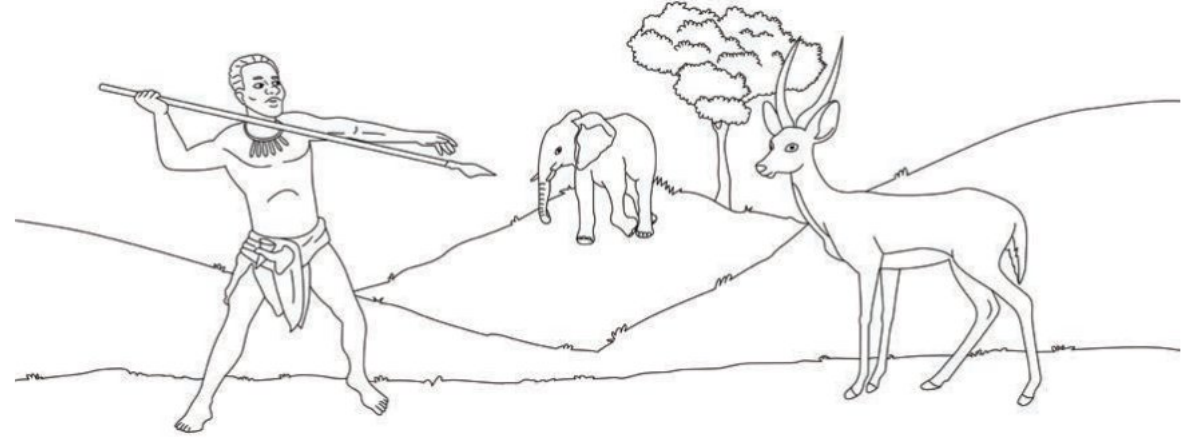
William Hudson (1960) showed images to 85 Black southern African factory workers of different tribal origins, educational levels and degrees of urbanisation. A Western viewer would interpret the image as showing a man about to spear an antelope, with an elephant standing in the distance.
Example
Hudson's Cross-Cultural Study (1960)
The Study: Hudson showed two-dimensional images to 85 Black southern African factory workers. A Western viewer would interpret the image as showing a man about to spear an antelope, with an elephant in the distance.
The Findings: The participants tended not to perceive depth in the images, instead interpreting them in two dimensions. When asked 'What is the man doing?', most of the African participants replied that the man was aiming for the elephant.
Conclusion: This demonstrates that cultural experiences can affect the ability to perceive depth in two-dimensional images. Participants without experience of Western-style pictorial representations interpreted the images differently.
Important
Research Limitations
For cross-cultural studies, a main limitation is that it is difficult to ensure that the measures by which data is collected are fair and appropriate, regardless of the participants' cultures. This can cast doubt on the findings but also represents an opportunity for future research to overcome this problem.
Researchers must be careful to avoid cultural bias in their measurement tools and interpretation of results.
Summary
Key Points to Remember:
-
The biopsychosocial model examines how biological, psychological and social factors interconnect to influence visual perception
-
Biological factors include depth perception cues:
- Convergence (within 7m)
- Retinal disparity (up to 10m)
- Accommodation (within 3m)
-
Psychological factors include:
- Perceptual set (past experience, memory, motivation, context)
- Perceptual constancy (size, shape, orientation)
- Gestalt principles (figure-ground, closure, similarity, proximity)
-
Social factors, particularly culture, shape how we perceive and interpret visual stimuli
-
These factors often work in combination rather than in isolation to shape our visual perception
-
No two people perceive the world in exactly the same way due to their unique combination of biological, psychological and social influences