Classical Conditioning (VCE SSCE Psychology): Revision Notes
📚Revision Notes
Classical Conditioning
What is learning?
Learning occurs when we gain knowledge or skills through our experiences. There are many different approaches to understanding how learning takes place in humans and animals.
The behaviourist approach
Both classical and operant conditioning are examples of the behaviourist approach to understanding learning. This approach suggests that behaviours are learned through interactions with the environment as a result of conditioning.
Note
Conditioning is a learning process whereby an organism's behaviour becomes dependent on specific environmental events or stimuli. This means that certain environmental triggers can influence and shape how organisms behave.
In classical conditioning specifically, the responses involved are involuntary or reflexive - they occur automatically and unconsciously. For example, you might blink reflexively when dust blows into your eye on a windy day, or you might salivate automatically when you smell your favourite freshly baked biscuits.
Classical conditioning is a simple form of learning that occurs through repeated associations between two different stimuli to produce a conditioned response. This learning happens involuntarily, meaning the organism doesn't consciously choose to learn the association.
Pavlov's pioneering research
Around 1900, Russian physiologist Ivan Pavlov made a groundbreaking discovery whilst studying digestion in dogs. Pavlov was investigating the role of saliva in dogs' digestion and had developed equipment to measure the amount of saliva dogs produced in response to food being placed in front of them.
Note
The Key Observation
Pavlov noticed something interesting: the dogs began to salivate as soon as the technician who fed them entered the room, even before any food appeared. This observation led Pavlov to experiment with other stimuli to see if they could also trigger salivation.
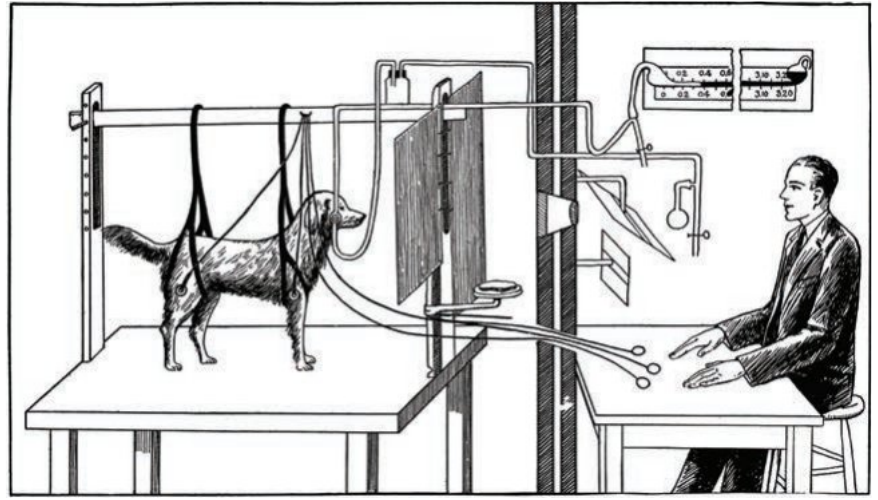
In his most famous experiment, Pavlov used a metronome (a device that produces a steady ticking sound). He would start the metronome ticking just before the dogs were fed. Initially, the dogs showed no response to the metronome sound alone. However, after multiple trials of pairing the metronome with food, the dogs eventually began to salivate unconsciously at the sound of the metronome alone, even when no food was present. This happened because the dogs had formed a repeated association between the metronome sound and the food stimulus.
This discovery led Pavlov to develop what we now call the three-phase process of classical conditioning.
The three-phase process of classical conditioning
Classical conditioning can be broken down into three distinct phases: before conditioning, during conditioning, and after conditioning. Understanding each phase and the terminology associated with it is essential for grasping how this form of learning works.
Before conditioning
Before conditioning is the phase when no learning has yet taken place. At this stage, we can identify three key elements:
Unconditioned stimulus (UCS): This is a stimulus that consistently produces a naturally occurring, automatic response. The word 'unconditioned' means 'not depending on any conditions' - the response happens naturally without any prior learning. In Pavlov's experiment, the UCS was the presentation of food.
Unconditioned response (UCR): This is the response that occurs automatically and involuntarily when the unconditioned stimulus is presented. Like the UCS, it doesn't depend on any conditions or prior learning - it's a natural, reflexive response. When a dog sees or smells food, it begins to salivate. This salivation is the UCR.
Neutral stimulus (NS): This is a stimulus that, prior to conditioning, doesn't produce any particular response. The word 'neutral' here means 'not doing anything'. In Pavlov's experiment, the sound of the ticking metronome was the neutral stimulus - the dog had no natural response to this sound.
Important
Understanding the Before Conditioning Phase
At this stage, remember that:
- The UCS naturally produces the UCR (no learning required)
- The NS produces no response at all
- No association exists yet between the NS and the UCS
During conditioning
During conditioning is the phase in which learning actually occurs through the association or pairing of two stimuli. The neutral stimulus is presented immediately before, or simultaneously with, the unconditioned stimulus. In Pavlov's experiment, the metronome was started (NS) and then food was presented (UCS), which caused the dog to salivate (UCR).
This pairing must be repeated multiple times for the association to form. The process through which the organism learns to associate the two events (the NS with the UCS) is called acquisition. Acquisition is at the heart of the classical conditioning learning process.
Important
Critical Timing Requirements
For the association to be most effective, certain timing requirements must be met:
- The neutral stimulus must be presented before the unconditioned stimulus
- No more than half a second should elapse between the presentation of the NS and the UCS
Getting the timing wrong can prevent the association from forming properly!
After conditioning
After conditioning is the final stage of classical conditioning, in which the learning is complete. At this stage, several important changes have occurred:
Conditioned stimulus (CS): Through repeated association during the previous phase, the neutral stimulus has now become the conditioned stimulus. The word 'conditioned' means that the stimulus depends on a condition - namely, that acquisition has occurred. The previously neutral stimulus (the ticking metronome) can now trigger a response on its own.
Conditioned response (CR): When the conditioned stimulus triggers a response, that response is called the conditioned response. The CR is a learned behaviour that is similar to (though not necessarily exactly the same as) the unconditioned response. Importantly, the CR is now triggered by the conditioned stimulus as a result of the conditioning process.
Note
When is Acquisition Complete?
Acquisition is considered complete when the conditioned stimulus alone produces the conditioned response - in other words, when the metronome sound alone causes the dog to salivate, even in the absence of food.
Understanding the relationship between UCR and CR
Whilst the unconditioned response and conditioned response are often similar, they may not be identical. In Pavlov's experiment, both the UCR and CR were salivation. However, consider this example: if the neutral stimulus is seeing a bee, the unconditioned stimulus is being stung by the bee, and the unconditioned response is pain from the sting, then the conditioned stimulus becomes seeing the bee and the conditioned response becomes fear of potential pain, not the actual pain itself.
Applying classical conditioning: the message notification example
Let's examine how classical conditioning works in an everyday situation that you may find familiar: receiving message notifications on your phone.
Before conditioning:
- A message from your friend (UCS) naturally produces feelings of excitement (UCR)
- The message notification sound (NS) produces no response - it's just a neutral sound
During conditioning:
- The message notification sound (NS) is repeatedly presented immediately before the message from your friend (UCS)
- This pairing happens multiple times
- Each time, the UCS produces feelings of excitement (UCR)
- Through repetition, your brain begins to associate the notification sound with the message from your friend
After conditioning:
- The message notification sound (NS) has now become the conditioned stimulus (CS)
- On its own, it now produces feelings of excitement, which is now the conditioned response (CR)
- You feel excited just hearing the notification sound, even before you see who the message is from
Note
This example demonstrates how classical conditioning operates involuntarily in our daily lives. You don't consciously decide to feel excited when you hear the notification sound - the response happens automatically as a result of the repeated association between the sound and messages from your friend.
Skills: Applying classical conditioning to scenarios
When answering examination questions about classical conditioning scenarios, you need to correctly identify and label the key elements using the appropriate terminology. Here's a systematic approach:
How to structure your answer
- Clearly identify each of the three phases (before conditioning, during conditioning, after conditioning)
- Label the key elements using brackets: UCS, UCR, NS, CS, CR
- Ensure you specify what each response is "in response to" or "at/to"
Example
Worked Example: The Seatbelt Scenario
Question: Celeste goes to the beach every day over a hot summer and has to park her car in the sun. As she is putting her seatbelt on, the hot metal tongue of the buckle brushes against her skin; Celeste feels pain as a result. This happens several days in a row. Before experiencing multiple seatbelt burns, she has never flinched whilst putting the seatbelt on; now every time she puts her seatbelt on, she flinches. Use the three-phase process of classical conditioning to explain why Celeste now flinches when putting her seatbelt on.
Answer:
Before conditioning The seatbelt (NS) does not cause Celeste a response. The burn (UCS) from the hot seatbelt causes Celeste pain (UCR) in response to the burn.
During conditioning The seatbelt (NS) is repeatedly presented just before the burn (UCS) from the seatbelt, causing Celeste pain (UCR) in response to the burn.
After conditioning Now the seatbelt (CS) alone causes Celeste to flinch in response to the seatbelt (CR) when putting it on.
Summary
Key Points to Remember When Answering Exam Questions:
- The neutral stimulus and the conditioned stimulus are often the same stimulus (e.g., the seatbelt remains the seatbelt, but its status changes from NS to CS)
- The unconditioned response and conditioned response are similar, but you must specify what each response is responding to:
- UCR: pain in response to the burn of the seatbelt
- CR: flinching in response to the seatbelt
- Always name each stage clearly in your answer
- Use brackets to identify the elements of classical conditioning
- Abbreviations such as UCR (unconditioned response) and CS (conditioned stimulus) are acceptable in examinations
Important procedural notes
Important
Essential Conditions for Classical Conditioning
For classical conditioning to work effectively, several conditions must be met:
-
Timing is critical: The neutral stimulus must be presented before the unconditioned stimulus for the association to be most effective.
-
Minimal delay: No more than half a second should elapse between the presentation of the neutral stimulus and the unconditioned stimulus. Longer delays make it harder for the association to form.
-
Completion of acquisition: Acquisition is complete when the conditioned stimulus alone produces the conditioned response, without the unconditioned stimulus being present.
-
Repetition is necessary: The pairing of the neutral stimulus with the unconditioned stimulus must occur multiple times. A single pairing is rarely sufficient to establish the association.
Summary
Remember!
- Classical conditioning is a form of involuntary learning that occurs through repeated associations between two stimuli
- The three-phase process consists of: before conditioning (no learning), during conditioning (acquisition through pairing), and after conditioning (learning complete)
- Key terminology: UCS produces UCR naturally; NS becomes CS after repeated pairing with UCS; CS produces CR
- Timing matters: the NS must come before the UCS, with no more than 0.5 seconds between them
- The responses (UCR and CR) are involuntary and reflexive - they happen automatically without conscious control