Deindividuation and the Impact of Culture on Individual Behaviour (VCE SSCE Psychology): Revision Notes
📚Revision Notes
Deindividuation and the Impact of Culture on Individual Behaviour
What is deindividuation?
Deindividuation occurs when a person's sense of individual identity and self-awareness is overridden by their identity within a group. This psychological state refers specifically to situations where people behave in particular ways because of the anonymity provided by being part of a group.
In everyday life, people generally maintain a sense of individuality and self-awareness that helps them monitor their interactions with others, evaluate their behaviour against their personal values, and recognise themselves as distinct individuals. However, when drawn into a group setting, individuals can lose this self-awareness. Their personal principles, personality traits, and beliefs may become less prominent as they gradually adopt the group's values and characteristics instead.
Note
The key distinction in deindividuation is the shift from individual self-awareness to group identity. This process is temporary and situational - people typically return to their normal sense of self once removed from the group context.
Examples of deindividuation
Consider a football match where you are surrounded by thousands of supporters. Everyone is shouting, banging their hands on their chests, and bouncing around excitedly. In this situation, you might engage in similar behaviours that you would never display if standing alone. Being part of the crowd allows you to temporarily shed your usual identity and act in ways you otherwise wouldn't.

Example
Real-World Example: The London Riots
During the London riots, individuals engaged in looting and violence—antisocial behaviours they would likely never engage in under normal circumstances. When immersed in the group, these individuals lost their sense of personal accountability and adopted behaviours aligned with the crowd's actions. The anonymity of the large crowd and the chaotic environment created conditions where normal inhibitions were reduced.
Positive and negative effects of deindividuation
Negative effects
Because anonymous individuals within a group cannot be easily identified or blamed for their actions, deindividuation can reduce personal accountability. This reduction in accountability frequently leads to socially undesirable behaviours such as:
- Rioting
- Theft and looting
- Physical violence
- Property damage
Important
A real-world example occurred after Hurricane Katrina in Louisiana in 2005. The disaster brought the city to a standstill, and widespread looting followed. Aerial footage captured people casually walking out of stores carrying televisions and other goods. Most individuals wouldn't normally engage in such behaviour, but during the crisis, the anonymity of the situation and reduced sense of accountability led many to act in ways they otherwise wouldn't.
Positive effects
However, deindividuation does not always lead to negative outcomes. The effects can be minor or even beneficial, particularly when group norms align with positive social values:
- Charity events: When individuals feel part of a major charitable cause, they often donate more generously. The presence of others making large donations can inspire people to give larger amounts themselves.
- Environmental action: Groups of volunteers united by concerns about climate change may band together to plant trees. Their collective effort and camaraderie enable them to accomplish far more than they could individually.

Note
The key factor is that deindividuation enhances adherence to group norms. When these norms conflict with broader societal standards, negative outcomes may occur. However, when group norms promote prosocial behaviour, deindividuation can facilitate positive actions.
Factors contributing to deindividuation
Psychologist Philip Zimbardo identified several factors that can increase the likelihood of deindividuation occurring. Importantly, not all these factors need to be present simultaneously for deindividuation to occur.
Key contributing factors:
- Being part of a crowd and feeling anonymous: The sense of anonymity provides perceived freedom to act differently from normal behaviour patterns.
- Diffused responsibility: Feeling that other people share responsibility for a situation, or that a group leader has taken primary responsibility.
- Being in a new situation: Unfamiliar environments can reduce normal behavioural constraints.
- Sensory input overload: Overwhelming sensory experiences, such as loud music at concerts or parties, can diminish self-awareness.
- High physiological activation: Feeling 'revved up' or experiencing heightened physical arousal.
- Being under the influence of alcohol or drugs: Substances that impair judgement and reduce inhibitions.
- Present-focused mindset: Concentrating on the immediate moment rather than considering past experiences or future consequences.
The process of deindividuation
Deindividuation typically follows a sequence of stages:
- A sufficiently sized group gathers: The initial formation of a group provides the foundation for potential deindividuation.
- An individual begins to feel anonymous: Within the group, personal identity becomes less salient.
- Interaction within the group leads to social arousal: Group dynamics create excitement and engagement.
- The individual feels decreased self-awareness: Personal identity and individual values become less prominent in consciousness.
- The individual feels responsibility diffusing to others: Personal accountability diminishes as it is shared across group members.
- Deindividuation occurs: The individual enters a psychological state characterised by reduced self-awareness and increased group identity.
- Loss of normal inhibitions: Usual behavioural constraints weaken.
- Increased responses to situational factors: Behaviour becomes more reactive to immediate environmental cues rather than internal standards.
The impact of culture on individual behaviour
Culture encompasses the many characteristics of a group of people, including their attitudes, behaviours, customs, and values that are transmitted from one generation to the next. Cross-cultural psychology examines how these cultural factors influence human behaviour.
While many parallels exist across cultures worldwide, notable differences can also be observed. For instance, people in all cultures experience happiness, but the ways they express and communicate this emotion vary considerably between cultures.
Individualist and collectivist cultures
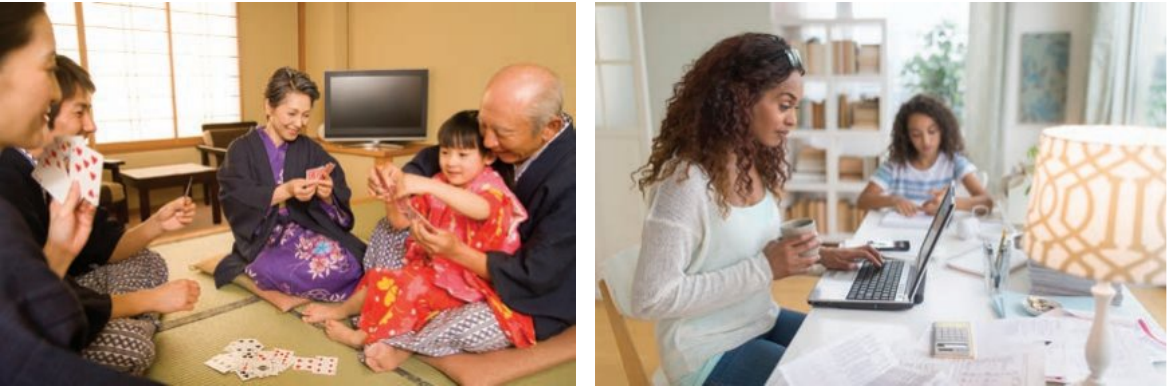
Cross-cultural psychologists frequently examine the differences between individualist and collectivist cultures, as these represent fundamentally different approaches to social organisation and individual behaviour.
Collectivist cultures
Collectivist cultures emphasise the needs and goals of the group as a whole over the needs and desires of each individual. In these cultures, each person's identity is shaped primarily by their interactions with other group members and their interconnections within the community.
Examples of collectivist countries: North Korea, South Korea, China, Japan, Indonesia, Ecuador, India, Brazil, Guatemala, and Venezuela.
Note
Key characteristics:
- Long-term relationships are essential because they help the group achieve its collective goals
- A person's interests extend beyond themselves and immediate family to include the broader community
- Kinship and community connections are highly valued
- Traits such as self-sacrifice, dependability, generosity, and helpfulness are particularly esteemed
- Non-Western civilisations frequently exhibit this cultural tendency
Individualist cultures
Individualist cultures prioritise the needs of the individual over those of the group. People in these cultures are considered self-sufficient and autonomous, with individual attitudes and preferences strongly influencing social behaviour.
Examples of individualist countries: United States, Australia, Germany, South Africa, and Ireland.
Note
Key characteristics:
- Independence and self-reliance are highly valued
- People are considered 'good' if they are strong, distinctive, assertive, and independent
- Individual rights take priority over group needs
- Personal achievement and standing out are encouraged
- Self-sufficiency is connected to pursuing personal goals
Important
Research indicates that individualist cultures are becoming more prevalent worldwide, which may be linked to rising socioeconomic levels. However, notable exceptions exist, such as China, which maintains collectivist values despite economic growth.
Cultural differences in behaviour
The distinction between individualist and collectivist cultures profoundly affects various aspects of behaviour and social functioning. These differences manifest across multiple domains:
Creating a self-image
Individualist cultures:
- Foster self-concepts emphasising independence over interdependence
- Individuals express themselves through personality traits and characteristics
- Example: "I am analytical, cautious, and athletic"
Collectivist cultures:
- Individuals describe themselves in terms of social connections and responsibilities
- Self-concept is relationally defined
- Example: "I am a good spouse and devoted friend"
Maintaining relationships
Individualist cultures:
- People dedicate considerable time and energy to actively sustaining personal connections
- Relationships tend to be more fragile compared to collectivist societies
- Partnerships are often viewed as choices
- People are more willing to leave relationships that no longer provide benefits
Collectivist cultures:
- Relationships are typically secure, robust, and long-lasting
- Connections are frequently determined by family ties and geographical proximity rather than personal choice
- Creating new relationships can be difficult, partly because meeting new people presents challenges in these social structures
Using social support
Individualist cultures:
- Emphasise the importance of handling issues and achieving goals independently
- People are more inclined to prioritise their personal wellbeing over group benefit
- Seeking help is generally more acceptable and encouraged
Collectivist cultures:
- People may be reluctant to seek social support due to concerns about upsetting others, destroying group harmony, losing face, or worsening problems
- More likely to seek implicit social support (spending time with loved ones without explicitly discussing stressors)
- People are more inclined to help family and friends during difficult times
- May be willing to sacrifice personal comfort for the greater welfare of everyone
Making decisions
Individualist cultures:
- Workplaces tend to be highly competitive, encouraging employees to believe strong performance leads to professional advancement
- Employees are typically productive and self-motivated
- Decisions are often more rational and autonomous
- Competitiveness can induce insecurities, stress, and anxiety
- Collaboration might be viewed as worthless or inconvenient
- Some research indicates people may exert less effort when working in teams
- Groups are more likely to experience risky shifts during group decision-making
Collectivist cultures:
- Workplaces prioritise the good of the team and company over individual interests
- Decisions are made through collaboration and group consensus
- People focus on team or organisation goals and needs
- Employees work harder in groups compared to working alone
- Company cultures are more likely to exist in uniform environments
- Employees are strongly encouraged to adopt the group's values, views, and motivations
- Individual values, beliefs, and incentives are discouraged from expression
- Groups are more likely to experience cautious shifts during decision-making
Summary
Key Points to Remember:
-
Deindividuation occurs when group membership overrides individual identity, leading people to act in ways they normally wouldn't due to anonymity and reduced self-awareness.
-
Multiple factors can contribute to deindividuation, including crowd anonymity, diffused responsibility, sensory overload, physiological arousal, substance use, new situations, and present-focused thinking. Not all factors need to be present simultaneously.
-
Effects can be positive or negative: Deindividuation can lead to antisocial behaviours (rioting, violence) or prosocial actions (volunteering, charity work), depending on group norms.
-
Individualist cultures prioritise individual needs, independence, and personal achievement, whilst collectivist cultures emphasise group harmony, interdependence, and collective goals.
-
Cultural background significantly influences behaviour across domains including self-image formation, relationship maintenance, social support usage, and decision-making processes.