The Development of Independence and Anti-Conformity (VCE SSCE Psychology): Revision Notes
📚Revision Notes
The Development of Independence and Anti-Conformity
Understanding non-conformity and its forms
While conformity plays an important role in strengthening social bonds, not all individuals conform when faced with group pressure. History shows many examples of people who took independent stances against popular opinion or deliberately opposed group positions. Understanding these different responses to social pressure helps explain how people make decisions within group settings.
Research into conformity, such as Asch's line perception experiments, found that approximately 75% of participants conformed to incorrect group answers at least once. However, this also means that 25% of participants never conformed. The behaviour of these non-conforming individuals requires its own explanation, separate from theories of conformity.
Note
The significant minority of participants who never conformed in Asch's experiments demonstrates that conformity is not universal. This 25% of non-conformers represents a substantial portion of the population whose behaviour cannot be explained by traditional conformity theories alone.
Non-conformity: two distinct types
Non-conformity refers to any behaviour that is not conformity. However, it is important to recognise that non-conformity takes two different forms: independence and anti-conformity. These two forms differ in their underlying motivations and how individuals respond to group pressure.
Independence occurs when a person recognises that group pressure exists but chooses not to respond to it at either the public or private level. Independent individuals aim to remain true to themselves, regardless of how others might receive their views. Their goal is authenticity rather than opposition. For example, young people who choose not to use social media or smartphones when most of their peers do are demonstrating independence. An independent person maintains their position when faced with disagreement, moving neither towards nor away from the group's stance.

Anti-conformity refers to deliberate behaviour that actively opposes the position of one or more people. When confronted with a disagreeing group opinion or decision, an anti-conformist becomes more extreme in their initial position. Rather than simply maintaining their view, they intensify it in direct opposition to group pressure.
Example
Real-World Example: The Christmas Lights Display
During Christmas 1994, a man in Little Rock, Arkansas received a court injunction requesting he remove some of the over 3 million lights from his Christmas display. His neighbours felt the display attracted too many visitors and created excessive traffic.
The man had three options:
- Conformity: Remove lights as requested
- Independence: Keep the same number of lights
- Anti-conformity: Add more lights in opposition
His choice: He displayed anti-conformity by defiantly increasing his display after the injunction, directly opposing the court's request.
The theoretical framework of Willis and Crutchfield
In the early 1960s, Richard Crutchfield and Richard Willis independently published foundational theoretical work distinguishing between conformity, anti-conformity and independence. Their framework proposed that conformity and anti-conformity represent opposite ends of a spectrum in terms of underlying motivations.
Conforming individuals are motivated to cooperate, follow and fit in with the group. In contrast, anti-conformist individuals are motivated to disagree with, disrupt and oppose the group. In research settings, conformity is typically measured by movement towards the majority opinion, whilst anti-conformity is measured by movement away from it. Anti-conformist individuals are driven by rebelliousness and remain uninfluenced by social forces or norms.
Important
Despite their opposite motivations, both conformity and anti-conformity share an important similarity: both are susceptible to group pressure. Therefore, both conformity and anti-conformity are considered forms of dependent behaviour determined by the group's position. Independence contrasts with both because the individual is not influenced in either direction by social forces.
Whilst independence may appear similar to anti-conformity on the surface, the underlying motivations differ substantially.
Factors affecting non-conformity
Several factors influence the likelihood that individuals will display non-conformity through either independence or anti-conformity. Research has identified factors related to group dynamics, task characteristics, individual personality and cultural background.
The minority versus the majority
Non-conformists can profoundly affect a majority group, even if the majority simply laughs at them or argues against them because they perceive the non-conformist as an outsider. Asch became interested in the dynamics of groups that included just one non-conformist member. To explore this, he conducted a study using his line task design, but with one confederate among 16 actual participants who gave incorrect answers. The results showed that the majority treated the confederate's answers with disbelief and ridicule.
Schachter's study of group dynamics
In 1951, Stanley Schachter expanded on Asch's experimental design by having participants read and discuss a juvenile delinquent case study. Each group contained five to seven participants, and Schachter introduced an additional paid confederate to each group. The confederate was instructed to play one of three roles:
- Deviate: A group member who took the opposing view to the group's general opinion
- Modal: A group member who took the view that conformed to the average of the real participants
- Slider: A group member who initially took the same view as the deviate but then changed to the view of the modal participant

The results revealed important patterns in how groups respond to non-conforming members. In nearly all experiments, more communication was directed towards the deviate than the other two roles. In highly cohesive groups, communication towards the deviate initially rose to a peak before falling away to the point where the deviate was virtually ignored.
Note
Little attention was paid to the modal participant because they conformed to group norms. The slider drew considerable attention until they conformed, after which communication towards them decreased. These findings suggest that rather than ridiculing the deviate, groups first attempted to persuade them. When persuasion failed, they ostracised the deviate.
Individual independence or anti-conformity may therefore come at the price of ridicule and isolation from the group majority.

Treatment of minority groups
Minorities comprising multiple members do not appear to suffer the same extreme disapproval as isolated individuals. Asch investigated what would happen to conformity rates when two or more people from minority backgrounds were confronted with a unanimous majority. In another variation of his baseline study, Asch used 11 actual participants against nine deviant participants.
Unlike his previous experiment involving one non-conformist participant, the general atmosphere was one of seriousness rather than mockery. This demonstrates that the minority group had some influence over the majority, though not enough to change their minds about the length of the line. Rather than being censured or ridiculed, the minority group was viewed as an independent group with an equally valid difference of opinion. This finding highlights how group size affects the treatment of non-conforming members.
Task ambiguity
Asch conducted additional experiment variations by manipulating whether the task was obvious or ambiguous. Ambiguity was achieved by making the differences between the lines so slight that determining the correct answer became difficult.
When tasks were ambiguous, participants were much more likely to behave independently of the group. In ambiguous situations, everyone becomes an expert witness, and individuals appear more comfortable being the odd ones out and acting independently. This suggests that the clarity of the task directly influences conformity and non-conformity levels.
Note
Task ambiguity creates an environment where individual opinions carry more weight. When there is no clear "correct" answer, people feel more justified in maintaining their own perspective, leading to higher rates of independent behaviour.
Personality factors
Crutchfield and other theorists collected data regarding the personality traits and intelligence of their participants whilst conducting conformity studies. They identified typical differences between conformers and individuals who were more independent of the group.
| Trait | Conformers | Non-conformers |
|---|---|---|
| IQ | Less intelligent | More intelligent |
| Emotions | More anxious | Less anxious |
| Self-concept | Lack self-confidence and are less insightful | Have realistic self-perception |
| Interpersonal relations | Have poor judgement of others | More self-contained and autonomous |
| Attitudes/values | Conventional and moralistic | More original |

These findings support the view that conformers tend to rank low in self-esteem, intelligence and status, whilst ranking high in anxiety and insecurity. In contrast, non-conformers tend to be more intelligent and less anxious, and they do not depend on the group's social approval to the same degree as conformers. Conformers may therefore depend more heavily on informational and normative influences than their non-conformist counterparts. Due to their higher intelligence and realistic outlook, non-conformers may resist the implicit and explicit social pressure of group influences more successfully.
Culture
Cultural differences significantly influence conformity and anti-conformity behaviours. In 1973, Meade and Barnard conducted a study examining anti-conformity behaviours in American and Chinese university students. Groups consisted of one participant and five confederates (either all male or all female) who were presented with six statements about controversial issues. Participants were asked to verbalise their opinions and the strength of those opinions to their group. The delay between hearing the controversial statement and sharing opinions was recorded, and participants and confederates were permitted to change their responses at any point.
The results showed that Chinese participants hesitated longer before responding compared to American participants. More notably, American participants showed a far greater tendency towards anti-conformity than Chinese participants. This difference can be explained by the cultural contrasts between the two countries: the United States has an individualist culture that values personal autonomy and uniqueness, whilst China has a collectivist culture that emphasises group harmony and cohesion.
Important
Cultural background plays a crucial role in determining how individuals respond to group pressure. Individualist cultures tend to produce higher rates of anti-conformity, whilst collectivist cultures tend to produce higher rates of conformity. Understanding these cultural differences is essential for interpreting non-conformity research across different populations.
Explanations for non-conformity
Social psychologists have proposed several theories to explain why people engage in anti-conformity and independence. Research shows that people are often motivated to disagree with individuals they perceive as dissimilar, disliked, unattractive or outside their social circle. Three major theoretical explanations help us understand the mechanisms behind non-conforming behaviour.
Psychological reactance theory
Jack Brehm developed the psychological reactance theory in 1966 to explain how individuals respond when their freedom to choose or act is restricted. Brehm defined psychological reactance as an unpleasant arousal that occurs when people experience a threat to or loss of their free behaviours, which motivates them to act in ways that reduce the threat.
The theory suggests that when people perceive their freedom as threatened, they often react by taking steps to restore that freedom. One common way to reclaim threatened freedom is to do the opposite of what the source of the threat suggests. For example, teenagers told by their parents that they cannot date until a certain age might feel motivated to increase their dating behaviour to reclaim their sense of freedom.
Example
Consumer Behaviour Study: The Reactance Effect
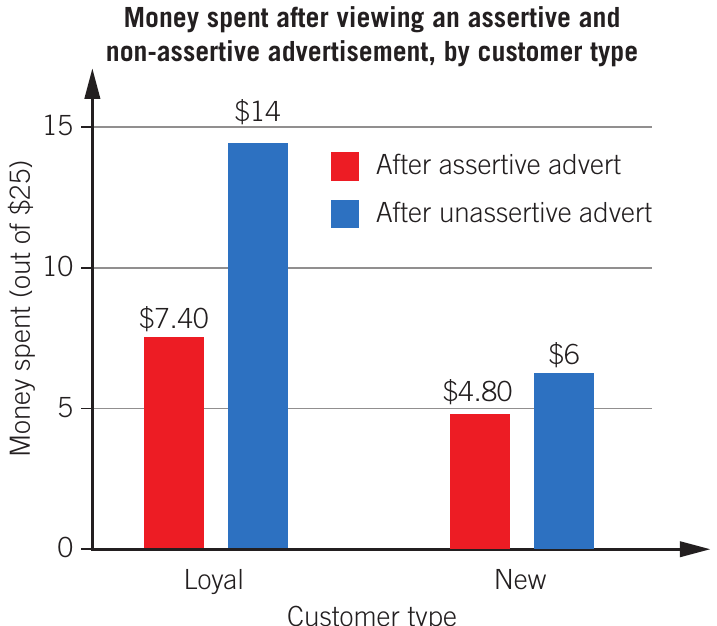
A study with 84 participants examined how people responded to assertive versus non-assertive advertisements.
Results:
- Loyal customers spent `$7.40 after seeing an assertive advertisement compared to $`14.00 after a non-assertive advertisement
- New customers spent `$4.80 after assertive adverts versus $`6.00 after non-assertive adverts
Explanation: Loyal customers felt their freedom to decide was threatened by the assertive messaging, leading them to react by spending less. The effect was smaller for new customers, perhaps because the product did not seem as important to them.
Conditions for psychological reactance
Brehm identified several conditions that must be present for psychological reactance to occur:
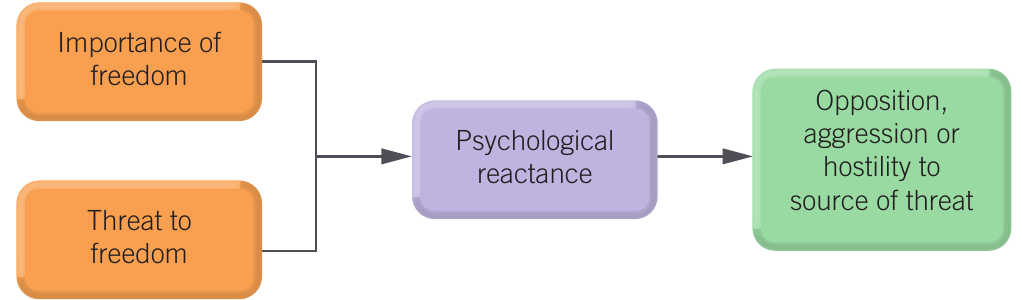
Importance of freedom: Psychological reactance becomes more extreme if the perceived freedom being threatened is important to the person. A person will even act against their own self-interest to reassert their freedom.
Example
The Cupcake Scenario
Imagine a mother telling her child not to eat too many cupcakes because it will make them feel sick. The child, perceiving that their mother's order restricts their freedom and right to make choices, then eats as many cupcakes as they can. The child predictably feels sick afterwards.
It was good advice not to eat 10 cupcakes, but the child still chose to act in a contrary manner to reassert their freedom of choice.
Presence of choice: A choice must exist for psychological reactance to occur. If there were no cupcakes in the house, the child would not have the option to eat as many cupcakes as they wanted, nor could they note their mother's advice and choose not to follow it. If no options exist, then a person cannot feel as though their freedom to explore options and make choices is being threatened.
Important
For psychological reactance to occur, two conditions must be met: (1) the threatened freedom must be important to the individual, and (2) there must be genuine choices available. Without these conditions, reactance cannot take place.
The need for uniqueness
Uniqueness involves a person's distinctiveness in relation to other people. People vary in the degree to which they want such distinctiveness. Some individuals are highly eager to be special (demonstrating a high need for uniqueness), whilst others prefer not to stand out from the crowd (demonstrating a low need for uniqueness).
The need for uniqueness is a psychological state in which individuals feel indistinguishable from others, which then motivates compensatory acts to restore a sense of uniqueness. In certain conditions, perceiving oneself as too similar to others has been likened to experiencing a negative feeling, prompting actions that allow the person to compensate for this feeling.

One situation that triggers this response is when an individual feels too similar to others who make up the majority. This perception makes the majority position undesirable. In such cases, an individual might choose non-conformity to feel different from the majority. For example, individuals with a high need for uniqueness might reject certain products such as popular clothing brands or devices, or they might use products that are unusual or even unpopular. Using products outside social norms might serve as a recognisable symbol of uniqueness and specialness.
Note
People with a high need for uniqueness often express their distinctiveness through:
- Rejecting popular clothing brands or mainstream devices
- Choosing unusual or unpopular products
- Adopting distinctive styles or appearances (e.g., punk style)
- Following alternative lifestyles (e.g., veganism)
These choices serve as recognisable symbols of uniqueness and specialness, helping individuals maintain their sense of distinctiveness from the majority.
Social impact theory
Latané and Wolf (1981) drew on social impact theory to explain independent behaviour. Social impact theory suggests that the degree of influence a person experiences in group settings depends on three factors: the group's strength, the group's immediacy and the number of people in the group exerting social influence.
The three factors of social impact theory
| Social force | Description | Examples |
|---|---|---|
| Strength | Refers to the group's perceived status and power, which can relate to the group members themselves (trans-situational strength) or to the roles that group members play (situational strength) | Trans-situational strength: age, type of authority held, perceived intelligence and physical characteristics Situational strength: a doctor giving information about a virus or an influencer giving information about the next big trend |
| Immediacy | Refers to the closeness between the influencing group members and the individual being influenced. This closeness can be physical, temporal or social | Physical immediacy: geographical location, seat spacing and crowding Temporal immediacy: the time between contacts and the duration of contact Social immediacy: the perception that others are similar to the person being influenced |
| Number of people | Refers to the number of influencing group members who influence an individual's decision | Number of people in a crowd, a class or in an online community |
Trans-situational strength refers to characteristics that group members hold that give them a higher level of status and power. These might include age, authority, perceived intelligence or physical characteristics.
Situational strength refers to roles that group members play that give them a higher level of status and power. For example, a doctor providing information about a virus holds situational strength due to their professional role.
Immediacy refers to the physical, temporal and social closeness between the influencing group members and the individual being influenced. Physical immediacy relates to geographical location, seat spacing and crowding. Temporal immediacy concerns the time between contacts and the duration of contact. Social immediacy involves the perception that others are similar to the person being influenced.
Note
If the level or degree of these social impact theory factors is significantly high or low, they will seriously affect how much the individual is being influenced. For example, a group with many members (rather than few), high power (rather than low power) and close proximity (rather than distant proximity) should exert the most influence on an individual.
Conversely, if the strength of the person exposed to the social influence increases, then the immediacy of the group decreases. If the number of influencing group members decreases, then the level of influence exerted by the group on the individual decreases, resulting in higher levels of non-conformity. This framework helps explain why some individuals successfully resist group pressure whilst others do not.
Summary
Key Points to Remember:
-
Non-conformity takes two forms: Independence involves maintaining one's position without being influenced by group pressure, whilst anti-conformity involves deliberately opposing the group's position and becoming more extreme in one's views.
-
Multiple factors influence non-conformity: Individual non-conformists face ridicule and isolation, whilst minority groups receive more serious consideration. Task ambiguity, personality traits (particularly higher intelligence and lower anxiety), and cultural background (individualist versus collectivist) all affect non-conformity levels.
-
Psychological reactance explains opposition to pressure: When people perceive their freedom as threatened, they may do the opposite of what is suggested to restore their sense of freedom. This effect is stronger when the threatened freedom is important to the person and when genuine choices exist.
-
The need for uniqueness drives some non-conformity: When individuals feel too similar to others, particularly the majority, they may engage in non-conforming behaviour to restore their sense of distinctiveness and specialness.
-
Social impact theory identifies three key factors: The strength (status and power), immediacy (physical, temporal and social closeness) and number of people in the influencing group determine how much influence is exerted on an individual. Lower levels of these factors result in higher non-conformity.