Investigation Aims, Questions, Hypotheses, and Variables (VCE SSCE Psychology): Revision Notes
📚Revision Notes
Investigation Aims, Questions, Hypotheses, and Variables
Introduction to research in psychology
Psychology follows a scientific approach when conducting research. Research psychologists work in universities or organisations to plan experiments, gather data, analyse evidence, and share findings with the scientific community. Understanding how the brain works and investigating human behaviour requires careful planning and precise methodology.

Note
The foundation of psychological research rests on systematic investigation methods. Every study must be carefully designed to ensure that results are reliable and can contribute meaningfully to our understanding of human behaviour and mental processes.
Investigation aims and questions
When a researcher develops an idea for a study, they must first establish two foundational elements: the investigation aim and the investigation question.
Investigation aim
The investigation aim is the purpose of the study, written as a statement that includes the variables being studied. It provides a clear direction for what the research intends to accomplish.
Example
Example Investigation Aim:
"To investigate the effect of sugar consumption on attention levels in children."
This aim clearly identifies both variables (sugar consumption and attention levels) and states the purpose of the research.
Investigation question
The investigation question is the specific question the study intends to answer, or what the researcher is trying to discover. It frames the research as an inquiry.
For example: "Does consuming sugar affect attention in children?"
Both the aim and question emerge from identifying gaps in current knowledge or from observing interesting phenomena that warrant further exploration.
Variables
Variables are elements that change or vary in an investigation. They can be modified, measured, or controlled. In the example above, "sugar consumption" and "attention levels" are the variables being studied. The relationship between different types of variables forms the foundation of experimental research.
Hypotheses
What is a hypothesis?
A hypothesis is a statement that outlines the probable outcomes of an investigation based on current theory. It represents the researcher's educated prediction about what will happen in the study. The investigation will test whether the hypothesis is supported, partly supported, or refuted (not supported).
Purpose of hypotheses
Researchers use hypotheses to:
- Focus their investigation on specific outcomes
- Make testable predictions based on existing knowledge
- Clarify the relationship between variables
- Provide a benchmark for evaluating results
Structure of a hypothesis
A well-constructed hypothesis outlines whether one variable (the dependent variable) will change as a result of another variable (the independent variable). It must be written in one sentence and include three essential components.
How to write hypotheses
Important
A hypothesis should include three key parts:
- The IV and DV being investigated - Clearly identify both variables
- An indication of the strength or direction - Specify whether the DV will increase, decrease, improve, worsen, show more or less, etc.
- A comparison of the groups - State what the experimental group will show compared with the control group
Example
Example Hypothesis with Labeled Components:
"It is hypothesised that children who consume sugar will have a lowered level of attention as compared with those who do not consume sugar."
Breaking down the components:
- IV (experimental group): children who consume sugar
- Strength/direction: lowered level
- DV: attention
- IV (control group): those who do not consume sugar
What NOT to include in a hypothesis
Important
Common Mistakes to Avoid:
When writing hypotheses, you should avoid:
- Including explanations or reasons for the predicted outcome
- Describing how variables will be measured (unless done consistently for all variables)
- Being vague about the direction of the relationship
- Using overly technical measurement descriptions
A hypothesis should be a clear, testable prediction without justification.
Variables in detail
Independent and dependent variables
Understanding the relationship between independent and dependent variables is essential for designing and interpreting experiments.
Independent variable (IV): The variable that the researcher manipulates, controls, selects, or changes in an investigation. This is what differs between the experimental and control groups.
Dependent variable (DV): The variable that the researcher measures. This is the outcome that may be affected by changes in the independent variable.
Research seeks to determine the effect of an independent variable on a dependent variable.
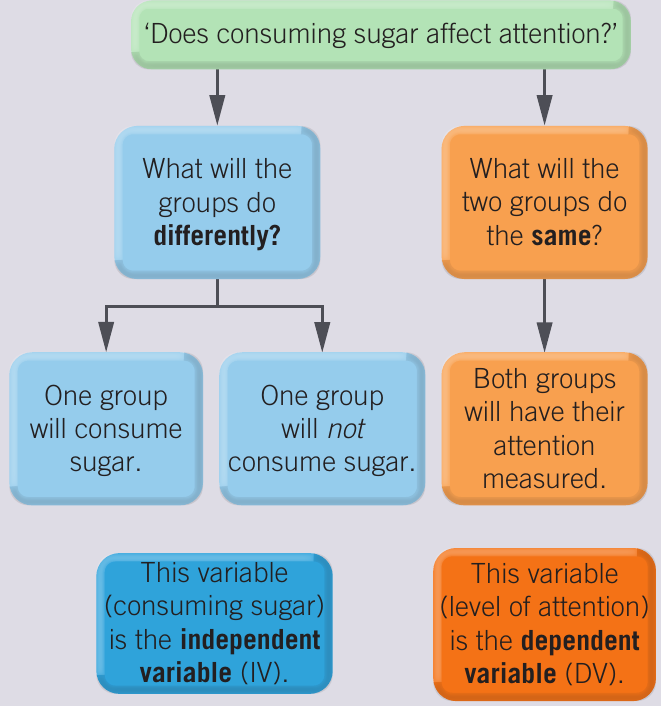
The sugar and attention example
For the research question "Does consuming sugar affect attention in children?":
- Independent variable: consumption of sugar (this is what the researcher manipulates)
- Dependent variable: level of attention (this is what the researcher measures)
The consumption of sugar may affect attention levels. The researcher manipulates whether children consume sugar and then measures their attention.


How to identify the IV and DV
There are two effective methods for identifying variables in a study:
Note
Method 1: The DV depends on the IV
Remember that the dependent variable depends on the independent variable. In our example, the level of attention (DV) depends on whether sugar has been consumed (IV). This dependency relationship helps clarify which variable is which.
Note
Method 2: What groups do differently vs. the same
Think about what the two groups of participants will do:
What will the groups do differently? This is the independent variable
- One group will consume sugar
- The other group will not consume sugar
What will the two groups do the same? This is the dependent variable
- Both groups will have their attention measured in the same way
The IV is consuming sugar because the two groups do this differently. The DV is level of attention because both groups are measured in the same way.
Practice identifying variables
| Research scenario | IV | DV |
|---|---|---|
| The effect of diet on happiness levels | Diet | Happiness levels |
| Whether using an air purifier nightly decreases asthma symptoms | Using an air purifier | Asthma symptoms |
| Do households with a higher income have more television streaming service subscriptions? | Household income | Number of streaming subscriptions |
| Students remember more content when they write their own exam notes | Note-taking method | Content retention |
| Soft-drink companies sell more sugar-free drinks when they are placed in the middle of the retailer's fridge | Product placement in fridge | Sales of sugar-free drinks |
Extraneous, controlled, and confounding variables
Controlled experiments
A controlled experiment is an investigation methodology that aims to test the effects of an IV on a DV, with all other variables controlled as much as possible. This control is essential because researchers need to be confident that changes in the DV are caused by the IV alone, and not by other factors.
Extraneous variables
Extraneous variables are variables other than the independent variable that may have an unwanted effect on the dependent variable and results. These variables threaten the internal validity of an investigation - that is, whether the study actually investigates what it claims to investigate.
Types of extraneous variables
Several categories of extraneous variables can affect research:
- Individual participant differences:
- Age, sex, personality traits
- Previous experiences
- Behavioural differences
- Current feelings or emotional state
- Experimental setting differences:
- Temperature variations
- Noise levels
- Lighting conditions
- Time of day
- Demand characteristics:
- Aspects of the experiment that provide cues about the study's aim
- Environmental factors that influence participants' natural behaviour
- Participants' expectations about expected findings
- Experimenter effects:
- The influence of the researcher on participant responses
- Variations in how the researcher conducts procedures
- Practice and fatigue effects:
- The effect of practice when participants complete multiple trials
- Boredom or tiredness affecting performance
Examples of extraneous variables
Note
In the sugar and attention experiment:
- Time of day: A child may naturally have better attention in the morning than the afternoon
- Attention-related disorder: A child with ADHD may perform poorly regardless of sugar intake
- Usual consumption of sugar: A child who regularly consumes high amounts of sugar may respond differently than one who rarely does
Note
In a migraine drug experiment:
- Positive mindset: A person may feel better because they believe they received helpful treatment, leading to other healthy behavioural changes that could reduce migraines
Controlled variables
Controlled variables are variables that are held constant to ensure that the only influence on the dependent variable is the independent variable. When researchers identify an extraneous variable and account for it, it becomes a controlled variable.
How to control extraneous variables
Researchers can control extraneous variables by:
- Testing everyone in the morning (controls for time of day)
- Using a pre-test to identify and exclude participants with attention-related disorders (controls for attention disorders)
- Using large random samples and random allocation (controls for usual consumption patterns and individual differences)
Important
Controlled variables help ensure validity of results because it becomes clearer that any changes in the DV are due to the IV alone, rather than another factor.
Procedures for controlling extraneous variables
Different procedures can be implemented to control for extraneous variables:
- Using appropriate investigation design - Select a methodology that minimises unwanted influences
- Using appropriate sampling techniques - Employ random sampling and random allocation to distribute individual differences evenly
- Increasing the sample size - Larger samples help average out individual variations
- Standardising procedures - Use written scripts for verbal instructions and ensure the experimental setting remains constant among groups
- Using blinding techniques - Prevent participants and/or researchers from knowing which group receives the experimental or control condition
- Providing placebos - Give fake treatments to the control group to control for psychological effects of believing one received treatment
- Selecting different methodologies - Choose investigation methods where certain variables do not need to be controlled, such as fieldwork
When an extraneous variable cannot be controlled, it should be monitored closely throughout the investigation to determine any unwanted effect on the results.
Confounding variables
Confounding variables are unwanted variables that have affected the DV and results in an investigation, where it cannot be determined whether the IV or the confounding variable caused the change in the DV.
How confounding variables arise
Confounding variables typically arise in two ways:
- Extraneous variables that were not controlled - When researchers fail to identify and control an extraneous variable before the study begins
- Variables that cannot be controlled - Some variables simply cannot be controlled by the researcher, regardless of planning
Impact on research validity
Important
When confounding variables are present:
- Both the IV and the confounding variable may have affected the results
- It becomes impossible to determine the degree of influence of each
- Internal validity is compromised
- No reliable conclusions can be made about the relationship between the IV and DV
- Multiple possible explanations exist for the results
Controlled variables vs. control groups
It is important to note that controlled variables are not the same as control groups:
- Controlled variables are kept constant for both experimental and control conditions
- Control group is the group that does not receive the experimental treatment
- Controlled variables apply to all participants regardless of which group they are in
Example
Example: Study on the effect of caffeine on reaction time
Controlled variables (kept constant for everyone):
- Vision impairment screening
- Comfort levels
- Screen brightness
Control group: participants who do not receive caffeine
Experimental group: participants who receive caffeine
All participants, whether in the control or experimental group, would have the same controlled variables applied to them.
Remember!
Summary
Key Points to Remember:
-
An investigation aim states the purpose of a study and includes the variables being studied, while an investigation question frames what the researcher is trying to find out.
-
A hypothesis must include three key components: the IV and DV, the strength or direction of the relationship, and a comparison between experimental and control groups. It should never include an explanation.
-
The dependent variable depends on the independent variable - this relationship is key to identifying them. Alternatively, think about what groups do differently (IV) versus what they do the same (DV).
-
Extraneous variables are potential threats to internal validity that must be identified and controlled before an investigation begins. When controlled, they become controlled variables.
-
Confounding variables are extraneous variables that were not adequately controlled and have affected the results, making it impossible to determine whether the IV or the confounding variable caused changes in the DV. Their presence compromises the validity of research conclusions.