Fundamental Particles (AQA A-Level Chemistry): Revision Notes
📚Revision Notes
1.1.1 Fundamental Particles
Evolution of Atomic Structure Knowledge
The understanding of atomic structure has evolved significantly over time. Early models of the atom were based on limited experimental evidence, but as scientific techniques and technologies improved, so too did our understanding of the atom's structure.
John Dalton's Atomic Theory (1803):
- Dalton proposed that atoms were indivisible, solid spheres, with each element consisting of identical atoms.
- This theory laid the groundwork for modern atomic theory but did not account for subatomic particles.
J.J. Thomson's Discovery of the Electron (1897):
- Thomson's experiments with cathode rays led to the discovery of the electron, a negatively charged subatomic particle.
- His 'plum pudding' model envisioned the atom as a positive sphere with embedded electrons, reflecting the new understanding that atoms contained smaller, charged particles.
Ernest Rutherford's Nuclear Model (1911):
- Rutherford's famous gold foil experiment revealed that atoms have a small, dense, positively charged nucleus, surrounded by mostly empty space.
- This overturned the plum pudding model, introducing the concept of a central nucleus containing protons.
James Chadwick and the Neutron (1932):
- Chadwick discovered the neutron, a neutrally charged particle in the nucleus, which helped explain the difference in mass between different atoms and laid the foundation for nuclear physics.
Quantum Mechanical Model:
- Advances in quantum mechanics by scientists like Niels Bohr and Erwin Schrödinger led to the modern model of the atom.
- This model describes electrons not as particles orbiting the nucleus in fixed paths, but as existing in probability clouds (orbitals), which represent the likelihood of an electron being found in a particular region around the nucleus.
Fundamental Particles
Atom: the smallest particle of an element which has the characteristic, (chemical and physical) properties of that element.
Relative Mass of Subatomic Particles
- Atoms are made of smaller particles: protons, neutrons, & electrons
- These 3 particles are fundamental
- Atoms of different elements are made of different combinations of the three (that's why different elements have different relative masses!)
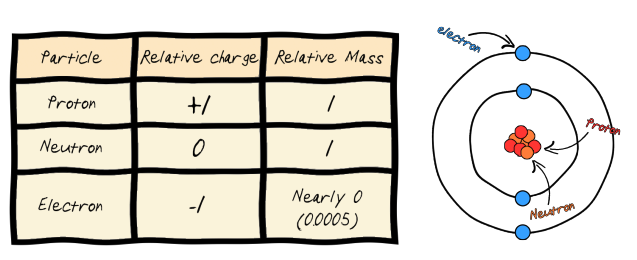
This table tells you everything you need to know about protons, neutrons, & electrons
- As you can see, the relative mass of an electron is negligible (Very small).
- This means most of the mass of an atom is concentrated in the nucleus.
- You find this right in the middle; the nucleus is only a tiny fraction of the atom's total volume.
- The incredibly high density of the nucleus suggests that the particles inside it are held very close together by an extremely powerful force.
- Protons are positively charged, so without this force the positive.
Note
Exam Tip: Positive repulsion would lead to the nucleus essentially exploding.